LET HIM GO (2020)

November 5, 2020

 Greetings again from the darkness. Diane Lane and Kevin Costner reunite on screen, only this time it’s not as the earthy and earthly parents to Superman (MAN OF STEEL, 2013). Instead, this film from writer-director Thomas Bezucha (THE FAMILY STONE, 2005), based on Larry Watson’s 2013 novel, features the two stars as long-time married couple, Margaret and George Blackledge, living a peaceful existence on their Montana ranch. Well, it’s peaceful now, as George is retired from his career as a lawman.

Their son James (Ryan Bruce), his wife Lorna (Kayli Carter, “Godless”), and young son Jimmy live on the ranch with Margaret and George. Grandma Margaret’s devotion to her grandson and judgmental nature sometimes crosses the line, creating quiet tension with his mother Lorna. George’s trained eye sees it all, but he mostly keeps his thoughts private, although the communication he shares with Margaret is often through a simple gesture or nod. Their chemistry is one that’s only built through time (and fine acting).

When a freak accident leaves James dead, we flash forward three years as Margaret and George attend Lorna’s wedding to Donnie Weboy (Will Brittain, who was excellent in this year’s BLOW THE MAN DOWN). George senses that Donnie does not possess the highest moral character, but Margaret is hit hardest by the newlyweds moving off the ranch and taking her beloved grandson with them. Concern escalates quickly when Margaret witnesses Donnie being physically abusive to Lorna and Jimmy, and then he relocates them to North Dakota to be near his family … without so much as a warning or goodbye to Margaret and George.

Crossing Grandma Margaret is like kicking the hornet’s nest. Poor George arrives home one day to find the car packed and Margaret on a mission to bring Jimmy home. George’s feeble attempt to reason with her fails (as he knew it would) and the two are soon on the road through some gorgeous countryside captured by cinematographer Guy Godfree. Along the way, they cross paths and befriend Peter (Booboo Stewart), a Native American who deserted “Indian School” for a life of solitude on the plains. It’s also on this road trip where Margaret and George are inundated with every possible warning about the notorious Weboy clan of North Dakota. No specifics are provided, but the message is clear … no one messes with the Weboys.

A tip leads the grandparents to Bill Weboy (Jeffrey Donovan, “Burn Notice”), and he provides living proof that the Weboy clan is rotten to the core. Behind an evil grin, Bill invites Margaret and George to the family ranch for dinner and a visit with their grandson. At the ranch, we are introduced to the twisted matriarch, Blanche Weboy (Lesley Manville, PHANTOM THREAD, 2017). This meeting of the families is about as tense as any we’ve seen on screen. A clash of good versus evil is always welcome, which makes it so disappointing that a film so stellar to this point, abruptly shifts from an intriguing psychological thriller into a ludicrous circus of violence, poor decisions, and absurdity.

There is a lot to like here, before it spins off the axis. Diane Lane is ferocious in the role, and Costner is very effective as her ‘still waters’ husband. It’s a hoot to see Ms. Manville lose her British accent and go over-the-top as nasty Blanche, and the early 1960’s setting looks great, including the vehicles. As mentioned before, the scenery is breath-taking, with Alberta (Canada) standing in beautifully for Montana and North Dakota. Composer Michael Giacchino is more accustomed to working on superhero and animated movies, and the score is often distracting in the first half, but fits better in the final act. Brace yourself for a couple of tough to watch scenes and a jarring tonal shift.

watch the trailer


KINDRED (2020)

November 5, 2020

 Greetings again from the darkness. It’s the first feature film for writer-director Joe Marcantonio and his co-writer Jason McColgan, which might explain why the film starts strong before faltering, mostly salvaged by three strong performances. Eighteen months into their relationship, veterinarian Ben (Edward Holcroft, KINGSMAN: THE SECRET SERVICE, 2014) and Charlotte (Tamara Lawrance) break the news to his mother that they are moving from England to Australia. Mum is none too pleased, as she expects her son to carry on the legacy of nine generations that have lived in the now dilapidated (and isolated) family estate.

Ben’s overbearing mother is Margaret (Fiona Shaw, Petunia in the Harry Potter movies) and she lives in the drafty mansion with Ben’s step-brother Thomas (Jack Lowden, TOMMY’S HONOUR, 2016), who seems more man-servant than son to Margaret. Charlotte soon discovers she’s pregnant, and while Ben is thrilled, she is unsure whether she even wants to keep the baby. Her own mother’s history plays a significant role in her uncertainty. A freak on-the-job accident kills Ben, and Charlotte soon finds herself … um … a guest of Margaret and Thomas. She’s the type of guest that’s not allowed to leave or make phone calls. Yep, she’s being held captive under the guise of this being in the best interest of her baby.

While Margaret is straight-forward vile and ignoble towards Charlotte, Thomas is more difficult to read … albeit no less off-center. Clearly both have a vision for where this is all headed. Margaret spills hers in a terrific scene where she lets her guard down with Charlotte, while Thomas is perfectly creepy and overuses the “making a quiche” punchline. For her part, Charlotte frequently passes out and has recurring dreams featuring birds/ravens/crows … and as fans of horror can tell you, that’s never a good sign. Has Charlotte been drugged or is she being gaslighted by Margaret and Thomas?

Director Marcantonio has delivered a psychological thriller that’s more frustrating than haunting. It has vibes of the classic ROSEMARY’S BABY (1968) sans Satan, but of course, is not at that level – although we do get the chilling doctor played here by Anton Lesser. Charlotte is the proverbial trapped damsel, but the film falls into a pattern of ‘escape-capture-repeat’. It also attempts to use music, but the combination of Debussy’s “Claire de Lune”, Bach’s Cello Suite No. 1, and the long-time standard “Dream a Little Dream of Me”, reaches overload. The Production Design from Derek Wallace and Set Decoration by John Neligan are top notch, but in the end, the frustration we feel overrides any creep factor or strong performance. It’s a near miss.

watch the trailer


THAT GOOD NIGHT (2020)

November 4, 2020

 Greetings again from the darkness. Art imitating life is something we’ve not only grown accustomed to, but also something we expect. In this case it’s the bittersweet final performance of the great John Hurt. A terminally ill man taking on the role of a terminally ill man. Director Eric Styles is working from a script by Charles Savage that was adapted from N.J. Crisp’s stage production. It’s easy to see how this could be a powerful live show, but the stunning home in Portugal where most of the film is set, makes for a pleasant transition to the screen.

John Hurt stars as Ralph Maitland, a self-centered, highly successful screenwriter, who may be an even more proficient curmudgeon. He lives in a beautiful home with his younger wife Anna (Sofia Helin, “The Bridge”), who was once his nurse. Ralph receives the dreaded prognosis at his doctor appointment. Rather than tell his wife, he proceeds with ‘getting his affairs in order’ and summoning home his estranged son Michael (Max Brown, “The Royals”). Michael was born to Ralph’s first wife, and he is also a writer.

Ralph’s true colors shine when Michael shows up with his girlfriend Cassie (Erin Richards, “Gotham”). Although Cassie is pretty tough, Ralph devolves from curmudgeon to downright churlish. His rudeness exceeds the bounds of palatable during dinner at a local restaurant, sending Michael and Cassie scampering off before appetizers. Anna is embarrassed by her husband’s actions, but he just continues on with his process – a process that includes contacting “The Society”, which facilitates Euthanasia.

A man in an impeccable white linen suit appears in the doorway of Ralph’s office. He’s only referred to as “The Visitor”, and his played by Charles Dance, Mr. Hurt’s co-star in the underrated 1987 film WHITE MISCHIEF. The conversations between Ralph and The Visitor deliver the best dialogue in the film, and likely the deepest since it forces Ralph to face his mortality and the impact and finality of his decision. It’s here where Ralph’s “low boredom threshold” is mentioned, and quickly minimized by The Visitor.

The film is a relatively simple look at a complex topic, and it also highlights the importance of reconciling with family members, and discovering a reason to keep living. The weakness here is that we only scratch the surface of Anna and Michael, and even what turned Ralph into the man he is. We get a quick glimpse of Ralph interacting with Ronaldo (Noah Jupe, HONEY BOY, A QUIET PLACE), the housekeeper’s son, in a manner that makes us believe he has regrets on his poor parenting during Michael’s childhood. Cinematographer Richard Stoddard takes full advantage of the beautiful scenery, as well as the uncomfortable interactions amongst the family.

John Hurt died in 2017, just 3 weeks after filming was complete. He had a remarkable 55 year acting career, including Oscar nominations for his work in MIDNIGHT EXPRESS (1978) and THE ELEPHANT MAN (1980). Of course he will always be remembered for his iconic chestburster moment in ALIEN (1979). He compiled more than 200 acting credits, and some of my other favorite John Hurt characters are found in: 1984 (1984), OWNING MAHONEY (2003), TINKER TAILOR SOLDIER SPY (2011), and the voice of rabbit Hazel in WATERSHIP DOWN (1978). Dylan Thomas’ 1947 poem plays a key role in this film (and title), and the sentiment also captures the spirit of John Hurt: “Do not go gentle into that good night. Old age should burn and rave at close of day. Rage, rage against the dying of the light.”

watch the trailer


FISHBOWL (2020)

October 28, 2020

 Greetings again from the darkness. In the not so distant past, folks who lived in small towns felt like there were no secrets – everyone in town knew each other and what they were up to. Thus, the proverbial “fishbowl” of the title. Of course, these days, people in towns and cities of all sizes voluntarily advertise their every waking moment on social media, making privacy and gossip relics of a bygone era. Brother-sister co-directors Alexa Kinigopoulos and Stephen Kinigopoulos (first feature for both), working with a script by writers Piero S Iberti, Maria Stratakis, and (co-director) Stephen Kinigopoulos serve up a taste of small town life in the good ‘ol days.

“In Bishop, you either talk or you’re talked about.” So says our narrator Belle over the slow-motion opening montage. She’s the oldest of three sisters who live with their father and attend a local Catholic school. All members of this family are broken in their own way, and it’s made clear this is due to the beloved mother/wife no longer being around (though initially we aren’t sure what happened). Belle (newcomer Belle Shickle) is the rebellious one, though not quite as self-assured as she likes to think. The middle girl, Rachel (Emily Peachey), is sensitive and stunned when her friend tells her they can’t hang out anymore – even for her birthday. The youngest, Jessa (newcomer Caroline Coleman) hasn’t spoken a word in the 4 months (actually 118 days) since mom has been gone. Their dad (longtime stuntman-actor Rick Kain) is a mess, bouncing from over-zealous religious fanatic to forsaking it altogether, and then back again.

We see the family faced with hostile reactions in the community, at school, and even at church, where the priest suggests it would be better for everyone if they stayed away. Dad is drawn in by Tele-Evangelist Ron Peltz (Bobby J Brown) who is hocking his $1000 “Save Me Now” program as protection from The Rapture, which he proclaims will arrive on September 29. Close to foreclosure on their house, the dad plops down the grand, and forces his daughters to go door-to-door trying to “save” the neighbors from the end of the world.

A countdown to the final days also includes the teenage sisters trying to find their way in this new world. We get flashbacks to when they were younger and family life with mom (Judith Hoag, TEENAGE MUTANT NINJA TURTLES) was pleasant, despite dad’s alcoholism at the time. The three sisters cling to each other, but grow more concerned for their father and themselves. A particularly telling sequence has them defying their father and attending a costume party dressed as a devil, a nun, and a princess. It doesn’t end well, and sets up the finale.

The Kinigopoulos filmmakers give the movie a dreamy/surreal look and feel, and perhaps Jeff Nichols’ far superior 2011 TAKE SHELTER is the closest comparison. The four lead actors are fine (especially Ms. Shickle), but the background actors are exaggerated and distracting – perhaps this is done on purpose to help us understand what the family is going through. Pretty significant observations are offered up on small towns, parenting, church-goers, faith as a crutch, and alcoholism. It’s not an easy watch, and one that will probably not have mass appeal. It’s the type of movie that fits easily into the line-up of many film festivals, as that’s the environment where it is most likely to find appreciation.

Available VOD October 27, 2020

watch the trailer


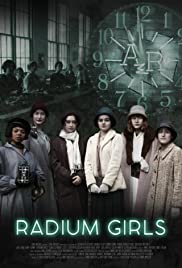
RADIUM GIRLS (2020)

October 23, 2020

 Greetings again from the darkness. A huckster or carnival barker is spouting off the many uses and health benefits of radium. He even hails it as “liquid sunshine”. That’s how this film from co-directors Lydia Dean Pilcher (A CALL TO SPY, 2020) and Ginny Mohler kicks off. Ms. Mohler co-wrote the screenplay with Brittany Shaw, and it’s presented as a historical dramatization – some of the names have been changed to protect both the innocent and guilty.

Joey King (“Fargo”) stars as Bessie, younger sister to Josephine (Abby Quinn, I’M THINKING OF ENDING THINGS). Josephine is the more studious of the two, as Bessie dreams of becoming a Hollywood star. Both girls work as dial painters at American Radium (re-named from the actual United States Radium Corporation). Josephine wins awards for being the most productive, while Bessie gets scolded and has her pay docked due to shoddy work. See, Bessie refuses to lick the brush to create the fine tip needed for precise work. So what’s a dial painter? Well, it’s 1925, and these women are applying a radioactive liquid to the faces of watches to create the popular glow-in-the-dark effect. Marie Curie’s discovery from twenty years prior has been found to have many uses, including shrinking cancerous tumors. However, the story finds the dial painters who lick-dip-paint, are getting sick and dying at an ever-increasing rate.

Mary, older sister to Bessie and Josephine and also a dial painter, had previously died after being diagnosed with syphilis. Bessie’s outrage and curiosity starts to build when the company doctor passes along the same diagnosis to (virgin) sister Josephine when her teeth start falling out, her joints ache, and her skin breaks out in a rash. We witness the transformation of Bessie from teenybopper to activist. She’s helped along by love interest Walt (Collin Kelly-Sordelet) who introduces her to the socialist movement, as well as Wiley Stephens (Cara Seymour, “The Knick”), the real life founder of the Consumers League.

Many dial painters refused to believe the connection and were frightened to lose their job. A few came forward, though they struggled to find a legal counsel willing to go against the giant corporation led by the arrogant Mr. Roeder (John Bedford Lloyd). It’s interesting to see the pieces come together for the 1928 court case. Another real life player in this chain of events was Dr Katherine Drinker (played her by Veanne Cox), the scientist who conducted the confidential study that concluded radium produced harsh effects, including physical deterioration – just as Josephine has experienced.

The courtroom scenes may not have the dramatic impact that we are accustomed to seeing in cinema, but this is a remarkable story of some incredibly strong women who stood up, not just for themselves, but for those who wouldn’t or couldn’t come forward. Their court case led to changes in workplace safety laws, while also reminding us of an era when women were given so little power, and giant corporations and the government ruled the roost and couldn’t be trusted. The filmmakers blend some vintage clips throughout, and use the discovery of King Tut’s tomb only three years prior to give the feel of this era nearly 100 years past. Rosamund Pike starred as Marie Curie in RADIOACTIVE earlier this year, and there have been a couple of books written on this topic: “The Radium Girls: The Dark Story of America’s Shining Women” by Kate Moore (2016), and “Radium Girls: A Play in Two Acts” by DW Gregory (2000). It’s a story of courageous women that deserves a wider audience.

watch the trailer


MEMORIES OF MURDER (2003, South Korea)

October 19, 2020

 Greetings again from the darkness. Between 1986 and 1991, 10 women were raped and brutally murdered in the province of Gyeong-gi outside Seoul. Considered South Korea’s first serial killer case, the crime went unsolved until 2019. The case was the inspiration for writer-director Bong Joon Ho’s second feature film, as was Kwang-rim Kim’s play, “Come to See Me”. Director Bong Joon Ho co-wrote the screenplay with Sung-bo Shim, and of course, went on to win an Oscar for PARASITE (2019), in addition to providing other popular features such as OKJA (2017), SNOWPIERCER (2013), and THE HOST (2006). This early film can be compared to David Fincher’s ZODIAC (2007), although this one is a blend of murder mystery, crime thriller, black comedy, and political commentary.

Kang-ho Song (PARASITE) stars as Park, a local detective called to the scene of the first victim. Almost immediately we can tell Park and the police force are borderline incompetent. Park is convinced he has “Shaman eyes” and can identify the guilty party simply by looking at them. Of course, this is ridiculous and is proven so on a few occasions. Park’s partner, Detective Cho (Roe-ha Kim), is a hothead who takes a heavy-handed approach to interrogation (though he later experiences true karma). When a second victim is discovered, a more seasoned professional, Detective Seo (Sang Kyung-Kim), arrives from Seoul. In contrast to Park’s gut-feeling approach, Seo puts faith in evidence, proclaiming, “Documents never lie”. These two detectives are at the core of the story and we watch as each evolves.

The film begins on October 23, 1986 as the body of the first victim is found. We witness how the crime scene is immediately corrupted by both cops and local kids. This is also our indoctrination to how the filmmaker is treating this much differently than most crime dramas. A stream of suspects Park refers to as “punks” are paraded through the station, but true chaos ensues at the scene of the second body. We can’t help but be relieved when a professional, big city detective arrives. Bits of evidence are slowly assembled – red clothes, rainy nights, a song on the radio – each may play a role in the actions of the killer. Frustration builds as more murders occur and the detectives are unable to pin down the perpetrator.

The mental and physical toll that detectives endure with such a case are on full display. The obsession with finding the murderer never ends and the fantastic ending proves that even a career change doesn’t erase the failure. We are inundated with crime thrillers these days, but it’s difficult to grasp how this masterpiece was put together by a director whose career was just getting started. Certainly today we recognize the brilliance of Bong Joon Ho, but this was 17 years ago! It plays as a time capsule of South Korea socially and politically in 1986, and it works on that level every bit as much as a crime thriller. Cinematographer Hyung Koo Kim (THE HOST) balances the crime scenes with the police station, as well as the telling facial expressions of the characters. Last year’s solving of these horrific crimes pushed this classic into release, and it’s well worth a watch.

watch the trailer


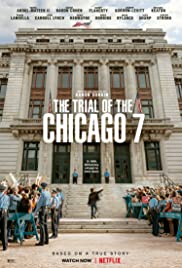
THE TRIAL OF THE CHICAGO 7 (2020)

October 15, 2020

 Greetings again from the darkness.  Tom Hayden, Alex Sharpe, Abbie Hoffman, Jerry Rubin, David Dellinger, Bobby Seale, Lee Weiner, and John Froines. Those were the defendants charged with conspiracy and inciting a riot at the 1968 National Democrat Convention in Chicago. So why were there 8, when they are known as the Chicago 7? Well, writer-director Aaron Sorkin (Oscar winner for THE SOCIAL NETWORK, 2010) not only answers that question, but also fills in many of the blanks for those of us who have known only the highlights of the story.

This story has been told many times before in books, articles, and other movies, but it’s never before had Sorkin’s focus on the spoken word and the transcripts pulled from the 1969 trial. For those familiar with Sorkin’s work, his penchant for absurdly rapid and a bit too on-the-nose chatter is renowned. Here, he has assembled a truly superb cast that revels not just in the words, but in the historical aspect and the modern day relevance. There are a lot of characters to get familiar with, and Sorkin doesn’t delay in introducing each of them by name and affiliation.

Tom Hayden (Eddie Redmayne, Oscar winner for THE THEORY OF EVERYTHING, 2014) and Rennie Davis (Alex Sharp) represent Students for a Democratic Society (SDS) and are focused on the lives being lost in the war. Abbie Hoffman (Sacha Baron Cohen) and Jerry Rubin (Jeremy Strong) are the leaders of the Youth International Party (the Yippies) and their goal is to disrupt the system through chaos. Actual Boy Scout leader David Dellinger (John Carroll Lynch) is a conscientious objector and part of the National Mobilization Committee to End the War in Vietnam, aptly nicknamed “The Mobe”. Bobby Seale (Yahya Abdul-Mateen II) is the leader of the Black Panthers, while Lee Weiner (Noah Robbins) and John Froines (Danny Flaherty, “The Americans”) were protesters, but can’t understand why they are lumped in with the more recognizable group leaders.

William Kunstler (Oscar winner Mark Rylance, BRIDGE OF SPIES, 2015) and Leonard Weinglass (Ben Shenkman) are the attorneys for all except Bobby Seale, whose attorney was unable to attend due to a medical emergency. Richard Schultz (Joseph Gordon-Levitt) is the hand-picked prosecutor for the Justice Department, while Julius Hoffman (Frank Langella) is the presiding judge. Other key players include Kelvin Harrison Jr as Fred Hampton, leader of the Chicago Black Panthers, and the always great Michael Keaton as former U.S. Attorney General Ramsey Lewis.

There is a lot going on here for a courtroom drama. The diverse personalities alone make this a must watch. Flashbacks to the violence and the interactions between police and protesters are mixed in between testimonies. We are also taken into the Conspiracy House, where conversations and debates between the accused get quit colorful. There are also glimpses of Abbie Hoffman’s college campus speeches/performances which illuminate his thinking, and some of the best conflicts occur when Abbie and Hayden are going at each other in such contrasting manners. Langella’s Judge Hoffman is a true lightning rod in the courtroom. Is he biased or incompetent … or both? His behavior is what drives attorney Kunstler, the ultimate believer in the law, to finally understand what Abbie had said all along … this was a political trial – a show of governmental power, and an attempt to quash anti-war activists. This trial occurred mere months after Nixon was elected, and though they never share a scene, the sword-fight between newly appointed Attorney General John Mitchell (John Doman) and outgoing AG Ramsey Lewis (Keaton) is a thing of beauty. Keaton especially shines in his two scenes.

“The Whole World is Watching” became a common protest chant as the government worked to shut down the movement to end the Vietnam War. Netflix and Sorkin have capitalized on the current political and social environment to demonstrate what happened 50 years ago … the more things change, the more they stay the same. Abbie Hoffman states, “I’ve never been on trial for my thoughts before”, and that ties in brilliantly with the desire for Cultural Revolution. Hayden’s intellect in on display here, and Rylance is the real standout as Kunstler, though Langella (the Judge) and Abdul-Mateen (Bobby Seale) aren’t far behind. The scene where Seale is bound and gagged in an American courtroom is one of the most uncomfortable moments I can recall. There may be some questionable directorial choices, but the story and performances make this one to watch.

Premiers on Netflix on October 16, 2020

watch the trailer


LA RESTAURACION (2020, Peru)

October 15, 2020

 Greetings again from the darkness. We don’t typically look to Peru for observant black comedy filmmaking; however this first feature film from writer-director Alonso Llosa (story co-written with Gustavo Rosa) is one of those pleasant surprises we usually only get from film festivals or a spontaneous streaming selection. It’s yet another reminder that an entertaining film doesn’t require a massive budget or a mega-movie star. A terrific story with relatable characters and heartfelt performances will do just fine.

Shots of Lima’s towering and shiny new skyscrapers open the film as we hear from the narrator who describes the booming economy, as well as Peru being “a country of builders that peaked during the Inca period”. That narrator is Tato Basile (played by Paul Vega), a 50-ish failure at life. He dropped out of school which kept him from pursuing his preferred career as an architect. His marriage didn’t last. He has no job, lives with his mother, is addicted to cocaine, and claims he is ‘psychologically incapable of working”. His mother Rosa (Attilia Boschetti) is bedridden and near death, and is fairly disgusted with her grown man son who should have figured out life by now. Still, she grudgingly gives him money for his habit. Her long-time trusted housekeeper and personal assistant Gloria (Delfina Peredes) has protected Rosa from the fact that the family funds are nearly depleted … and the once glorious mansion is crumbling.

One day Tato runs into old friend Raymond (Pietro Sabille), who is now a real estate tycoon cashing in on Lima’s boom market. Their conversation leads Tato to concoct an ingenious and devious plan that requires the assistance of Gloria, as well as Eladio (Luis Fernando Ananos Raygada), the family friend-gardener-handyman-driver, and Inez (Muki Sabogal), Rosa’s young caregiver. The idea is to sell the family house to Raymond for top dollar, and to keep the transaction a secret from Rosa by telling her the family home is being renovated. To pull this off, the co-conspirators will re-create her bedroom in a remote location, and pipe in construction noise and the familiar aroma of the neighbor’s stew. Of course the plan is ludicrous, but desperation for money often leads to poor decisions.

Llosa includes humorous moments and memorable characters, in addition to the life lessons that Tato learns about 3 decades later than he should. Rosa has a recurring acute punchline about disliking “social climbers”, and the score has a 1980’s “Miami Vice” vibe that complements the retro look and feel of the film (including the credits). Llosa’s film is sweet, funny, and sad, and is an example of excellent story-telling. Mr. Vega perfectly captures adult Tato as he finds the soul and love that he’s been lacking. This one might take some effort to track down, but you’ll likely find it worthwhile and entertaining. I sure did.

watch the trailer


2 HEARTS (2020)

October 15, 2020

 Greetings again from the darkness. We’ve seen it before. Two stories, seemingly unrelated, yet parallel. Only this time it’s based on a true story, and the 2017 book “All My Tomorrows” by Brian Gregory. Director Lance Hool and co-writers Veronica Hool and Robin U. Russin serve up a touching and inspirational story of how the lives of families can intersect, and how triumph can come from tragedy.

Admittedly, the film has a bit of Lifetime Movie Channel look and feel. It even begins with some conventional philosophy on life courtesy of our narrator: it’s either a miracle or it’s not, and life either happens to us or for us. These are neither particularly thought-provoking nor deep, however, they do set the stage well enough for the story. We first see an unconscious Chris Gregory (Jacob Elordi, THE KISSING BOOTH) being wheeled on a gurney into the surgical area of a hospital. His loved ones are obviously concerned. We then cut to a period many years earlier as a young Cuban boy passes out on a soccer field. We learn Jorge Bolivar has a lung disease, and has been told at various stages that he wouldn’t live past 12, 20, or 30 years old.

Despite the different time periods, we see the symmetry with the romantic interests of the men. Modern day college student Chris (also the film’s narrator) literally bumps into Sam (Tiera Skovbye, “Riverdale”), and the two become ‘Safety Buddies’ on campus – offering a ride to those students in need. An older Jorge (Adnan Canto, “Designated Survivor”) locks eyes with flight attendant Leslie (Radha Mitchell), which kicks off a whirlwind globe-trotting romance. Chris is a middle-class boy whose parents (Kari Matchett, Tahmoh Penikett) are loving and demanding. Jorge is part of a wealthy Cuban family forced to relocate to Miami due to political pressures under Castro.

Keeping up with the time period for Jorge and Leslie involves spotting the clothing styles and technology hints, and very few viewers won’t know where this is headed well before it gets there. The two staged weddings provide all kinds of cuteness, as does goofy, easy-going Chris. Life perspective is one of the key takeaways here, as is a fact that most people should already be well aware: organ donors make a difference and mean the world to those impacted. The film ends with a note on the Gabriel House of Care, a non-profit worth researching.

watch the trailer


YELLOW ROSE (2020)

October 8, 2020

 Greetings again from the darkness. Immigration and the plight of undocumented workers is as relevant now as it has ever been. Writer-director (and fellow Longhorn) Diane Paragas and co-writers Andy Bienen, Annie J Howell, and Celena Cipriaso have expanded Ms. Paragas’ 2017 short film of the same name into her first feature length project. Although it covers some familiar topics, the film has a distinct look and feel to it … the vision of an interesting new filmmaker as she provides a glimpse at the struggles and challenges facing undocumented folks, both young and older.

Eva Noblezaba stars as Rose Garcia, a 17 year old undocumented Filipino living in the outskirts of Austin in the hotel where her widowed mother (also undocumented) cleans rooms. This is Ms. Noblezaba’s first film, and she’s best known for playing Kim in the stage production of “Miss Saigon”. Here, she’s the teenage daughter of a very protective mother, and she spends her time trying to fit in at school, while also jotting down Country Music song lyrics in her Townes Van Zandt notebook, and strumming the battered guitar her late father gave her. Rose professes no interest in singing her songs for others, but that and everything else changes in one eventful night.

Elliott (Liam Booth), a friend in her class and an admirer of hers, invites her for night out in Austin at the Broken Spoke, “the last of the true Texas Dance Halls”, where Austin Country Music icon Dale Watson is performing. An underage Rose over drinks, but also catches the performing “bug”, and loves everything about the honkytonk atmosphere. The youngsters return to the motel just as ICE (Immigration and Custom Enforcement) is finishing up a raid, and are taking Rose’s mother (Princess Punzalan) into custody. Rose’s mother instructs her to seek shelter with her Aunt Gail.

Gail (Tony winner Leah Salonga) lives in an upscale Austin neighborhood – quite the contrast to the life Rose and her mother have been living. Gail is sympathetic to Rose’s plight, but Gail’s husband doesn’t want to get mixed up with harboring an illegal. So Rose recognizes that she’s unwanted and seeks refuge with Jolene (Libby Villari), the owner of Broken Spoke (Ms. Villari gives an excellent performance, though it should be noted that the infamous James White is the real life owner of the iconic dance hall). Jolene offers Rose a bed in a back room of the club, something a great many Austinites would pay handsomely for (maybe it should be an AirBnB!).

Dale Watson turns into a reluctant mentor for Rose, and the two write songs and perform together. Mr. Watson is a natural playing the on screen version of himself. There is a lot going on here, as this teenager from the Philippines proves she is strong-willed in both pursuing assistance for her mother, and in following her Country Music dream … all while maneuvering through the obstacles of being undocumented. There is inherent racism in the film’s title (Rose’s nickname at school), but director Paragas never allows politics to override Rose’s personal story.

watch the trailer