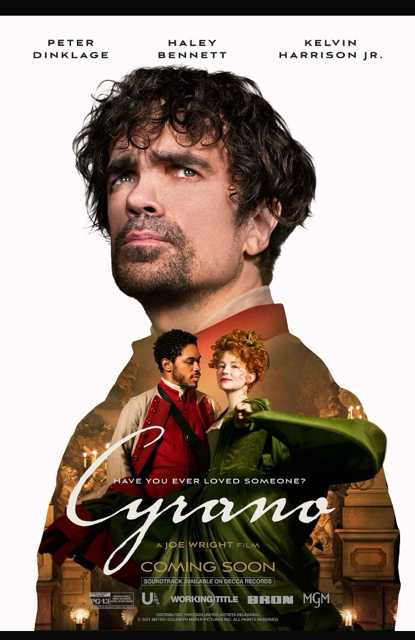
 Greetings again from the darkness. Filmmaker Joe Wright has proven how adeptly he can re-make a classic love story. You’ll likely agree if you’ve seen his versions of ANNA KARENINA (2012) and/or PRIDE AND PREJUDICE (2005), which are in addition to his best film (also a love story), ATONEMENT (2007). Working from the terrific script Erica Schmidt adapted from Edmond Rostand’s 1897 play, Wright delivers a musical version of Cyrano de Bergerac that delivers all of the intended “panache” of the original tragic-romance.
Peter Dinklage (THE STATION AGENT, 2003) stars as Cyrano, a master swordsman and orator who entertains with words that cut like a surgeon’s scalpel … except when he’s weaponizing those words for love. Haley Bennett (SWALLOW, 2019) plays Roxanne, the secret object of Cyrano’s desire, though she views him as but a close friend and confidant. Instead, her gaze is upon the newly arrived Christian (Kelvin Harrison Jr), a virile and handsome man lacking the charisma and common sense required to court Roxanne. This dilemma lends itself to the melding of Cyrano’s word being delivered by the preferable packaging of Christian.
Rather than Cyrano’s oversized nose, the film uses Mr. Dinklage’s diminutive stature and feelings of unworthiness of Roxanne’s affections to create the division, and yet it’s the musical aspect that takes a bit of getting used to. Dinklage excels in the film’s best sequence, as early on he humiliates a poor stage actor, a rebellious act that ends in a duel … entertaining for the play’s audience as well as us as viewers. It’s the connection between Cyrano and Christian that leaves us missing the good stuff. It all happens quickly and efficiently, rather than a slow transition from foes to partners. The film is at its best when Cyrano’s loneliness is at the forefront … Dinklage excels in these scenes. In fact, Wright and the actors (Dinklage and Bennett) nail the ending which packs the punch Rostand intended.
Mr. Dinklage has long been married to the film’s screenwriter Erica Schmidt, and Ms. Bennett and director Wright have a daughter together. These ties may have contributed to the effectiveness of the best scenes, though we do wish Ben Mendelsohn (as De Guiche) had a bit more screen time. The three most well-known film versions are CYRANO DE BERGERAC (1950) starring Jose Ferrer, ROXANNE (1987) starring Steve Martin, and CYRANO DE BERGERAC (1990) starring Gerard Depardieu. Wright’s latest version is set apart with the musical aspect, and certainly the Dinklage performance ranks amongst the best. Edmond Rostand’s play was a fictionalized version of the life of Savinien de Cyrano de Bergerac (1619-1655), but the romance, ego, and self-doubt applies to all eras.


 Posted by David Ferguson
  Greetings again from the darkness. “A fable of a true tragedy.” Such is the cautionary sub-heading that director Pablo Larrain begins his latest film. As in his 2016 film, JACKIE, the director turns his lens to an icon of which both too much and too little is known. The screenplay is written by Steven Knight (DIRTY PRETTY THINGS, 2002), and it takes place in the early 1990’s not long before the official marital break of the Prince and Princess of Wales. Much of this movie occurs in the muddled mind of Lady Diana through surreal dream sequences and imagined internal mental imagery.
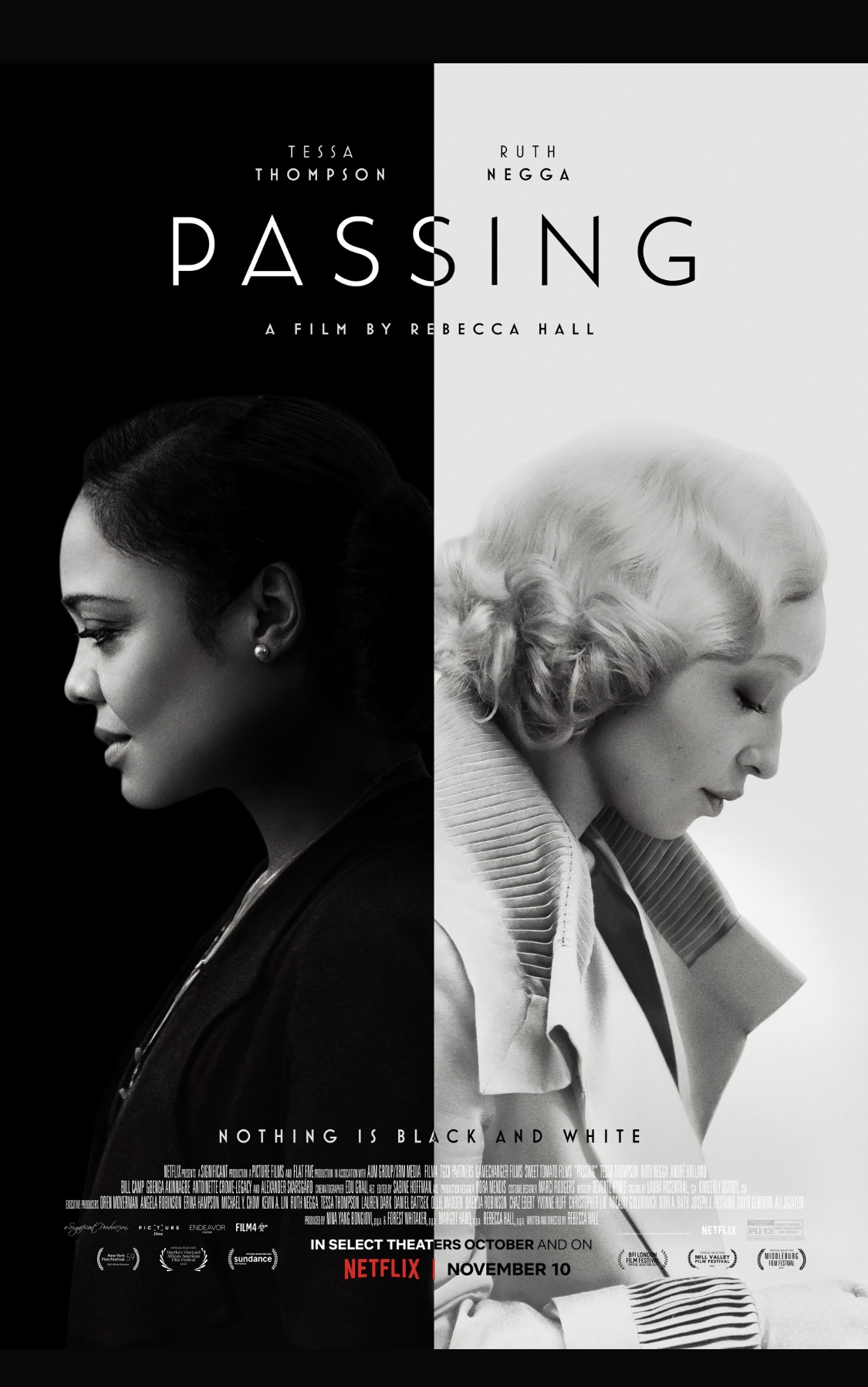 Greetings again from the darkness. “We’re all passing for something or other.” Irene (played by Tessa Thompson) speaks the line that cuts to the quick of Nella Larsen’s 1929 novel, adapted here by first time writer-director Rebecca Hall. We are familiar with Ms. Hall’s many film projects as an actor, and her debut as a director shows immense promise. Ms. Larsen’s novel was inspired by her own life as a mixed-race woman.
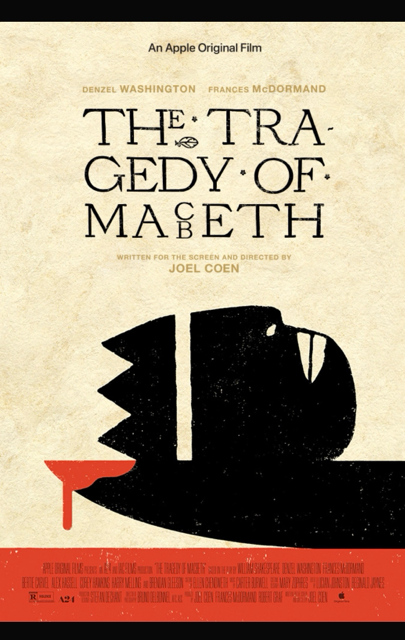 Greetings again from the darkness. The confounding part about screen adaptions of great and familiar literary works is that we have each already formed our mental images of characters and setting. Adapting Shakespeare’s 400 year old play is Joel Coen (4 time Oscar winner, NO COUNTRY FOR OLD MEN), and it’s also his first time to fly solo as director without his brother Ethan. Filmed in black and white on a sound stage, this production may lack the frills we’ve come to expect in modern times, yet while its stark sets recall German Expressionism, the film still manage to deliver memorable visuals.
 Greetings again from the darkness. The only honest way for me to begin is to simply admit that I adore this movie. In fact, I may love it as much as writer-director Paul Thomas Anderson loved making it. The setting is 1970’s San Fernando Valley, the area where the director was raised, and it’s such a caring tribute and sweet story (while also being exciting and nostalgic) that’s it’s tempting to stop writing and just encourage everyone to watch it. My only regret is that for those who weren’t around during this time period, some of the attention to detail and meticulous filmmaking won’t strike the same chord as it will for the rest of us.
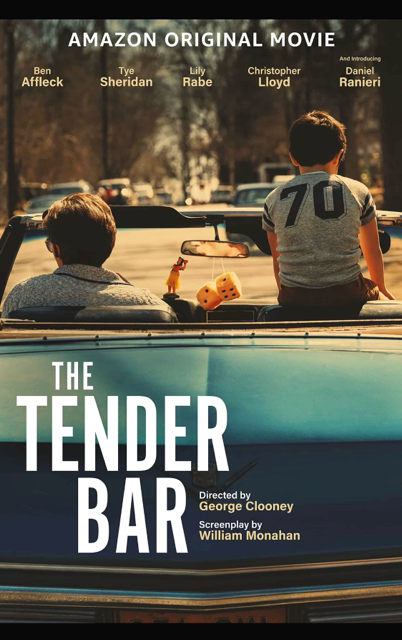 Greetings again from the darkness. Pulitzer Prize winning novelist and journalist JR Moehringer published his memoir in 2005. Fortunately for him, it led to his being in high demand to pen the memoirs of others. Unfortunately for us, it also led to George Clooney directing a mostly listless movie version. Adapted by Oscar-winning screenwriter William Monahan (THE DEPARTED, 2006), the film does offer a surprisingly interesting performance from Ben Affleck, while also failing to capitalize on other elements that could have provided a boost.
 Greetings again from the darkness. Movies don’t get the credit they deserve for opening our eyes to other cultures and providing a snapshot into the lives of others … lives often unimaginable to us. Another aspect of World Cinema is that it serves as a reminder that people are people all over the globe. Dreams and disappointments are simply a part of the human existence. Often we recognize more similarities than we previously thought. Such is the case with the debut feature film from writer-director P.S. Vinothraj. This is India’s official submission for the Foreign Language Academy Award.
 Greetings again from the darkness. There are so many things that go unspoken about parenting, and first time writer-director Maggie Gyllenhaal specifically focuses her lens on the pressures of motherhood, by adapting the 2006 novel from the anonymous and talented and mysterious Italian writer Elena Ferrante. Of course, we are all aware of Ms. Gyllenhaal’s fine work as an actor, yet it’s almost beyond belief that this is her debut as a feature film director. The source material is strong, but Ms. Gyllenhaal, along with a terrific performance from Olivia Colman (Oscar winner, THE FAVOURITE, 2018), turn a coastline vacation into a mesmerizing psychological case study.
 Greetings again from the darkness. If you are a fan of little films that seem quiet on the surface but deep down have jarring tremors of emotions, then this 3 hour art-house gem from Japanese writer-director Ryusuke Hamaguchi is a must-see. The director, along with co-writer Takamasa Oe, adapted the script from the short story by Haruki Murakami, part of his “Men Without Women” collection. The story revolves around Russian playwright Anton Chekhov’s “Uncle Vanya”.
 Greetings again from the darkness. Fans of filmmaker Guillermo del Toro anxiously await his new projects knowing full well that each will have a stylish atmosphere, a certain fantastical creepiness, and characters a bit outside the norm (whatever normal is these days). Beyond that, the mystique derives from whatever new approach the extraordinarily talented filmmaker will surprise us with this time. For his first follow-up to his Oscar winning THE SHAPE OF WATER (2017), del Toro and co-writer Kim Morgan have adapted the 1947 cult noir classic by director Edmund Goulding (starring Tyrone Power), which itself was adapted from William Lindsay Gresham’s 1946 novel.
 Movie Reviews from the Dark