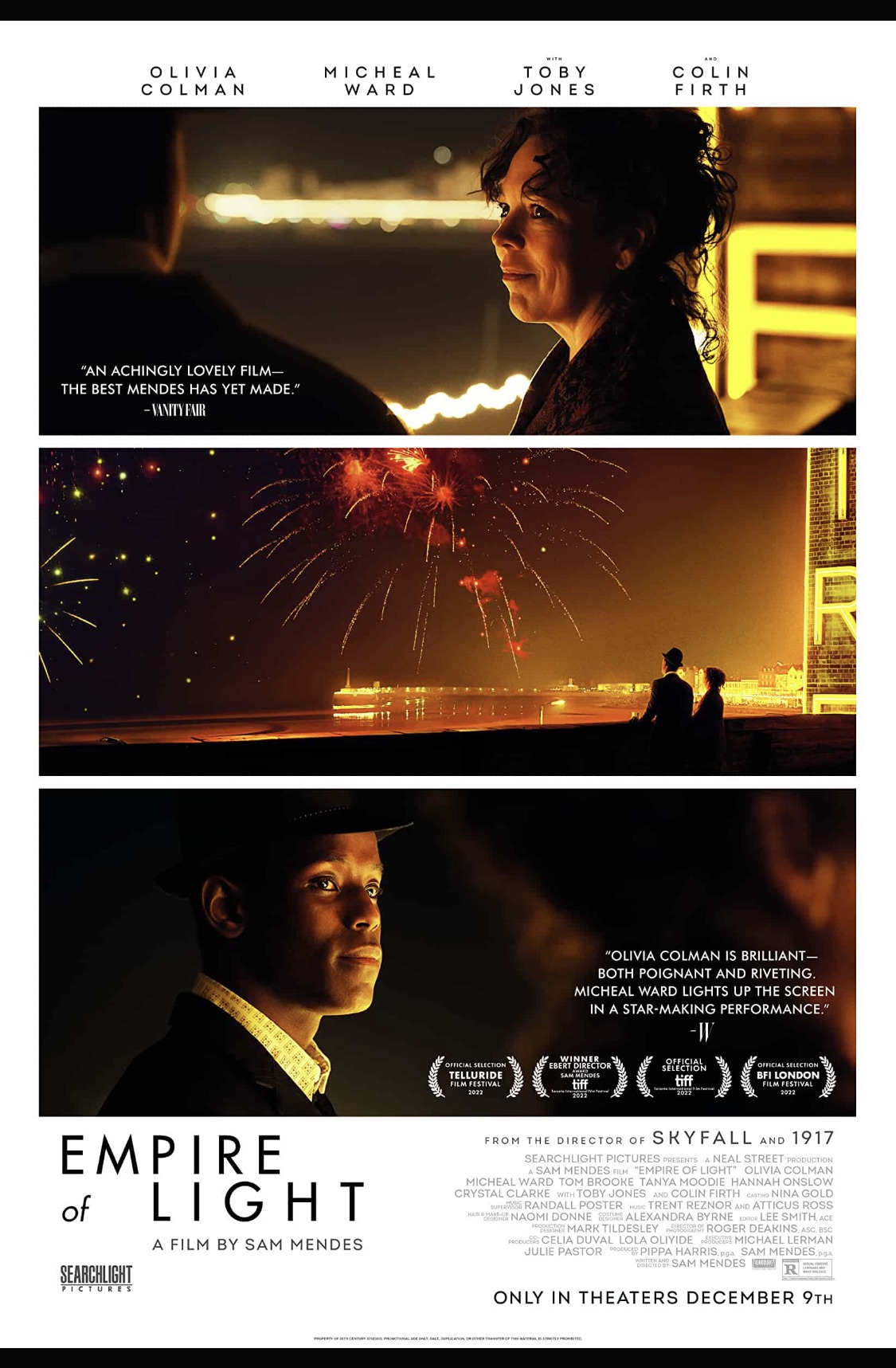
 Greetings again from the darkness. Writer-director Sam Mendes won an Oscar for AMERICAN BEAUTY (1999), and has directed other popular movies, including ROAD TO PERDITION (2002) and a couple of James Bond films: SPECTRE (2015) and SKYFALL (2012). This is his first movie since the 3-Oscar winning war film 1917 (2019), and it’s a project that seems designed for Mendes to proclaim his love of movies and belief in movie magic. However, a funny thing happened on the way to movie magic … a movie about mental health, racism, and the Margaret Thatcher era broke out.
By now we’ve all realized that a movie starring Olivia Colman (Oscar winner for THE FAVOURITE, 2018) features at least one outstanding performance. Here, she delivers as Hilary, a theater manager who doesn’t watch movies, and is in therapy for some type of breakdown that occurred over the past year. Her smile for the customers isn’t always able to hide her depression and mood swings – and neither are the ‘quickie’ meetings the married theater owner, Mr. Ellis (Oscar winner Colin Firth, THE KING’S SPEECH, 2010), calls when the urge strikes. Her vulnerability and solitude are on full display.
The closeness of the theater staff is evident by the time new employee, Stephen (Michael Ward), shows up. He brings a spark, along with an ambition for advanced education, and he and Hilary hit it off immediately. Romance blossoms between the odd couple, and we soon learn Stephen has grown accustomed to facing racism, while Hilary seems oblivious to such things happening in the world. Empire Cinema is located on the seaside boardwalk, and the plush lobby is coated in heavy red velvet and adorned with sparkling brass fixtures. The timeframe is evident from the theater’s movie posters: BLUES BROTHERS, ALL THAT JAZZ, STIR CRAZY, etc.
The closed off screens 3 and 4 and the upper-level abandoned ballroom act as the rendezvous spot for Hilary and Stephen, while fireworks and a New Year’s rooftop kiss bring joy and excitement into Hilary’s life. The always interesting Toby Jones plays old school projectionist Norman, and he helps explain the second meaning of the film’s title when he describes the beam of light that flashes through the 24 frames/second of film. He terms that beam of light an “escape”, which is how so many view the movies.
Hilary’s history of schizophrenia and depression and lithium treatment mean that smooth sailing will not last for her. A street riot spills over into the theater and the scene shifts to the local hospital, where another character is introduced – one that might have added quite a bit to the story if expanded. Mendes chooses an odd approach to paying tribute to cinema, even when Hilary does finally realize the magic in a scene that recalls CINEMA PARADISO (although Hal Ashby’s gem BEING THERE is what she watches). Cinematographer extraordinaire and two-time Oscar winner Roger Deakins proves yet again how his work can elevate a film, as does the score from Trent Reznor and Atticus Ross (the Oscar winning composers).
Mendes chooses a restrained presentation, and though many of us believe in that feeling of elation associated with movies, no one believes movie magic is a cure for anything as serious as mental illness or racism. There are some terrific individual scenes that work better than the movie as a whole, but it’s unclear whether the film needed to be shorter, longer, or just better constructed.
Opens in theaters on December 9, 2022


 Posted by David Ferguson
  Greetings again from the darkness. Persistence. It’s the word used to describe “runners” by the man known for tracking the slaves who try to escape the abusive treatment and back-breaking work of plantations. However, the word can also be used to describe how the movie industry ‘persists’ in bringing us stories about how white slave owners created a brutal environment for black slaves. We really do get it. The history is awful and the treatment is inexcusable. It’s just difficult to understand how more movies are going to make any difference in what happened 150 years ago.
 Greetings again from the darkness. For most of us movie lovers, Steven Spielberg has been at the forefront of our cinema experiences since the mid-1970s. He has won 3 Oscars (along with 20 nominations) while delivering such classics and memorable films as: JAWS (1975), CLOSE ENCOUNTERS OF THE THIRD KIND (1977), the “Indiana Jones” franchise (1981, 1984, 1989, 2008), E.T. THE EXTRA-TERRESTRIAL (1982), THE COLOR PURPLE (1985), JURRASIC PARK (1993), SCHINDLER’S LIST (1993), SAVING PRIVATE RYAN (1998), MINORITY REPORT (2002), CATCH ME IF YOU CAN (2002), LINCOLN (2012), and WEST SIDE STORY (2021). Remarkably, that’s a partial list of his films and doesn’t take into account others that he’s directed or produced, or his commitment to preserving film history. Despite (or perhaps because of) his diverse catalog of films, Spielberg always manages to find the human element while entertaining us. In fact, some have criticized him for putting too much emphasis on entertainment, as if that is somehow a problem.
 Greetings again from the darkness. The first feature film from writer-director Nikyatu Jusu is a supernatural psychological thriller that may or may not belong in the horror genre. It’s filled with original concepts, innovative camera shots, and a truly powerful lead performance. Despite all it has going for it, the film never quite gels for us, instead creating a bit of confusion as to whether it was trying to make a point or not.
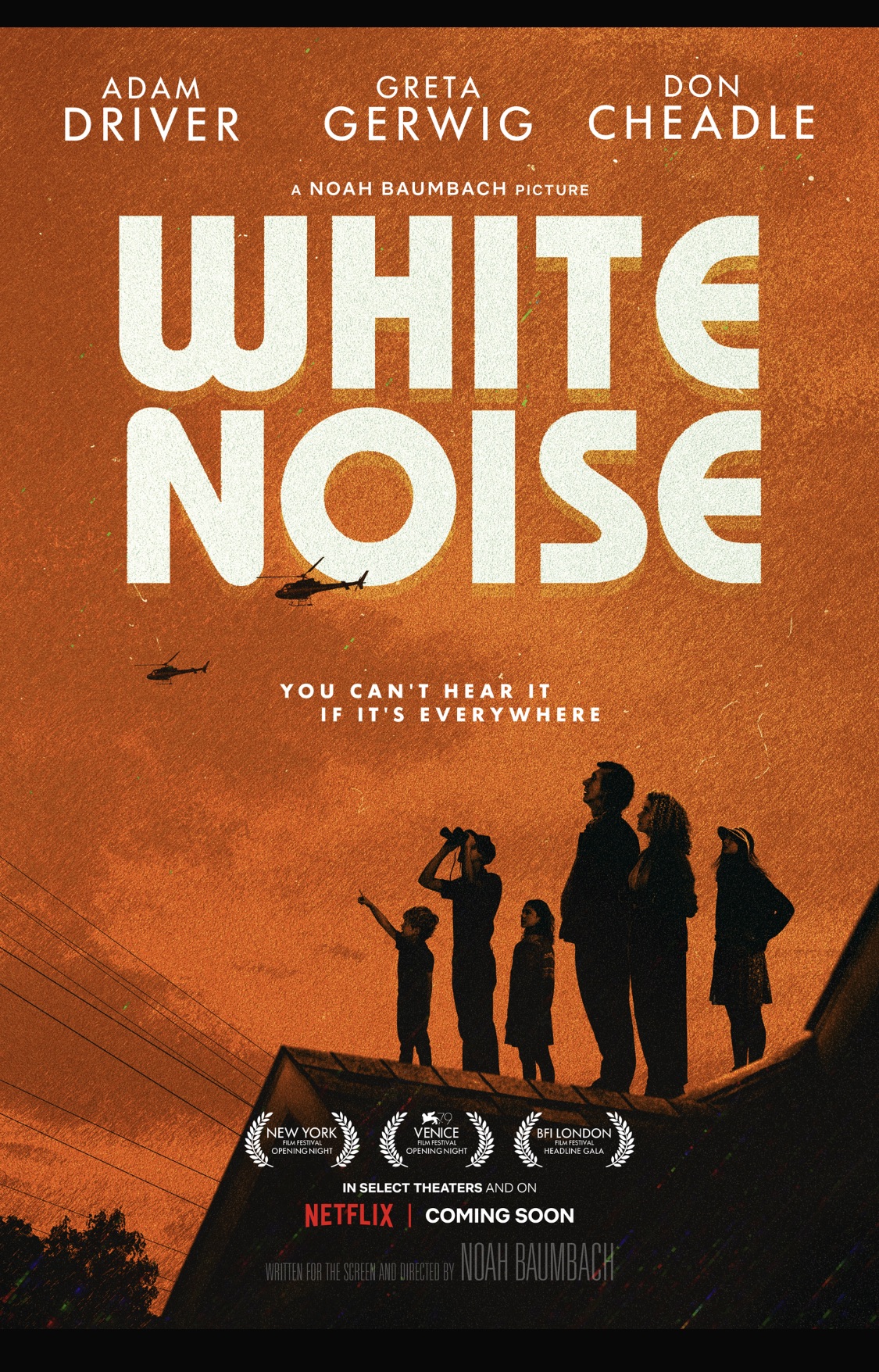 Greetings again from the darkness. Writer-director Noah Baumbach’s latest film is one of those that causes us to feel a bit guilty at not finding it as important or noble as it finds itself. That’s not meant to be as critical as it sounds. Afterall, Baumbach is the one who has managed to bring the “unfilmable” … Don DeLillo’s 1985 novel (National Book Award for fiction) … to the big screen. Baumbach’s last film was MARRIAGE STORY (2019), a masterpiece on relationships, and while this current film is a more ambitious undertaking, it likely will prove less accessible to many viewers.
 Greetings again from the darkness. Many filmmakers mine their own lives for projects, making their work personal, revealing, and sometimes invasive. It’s easy to label these works as narcissistic, and by definition, that would be accurate. However, some of the finest films from our most interesting writer-directors fall into the autobiographical (or semi-autobiographical) category. Examples include Fellini’s 8 ½ (1963), Cameron Crowe’s ALMOST FAMOUS, and Woody Allen’s STARDUST MEMORIES. This time it’s Oscar winner Alejandro Inarritu looking inward. Inarritu won his Oscars for THE REVENANT (2015), and his previous nominations include BIRDMAN (2014) and BABEL (2006), and those are in addition to his other standouts: BIUTIFUL (2010), 21 GRAMS (2003), and AMORES PERROS (2000). He’s joined on this project by his BIUTIFUL and BIRDMAN co-writer, Nicolas Giacobone.
 Greetings again from the darkness. Allow me to open with how I fully support the idea of telling (and re-telling) these stories and exposing those behind the many instances of intimidation and abuse that occurs in and around the workplace. Newspaper articles, magazine articles, TV shows, podcasts, books, and movies all find an audience and help educate and enlighten those who might become more attuned to the topic. So, even though most everyone knows the saga of movie mogul and chronic abuser Harvey Weinstein, there is a place for director Maria Schrader’s (I’M YOUR MAN, 2021) film … even as an imprisoned Weinstein continues to face additional charges in various states. Rebecca Lenkiewicz (IDA, 2013) adapted the screenplay from the 2019 book by Jodi Kantor and Megan Twohey; a book based on their New York Times investigation and series.
 Greetings again from the darkness. It’s understandable why we ended up with so many Pandemic-based movies. Writers need to write. Actors need to perform. Filmmakers need to make movies. Even the trickery can be accepted given the unusual circumstances. With his latest, writer-director Andrew Bujalski, the father of Mumblecore, delivers an unusual ensemble piece – one where the actors share scenes, but not the set.
 Greetings again from the darkness. IN BRUGES is a cinematic litmus test. It turns out, whether someone is a fan of that movie or not is a particularly dependable indicator of similar or disparate tastes in dark comedy material. For me, it’s a film I never tire of … whether re-watching in its entirety or catching just a few scenes while surfing. The plot is bleak, yet we laugh. The characters are sad, yet we are charmed. It’s the perfect blend of character, story, and setting … and proves how exceptional and precise screenwriting can be. So why am I writing so much about a movie from 2008? Well, that film’s writer-director, Martin McDonagh, is back, and he’s brought along that film’s co-stars, Colin Farrell and Brendan Gleeson.
 Greetings again from the darkness. A soldier’s injuries come in too many types to describe, and we often see the emotional side is every bit as difficult to recover from as a physical injury. PTSD is frequently explored in films, and in Lila Neugebauer’s first feature film, it corresponds to a severe brain injury. Combining on the screenplay were co-writers Ottessa Moshfegh, Luke Goebel, and Elizabeth Sanders, and their ‘quiet’ approach works thanks to superb performances from Oscar winner Jennifer Lawrence and Brian Tyree Henry.
 Movie Reviews from the Dark