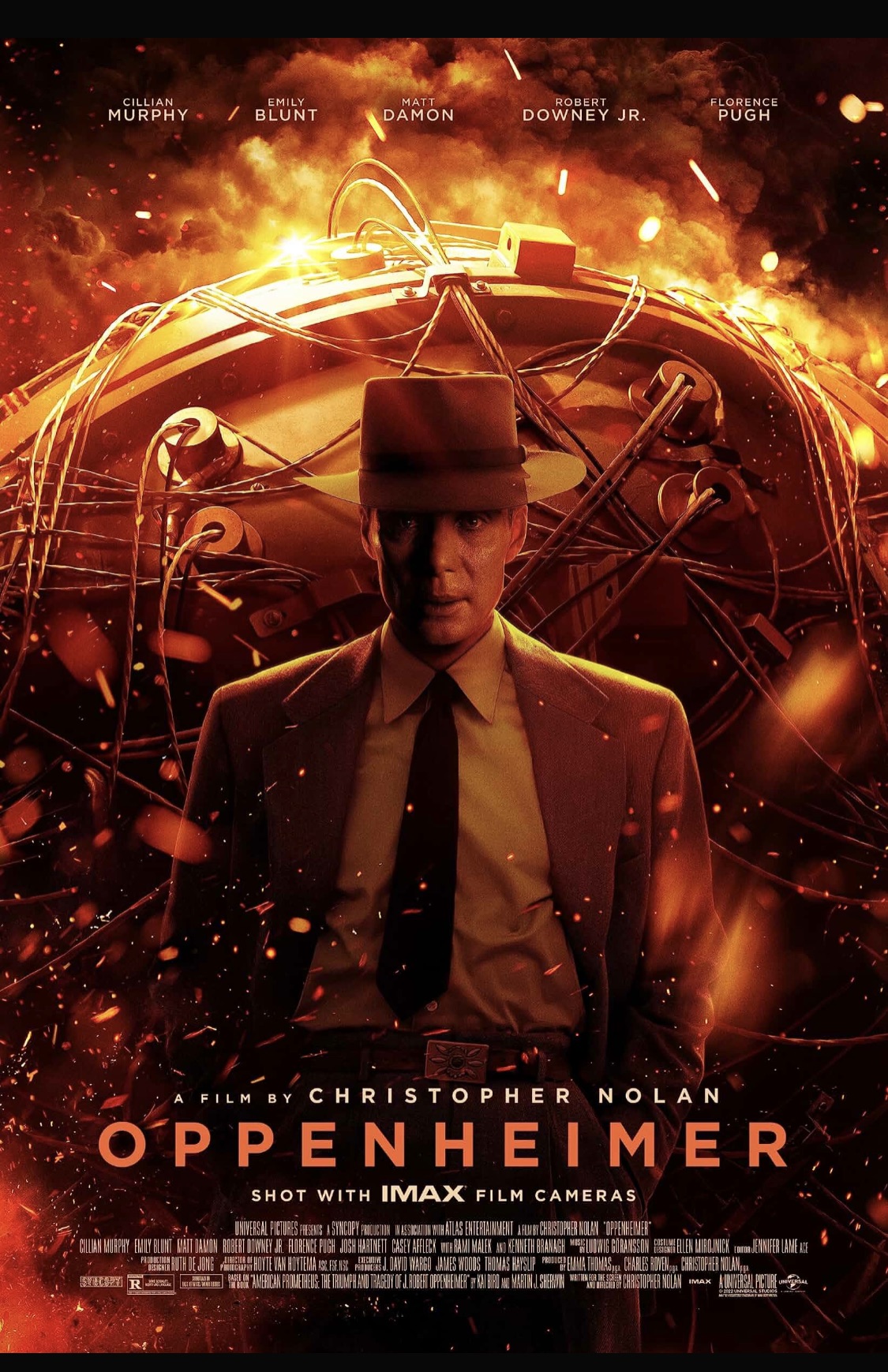
 Greetings again from the darkness. As pupils slouched in our school desks during history class, we easily and naturally disassociated with the many stories of war. World War II was lumped in with WWI, the Civil War, and The Revolutionary War. There were names and dates to memorize for quizzes and final exams, yet even with relatives recounting stories of kin, a personal connection was rare. As we aged and experienced modern-day warfare, the personal connection became all too real. Reality struck that soldiers are human beings with families, and despite their missions and marching orders, most are as innocent as the ‘tragic civilian casualties’ reported on the newswires. Along these lines, an aspect of war that has often remained overlooked is the behind-closed-doors decision-making of politicians and military leaders. Filmmaker-extraordinaire Christopher Nolan takes us behind those doors through the eyes of J Robert Oppenheimer, the Father of the Atomic Bomb. What we see is quite frightening.
Prepare yourself. At a full three hours in length, Nolan’s film is a hefty undertaking for viewers. It demands full focus and attention to details and nuance, as you spend significant time listening to brilliant men talk amongst themselves. Nolan adapted the screenplay from the 2005 biography, “American Prometheus: The Triumph and Tragedy of J Robert Oppenheimer”, written by Kai Bird and Martin Sherman. The end result is a film centered on complex physics and mathematics, yet presented in a simplified manner such that it’s much more a character study than a science class. The key is what characters say to each other, how they say it, and how they debate and rationalize the morality of the objective … building a bomb designed to kill people.
The morality of The Manhattan Project is under the microscope here, as is the motivation and concern of Oppenheimer. We get some early background establishing him as an upcoming mind in the world of physics from his academic stops around the globe. Some know Cillian Murphy from “Peaky Blinders” or as Scarecrow in Nolan’s Batman movies. I’d also recommend a couple of Murphy’s underrated gems: FREE FIRE (2016) and RED EYE (2005). It’s hard to overstate how spot on Murphy is as Oppenheimer. He lost weight for the role and captures the distinctive movements and speech patterns, as well as the familiar poses and deep-in-thought eyes. We never once question whether this is Oppenheimer, the leader of the science team at the Los Alamos Lab and the Father of the Atomic bomb … the one who “sees beyond the world we live in.”
Once Major Groves (Oscar winner Matt Damon) recruits Oppenheimer to run and assemble the great scientific minds, the obvious question to those involved is … even if we can create this bomb, should we do it? This weighs heavily on Oppenheimer – a man so engulfed by science that his haunting visions are that of atoms and particles and experimental reactions (perhaps a bit too heavy in the first act). Groves is the military leader of the project and the liaison between the scientists, the military, and the government. It’s also clear that while Oppenheimer’s brilliance is recognized and necessary to the project, almost no one outside of the scientists trusts him. This is where antisemitism and fears of communism arise. Oppenheimer was Jewish and, though he never joined the communist party, was associated with many who did. This included his love interest, Psychiatrist Jean Tatlock (the fabulous rising star Florence Pugh), his wife Kitty (Emily Blunt), and his brother Frank (Dylan Arnold).
The teamwork and stress involved with building the bomb in Los Alamos is conveyed as rooms full of brilliant minds determine the future path of the country and the world. This culminates in the stunning sequence of The Trinity Test near Alamogordo. A blending of complete silence, along with spectacular sound and light, is truly a technical highlight of the film. The initial celebration of success initially overshadows the true meaning … the bomb is now ready for Hiroshima and Nagasaki, killing two hundred thousand people and essentially ending WWII, less than four years after the bombing of Pearl Harbor by the Japanese (never mentioned here).
The bombings are heard via radio news reports, and it’s at this point where the weight of what the scientists have done is fully realized. Oppenheimer became a national hero and his Time Magazine cover proves it. A meeting with President Harry S Truman (Oscar winner Gary Oldman sporting a Missouri accent) doesn’t go well, as Oppenheimer is introduced to political gamesmanship, something he would face even more directly in the near future. Lewis Strauss (Oscar winner Robert Downey Jr) is a key player as chairman of the US Atomic Energy Commission, and through him, we witness ego, ambition, and petty behavior that leads to a level of vindictiveness typically only seen at the junior high level.
Multiple timelines are covered. There is the background information on Oppenheimer’s early years, his well-rounded academia, his love life (lives), his building of the Los Alamos lab team, the overseeing of the bomb development, his time as a hero, the later backroom kangaroo court designed to disgrace him, and Strauss’ Senate Confirmation hearing for Secretary of Commerce. All of these tie together, and it’s those final two that make up the last act of the film – giving us a taste of just how nasty politics was 70 years ago (not unlike these days).
Nolan has assembled a deep cast with numerous Oscar winners and a roster of talented actors. Among the familiar faces not already named above are: Oscar winner Kenneth Branagh as Danish Physicist Neils Bohr, Oscar winner Rami Malek as experimental physicist David Hill, Oscar winner Casey Affleck as Military security advisor Boris Pash, Tom Conti as Albert Einstein, Benny Safdie, Dane DeHaan, Jason Clarke, Josh Hartnett, David Krumholtz, Matthew Modine, Alden Ehrenreich, Scott Grimes, Tony Goldwyn, James D’Arcy, James Urbaniak, Olivia Thirlby, James Remar, and (Nolan regular) David Dastmalchian.
The film is a historical biopic and also an unconventional thriller. Is this about unparalleled advancement in science or is it about the moral dilemma of mass destruction and death? Politics, military, ego, power, science, love, revenge, and redemption are all displayed as Oppenheimer struggles with the power he has created and the lack of power in how it’s used. My favorite line in the film is aimed at Oppenheimer when someone informs him that he’s now “not just self-important, but actually important.” The stakes are clear during the test when it’s stated that there is a “near zero” chance of destroying the world.
Cillian Murphy is a shoe-in for a Best Actor nomination, and his performance mesmerizes us. It’s nice to see Robert Downey Jr remind us of his true talent, and he should be rewarded with a Best Supporting Actor nomination. Florence Pugh and Emily Blunt, in the only two substantive women roles, should both receive consideration as well. Pugh’s role is limited but memorable, while Blunt shines in her best scene during the security hearing.
Christopher Nolan has delivered near perfection in technical movie-making, and on top of that, the story and characters are real life, and the performances are top notch. His use of Black & White film for Strauss’ perspective allows the viewer to differentiate the Oppenheimer viewpoint. Impressively, while there are some visual effects, Nolan has stated that no CGI was used in the film, and that’s most evident in the relatively short closing credit roll – where we typically get dozens if not hundreds of technical experts listed. Ludwig Goransson’s (Oscar winner for BLACK PANTHER) score packs an emotional punch, and Jennifer Lame’s editing is excellent and vital. Lastly, cinematographer (and regular Nolan collaborator) Hoyte Van Hoytema drives home the power of smart men in a room, as well as the devastation of the bomb test. This is excellent filmmaking and a reminder that the only thing we love more than lifting new heroes onto the pedestal of worship is tearing down those same heroes with a dose of humility. These types of movies rarely get produced these days, so here’s hoping enough people go back to the theater to see it to inspire more filmmakers to take a shot.
Opened nationally July 21, 2023
WATCH THE TRAILER
 Greetings again from the darkness. By coming clean up front, my hope is that forgiveness and understanding is in order, and maybe others will be diverted from the same path I took. Between the film’s title, the trailer, and knowing it was based on Audrey Shulman’s book and true story, my assumption was that this was going to be a straightforward, good old fashioned chick flick. And although comparisons to BEACHES (1988) are not without merit, director Trish Sie (PITCH PERFECT 3, 2017) serves up additional layers (yes, pun intended).


 Posted by David Ferguson
 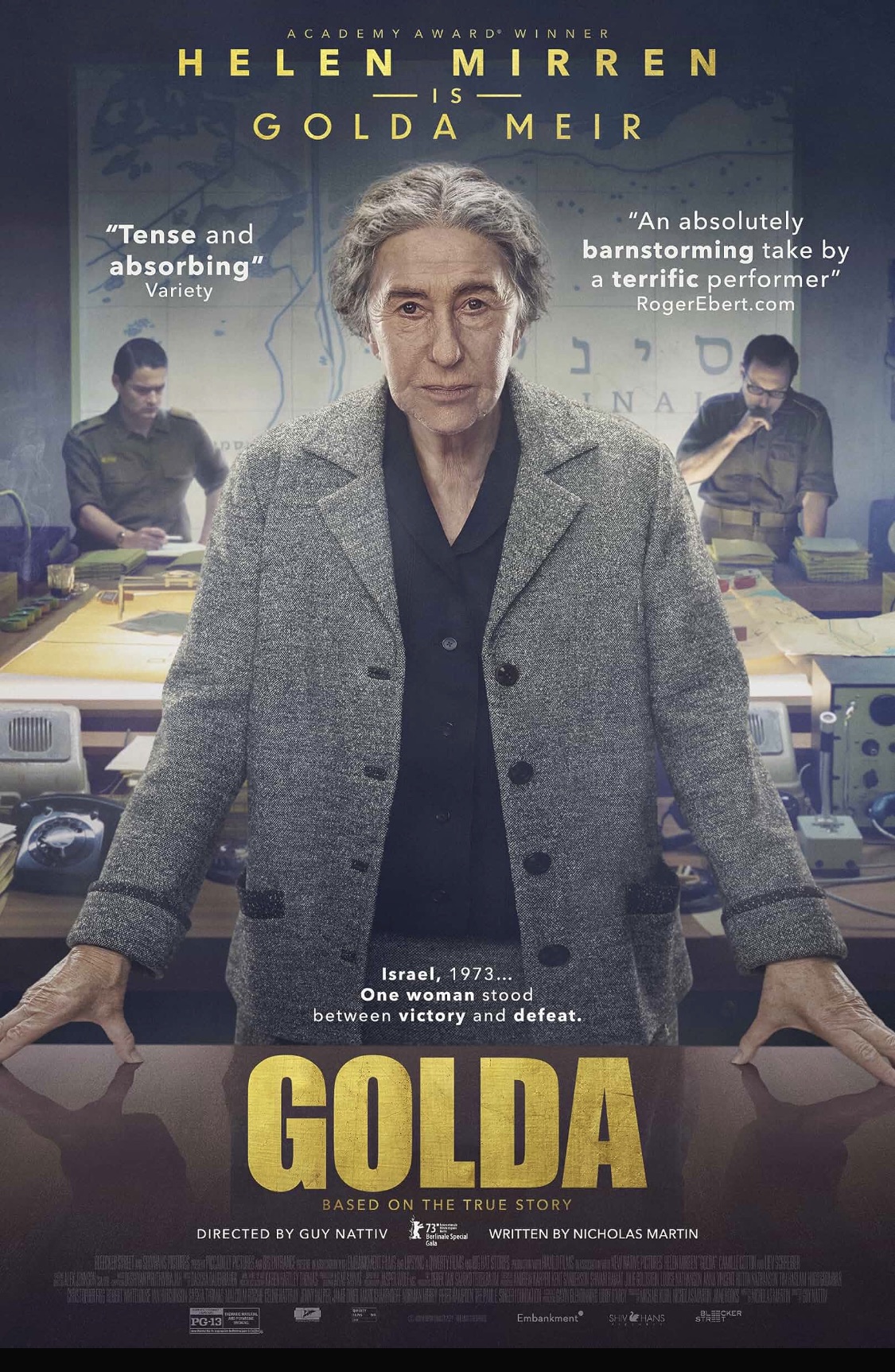 Greetings again from the darkness. More than forty years have passed since the great Ingrid Bergman portrayed Israel Prime Minister Golda Meir in the TV miniseries, A WOMAN CALLED GOLDA (1982). Fighting through cancer during filming, it was Ms. Bergman’s final role, and she won a posthumous Emmy for a performance that left quite a mark on this young (at the time) viewer. Guy Nattiv won an Oscar for his excellent short film, SKIN (2018), and here he takes on a narrow, yet vital window in the term of Golda Meir … a time when the survival of her country was in jeopardy. The screenplay was written by Nicholas Martin (FLORENCE FOSTER JENKINS, 2016).
 Greetings again from the darkness. Alien invasion movies have long been a favorite of science-fiction filmmakers, as well as platform for those who strive to caution us to our societal missteps and wrong choices along life’s muddy path. Within the past couple of weeks I watched JULES (2023), a cute, heart-warming story about an alien who crash-lands in Pennsylvania and is cared for by Ben Kingsley’s character. Going back further we have the thoughtful ARRIVAL (2016), the outlandish MEN IN BLACK (1997), the precious E.T. THE EXTRA-TERRESTRIAL (1982) from Spielberg, the frightening ALIEN (1979) by James Cameron, the often-re-made WAR OF THE WORLDS (1953), and the classic FORBIDDEN PLANET (1956). Of course, this is but a tiny portion of the complete list, but it gives some idea of the long-lived fascination.
 Greetings again from the darkness. Senior citizens sometimes nearly cease to exist for the outside world, or at best, are humored in a ‘there-there’ manner. So, what do you think happens when an elderly gentleman in a small western Pennsylvania town repeats the same suggestions at multiple City Council meetings, and then, in a nonchalant way, mentions that a spaceship crash-landed in his backyard, damaging his azaleas and birdbath? Right, others just shrug and move on, assuming the ol’ geezer is just imagining things.
 Greetings again from the darkness. As one who readily admits to watching too many movies each year, I always welcome the unanticipated joy in being pleasantly surprised by one that exceeds expectations. Doing just that is the first feature film from writer-director Nicholas Maggio and co-writer Rob Healy – a neo-noir thriller that takes place in a small rural community down south.
 Greetings again from the darkness. In the past twenty years, Randall Park has built an excellent acting career, likely best known as nice guy dad, husband, and restauranteur on the long-running TV series “Fresh Off the Boat”. He also had prominent roles in the mini-series “WandaVision”, “Veep”, and the Ant-Man movies. Now taking his shot as a feature film director, Mr. Park sticks closely to the Asian community, while simultaneously taking a step forward by not emphasizing generational aspects and familiar cultural tropes. He’s working from a script that Adrian Tomine adapted from his own graphic novel.
 Greetings again from the darkness. Not long ago, cable movie channels were filled with late night flicks that were easy enough to watch, and even easier to forget. Unfortunately, that description fits the second feature film from director Amy Redford (daughter of screen legend Robert Redford). Scott Organ adapted the screenplay from his own play, “The Thing with Feathers”, and the title of the film has been changed … it played the 2022 Toronto Film Festival as ROOST. It’s one of those times where some individual pieces are better than the film as a whole.
 Greetings again from the darkness. A reasonable assumption could be made that a movie based on a doll so popular with pre-adolescent girls would be geared towards that audience. However, this is the era of comic book movies targeting “grown-ups”, and since we know, based on her previous work (the exceptional LADY BIRD, 2017), Greta Gerwig is an intelligent filmmaker, a more reasonable assumption is that she purposefully aimed the movie at women who once played with Barbie dolls and now fill their days with work, family, and adulting. This strategy has proven to be box office gold, and the heavy dose of cosplay at screenings proves the lasting impact this plastic doll has had on many women who lined up for tickets.
 Greetings again from the darkness. The Grotto of Massabiele in Lourdes, France is a major Catholic pilgrimage site, where each year millions visit to experience the healing powers of the flowing waters. Legend has it that in 1858 the Virgin Mary appeared to a local woman, turning this into a holy site. The healing powers of Lourdes plays a significant role in this film from director Thaddeus O’Sullivan and the film’s co-writers Joshua D Maurer, Timothy Prager, and Jimmy Smallhorne.
 Movie Reviews from the Dark