AMERICAN HUSTLE (2013)

December 21, 2013

american1 Greetings again from the darkness. Over the years, there have been some very entertaining con artist films, and they range from outright comedy (Dirty Rotten Scoundrels) to cheeky (The Sting) to dramatic (The Grifters). My personal favorite is David Mamet’s House of Games, a very quiet and subtle look at the con. The stylistic opposite of Mamet’s gem is the latest from director David O Russell. It’s like comparing Duke Ellington to Donna Summer – both of which are featured on this soundtrack.

For the past few months, I have said that this film’s trailer is one of the best I have ever seen. The energy and visuals were enthralling and have had me anxiously awaiting a chance to see the film. So please understand when I say that american2the movie does not quite match the expectations, it’s not really a criticism … more of a tip of the cap to the marketing efforts. This is one showy, flamboyant, often frenetic wild ride that is also a bit messy and sometimes even clunky.
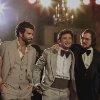
Hair, clothes, cars, music … the best and worst of the 1970’s … are on full display. Christian Bale sets a new standard for worst (and most elaborate and labor-intensive) comb-over in film history. Bradley Cooper’s perm wins the contest for tightest curls over Emma Thompson in Saving Mr Banks. Jeremy Renner’s pompadour would make any rockabilly performer envious. And let’s not forget the women. Amy Adams and Jennifer Lawrence provide a steady stream of flowing and floppy locks that would keep any shampoo or blow dryer american3company in business. The soundtrack, usually coordinated to story events, also includes Steely Dan, Jeff Lynne, Elton John and many others.

Director Russell’s most recent films include The Fighter and Silver Linings Playbook. He is obviously infatuated with odd characters who are slightly off center from society. What better topic than con artists so desperate to be liked that they spend all effort trying to rip off the gullible types? Now mix that trait with the overly ambitious persona of Bradley Cooper’s FBI Agent and the US Attorney played by Alessandro Nivola, and you have a collision of worlds that results in a fictionalized account of the ABSCAM events of the late 70’s and early 80’s. I say fictionalized because the film starts with a banner that states “Some of this actually happened”. What did or what didn’t really doesn’t matter here.

Who is playing whom? What is real and what is part of the con? Those are the questions that we as viewers ask, and oddly enough, these are the same questions the key characters ask. If they can’t tell, we certainly have little chance.

american4 This one is all about the characters. Mr. Bale (40 lbs heavier) bears no resemblance to Batman, or even Bruce Wayne. He embodies the falsely confident con man. Cooper is a bit over-hyped in his role, while Adams is at her best in a role that is the film’s most diverse. The real explosion comes every time Jennifer Lawrence is on screen. Not only do things blow up in her kitchen, but she jolts the film in each of her scenes. Some may be tired of Ms. Lawrence’s recent success, but as a film lover, I put her screen presence very near that of Marilyn Monroe. She grabs our attention and squeezes like a vise. That’s talent that very few possess.

Supporting work that should be noted includes Louis CK as Cooper’s reluctant supervisor, Michael Pena as a fake sheik (can they do that?), Jack Huston and Shea Whigham (both from “Boardwalk Empire“), and the great and rarely seen Anthony Zerbe (one of the all time TV villains). There is also a high profile cameo that seems right in line with Russell’s adoration of Scorcese’s Goodfellas.

If you are looking for a film to analyze and dissect, you will be most disappointed in this one. If you are looking for a fun, wildly visual and very entertaining retro film, this one should fit the bill. Just keep your hand on your wallet and don’t be one of the suckers.

SEE THIS MOVIE IF:  you are up for a wildly entertaining movie OR you want to see some of the craziest hairstyles packed into a single movie

SKIP THIS MOVIE IF: scary hairstyles, bizarre characters and exemplary acting aren’t enough to distract you from an inconsistent script

watch the trailer:

https://www.youtube.com/watch?v=ST7a1aK_lG0


INSIDE LLEWYN DAVIS (2013)

December 15, 2013

Greetings again from the darkness. If you are a follower of the filmmaking Coen Brothers (and you should be), then you are quite aware of their complete lack of artistic interest in any traditionally successful character. Their work is inspired by life’s obstacles and tough luck, even if brought on by a character’s own poor judgment. Coen Bros stories revolve around those who carry on and have (blind?) faith that their approach, no matter how ill conceived, is the only option … the only path worth taking. Their main character this time out apparently thinks life is filled with only careerists (sell-outs) or losers (those who can’t catch a break).

llewyn6 The titular Llewyn Davis (played by Oscar Isaac) is introduced to us onstage at the Gaslight singing a beautiful folk song. Moments later he is lying in the back alley after taking a whipping from a mysterious stranger. It’s not until this scene is repeated again for the film’s finale do we understand the cause of this effect. See, Llewyn is not a very likable guy. We learn he is still grieving from the suicide of his musical partner (as sung by Marcus Mumford), and that he bounces from sofa to sofa amongst acquaintances and family members. Llewyn has no friends, only acquaintances too kind to throw him out … even if he might be the father of an unwanted baby, or if he accidentally allows a beloved pet cat to escape, or he uses excess profanity in front of kids.

The story is based in the folk music scene of 1961 Greenwich Village in the pre-Bob Dylan days. The Coen’s were inspired by the memoirs of Dave Van Ronk entitled “The Mayor of MacDougal Street“. So while the songs are real and the characters are often inspired or based upon real artists of the time, Llewyn’s story is pure Coen fiction. From a viewer’s perspective, that means cringing, levels of discomfort, uneasy chuckling and moments of rapture … such as John Goodman evoking a drugged out Doc Promus spewing harsh poetic diatribes.

llewyn5 We never really know if the Coens are making a statement or tossing it out for us to debate. Are they saying that even the ugliness of Llewyn’s personality can produce something as beautiful as music, or are they saying that we allow ourselves to get tricked by beautiful music into thinking that the artist must also be pure? Carey Mulligan (as Jean) has one of the film’s best and most insightful lines when she tells Llewyn he is “King Midas’ idiot brother“. Her pure disgust (and expert rendering of the F-word) and anger contrasts with her angelic onstage persona with husband Jim (Justin Timberlake).

As always, the Coens provide us a constant flow of interesting and oddball characters. In addition to Goodman’s jazz hipster, we get Garrett Hedlund as an ultra cool (til he’s not) valet, Adam Driver as a cowboy folk singer, Troy Nelson as a virtuous Army folk singer (based on Tom Paxton), and Llewyn’s Upper East side cat owners, his spunky sister, and best of all F Murray Abraham as Bud Grossman, the owner of Chicago’s Gate of Horn club. Based on the real Albert Grossman who discovered Peter, Paul and Mary, and managed Bob Dylan (whose spirit lingers all through this movie), Grossman is the lone witness to Llewyn’s audition. This may be the most touching musical moment of the movie (“The Death of Queen Jane”), but it’s clearly the wrong song for the moment.

llewyn3 Oscar Isaac is exceptional as Llewyn Davis. He captures that crisis of self that’s necessary for an artist whose talent and passion is just out of step with societal changes. We feel his pain, but fail to understand the lack of caring he often displays towards others. We get how his need for money overrides his artistic integrity as he participates in the absurd novelty song “Please Mr Kennedy”. Why Isaac’s performance is not garnering more Oscar chat is beyond my understanding. It’s possibly due to the fact that the movie and his character are not readily accessible to the average movie goer. Effort, thought and consideration is required.

If you are expecting a feel good nostalgic trip down the folk singer era of Greenwich Village, you will be shocked and disappointed. Instead, brace yourself for the trials of a talented musician who wrongly believes the music should be enough. Speaking of music, the immensely talented T Bone Burnett is the man behind the music and it’s fascinating to note how he allows the songs to guide us through the story and keep us ever hopeful of better days. This is the Coen Brothers at their most refined and expert.

**NOTE: It’s kind of interesting to think that both this movie and Saving Mr Banks are both based in 1961 and the two films are being released at the same time in 2013.  Though totally unrelated, they do provide a stark contrast in NYC vs LA.

SEE THIS MOVIE IF: you are a Coen Bros fan or past due for an introduction

SKIP THIS MOVIE IF: you’ve tried, but Coen Bros humor is just a bit too dark or esoteric for your tastes

watch the trailer:

https://www.youtube.com/watch?v=LFphYRyH7wc


THE SECRET LIFE OF WALTER MITTY (2013)

December 15, 2013

mitty1 Greetings again from the darkness. Sometimes the line between reality and fantasy is blurred. In the moment, daydreams can feel like real life. Such is the existence of Walter Mitty, the milquetoast main character of James Thurber’s 1939 “New Yorker” short story. This is no remake of Danny Kaye’s 1947 movie, and thank goodness for that … no one wants to see Ben Stiller singing and dancing. Mr. Stiller not only takes on the role of the zoned out Mitty, but he also directs.

mitty4 Walter is a quiet, photo lab geek at Life Magazine, the long time publication that is closing its doors. Of course, in real life, those doors closed years ago, but the magazine name makes for the perfect contradiction to Mitty’s humdrum existence. The transition team is in place led by the snide, bearded corporate presence of Adam Scott. Photographer extraordinaire Sean O’Connell (played by Sean Penn) has delivered the perfect shot for the final cover. Only one problem: Walter has misplaced the negative (yes, O’Connell still shoots on FILM).

This gaffe leads Walter to cross paths with a co-worker played by Kristen Wiig, whom he has secretly admired both across the office and by staring at her eHarmony profile online. Their investigative work leads Walter on the first real journey of his life. He even breaks free of the family stranglehold of his mom (Shirley MacLaine) and sister (Kathryn Hahn) and gets a pep talk and well timed boost from Patton Oswalt.

mitty2 Walter’s expedition leads him to Greenland, Iceland, the Himalayas, and Afghanistan by way of Yemen. He also encounters a wild helicopter pilot and ride, sharks, an erupting volcano, drinking beer from giant glass boots, a sad and aggressive Karoke singer, and takes an accelerated ride via skateboard. Rather than changing Walter, these experiences just bring out a lust for life that was previously only flashed through his periods of fantasy zone outs.

The acting is very strong in this one, and that comes from a guy who is not much of a Stiller fan. His beaten down demeanor and stone-faced expressions are spot on for the Mitty role. Ms. MacLaine, Ms. Hahn, Mr. Oswalt and Mr. Scott all add very nice comedic touches and Sean Penn captures the rugged fearlessness of a world weary photographer who recognizes the depth within Mitty.

If you are a fan of Thurber’s short story then you must know artistic license is taken to turn it in to full length feature. Screenwriter Steven Conrad provides Life magazine as a foundation, and sends Walter to some of the most beautiful places on earth during the journey. He even gives us a “poetry falcon” (my first) and a curious parody of “Benjamin Button” (a bit out of place). Cinematographer Stuart Dryburgh delivers these locations to us in stunning fashion. The film is beautiful to look, and thanks to the score from Theodore Shapiro, it’s complimented by well fitting music.

This is one of those crowd-pleasing movies filled with sentimentality and charm. Critics will bash it, but most of us can relate to the underdog lead and his delusions of grandeur.

**NOTE: the opening and closing credits are works of art in their own right … so be seated early and hang around a few extra minutes.

SEE THIS MOVIE IF: you are looking for a feel good, slightly quirky movie for the grown-ups over the holidays

SKIP THIS MOVIE IF: you are expecting the next Citizen Kane (in other words, many critics are going to bash it despite it being a crowd pleaser).

watch the trailer:

https://www.youtube.com/watch?v=kGWO2w0H2V8


OUT OF THE FURNACE (2013)

December 15, 2013

furnace1 Greetings again from the darkness. Who in the world thought this would be the right time to release this film? Between holiday shopping and the new release schedule chock full of Oscar bait, dropping this hard-edged little film into theatres was box office suicide. And what a shame that is because there is definitely an audience for this exceedingly well acted snapshot of 2008 Rust Belt misery (has quite the holiday ring to it, eh?).

furnace3 The steel mill town of Braddock, Pennsylvania was once thriving, but is now on life support … just like the father of Rodney and Russell Baze. Casey Affleck plays Rodney, the brother who viewed enlisting in the Army as his way out of Braddock. When we meet him, he is about to leave for his 4th tour in the Iraq war. Russell (Christian Bale) is the more grounded, trying to do right brother. Russell dutifully works in the mill while trying to make a life with his girlfriend (Zoe Saldana).

Since life never hands folks in these towns a break, Russell ends up in prison, Rodney’s fourth tour leaves him scarred physically and emotionally, the dad dies, the girlfriend bolts, and the sleazy drug and crime world congregate right on top of the brothers’ heads. Rodney goes deeper into the ugly world of bare-knuckle fighting in an attempt to pay off his gambling debt to a local crime head played by Willem Dafoe (in yet another reptilian role). If you think cockfighting furnace2is merciless, the bare-knuckle fights held in backwoods Appalachian Mountains make that look like child’s play … and no tamales! The film is at its best when the nastiest of all these characters is on screen. Woody Harrelson plays Harlan DeGroat (great character name!), the soulless crime and drug lord of the area, who also runs (and fixes) these brutal fights. Harrelson is at his most menacing here, and even has Dafoe’s character a bit jumpy. Harlan DeGroat has no redeeming values, and admits to having “a problem with everybody”.

The story itself is quite predictable, but Bale, Affleck and Harrelson keep us glued to the screen. Zoe Saldana, Forest Whitaker and Dafoe have moments, but mostly their characters are underwritten here. Sam Shepard adds blue collar royalty as the uncle of the Baze boys. Director Scott Cooper (Crazy Heart) re-wrote Brad Ingelsby’s script, and it suffers from leaving us wanting more in regards to background and makeup of these characters. Still, the strong performances and the excellent score from Dickon Hinchliffe, keep us engaged and make this grimy, hopeless world something we can’t turn away from.

**NOTE: for a prime example of why so many of us consider Christian Bale one of the finest actors working today, check out the way he reacts to his release from prison … breathing fresh air for the first time, nervous energy that goes with freedom, pure joy in seeing his brother.

SEE THIS MOVIE: if you are looking for a movie that absolutely should not be viewed over the holidays, but you get a kick out of hillbilly evil

SKIP THIS MOVIE IF: the family is looking for a light-hearted, feel good flick for group viewing after a day of feasting on the Christmas beast and opening presents.

watch the trailer:

https://www.youtube.com/watch?v=ClzRVlMhU2E


THE GREAT BEAUTY (La grande bellezza, Italy, 2013)

December 15, 2013

beauty1 Greetings again from the darkness. This is Italy’s submission to the Academy for Best Foreign Film of 2013. If it wasn’t such a beautiful film to watch, a fun game of spot the Italian director influence could be played. Director Paolo Sorrentino owes much to Fellini and La dolce vita, but this is more than a tribute. Sorrentino shows great style and insight, and his commitment to camera angles, movement, colors, textures and faces are quite something to behold.

Toni Servillo plays Jep Gambardella, a man celebrating his 65th birthday by doing what he does most every night … beauty3partying with his group of intellectual friends. Jep had a successful novel published in his 20’s and has since worked sporadically as a journalist, but has never again focused on his writing. One can’t help but notice the similarities to Marcello Mastroianni in La dolce vita, but Jep is jolted with news that sends him flashing back to his younger years and his one true love.  Especially satisfying are the numerous shots of what makes Rome such an enchanting city.  The historical sites and beautiful sculptures and fountains provide quite the contrast to the startling appearance of the party goers.

beauty2 Much of the story includes Roman decadence, and it can easily be viewed as the decline of Roman civilization both past and present. See, Jep’s apartment overlooks the famous ruins of The Colosseum. Even moreso, we get a nice conflict between uppity society and the all too important modern and conceptual art crowd. Toss in a few pot shots at the Vatican and Sorrentino seems to be telling us that everyone takes themselves entirely too seriously … even as we belittle and judge others. Whatever his true message, the sensory overload provided here could be a film class in camera style and is quite fun to watch.

watch the trailer:

https://www.youtube.com/watch?v=Dyt430YkQn0


THE SWIMMER (1968) revisited

December 1, 2013

swimmer1 Greetings again from the darkness. Having first been drawn into this film by watching it on a 13 inch black and white TV in my dorm room, I have long wanted to experience it on a larger, full color screen. With this “dream” finally attained, the film remains a very odd, hypnotic, stylistic 1960’s film. Based on a John Cheever short story published in the “New Yorker”, it works as a dual allegory to: the failed American Dream and one man’s life.

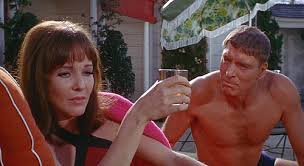
Burt Lancaster stars as Ned Merrill, a long-lost neighbor who shows up one morning to take a swim at the house of some friends. A little conversation leads to the formulation of Ned’s plan to “swim home” through each of the backyard pools in the valley. This is a chlorinated road trip and it’s quite an adventure. Along the way, Ned meets those that are happy to see him and those that aren’t. The former babysitter (Janet Landgard) follows him for part of the trip. He swimmer2also has an extended visit with a former lover (whom he clearly spurned) played by Janice Rule (pictured left) … a visit that starts poorly and goes downhill from there.  Various other interactions occur during his pool crawl, including some face time with a young Joan Rivers (who plays a pool party girl).

As we can tell from the delivery of the dialogue, something isn’t quite right with Ned. He has been “missing” for awhile and he seems to be oblivious to the changes in his life, while everyone else is quite aware. It seems Ned is swimming right through the stages of his life. The movie takes him: from morning to evening, from sunshine to rain, from warm to cold, from energetic to tired, and from healthy to hurt. By the end of his trip, we understand the current state of Ned’s life, even if he prefers to believe his wife and daughter remain part of his idealistic suburban paradise.

Eleanor Perry wrote the screenplay, while her husband Frank Perry (Mommie Dearest) directed. They also collaborated on Diary of a Mad Housewife. A minor bit of trivia notes that Fred was singer Katy Perry’s uncle. Due to creative differences with Lancaster, Mr. Perry left the film before it was completed. Sydney Pollack was brought in to re-shoot the scene with Lancaster and Ms. Rule. It had previously been shot with Barbara Loden. A 24 year old Marvin Hamlisch composed the somewhat heavy-handed score … it was the first of many film scores he would compose.

This is an unusual looking film – very stylistic and impressionistic for the times. It flows more like a play than a traditional movie and the dialogue is more literary than conversational. Lancaster’s performance is exceptional, and it should be noted, he was 52 years old at the time of shooting. If you have seen the movie, you understand why that is so impressive.

watch the trailer:


THE BOOK THIEF (2013)

December 1, 2013

book thief1 Greetings again from the darkness. You may be familiar with the source material – the huge best selling novel from Markus Zusak. If not, you may be surprised at the “through the eyes” of an illiterate, orphaned child’s perspective of the German home front during WWII. You may be more surprised to learn that it’s narrated by The Grim Reaper (British actor Roger Allam), and includes a Nazi rally, book-burning, bomb shelters, a look at the anti-Jew and anti-Communist movements, the German conscription/military draft and the dangers associated with hiding a Jew in one’s basement (with similarities to “The Diary of Anne Frank”).

book thief2 There is no denying the melodramatic nature of the story and the presentation from director Brian Percival, but this one avoids schmaltz thanks to the remarkable performances of the internationally diverse cast led by the great Geoffrey Rush and Emily Watson, and especially Sophie Nelisse as the incredibly perceptive Liesel who provides the innocence and powers of observation that prove to us (and Death) that good people will do extraordinary things no matter the atrocious conditions. Another young actor to keep an eye on is Nico Liersch, who plays Liesel’s Aryan schoolmate Rudy … a dreamer who imagines himself as Jesse Owens (not a popular view among the Nazi powers that be).

book thief 3 As Liesel’s foster parents, Rush plays a warm-hearted WWI veteran, and Watson plays a cantankerous, grounded woman hiding the emotion she carries for her husband and new daughter. The biggest piece of hiding involves Max, a young Jewish man who is the son of a soldier who once saved the life of Rush’s character. Max and Liesel have a wonderful bond as he teaches her to speak through her eyes and she nurses him back to health by sharing her new found joy of reading.

The ghost of the boy who lived in the shadows … from H.G. Wells “The Invisible Man” plays a key role as Liesel tries to make sense of a world that delivers a daily dose of relentless danger. As she develops her love and dependence on the written word, it’s clear that to survive in these times, one must have something that provides hope. The unusual story structure with the odd narrator, and a mix of wry humor, keep us connected with the characters and allows the humanity to shine through. Still, I challenge you to watch this without a lump in your throat.

**NOTE: the score is from the great John Williams, who once again excels in complimenting emotional storytelling.

SEE THIS MOVIE IF: the melding of a child’s innocence and strength can be enough to overcome the pain and shame of seeing how the Nazi movement affected so many, at least for a two hour period.

SKIP THIS MOVIE IF: you care not to revisit any of the suffering and caused by WWII (even if it’s within a story of personal strength and survival)

watch the trailer:

https://www.youtube.com/watch?v=92EBSmxinus


PHILOMENA (2013)

November 29, 2013

philomena Greetings again from the darkness. Two people telling the same story can make that story sound infinitely different. Two people united in their efforts to solve a mystery can have vastly different reactions to the same situations. Such personality and attitudinal differences are the real core of this story … even more than the true life inspired story of a quest to reunite a mother and child after 50 years.

Peter Mullan’s startling 2002 film The Magdalene Sisters provided us a look into the dark side of Ireland convents in the 1950’s. Here, director Stephen Frears brings us the very personal story of Philomena Lee – one of the unwed teenagers banished to the convent to deliver her baby and work off her debt to the nuns and church, after signing away all future access to her child. It’s a heart-breaking story of the times, of the church, and of a singular woman. Philomena struggles with guilt and regret over 50 years until her daughter arranges a meeting with journalist Martin Sixsmith. This begins their journey to uncover the truth and find Philomena’s son, and provide us with a front row to two distinct ways of viewing the world.

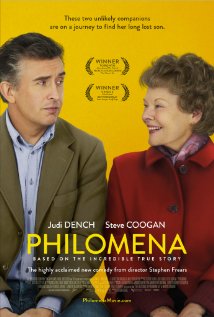
Dame Judi Dench plays Philomena and Steve Coogan (also co-writer and producer) plays Martin, resulting in a very “odd couple” road trip and personality test. Dench is remarkable is her role (surely in the running for an Oscar nom) as the seemingly simple woman who reads romance novels, gets excited about salad bars, is thrilled with mints on her pillow, and has lived a lifetime with a hole in her heart created by having her young son ripped from her world. Coogan is effectively restrained (minus his usual exaggerated comic mannerisms) as the snooty Brit journalist who thinks writing and reading human interest stories are a waste of time. She has maintained her religious faith and faith in people, while he has long ago given up on God and flaunts his cynicism in most every situation.

Director Frears has a widely varied movie career – from The Grifters to High Fidelity to The Queen. He excels in drama with a wry sense of humor.  Some will view the movie as anti-Catholic (replete with cruel nuns) … it is difficult to defend the painful childbirth, isolated mothers, selling of children and lack of assistance in reconciling the parties. Others will view this as a victory of faith over intellect. It’s the world-weary journalist with the $5.00 words who ends up learning a life lesson. It can be a reminder that life is going to throw some difficult situations your way. Your attitude and approach that will determine how you deal with it … and how much emotional pain follows. This is another entry into gray cinema that will generate much debate and discussion … a sure sign of success for a movie!

**NOTE: this is based on Martin Sixsmith’s book “The Lost Child of Philomena Lee”

SEE THIS MOVIE IF: instigating post-viewing debate is one of your movie criteria OR you want to see what could be another Oscar nominated role for Judi Dench

SKIP THIS MOVIE IF: stories inspired by real life heart-break is not your idea of holiday entertainment, no matter how thought-provoking or well-acted.

watch the trailer:

https://www.youtube.com/watch?v=4DBPqcp6Hc4


NEBRASKA (2013)

November 24, 2013

nebraska1 Greetings again from the darkness. Director Alexander Payne has proved yet again that he has a remarkable eye for characters, and no need to bury those characters deep in plot. About Schmidt, Sideways, and The Descendants provided us with characters we could laugh with, cry with and feel with. His latest is his first film which he did not write, but it’s clear that he and screenwriter Bob Nelson are similar type people watchers.

What you notice immediately is that this film and its characters move at their own pace. There is no rushing or urgency. They do nebraska2things and say things in due time. Or not. What you also notice is that the camera does the same thing. Filmed in stark black and white, the camera is exceedingly quiet and still … just like the characters and landscape. We can thank Director of Photography Phedon Papamichael, who also worked with Payne on Sideways and The Descendants. Even the score is a bit offbeat. The blending of trumpet and guitar is rare, yet seems to fit just right.

Bruce Dern is 77 years old and in his sixth decade of acting. While I have liked him quite often – and really liked him in The King of Marvin Gardens (1972) – this may be his best performance and best role yet. Dern’s Woody Grant is an alcoholic, nebraska4and hard of hearing, and crotchety, and isolated. More seriously, he seems to be in the early stages of dementia given his insistence on walking to Nebraska to collect his “winnings” from a mass marketing mailing similar to Publishers Clearing House. With minimal dialogue, we “get” Woody. That’s thanks to Dern’s physical performance and ability to emote through simple gestures. We feel his quiet desperation in the search for meaning in a life that is slipping away. He just wants to be somebody before the end.

The delivery mechanism is a road trip shared by Woody and his very patient son David (Will Forte). We sense David looks at the trip as an opportunity to connect for the first time with his dad, and maybe even get some life questions answered along the way. On the trip, other family members join in, including Woody’s other son Ross (Bob Odenkirk), and Woody’s colorful wife Kate (June Squibb). The trip takes them to Woody’s hometown where they cross paths with other family and old friends.

nebraska3 Woody’s insistence that he is about to be a millionaire brings out the “true self” in those whose paths they cross. Many of his old friends are truly happy for him and wish him nothing but the best. Others aren’t so kind. True colors can be hard to watch, especially as shown by Woody’s old partner Ed Pegram (Stacy Keach), and other family members who are just after “their fair share” of the loot. The movie excels in these moments … watching a fiery Kate put these vultures in their place, while defending the husband she has spent the whole time badgering is priceless.

Ms. Squibb delivers the film’s funniest lines, but she also gives a depth to Kate that adds the level of realism. Will Forte is surprisingly effective given his “Saturday Night Live” background, but we never lose sight of Bruce Dern (and his hair). The characters we see are grounded rural midwesterners who live their life from day to day, depending heavily on family and friends. Their interpersonal skills are quite different than what is found in metropolitan areas, and those born and raised in heavily populated areas may struggle to relate.

The film should garner Oscar nomination consideration in multiple categories, and Mr. Dern is probably a shoe-in for a Best Actor nom. So slow down and share this trip from Montana to Nebraska … while I can’t promise a prize of one million dollars, you will definitely be rewarded.

SEE THIS MOVIE IF: you enjoy character driven dramatic comedies based on people you might know (if you know people in the rural midwest)

SKIP THIS MOVIE IF: your sense of humor is more likely to parallel that of Adam Sandler or Will Ferrell than Sideways or About Schmidt.

watch the trailer:

https://www.youtube.com/watch?v=UT5tqPojMtg


THE 400 BLOWS (1959, Les quatre cents coups, Fr.)

November 23, 2013

4001 Greetings again from the darkness. Cited as one of the films that begot the French New Wave, this one cuts straight to the nerve if you were ever misunderstood or felt isolated as a kid (and who wasn’t?). Knowing that it’s a semi-autobiographical presentation from director Francois Truffaut makes it all the more poignant. Truffaut was a troubled youth and (like many of us) used his love of cinema as an escape, and to provide hope for his future. His mentor, the famous film theorist Andre Bazim, died just before this (Truffaut’s first) film was released … it bears a dedication to Bazim.

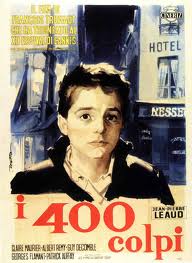
Jean-Pierre Leaud plays 12 year old Antoine Doinel, a boy who just can’t get a break at home or school. Labeled a troublemaker (the film title translates “to raise hell” or “to live a wild life”) by a lazy, cruel teacher, and treated as a lost cause and unwanted burden by his tight-sweater-wearing mother (Claire Maurier, over 80 and still acting today) and stepfather (Albert Remy). Antoine’s days are spent reading Balzac, watching movies, and dreaming of escape. A couple of unfortunate incidents spiral out of control and he ends up first in jail, and then in an “observation center” for troubled kids.

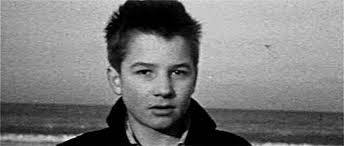
4002 The beauty of the filmmaking is evident in most every shot … and there are some amazing extended takes. The overhead scene of the PE teacher “losing” students as they jog through the city is humorous and insightful. The puppet scene in the park is an extraordinary long take of kids’ innocent and mesmerized faces, and the extended shot of Antoine running through the countryside is a cinematic first. Above all of that is the famous ending shot – a zoom in to freeze frame of the young boy caught between land and sea (past and present).

Truffaut and Leaud teamed up for four more projects featuring the same character, Antoine Doinel. In 1962’s Antoine and Colette, he finds first love. 1968 brings Stolen Kisses and true love. 1970’s Bed & Board has Antoine getting married, and finally 1979’s Love on the Run brings divorce and life after a failed marriage. Other than the “7 Up” series, I can’t recall a movie character being tracked in real time for two decades in multiple films.

The French New Wave also included directors such as Jean-Luc Godard, Claude Chabrol, and Jacques Remy (who appears as a policemen in this movie). These filmmakers used realism to tell their stories just after the time when Hollywood was using icons such as James Dean and Marlon Brando to express rebellious youth. This makes for an interesting comparison and fun analysis. Whatever your preference, Truffaut’s first feature is clearly an exciting development for cinematic history.

**NOTE: Francois Truffaut was a huge Alfred Hitchcock fan, and published a book “Hitchcock, Truffaut” in which he interviewed Hitchcock on each of his films, in order.

**NOTE: Francois Truffaut periodically acted in films (including a cameo in The 400 Blows).  His most famous role was when Steven Spielberg (a huge Truffaut fan) cast him in Close Encounters of the Third Kind.

watch a trailer (not the original trailer):

https://www.youtube.com/watch?v=i89oN8v7RdY

The 400 Blows