Greetings again from the darkness. A very low-budget indie done in the vignette style with multiple characters and story lines is a very ambitious undertaking for first time writers (Rachel Noll, Katy K Burton) teamed with a first time director (Eric Priestley). The inexperience shows, but there is also enough spark here to raise a little interest in the parties involved.
The cast includes the two co-writers, Sean Stone (director Oliver Stone’s son), Nancy Karr (former Laker girls), Elizabeth Izzo, and brief appearances from Keith David, Jake Busey, C Thomas Howell and Jeremy London. Hannah (Ms. Noll) is an artist who is told she is in the final stages of cancer. Danielle (Ms. Burton) is a rising movie star trying to balance her shot at fame with family demands and a personal life. Jill (Ms. Karr) is an aspiring ballet dancer stuck in lousy marriage with a workaholic jerk. Brooke (Ms. Izzo) is a young pregnant girl in desperate need of guidance.
It would be nice if the stories of the four ladies were better intertwined, though the climactic convergence in a diner provides a quick glimpse of what could have been. All of the stories involve the characters attempting to overcome obstacles and re-gain control of their own lives. They have each missed opportunities and are dealing with that crazy thing we all call life … the one thing we don’t want to pass us by.
The film often suffers from heavy-handed melodrama, especially the overly-sentimental songs directing us how to feel at any given moment. But given the low budget and lack of resume from the filmmakers, it’s actually a promising effort.
Greetings again from the darkness. Angels have been frequently cast as characters in movies such as Heaven Can Wait, It’s a Wonderful Life, Angels in the Outfieldand the American remake of this one … City of Angelswith Nic Cage. Director Wim Wenders (Paris, Texas1984) has always taken a poetic approach with filmmaking, even with his documentaries such as Pina (2011). His slow, thought-provoking style is not to everyone’s liking, but he has real talent for inspiring us to question ourselves, question others, and question life.
Damiel (Bruno Ganz) and Cassiel (Otto Sander) are two long-term angels who drift through the streets and libraries of WWII Berlin observing and listening to the internal thoughts and mental meandering of citizens … the wishes, the hopes, the happiness, the tragic, the loneliness … all emotions experienced in a typical day. The angels try to ease pain by offering a soothing hand on the shoulder, but they can have no direct impact and aren’t always successful. Damiel finds himself drawn to a Marion (Solveig Dommartin), a circus trapeze artist whose line “Most of the time I’m too aware to be sad” could easily have been the words of the angels.
There is an over-lapping subplot with Peter Falk playing himself as an actor in a German film. His character provides an instant infusion of interest and mystique, which the story later resolves. As Damiel gets closer to making the no-going-back decision to become human and bond with Marion, we see more of the fleeting moments that make up our lives. The angels see all, but can do very little. It’s this existence that makes Damiel’s decision understandable.
Famed cinematographer Henri Alekam’s floating camera, mixed lighting and dramatic contrast of black & white (angels view) and color (human view), add to the meditative effects of the film. There is a healthy dose of philosophy, metaphysics and spiritual questioning that goes on, including the three specifics asked by the film: Why am I me and not you? Why and I here and not there? When did time begin and where does space end? If such thoughtfulness is inspiring to you, then this Wim Wenders (Cannes’ Best Director winner) and Peter Handke (German playwright) script should keep you drifting with your thoughts for quite some time.
***NOTE: if you are unfamiliar with Bruno Ganz, not only is this film recommended, but so is his chilling turn as Adolph Hitler in Downfall from 2004.
Greetings again from the darkness. What a cinematic treat to revisit this movie on the big screen some 30 years after its release. Standing in stark contrast to the superhero and graphic novel special effects extravaganzas of today, this little film takes a slow, simmering approach as it deals with real emotions of life.
Robert Duvall won his only (so far) Oscar (he’s been nominated 6 times) for playing Mac Sledge, a divorced former C&W singer/songwriter who spends each day trying to kill the pain by draining bottles of booze. The similarities to Jeff Bridges’ 2009 film Crazy Heartare unmistakable, but this film is much quieter with emotions being relayed through the eyes and body language of the key characters.
Mac’s gradual path to redemption comes courtesy of war-widow Rosa Lee, played exceedingly well by Tess Harper (her first feature film). Rosa Lee runs a gas station/hotel while raising her young boy named Sonny (Allan Hubbard in his only screen appearance). As the story develops, we meet Mac’s ex-wife Dixie, played by a bombastic Betty Buckley (the mom from TV’s “Eight is Enough”, a Tony winner, the helpful teacher in the original Carrie) as she lives a life of luxury and insecurity courtesy of a career singing Mac’s songs. Their daughter is played by Ellen Barkin in only her second screen appearance (Diner, 1982). Dixie’s manager offers us a chance to see the always superb Wilford Brimley with his drawling charm.
The story was written by the remarkable Horton Foote (a native Texan), who also won the Oscar for Best Original Screenplay. Mr. Foote also won an Oscar for adapting Harper Lee’s To Kill a Mockingbirdfor the screen, was nominated for The Trip to Bountiful, won the Pulitzer Prize in 1955, and was nicknamed the “American Chekov”. His works always captured the essence of what makes people tick, and how they deal with adversity. He passed away in 2009 at age 92.
Australian director Bruce Beresford was coming off the masterful Breaker Morant(nominated for his screenplay) and was surprised to be chosen to direct his first American film. He would later go on to direct Driving Miss Daisy, winner of the Best Picture Oscar. Mr. Beresford is now in his 7th decade of film work spanning his 1959 short film and his TV mini-series “Bonnie & Clyde” from 2013.
This is such a no-frills, down-to-earth presentation that it’s easy to be tricked into thinking it’s a simple story about simple people. Instead, these are complicated folks leading complicated lives in a seemingly quiet manner. Mostly they are re-assembling the pieces as best they can … some are better at it than others. The core of these people is captured in Mac’s line: “I don’t trust happiness. I never did. I never will“.
***NOTE: Wilford Brimley, a former Marine in the Korean War, spent time as personal bodyguard to billionaire Howard Hughes.
***NOTE: Not to be outdone in reference to billionaires, Ellen Barkin spent 7 years married to Ron Perelman, billionaire Chairman of Revlon. She has since resumed her career.
Greetings again from the darkness. Not many writers/directors would put their two lead actresses in a coma for most of the movie. But then Pedro Almodovar has never been one for a conventional approach. His creative, challenging and visual story telling is at its peak with Talk To Her. The Dallas Film Society provided an opportunity for me to revisit this one for the first time since my initial viewing in 2002. A rare Best Original Screenplay Oscar winner for a Foreign Language film, those eleven plus years have not even slightly dulled the impact.
It’s typically pretty simple to determine what genre a particular film falls into. Somehow Almodovar walks (and writes) a fine line between love story and horror story … comedy and tragedy. Always an expert at writing interesting female characters, this time he shows the women are the stronger force even while comatose! The male leads are the ones suffering and dealing with loneliness. Javier Camara as Benigno is both likeable and suberbly creepy as Alicia’s (Leonar Watling) caregiver. Dario Grandinetti is stunning as Marco, whose stoic personality can reach dimensions most actors can’t touch. His scenes with Lydia (Rosario Flores) and Benigno are unlike anything ever seen on screen.
The film begins with a ballet piece featuring the amazing Pina Bausch (you should see the 2011 documentary Pina), and the rest of the film features similar pacing … each individual scene and even the film score create the feel of watching a ballet. There is even a fantasy/faux silent movie sequence within the movie that will cause uneasiness and nervous laughter … while Almodovar again makes the point that the force of women can literally consume a man.
In addition to terrific performances by Camara and Grandinetti, the flashback sequences really allow Ms. Watling (as a fresh-faced dancer) and Ms. Flores (as a confident bullfighter) to prove why these men fell so hard. One other actress adding interest is Geraldine Chaplin (daughter of Sir Charles) as Alicia’s dance instructor. Her presence helps tie in the flashbacks and present tense.
While most writers tie up stories with a pretty bow, Almodovar purposefully challenges us to think and feel and dig into our own thoughts and beliefs. He is brilliant (and a bit annoying) with his persistence in making us work so hard. There are decisions coated in gray, rather than black and white. There are characters who we want to like, but maybe/probably shouldn’t. Pedro’s use of color and texture is fascinating. This is an example of a master filmmaker at the peak of his craft. Sure, he has many other excellent films (Volver, All About My Mother, Broken Embraces), but if you only get one Almodovar, make it this one.
**NOTE: The priest in the wedding ceremony is played by Agustin Almodovar, Pedro’s brother and the film’s producer
Greetings again from the darkness. Tracy Letts had a very nice year in 2008. He won the Pulitzer Prize and a Tony for writing the play August: Osage County. Since then, he has also written the play and screenplay for Killer Joe, and been seen as an actor in the key role of a Senator in the TV show “Homeland“. This time out, he adapts his own play for director John Wells’ (The Company Men, TV’s “ER“) screen version of August: Osage County.
With an ensemble cast matched by very few movies over the years, the screen version begins with what may be its best scene. Weston family patriarch and published poet Beverly (the always great Sam Shepard) is interviewing Johnna for a position as cook and housekeeper when they are interrupted in stunning fashion by Violet (Meryl Streep), Beverly’s acid-tongued wife who is showing the effects of chemotherapy and her prescription drug addiction. This extraordinary pre-credits scene sets the stage for the entire movie, which unfortunately only approaches this high standard a couple more times.
Despite the film’s flaws, there is no denying the “train-wreck” effect of not being able to look away from this most dysfunctional family. Most of this is due to the screen presence of a steady stream of talented actors: in addition to Streep and Shephard, we get their 3 daughters played by Julia Roberts (Barbara), Julianne Nicholson (Ivy) and Juliette Lewis (Karen); Ewan McGregor and Abigail Breslin as Roberts’ husband and daughter; Margo Martindale (Violet’s sister), her husband Chris Cooper (Charles) and their son Benedict Cumberbatch.
As with most dysfunctional family movies, there is a dinner table scene … this one occurring after a funeral. The resentment and regret and anger on display over casseroles is staggering, especially the incisive and “truth-telling” Violet comments and the defensive replies from Barbara. As time goes on, family secrets and stories unfold culminating in a whopper near the end. This is really the polar opposite of a family support system. Unlike many movies, getting to know these people doesn’t make us like them any more.
Meryl Streep’s performance is one of the most demonstrative of her career. Some may call it over the top, but I believe it’s essential to the tone of the movie and the family interactions. Her exchanges with Julia Roberts define the monster mother and daughter in her image theme. They don’t nitpick each other, it’s more like inflicting gaping wounds. Surprisingly, Roberts mostly holds her own … though that could be that the film borders on campy much of the time. Streep’s scene comes as she recalls the most horrific childhood Christmas story you could ever want to hear.
It must be noted that Margo Martindale is the real highlight here. She has two extraordinary scenes … each very different in style and substance … and she nails them both. Without her character and talent, this film could have spun off into a major mess. The same could be said for Chris Cooper, who is really the moral center of the family. While the others seem intent on hiding from their past, he seems to make the best of his situation.
The film never really captures the conflicting environments of the claustrophobic old Weston homestead and the free wide open plains of Oklahoma. The exception is a pretty cool post-funeral scene in a hayfield where Roberts tells Streep “There’s no place to go“. The main difference between the film version and stage version is the compressed time and the decision to include all explosive scenes. There is just little breathing room here. Still, it’s one of the more entertaining and wildly dysfunctional comedy-dramas that you will see on screen, and it’s quite obvious this group of fine actors thoroughly enjoyed the ensemble experience.
SEE THIS MOVIE IF: you want to sit back and watch family members go at each other with much more verocity than anything at your own family events OR you just want to see some of the best actors working today (Streep, Martindale, Cooper, Cumberbatch)
SKIP THIS MOVIE IF: you can’t imagine sitting through a dysfunctional family dinner so soon after your own holiday family time.
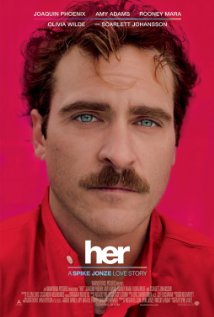
Greetings again from the darkness. Well, critics have been raving about this film so strongly the past few weeks that I almost feel guilty going against the grain. Almost. Where they see a masterpiece with insight into love and self, I see an implausible story bordering on ludicrous.
Writer/director Spike Jonze is an incredibly creative filmmaker. His Adaptation and Being John Malkovichare two movies I can watch repeatedly. I was a fan of his film version of Where The Wild Things Are, but this one just brought me nothing but annoyance, frustration and irritation.
Rather than defend my minority stance, I’ll just admit to not being onboard with this one. I have always believed we should each judge a film by how it touches us … how we connect with it. I was neither touched nor connected.
What I will say is the premise of technology replacing human interaction in the near future is not unthinkable and has already happened for some. But to say that a real relationship … that true love … can not just occur, but become commonplace between people and machines just simply contradicts what I believe comprises true love.
The film is extremely well made and visually beautiful. The acting is superb: Joaquin Phoenix, Rooney Mara, Amy Adams are all terrific. Voice acting is spot on including Scarlett Johansson, Brian Cox, Kristen Wiig, and even Spike Jonze. But falling in love with an operating system? Maybe what Osgood Fielding III said at the end of Some Like it Hotis really true … “Nobody’s perfect“.
SEE THIS MOVIE IF: you would like to see a very sad version of what could happen if technology continues to expand its role in our lives OR cyber-sex with Kristen Wiig is appealing to you
SKIP THIS MOVIE IF:you prefer your love stories to involve two PEOPLE!
Greetings again from the darkness. Yojimbo translates to “bodyguard”, but do not make the mistake of comparing it to the 1992 sappy mess The Bodyguard(Kevin Costner, Whitney Houston). This is one of the finest Japanese films ever made, directed by arguably the greatest Japanese director (Akira Kurosawa), and starring one of the top Japanese actors (Toshiro Mifune). It also served as the inspiration for Sergio Leone’s classic 1964 western, A Fistful of Dollars(with Clint Eastwood).
Based in 1860, we meet the unemployed ronin/samurai (Mifune) wandering the countryside allowing a tossed tree branch to determine the direction of his path. It leads him to a town where the ominous first visual is a dog carrying a human hand in his mouth. We realize this isn’t going to be the most welcoming of towns.
The town is controlled by rival factions: the Silk merchant versus the Sake brewer. They represent crime lords Seibel and Ushitora, respectively (think modern day bloods vs crips). Our clever ronin decides to play both sides against the middle and ends up hired as a bodyguard by BOTH gangs. As you can imagine, this leads to real problems for all involved.
The psychology of (corrupt) power and fear is in play here, as is some dark humor (the coffin maker). The biggest clash comes with Unosuke (Tatsuya Nakadai), who proudly carries the town’s only pistol. He certainly enjoys (and abuses) the respect and power that comes with that handgun. The samurai are trained to be loyal at any cost, and it’s quite interesting to see our protagonist adapt to the self-preservation required in his new world.
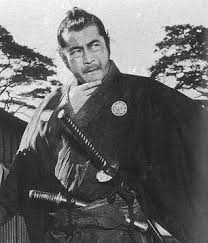
Masaru Sato delivers a very unique score – one quite unusual for the samurai genre. Toshiro Mifune (pictured left) has one of the great faces in cinematic history, and Kurosawa is in prime form. This is definitely one to see if you enjoy the best films from all countries. Other must see Kurosawa films include: Rashomon (1950), Seven Samurai(1954), Kagemusha (1980), and Ran (1985). It should also be noted that Kurosawa directed a comedic sequel to Yojimbo called Sanjuro (1962). The sequel also starred Mifune.
Greetings again from the darkness. Released in 1956, this William Wyler film holds up today because some of the debate and dilemmas touched on remain unresolved 57 years (and numerous wars) later. The film takes place in 1860’s Indiana as the Civil War rages. The story is told from the perspective of a pacifist Quaker family and is based on the 1945 book by Jessamyn West.
The patriarch of this Quaker family is played by Gary Cooper, who was four years past his Oscar winning performance in High Noon, and five years from his death due to cancer. His wife, the Minister Eliza, is played well by Dorothy McGuire, who the following year would play the mother in Old Yeller. The film’s best performance comes from young Anthony Perkins (his second film) who of course made cinematic history as Norman Bates in the 1960 classic Psycho. Both of these Perkins characters share mommy issues and complicated decisions of conscience, and in this one he has a remarkable scene when he crosses that line.
The opposition to war and violence is the main theme here, and there have been many interpretations over the years. Is it religious belief or fear that prevents the men from joining the cause? At least Perkins’ character is honest enough to wonder. Cooper kind of plays against type here since he was so often a man of movie action, but in reality his strength of character and belief allows him to maintain his strong leading man image.
Comedy relief is at hand given the youngest son’s ongoing battle with Samantha the Goose, a family pet with devious attack modes. Daughter Mattie, played by Phyllis Love, falls madly in love with a soldier played by Peter Mark Richman. See, every character has their own personal battles and decisions regarding conscience and violence.
The great Margaret Main has a sequence as a single mother of three daughters (every one a gem!). The daughters introduce Cooper and Perkins to the joys of music … forbidden by the Quaker church. One of the daughters is played by Marjorie Durant, whose father was a writer and assistant to Charlie Chaplin. Her grandmother married EF Hutton, so Ms. Durant could have spent a great deal of time researching her only family stories.
While it’s difficult to understand these days, screenwriter Michael Wilson was not originally credited for his work. He was on the Hollywood Blacklist, and his screen credit was not reinstated until 1996. William Wyler was one of the most successful directors in Hollywood history and his resume includes Jezebel, Mrs Miniver, The Best Years of Our Lives, and of course, Ben-Hur. Though this movie was nominated for 6 Academy Awards, it didn’t win any and lost out to Best Picture winner Around the World in 80 Days.
**NOTE: This was Ronald Reagan’s favorite movie and he presented a copy to Mikhail Gorbachev in hopes the message would prove perspective and alternatives to a war between the super powers.
Greetings again from the darkness. A brilliant and expertly made film that is excruciatingly painful to watch, yet impossible to look away. That would be my one line review. Of course, that line could be followed by a 10 page essay, to which I won’t subject you. How to do justice to this extraordinary three hours of excess and debauchery? How to give due credit the craftsmanship of director Martin Scorcese? How to acknowledge the pure physicality and kinetic energy of Leonardo DiCaprio’s performance? How to heap praise on a project so lacking in morality and decency? There are no easy answers to these four questions, but there is plenty to discuss.
Let’s be clear. This is a vulgar film telling the disgusting story of a crude and egotistical scam artist who defrauded many innocent people. Jordan Belfort’s autobiography serves as the source material for the screenplay from Terrence Winter (“The Sopranos”, “Boardwalk Empire“). Leonardo DiCaprio (in his fifth collaboration with Martin Scorcese) portrays Belfort as the talented stock broker who soaks up lessons from both his mentor and the real world stock market crash of 1987. That Black Monday led him right into the world of penny stocks and huge commissions. Those commissions and his stunning sales skills take him right into a world that rivals that of Caligula or Fellini’s Satyricon. This is certainly DiCaprio’s most free and limitless performance to date … it’s also his most comedic.
Sex. Drugs. Rock and Roll. Sorry, that’s not enough for Belfort. He is also driven by money, greed, power and the need to take advantage of the weak. I lost count, but surely Belfort displays more than seven deadly sins. Everything is extreme. Nothing in moderation. Belfort is both smart and stupid. He is the worst of human nature, and when combined with his charisma, becomes very dangerous. Watching him give his invigorating and over-the-top pep talks to the team recalls the cult evangelists we have seen over the years. His religion is money and winning … never accepting “no”. His followers eat it up.
While most of the movie is pedal to the metal, there are two exceptional scenes that really stood out. When a young, eager, new to Wall Street Belfort has lunch with his mentor (played by Matthew McConaughey), we sense him soaking up the lessons … we see the wheels turning to a new way of thinking. McConaughey is in top form here. The other standout scene takes place aboard Belfort’s yacht as he interacts with the FBI agent played by Kyle Chandler. This agent is the closest thing to a moral barometer the movie allows and their dance of dialogue and acting is pure cinematic magic.
Jonah Hill as Belfort’s business partner is his physical opposite, and possibly even less morally-centered than Belfort. He is also extremely funny in a demented way. Three very talented film directors have supporting roles. Rob Reiner (in a rare acting gig) plays Belfort’s bombastic dad and firm accountant. Jon Favreau is the high priced attorney fighting off the SEC and FBI. Spike Jonze plays the boiler room manager who first schools Belfort on penny stocks, and sets the wheels in motion. There is also a very sexy, funny performance from Margot Robbie as Belfort’s second wife.
My words don’t do justice to the manic existence and frenzied scenes of sex, profanity and drug use. The black comedy mixed in prevents this from being the bleak portrayal that it could have been, but don’t underestimate the depths to which the characters will stoop to get what they want. This one makes a similarly themed American Hustlelook like a Disney flick. Consider yourself warned … and don’t think you can just turn away from the screen.
**NOTE: the soundtrack is quite diverse and complements the pace of the film. The musical director is Robbie Robertson, who was part of The Band when Martin Scorcese directed The Last Waltz
Greetings again from the darkness. Surely it’s a coincidence that Disney Studios has released this movie just a few months ahead of the 50th anniversary of the classic Mary Poppinsfilm. Regardless of the promotional angle, the story of Walt Disney (played by Tom Hanks) going all out to woo stuffy Brit writer PL Travers (Emma Thompson)actually turns out to be a well made and pretty interesting story of two stubborn people butting creative heads. Even better is a behind the scenes glimpse of the creative and collaborative process of bringing the Travers book(s) to the big screen.
Director John Lee Hancock is the perfect fit with his track record of glossy, feel-good, inspired by true life stories with The Blind Sideand The Rookie. We never lose sight that this is a Disney production of a Disney story. The only Disney blemish shown is a quick shot of him stubbing a cigarette in an ashtray. Mr. Disney was an expert at hiding his smoking habit from the public … well at least until he died from lung cancer in 1966, a mere two years after the premiere of Mary Poppins. Mostly Walt is depicted as working diligently to provide the trust and security that Travers sought in protecting her most precious flying nanny.
The real star here is Emma Thompson’s portrayal of Travers. Her desperate need for money is mentioned once, but the story is more concerned with her innate need to protect the legacy of her story … no animation, no mean Mr Banks, no Dick Van Dyke, and no silly songs. Watching her interact with the songwriting Sherman brothers (Jason Schwartzman, BJ Novak) and the Disney screenwriter played by Bradley Whitford is the most fun this movie has to offer. Her “no, no, no” mindset is quite frustrating for the quite successful Disney creative team. The armchair psychology is really where the movie falters a bit. Watching Walt struggle to mesmerize Travers with his Disney magic feels a bit forced, and when combined with numerous flashbacks to her childhood, leave the audience way ahead in figuring out the key to her heart and mind.
Once the daddy issues come to light, we get Hanks’ best scene in the film. As he finally connects with Travers by laying bare his childhood (and fatherly) challenges, he eloquently explains the importance of imagination and storytelling for both children and adults. A desire to re-write or re-imagine our childhood seems to be at the core of many adults. It seems many dwell on the negative aspects of childhood, and even here, Travers’ dad (Colin Farrell) may be the nicest alcoholic who ever inspired their kid to be a writer.
PL Travers (born Helen Lyndon Goff) wrote 8 Mary Poppins books between 1934 and 1988, but was so unhappy with the film version that she never agreed to a sequel and it wasn’t until the 1990’s when she agreed to a stage version (no Americans allowed!). She passed away in 1996 at the age of 96, and the actual recordings played over the closing credits show just how well Ms. Thompson captured the strong will of the author.
**NOTE: Tom Hanks has an impressive family tree. He is a distant cousin of Walt Disney and Abraham Lincoln.
**NOTE: On his deathbed, the last words Walt Disney wrote were “Kurt Russell”. The reason for this was never discovered, although Mr. Russell was under a 10 year contract with Disney at the time.
SEE THIS MOVIE IF: you are interested in the creative collaboration process between two very talented sides with extremely different motivations
SKIP THIS MOVIE IF: you are expecting a kids’ or family movie about the classic Mary Poppins movie.
 Greetings again from the darkness. A very low-budget indie done in the vignette style with multiple characters and story lines is a very ambitious undertaking for first time writers (Rachel Noll, Katy K Burton) teamed with a first time director (Eric Priestley). The inexperience shows, but there is also enough spark here to raise a little interest in the parties involved.


 Posted by David Ferguson