TRUMBO (2015)

November 19, 2015

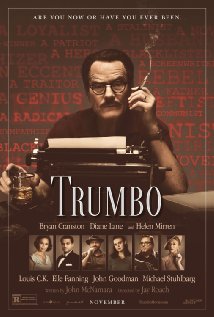
trumbo Greetings again from the darkness. For an industry that thrives on ego and self-promotion, it could be considered surprising that more movies haven’t focused on its most shameful (and drama-filled) period. The two Hollywood blacklist films that come to mind are both from 1976: Martin Ritt’s The Front (starring Woody Allen) and the documentary Hollywood on Trial. There are others that have touched on the era, but director Jay Roach and writer John McNamara (adapting Bruce Cook’s book) focus on blacklisted writer Dalton Trumbo in a film that informs a little and entertains a lot.

Director Roach combines his comedic roots from the “Austin Powers” and “Meet the Parents” franchises with his more recent politically-centered HBO projects Recount and Game Change. His subject here is the immensely talented writer Dalton Trumbo, whom Louis B Mayer signed to the most lucrative screenwriting contract of the 1940’s. It was soon after that Trumbo’s (and other’s) affiliation with the American Communist Party came under fire by the House Un-American Activities Committee headed by J Parnell Thomas. The divide in Hollywood was clear. On one side were the staunch Patriots like John Wayne (David James Elliott) and the Queen Muckracker, gossip columnist Hedda Hopper (Helen Mirren); on the other were “The Hollywood Ten” … those accused of being traitors simply because they stood up for freedom.

What’s interesting here is that despite the dark subject matter, the film has an enormous amount of humor … including multiple laugh out loud moments. This happens because most of the focus is on Trumbo the family man and Trumbo the justice fighter. Of course, as a writer, Trumbo does his best fighting with words … words whose message is “they have no right” to question the thoughts and beliefs of individual citizens. The committee’s mission was to prove treason by linking to the Russian agenda, but in reality these folks were mostly supportive of labor rights … most assuredly not a crime. The investigations, such as they were, seemed to prove the gentlemen were more Socialist than Russian – which makes an interesting contrast to modern day where we have an admitted Socialist running for President. The Hollywood Ten stood their ground, served jail time, and were either forced out of the industry or forced to go “underground” using pseudonyms. Trumbo, while unceremoniously writing under other names, won two Best Writing Oscars – one for Roman Holiday and one for The Brave One.

Bryan Cranston delivers a “big” performance as Dalton Trumbo. Everything is big – the glasses, the cigarette holders, the mustache, and definitely the personality. He does his best writing in the bathtub, and is never without a quick-witted comeback … whether sparring with The Duke or the committee. Unfortunately, Hedda Hopper does her most effective work in undermining the rights of Trumbo and his cohorts, including Arlen Hird (Louis CK) and Ian McClellan Hunter (Alan Tudyk). We also see how Edward G Robinson (Michael Stuhlbarg) quietly supports the cause, while also trying to salvage his fading career.

Trumbo is by no means presented as a saintly rebel with a cause. Instead, we see him as a loving yet flawed father, husband and friend. Once released from prison, he is so focused on writing and clawing his way back, that his relationships suffer – especially with his eldest daughter Nikola (Elle Fanning) and loyal wife (Diane Lane). It’s the King Brothers Production Company led by Frank (John Goodman) and Hymie (Stephen Root) who give Trumbo an outlet for writing and earning a living. Most were schlock movies, but there were also a few gems mixed in (Gun Crazy). However, it’s Kirk Douglas’ (Dean O’Gorman with an uncanny resemblance) courageous stand for his (and Stanley Kubrick’s) movie Spartacus, and director Otto Preminger (Christian Berkel) and his film Exodus, that put Trumbo’s name back on the screen, effectively ending Ms. Hopper’s crusade.

The ending credits feature clips of the real Dalton Trumbo being interviewed, and it brings clarity to Cranston’s performance, while more importantly relaying some incredibly poignant and personal words directly from the man … maybe they really should be “carved into a rock”. It’s an era of which Hollywood should not be proud, and it’s finally time it was faced head-on … and it’s quite OK that they bring along a few good laughs.

watch the trailer:


BROOKLYN (2015)

November 19, 2015

brooklyn Greetings again from the darkness. A popular proverb “Home is where the heart is” is filled with truth … unless the heart belongs in two places. Such is the case with Ellis, an Irish girl who leaves behind her family and homeland to discover the new world opportunities afforded by 1950’s America. The film is based on the popular and critically-acclaimed novel from Colm Toibin, and is directed by John Crowley (Is Anybody There? 2008) with a screenplay from Nick Hornby (About a Boy, An Education). It’s a blend of romance, drama, and self-discovery, while also examining a couple of diverse cultures from lands separated by more than 3000 miles (and a big ocean).

Saoirse Ronan plays Ellis in a performance that is sure to garner much Oscar talk. It’s only been 8 years since Ms. Ronan exploded onto the screen as 13 year old Briony in Atonement. In this current role we watch her blossom like a flower as she grows from a timid and reserved shop girl with a bleak future in Ireland, to a fully-realized woman with much spirit and hope. On that journey, she experiences many life obstacles including seasickness, homesickness, catty and envious housemates, heartbreak and romantic awkwardness … all while dealing with the overwhelming nature of her new world.

Director Cowley makes some interesting visual choices. We begin with a muted color palette and mostly close camera shots of Ellis’ life in Ireland. This “closed in” feeling continues through her crossing of the Atlantic. However, once she steps through the blue doors of Ellis Island, the world opens up with wide shots and shocks of bright colors. These contrasts blend together in the third segment where Ellis returns to Ireland after a family tragedy. The look of the film at any given time mirrors the mood and circumstance of our lead character.

Ellis struggles to adjust to the United States, both in the bordering house run by the colorful Ms. Kehoe (a terrific Julie Walters), and in the ritzy Bartocci store where she clerks for a demanding supervisor (Jessica Pare’, “Mad Men”). Ms. Kehoe provides her girls with such life guidance as “Giddiness is the 8th Deadly Sin”. It doesn’t take long for Ellis to meet Tony (a breakout performance by Emory Cohen, The Place Beyond the Pines), a pleasant and polite local Italian plumber who is enchanted by her. Their time together provides a wonderful comparison piece for today’s courtship vs. that of the 1950’s.

The movie is beautifully paced, filmed and acted; however, there are some issues to fight through with the story and details of the main character. Her return to Ireland introduces Jim Ferrell (solid work from the ever-evolving Domhnall Gleeson), and just like that, Ellis is confused about Tony’s line: “This is where your life is”. This time of confusion for her, creates similar type confusion for viewers as we either understand her uncertainty, or question it. This distracts a bit from some of the impactful elements like her transition from clueless fish-out-of-water on her first cruise, to strong mentor for an Irish girl much like her younger self on a later trip. The script has more than a few of these moments of gold, and Saoirse brilliantly nails each.

watch the trailer:


SECRET IN THEIR EYES (2015)

November 19, 2015

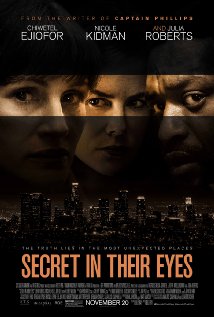
secret in their eyes Greetings again from the darkness. Why, Billy Ray, why? It’s not surprising that Hollywood green-lighted the Americanization of the 2010 Oscar winner for Best Foreign Language film, El secreto de sus ojos. That original from Argentina is exemplary filmmaking and a thoroughly entertaining and compelling mystery-thriller; a must-see for any true film lover. Even if an Oscar-studded cast is hired (2 Oscar winners, 8 nominations), the guiding inspiration for a remake should be more than losing the subtitles and filming Julia Roberts without make-up.

The story balances two timelines spanning 13 years. Jess (Ms. Roberts) is an investigator who works with FBI Agent Ray (Chiwetel Ejiofor), Assistant District Attorney Claire (Nicole Kidman), and a blustering District Attorney played by Alfred Molina. When Jess’ daughter is brutally murdered, the investigation is impacted by the suspect’s role as a department snitch. When we catch up all those years later, the unrequited attraction between now former FBI Agent Ray and now DA Claire is as strong as ever; Jess’ appearance is on par with someone suffering from a terminal illness, and the murder still hovers over these characters as if it had occurred last week.

It’s a fascinating story that was handled superbly in the original, yet mostly comes across as uninspired in this latest project. At times, it’s even a bit confusing in how the two eras are handled. The score from Emilio Kauderer and a couple of fine scenes from Ms. Roberts (although she gets no credit here for appearing sans-makeup) are the best parts of this one. Otherwise, Mr. Ejiofor (usually a fine actor) goes over-the-top, while Ms. Kidman is simply miscast and unable to generate the proficiency required for her position. Other support work comes courtesy of Dean Norris (“Breaking Bad”), Michael Kelly (“House of Cards”) and Zoe Graham.

Other than lacking the grit and realism of the original, the editing and camera work (so exceptional in the first version) at times come off as amateurish this time around. The soccer/futbol sequence from the original is replaced with Dodgers baseball (Chavez Ravine and Vin Scully) and a link to former Manager Walter Alston. Normally that would be considered an improvement, but again, these fall short and fail to generate the necessary suspense. A weak impersonation of the famous long-tracking shot certainly doesn’t help.

For anyone who hasn’t seen writer/director Juan Jose Campanella’s (an Executive Producer here) excellent original, this version from Billy Ray (Shattered Glass) might prove interesting enough; however, those same folks are strongly encouraged to instead track down the original, and experience the emotional depth and filmmaking expertise that made it such a worthy Oscar winner.

watch the trailer:


MEDITERRANEA (2015)

November 19, 2015

mediterranea Greetings again from the darkness. Success on the film festival circuit is much deserved for this first feature film from writer/director Jonas Carpignano, as he expands his short film A Chijana (2012). It’s based on the true story of a young man who migrated from Burkin Faso to the southern Italy town of Rosarno. What makes this special is that the real immigrant, Koudous Seihon, stars in the film and recreates much of what he went through.

We witness the obstacles facing those trying to leave Africa … they need money and assistance and a whole lot of luck. Mr. Seihon plays Ayiva, and he is traveling with his brother Abas (Alassane Sy). The rickety boat they pile into is one most of us wouldn’t consider sea-worthy enough to cross the Mediterranean Sea (especially through a storm), but it’s their only option.

They are certainly disappointed in the shanty town that becomes their new home. However, soon enough they realize sleeping on the ground in cold weather with but a thin quilt is no hardship compared to the everyday risk of violence and racism. Most of the locals are not welcoming in the least, and the hatred often escalates. It’s what led to the riots of 2010, which director Carpignano touches on here.

The film has a no-frills docu-drama feel to it, and Seihon has a real screen presence. Ayiva’s survival skills are enhanced by his ability to blend into his environment – he becomes what he needs to be to persevere. Unfortunately his brother rebels and lets his anger affect his actions. The real world struggles of migrants and refugees are a global issue these days, and the film brings into focus some of the struggles faced by those who see no other option.

watch the trailer:


BY THE SEA (2015)

November 19, 2015

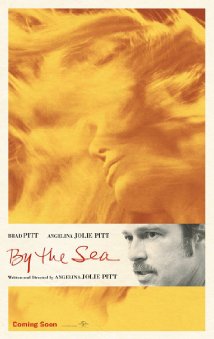
by the sea Greetings again from the darkness. As a devotee and lover of the cinematic art form, I tend to focus on the positive elements of films, and maintain a near reverent respect for filmmakers who engage in personal projects. Because of this, I typically avoid labels such as “bad” or “good” and instead focus on the experience. Unfortunately, this latest from writer/director Angelina Jolie (billed for the first time as Angelina Jolie Pitt) has delivered a prolonged experience of monotony and misery that can only be described as bad. Or awful. Or even beyond awful.

It’s based in the mid-1970’s and filmed on the island of Gozo in Malta. The setting is stunningly beautiful, and cinematographer Christian Berger captures the essence of this unique spot with naturalistic lighting and plenty of wide shots of the rocky beaches that provide the foundation for a classy and quaint inn run by Michel (Niels Arestrup, A Prophet). Roland (Brad Pitt) and Vanessa (Angelina Jolie) are the epitome of an unhappily married couple … though they are stylishly dressed while driving their 1967 Citroen convertible.

He is a writer who doesn’t write and she is a former dancer who doesn’t dance. While he is not writing, Roland sucks down gin, beer and anything else Michel will serve him. Vanessa mostly hangs out in the room popping pills and watching a fisherman in a row boat. When they are together, they rarely speak except to ensure we viewers understand just how miserable they are … with a lousy reason that isn’t explained until late in the film. Mostly she bats her porn star fake eye lashes while he sports a porn star mustache.

A glimmer of hope emerges when a honeymooning couple takes the room next door. Lea (Melanie Laurent) and Francois (Melvil Poupaud) seem quite happy and enjoy spending time together in bed. We know this because Vanessa discovers a peephole where she can take in the sights. In what is probably the only interesting twist, Lea and Roland are soon sharing peeps … a step that somehow begins the process of rebuilding their relationship. Of course, that doesn’t happen without many more scenes of misery prior to the quite predictable finish.

Angelina is clearly paying tribute to the 1950’s and 1960’s French arthouse films, but having two unlikable lead characters who can’t stand to be in the same room never allows the viewers to connect … though she seizes many opportunities to show off her exquisitely rebuilt breasts. The film is entirely too long – and feels even longer – as it squanders a real chance to explore the second stage of marriage. The beautiful scenery and Gainsbourg songs don’t come close to making this a movie worth enduring.

watch the trailer:


MY ALL AMERICAN (2015)

November 13, 2015

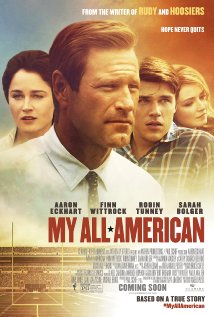
my all american Greetings again from the darkness. I’m a University of Texas alumnus and have vivid childhood memories of Freddie Steinmark the player, followed by Freddie Steinmark the tragedy, and finally Freddie Steinmark the inspiration. His legacy remains an active part of the Longhorns football program today via the stadium scoreboard dedication and the locker room tribute that is part of every game day in Austin. This is the directorial debut of Angelo Pizzo, who is known for writing two other inspirational sports movies: Hoosiers and Rudy.

It’s difficult not to cringe when the film opens in 2010 with a reporter interviewing legendary and elderly former coach Darrell Royal, who is dementia-stricken and forgetful … until he starts speaking of Freddie. The cringe-inducing part isn’t Coach Royal’s dementia (of which we fans were all aware), but rather the amateurish make-up applied to Aaron Eckhart in an attempt to age him into the 85 year old icon. Fortunately this segment is brief, and we are soon enough picking up a high school aged Freddie as he practices and works out ferociously with his dad in hopes of fulfilling his dream of playing football at Notre Dame.

Finn Wittrock (“American Horror Story”) plays Freddie, and captures the intensity, ambition and goodness of the young man who would galvanize the Longhorns program and end up making quite an impression on those Notre Dame coaches, but for much more than his play on the field. Burned into my memory (and that of anyone who witnessed it) is the shot of Freddie on crutches at the 1970 Cotton Bowl.

Director Pizzo offers some breath-taking aerial shots of Austin and Memorial Stadium (digitally altered to reflect the late 1960’s), and some impressive sequences of football practices and games. Football fans will have fun spotting former players making appearances including Case McCoy (as Razorback Bill Montgomery), Hays McEachern, Danny Lester, and Luke Poehlmann. You will also note Juston Street plays his father James (mimicking the game face), and Jordan Shipley plays my all-time favorite Longhorn receiver, Cotton Speyrer. Nostalgia flows as the game announcers call some of the greatest college players of the era: Ted Koy, Steve Worster, Jim Bertelsen, Steve Owens, and Chuck Dicus.

“The Game of the Century” is the centerpiece game of the movie, and we actually get a clip of President Richard Nixon arriving to the Texas-Arkansas game of 1969. It turned out to be Freddie’s final football game, but more aptly, a continuation of his influence. However, this is just as much the story of Freddie the individual as it is Freddie the football player. His determination, zest for life and incredible courage are the message here … not tackles and interceptions. Even his relationship with his high school and college sweetheart Linda (Sarah Bolger) seems the stuff of which dreams are made.

In addition to this film, there have been three books written about Steinmark: in 1971 Freddie worked with Blackie Sherrod on an autobiography called “I Play to Win”; in 2011, Jim Dent wrote “Courage Beyond the Game”; and just this year, the University of Texas published a new biography entitled “Freddie Steinmark: Faith, Family, Football” by Bower Yousse (a former friend and teammate). It should also be noted that Steinmark’s battle against cancer inspired Congress to pass the National Cancer Act of 1971, beginning the war on cancer and spurring a jump in cancer research that continues to this day.

It’s a football movie, but also a tearjerker. It’s a profile of an over-achiever, but also the story of a young man who inspired a team, a university and a nation. Every time you think the story is a bit corny, or that Freddie is too good to be true, just remind yourself that despite the cynicism permeating society today, Freddie Steinmark was flesh and blood, with a heart and soul and mentality that refused to surrender.

a picture of Freddie Steinmark:

freddie


THE 33 (2015)

November 12, 2015

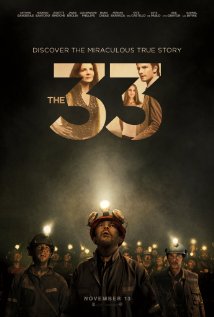
the 33 Greetings again from the darkness. How do you structure a film based on a true story that lasted 69 days, occurred 5 years ago, and was followed live on TV by half of the global population? Director Patricia Riggen (Girl in Progress, 2012) delivers a film designed to tug on heartstrings, and is based on the book “Deep Down Dark” from Hector Tobar, as well as interviews with the key players.

In 2010, the San Jose copper/gold mine collapsed trapping 33 Chilean miners more than 2300 feet under tons of rubble and an unstable rock that dwarfed the Empire State Building. Through some pretty solid special effects, we are there for the collapse. It’s this segment and the immediate reactions from the miners that provide the film’s best segment. We feel the miner’s sense of panic and doom as they begin to come to grips with their plight.

The film rotates between three struggles: the isolation of the miners struggling to survive, the tent city populated by their families struggling to maintain hope, and the Chilean government struggling with the politics and public relations of a rescue mission. From a character standpoint, each of these three segments is given a face. Antonio Banderas as Mario becomes the focal point of the miners. He searches for an escape route, takes charge of the (very limited) food rations, and acts as referee and light of hope in an extremely volatile situation. Juliette Binoche (yes the French actress) is Maria, the sister of one of the trapped miners and the most assertive of those pushing the government to attempt a rescue. Rodrigo Santoro plays Laurence Goldborne, Chile’s Minister of Mining, and the one who pushes the government to move forward with the costly rescue mission.

Other key characters include Bob Gunton as Chile’s President Pinera, Lou Diamond Phillips as “Don Lucho”, the safety inspector, Gabriel Byrne as the chief engineer, James Brolin as Jeff Hart (leading the U.S. drilling team), Naomi Scott as Mario’s wife, and three of the other miners: Oscar Nunez, Mario Casas, and Juan Pablo Raba.

The most bizarre segment comes courtesy of miner hallucinations. It’s a fantasy-infused Last Supper sequence that plays out to the sounds of a Bellini opera, while the food and drink flow and the family members join in the joy. It’s not difficult to imagine the brain taking these poor gentlemen to such places of mental torture.

As if the approach is to make the most viewer-friendly buried miner film possible, we aren’t witness to much underground conflict, and the internal bickering within the Chilean government officials is kept to a minimum. We do get to see the media circus that occurred during the ordeal … of course, most of us witnessed it in real time.

Director Riggen has delivered a film that taps into the multitude of emotions for the different groups of people, rather than concentrating on the miserable situation of the miners. It’s a challenge to keep us interested in a true story of which we all know the ending, but most viewers will stay engaged with the characters. It should also be noted that the minimalistic score is some of the last work from the late, great James Horner.

Watch the trailer:


SPOTLIGHT (2015)

November 12, 2015

spotlight Greetings again from the darkness. Faith. A word that easily could have been the title of this gripping and heart-wrenching film. Faith can be defined as trust and belief. Faith can also be defined as religion and ideology. Few things are more devastating than broken faith … the core of this “based on actual events” story of The Boston Globe’s exposure of rampant child molestation by dozens of Catholic priests, and the systematic cover-up by “The Church”.

It’s challenging to name a movie that is as well-made as this one, while also being as difficult to watch. We know the story … we even know how it snow-balled globally … but the raw emotions of disgust and sheer anger permeate much of our being as we watch it unfold on screen. Director Tom McCarthy (The Station Agent, The Visitor) co-wrote the script with Josh Singer (The Fifth Estate) and it’s worthy of favorable comparison to other investigative newspaper films like The Insider (1999), Zodiac (2007), and even the granddaddy of them all … All The President’s Men (1976).

The opening scene takes place in a 1976 Boston police station. A priest has been accused of molesting a child. Within a couple of minutes we witness the empty promises, the intimidation, and the cover up. So much is conveyed in this brief opener, not the least of which comes courtesy of the ambivalence of the veteran cop as he shrugs it off as ‘just another day’ in front of an idealistic rookie cop. This is accompanied by Howard Shore’s spot-on score, with the best parts featuring only a piano and bass.

Flash forward to 2001 as we meet the investigative journalist team called “Spotlight”. It’s led by editor Walter “Robby” Robinson (Michael Keaton) and his three reporters: Mike Rezendes (Mark Ruffalo), Sacha Pfieffer (Rachel McAdams), and Matt Carroll (Brian d’Arcy James). They report to Ben Bradlee Jr (John Slattery), whose father was the editor of The Washington Post during the Woodward/Bernstein/Watergate era. New to The Globe is managing editor Marty Baron (Liev Schreiber). Unlike the others, Mr. Baron is neither a Boston local nor a Catholic. In fact, we catch him reading Dan Shaughnessy’s book “The Curse of the Bambino”, just so he can get a better feel for the community and its people.

What is most fascinating about the movie is that it focuses on the investigative aspects – just how diligent the reporters were in putting the story together – and how fluid the process was … the story led them, not vice versa. There was no media agenda to “get” the church. Instead, the reporters experienced natural shock as each piece of the puzzle was discovered. One of their key sources was a priest-turned-psychologist (voiced by Richard Jenkins) who helped them put scope to the numbers. Another was Phil Saviano (Neal Huff), the leader of a victim’s group, who had tried before to provide documentation to the press. Saviano is the perfect example of how someone so passionate about a cause can be viewed with such skepticism … right up to the point when they are proven correct. Three attorneys add perspective to the cover-up. Eric Macleish (Billy Crudup) made a career of settling cases (and silencing victims) for the church. Mitchell Garabedian (Stanley Tucci) is the polar opposite – he fights vigorously to get the victims heard, while Jim Sullivan (Jamey Sheridan) is caught in the middle – settling cases for the church and struggling with his conscience. Other interesting characters include Paul Guilfoyle as Pete Conley, a smooth-talking power-broker for the church, and Len Cariou as Cardinal Law – the man at the top who eventually apologized and was rewarded with a high-ranking position at The Vatican.

The film is so well crafted and acted that it features more than a few “best scenes”. Sacha has a brief encounter with a former priest on his front door stoop. The priest freely admits to molesting kids and his rationalization will certainly deliver chills to most any viewer. Since this is Boston, it makes perfect sense for the reporters to be so distracted by the story, that it supersedes the Red Sox game they are attending at Fenway Park. Being that the investigation lasted well into 2001, it’s quite informative to watch a news agency shift directions for the September 11 tragedy, and along with the nation, put all else on hold. Finally, there is a point in the movie where we as viewers have just about had our fill of extreme emotions – we either need to hit something or throw up – and reporter Rezendes comes through with exactly what is needed: an emotional outburst and release of exasperation rivaling anything previously seen on screen. It’s a wonderful moment for Ruffalo as an actor, and a peak moment for viewers.

The story hit the front page of The Boston Globe in January 2002. The paper won a Pulitzer Prize in 2003 for its superlative investigative journalism. The report vindicated so many who had been taken advantage of, and exposed the colossal arrogance of the church. The innocence of a child vs the power of God. The story broke the faith that so many once held, and started a global (as evidenced by the closing credits) reckoning and awakening that was desperately needed. The film offers a line of dialogue, “It takes a village to raise a kid … or abuse one.” In other words, it took the often silent actions of so many to allow this despicably evil horror to continue. In a tribute to the newspaper profession, it took a small group of dedicated reporters to pull back a curtain that should never again be shut. Let’s have faith in that.

watch the trailer:


MISS YOU ALREADY (2015)

November 5, 2015

miss you already Greetings again from the darkness. The theatre was filled with the sounds of sobbing. And by sobbing, I mean bawling … not the typical post-movie sniffles. While I was a little confused on just where my fellow movie watchers thought this story was headed, it’s understandable that sometimes a dark theatre is simply the best place to have a good cry. Director Catherine Hardwicke and screenwriter Morwenna Banks deliver an unfettered look at friendship, sickness and loss … and a reason to bring tissues.

Tearjerker movies have quite the history of success. Some of the more popular sob fests include: Love Story, Brian’s Song, Terms of Endearment, Beaches, Steel Magnolias, and The Notebook. This latest is probably most similar to Beaches in that the focus is on two lifelong female friends (polar opposites in personality) who ride the rollercoaster of life together – through good times and bad.

Milly (Toni Collette) and Jess (Drew Barrymore) meet in elementary school and experience many of life’s “firsts” together. We know this because the film begins with a bit of a clumsy flashback sequence that shoots us through their high school years, heavy partying, and finally picks up after they are married.

There are many mysteries of the female gender that those of us with Y chromosomes will never comprehend. One of those is the close friendship between the vain, center-of-attention type, and the always supportive enabler. Milly is the classic taker, while Jess is a giver. Milly is the high-flying socialite who dresses flashy and draws a crowd, while Jess is the dependable sidekick, always there to make sure Milly is never alone. It’s confounding and a bit sad to those of us who view friendship as something much different.

Both Ms. Collette and Ms. Barrymore are strong in their performances, though Collette has the much meatier role. What’s impressive about the movie is how it takes head on the horrific travails of those with breast cancer. The emotional and physical and medical aspects are all dealt with no compromise. Some of it is tough to watch, but admirable in its directness. Milly’s breast cancer takes center stage, while Jess’ struggle to get pregnant is low-keyed. Fitting for their personalities, but each based in real life sagas. Milly’s husband Kit (Dominic Cooper), and Jess’ husband Jago (Paddy Considine) both provide understandable reactions to the obstacles faced by their spouses. Add in a bleached blonde Jacqueline Bisset as Milly’s eccentric mom, and the five lead actors each contribute a relatable element to the story.

Two other actors make an impression: Frances de la Tour as a wise and direct wig-maker, and Tyson Ritter (front man for The All-American Rejects) as a free-spirited bartender who may or may not be a good influence on Milly. Even though Jess is the heart of the story, it’s Milly who dominates … just like their friendship. Green vs glamour.

Director Hardwicke will always hold a special place in my movie memories thanks to her sparkling 2003 debut Thirteen. She and writer Banks clearly understand women, and believe it crucial to show the courage required in the fight against breast cancer. Fortunately, their main character is funny and spirited, and pals around with someone we would all be proud to call a friend. And that’s nothing to cry about.

watch the trailer:


SUFFRAGETTE (2015)

November 5, 2015

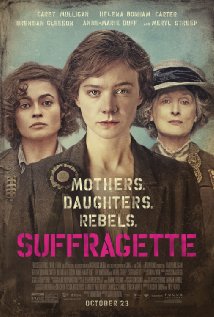
suffragette Greetings again from the darkness. Most “issues” movies go big in their approach to society-changing events and those that led the charge. Director Sarah Gavron (Brick Lane, 2007) and writer Abi Morgan (The Iron Lady, 2011) instead show us one little corner, a building block if you will, of the larger movement towards gaining women the right to vote in the UK. By focusing on the efforts of a small group of working class women in 1912, the struggle becomes one of flesh and blood, rather than granite statues.

Carey Mulligan stars as Maud Watts, a manual laborer at a commercial launderer. Her character is a composite of working class women of the time, and we come to appreciate her strength and the incredible sacrifices she makes for the greater cause. Maud seems to be a simple woman. She works hard, loves her son and is loyal to her husband Sonny (Ben Whishaw). When first exposed to the civil disobedience of the suffragettes, Maud is caught in the crossfire of a rock-throwing frenzy. She recognizes faces and becomes intrigued with the mission. At first, Sonny tries to be supportive, but soon enough, he is confused, embarrassed and finally forced to take extreme measures. After all, no self-respecting man of the time could allow his wife to sneak about town throwing rocks, setting off bombs, and attending secretive meetings … all for the sake of some ridiculous notion of equality for women!

Helena Bonham Carter appears as the neighborhood pharmacist who is a key cog in the local movement – a movement that had been ongoing peacefully for decades. What’s interesting about her appearance is that Ms. Bonham-Carter is the great-granddaughter of H.H. Asquith, the Prime Minister of UK from 1908-1916. He was an outspoken opponent of the suffragette movement during its most critical time. Her appearance and role in the film is a bit of redemption for the actress and her family.

Deeds not Words. This became the rallying cry for these women thanks to their leader Emmeline Pankhurst. Meryl Streep makes an all-too-brief appearance as Ms. Pankhurst, but it’s a key moment in the film as it solidifies the cause for this group of women who needed to believe that they could make a difference.

Gender inequality seems such an insufficient term for what these women endured. Sexual abuse, domestic violence, unequal pay, hazardous work environments, and almost no child custody rights in disputes with men … these were all commonplace at the time, and the film does a terrific job of making the points without distracting from its central message. Director Gavron’s subtle use of differing color palettes is effective in distinguishing the man’s world from that of the women.

It’s clearly a snapshot of a society on the brink of a revolution, and a grounded yet emotional glimpse at those foot soldiers in the war on injustice. Though this story focuses on the UK, the end credits remind us that in the U.S., it took until 1920 to ratify the 19th Amendment giving women the right to vote; and even more startling, Switzerland took until 1971 and the women of Saudi Arabia only this year obtained voting rights. The movie is a powerful personal story, and also an effective history lesson on the irrationality involved in bringing about humanistic change.

watch the trailer: