KRISHA (2016)

April 3, 2016

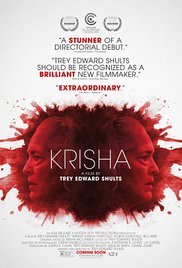
krisha Greetings again from the darkness. If we need a poster child for independent film, perhaps this little gem from writer/director Trey Edward Shults should be the leading candidate. The film is daring and raw and proves that even a familiar theme can be interesting if the creative forces are allowed to do what they do best. And on top of that … it was filmed in 9 days with no “stars” and almost no money.

The extended opening shot is a close up of only a woman’s face. Her eyes are expressive and her lip begins to quiver. Her look could be described as unnerved, and with the ominous music playing, our mind leads us to believe we are headed towards a horror film. Oh, how right … and wrong … that initial impression proves to be.

That woman is Krisha (played by Krisha Fairchild), a sixty-something year old who is joining her family for Thanksgiving dinner – after a 10 year absence. Of course, there are no shortage of family holiday dinner disaster movies, but most of the time they are either slapstick comedy or so stagey that the frustration never strikes a chord. Not so with this one.

Tension is palpable in every scene. It’s as if everyone is waiting for the proverbial shoe to drop. Krisha is a trainwreck as a mother, sister and person. She is an alcoholic and drug addict, though she proclaims herself healed. It’s pretty obvious to everyone (except herself) that her best intentions are not firmly planted in reality … and the inevitable is only a matter of time. Old wounds are re-opened (though they were probably never closed), and a simple conversation on the patio or checking the timer for the baking turkey become near catastrophes.

Mr. Shults has economically and effectively cast many of his own family members, and filmed in his mother’s home outside of Houston. Krisha is his real life Aunt, and Robyn (who plays Krisha’s emotionally devastated sister) is the director’s mother. This is a story that works because of the realness of each moment. It feels like family members unloading on each other rather than two actors reciting lines. Krisha’s swig of wine in the bathroom provides a moment of relief for both her and the viewer. Having been called “heartbreak incarnate” and an “abandoneer” … we even sympathize with her instinct to retreat to the bottle, though it’s with dread and misery.

Director Shults displays promise as a director who can capture a personal moment, no matter how awkward or painful. Krisha Fairchild has a Gena Rowlands on screen presence (very high praise) that delivers a touch of grounded realism to her words and actions. As a lover of independent films, here’s hoping we see more from them both in the very near future.

watch the trailer:


THE CLAN (Argentina, 2015)

April 2, 2016

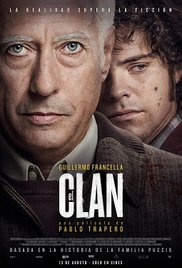
clan Greetings again from the darkness. It seems inherent within human nature for kids to want to make their parents happy and proud. Most of the time the reverse is also true: the majority of parents want to be good role models for their kids. However, when the latter is not true, things can get pretty ugly … even frightening. Such is the case with the real life story of the Puccio family in Argentina.

Acclaimed Argentinean director Pablo Trapero (Carancho, 2010) gives us a look at the Puccio crime family, and in the process draws parallels between the political turmoil and re-structuring of Argentina as it returned to a democracy in the early 1980’s.

The façade of the happy family makes for perfect public cover as horrendous crimes are perpetuated … often in the basement of the family home. Arquimedes (Guillermo Francella, The Secret in Their Eyes 2009) is the father who often seizes on the celebrity of his rugby star son Alex/Alejandro (Peter Lanzani) to catch their victims off-guard. The family Modus Operandi is pretty simple: kidnap-collect ransom- kill.  Arquimedes was known for his hospitality, often offering home-cooked meals to the victims as they were chained in the family basement. Quite a contrast to the brutality involved in the crimes.

The film raises many questions, and makes us wonder where the line of guilt is drawn between committing a crime, and simply looking the other way. It’s presented as if Alex felt compelled to support his father’s endeavors even though it caused major internal struggles for him. Certainly the mother/wife (an excellent Lili Popovich) made the conscious decision to do what was necessary. It’s especially unsettling to see Arquimedes helping his daughter with her school work, while the most recent victim is shackled in the cellar.

As Argentina’s Oscar submission for Best Foreign Language film, it didn’t make the final cut, but it’s absolutely at the level of the five nominated films. Fans of Scorcese and Coppola crime films will see the influences, and the film rates with such crime gems as A Prophet (2009) and Animal Kingdom (2010).

watch the trailer:


I SAW THE LIGHT (2016)

March 31, 2016

I saw the light Greetings again from the darkness. Most Hollywood musical biopics follow a similar and predictable structure, which is why Walk Hard: The Dewey Cox Story was so easily able to parody the genre. Of course, the legendary singer/songwriter Hank Williams deserves more than predictable storytelling … but unfortunately, that’s exactly what he gets here.

Tom Hiddleston delivers a spot on physical impersonation of Hank – right down to the slightly hunched over (due to Spina Bifida Occulta) posture and bouncy onstage waggle. Yes, the very British Tom Hiddleston, who plays Loki in The Avengers and Thor movies, has managed to capture the presence of one of the all-time great Country and Western icons. Mr. Hiddleston worked on the beloved songs with Rodney Crowell and delivers some very nice singing – so nice in fact that the singing is distracting and misleading. Hank Williams sang his songs in angst … a tortured soul seemingly without choice in his need to share his art. No one could be expected to perform with that emotion, and the void is obvious.

As source material, director Marc Abraham (Flash of Genius, 2008) utilizes “Hank Williams: The Biography” co-written by George Merritt, Colin Escott, and William MacEwen. It may be the least creative title possible for a biography, and the movie correlates perfectly. We track Hank’s early days as a struggling singer whose dream is to someday perform on the hallowed stage of The Grand Ole Opry, to his gas station marriage to Audrey May (Elizabeth Olsen), through his alcoholism, drug use, womanizing, superstardom, fall from grace, and ultimately tragic death at the age of 29.

Despite the nature of Williams’ short life, the film only skims the surface and rarely digs too deeply. The steady stream of women/wives is difficult to track … perhaps that’s the point. Audrey is the only one who gets much screen time and Ms. Olsen plays her as an ambitious shrew who comes across as impossible to like and as unwilling to work at the relationship. A staggering number of Hank Williams songs are embedded as merely interludes separating scenes of misery for all involved … especially Hank, who seems to find little joy in life.

We’ve all seen the destruction that fame often leads to, and when combined with Hank’s painful back disorder and relentless alcoholism, it’s little wonder his body simply surrendered at such an early age. The movie just seems a bit too high-gloss for such a tortured soul, and despite the best efforts of Tom Hiddleston, the film is not worthy of someone who left the musical legacy of Hank Williams.

watch the trailer:


REMEMBER (2016)

March 31, 2016

remember Greetings again from the darkness. Earlier this year, 81 year old Maggie Smith impressed with her lead role in The Lady in the Van. And now, just a few weeks later, comes 86 year old Christopher Plummer in a gut-wrenching performance as Zev Guttman, a 90 year old German grieving widower suffering from dementia. Don’t let that description fool you … Zev goes on a cross-continent road trip with a mission of seeking justice against the Auschwitz guard who killed his family more than 70 years ago.

Zev lives in a nursing home and often can’t remember to wear shoes, much less that his beloved wife Ruth has passed away. It turns out another resident/patient at the home shares a history at Auschwitz with him. Wheelchair-bound Max (Martin Landau) says the two men are the last surviving members of their cell block, and must work together to find the guard – now living under the assumed name of Rudy Kurlander – and find justice for their families. So we find ourselves with a coalition of sympathetic senior citizen Nazi hunters.

Given the war atrocities, it makes sense that over the years, many movies have placed Nazi hunting as a core theme. Among the most well known are: The Odessa File (1974), Marathon Man (1976), The Boys from Brazil (1978), Inglourious Bastards (2009), and The Debt (2010). But leave it to director Atom Egoyan (Ararat, Where the Truth Lies) to find a different spin and a twist on a familiar theme. At times, Zev’s dementia distracts us from his vengeful mission, while at various other times, the innocence of children acts as a dual reminder – the fragility of old age vs. the eye-for-eye brutality.

It’s Landau’s Max who acts as a type of narrative structure for the story. His sharp and focused plan is written out in letter form so that Zev can constantly refer and be reminded of his purpose. The letter also provides us viewers with the necessary back-story to fully comprehend the what’s and why’s. Each time Zev re-reads the letter, he re-experiences the loss of his wife – yet another of the film’s reminders of the effects of dementia.

Zev’s search takes him from Ohio to Canada to Idaho to Lake Tahoe. He goes through four Rudy Kurlanders – with Bruno Ganz (Downfall, 2004) and Jurgen Prochnow (Das Boot (1981) representing two. There is also a very uncomfortable sequence involving Dean Norris (“Breaking Bad”) which reminds that hatred is often passed down through generations.

The nursing home “getaway” and the purchase of a gun have us thinking Zev is some type of senior citizen Jason Bourne – sharing the lack of memory, but none of the skills. The title of “Remember” has many meanings and interpretations here, not the least of which is as a display of loss, guilt, revenge, family and old age. Even the most poignant moment of the film occurs when Zev says “I remember”.

watch the trailer:


KNIGHT OF CUPS (2016)

March 19, 2016

knight of cups Greetings again from the darkness. Some are calling this the third segment of a Terrence Malick trilogy – in conjunction with The Tree of Life (2011) and To The Wonder (2012). While the first of these three movies is considered an artful thought-inducing commentary on parenting and growing up, the third might just prove director Malick is the ultimate prankster … or maybe this is his grand social experiment to see just how far he can push his viewers.

Let’s start with the positive elements, as that won’t take long. Cinematographer Emmanuel Lubezki is an eight time Oscar nominee and three time winner (The Revenant, Birdman, Gravity), and has been the Director of Photography on these three Malick movies. He is a master with the camera, and truly creates art whether he is shooting nature, an isolated figure, or even the convoluted party scene in this latest. All three films are beautiful to look at … which doesn’t necessarily translate to being a pleasure to watch. OK, that’s the end of the good stuff.

The movie title, as well as the chapter titles flashed during the film, originates from Tarot cards. Unfortunately, the in-film titles seem to have little (or no) connection to the scenes that follow, nor those that precede. My guess is that Malick was playing truth or dare, and his opponent dared him to include Tarot cards in his next film … a worthy challenge for any director.

If you are looking for a story or anything approaching coherency or character development, Mr. Malick would have you believe that the trite tradition of beginning/middle/end is dead, and its replacement is a mosaic of barely related fragments with no need for such frivolity as conversation. Sure, the characters move their lips, but mostly what’s heard is whispered narration and mood music.

If somehow you aren’t yet excited to rush out to the theatre, perhaps you may be enticed by the random stream of empty or nearly empty buildings, odd angles of Los Angeles architecture, Christian Bale roaming the rocky desert, Las Vegas (just because), lots of fancy swimming pools, and family members apparently arguing (without us hearing most of their words, of course).

Here is what we know. Christian Bale plays a screenwriter apparently experiencing some type of writer’s block. While blocked, he reflects on his life and the six women with whom he had relationships (Cate Blanchett, Natalie Portman, Frieda Pinto, Teresa Palmer, Imogen Poots, Isabel Lucas). We know nothing of his character’s writing ability, but it’s obvious he has been successful in attracting beautiful women to his bed – and then, like most guys, screwing things up beyond repair. Bale’s character also has an angry (and perhaps ill) brother (Wes Bentley) and an angry (and perhaps ill) father (Brian Dennehy). At times, they are all angry together and angry at each other, and it’s apparently over the suicide of the youngest brother/son … though we are never clear on who blames who, or if they all blame each other and themselves.

To be sure, Terrence Malick is the only director making movies like this. His films attract the best actors working … even though no script exists. He may be the painter who paints like no other painter, and thereby appeals to the smallest possible audience. What I do know is that I counted 32 fellow movie goers walk out of the theatre during the movie, not to return. It’s possible the popcorn was somehow tainted, but more likely they value their time on Earth.

It’s certainly possible that my mental capacity falls substantially short of what’s required to comprehend the metaphysical Malick message. Or perhaps the project is as pretentious as it seems. Or perhaps I’m just not in on the joke. There is one line from the film that does make a point, “To suffer binds you to something higher than yourself”. Perhaps Malick is providing a service to those of us who suffer through this movie … if only we knew to what we were being bound.

Oh, and what’s with the helicopters?

watch the trailer … try muting the sound and closing your eyes for the full experience.


MIDNIGHT SPECIAL (2016)

March 19, 2016

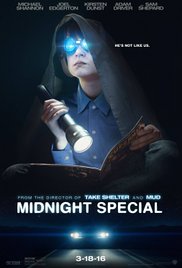
midnight special Greetings again from the darkness. Austin-based filmmaker Jeff Nichols serves up some of the familiar themes of spiritualism and parenting seen in his first three films: Mud (2012), Take Shelter (2011), Shotgun Stories (2007), but this time he goes a bit heavier on the science fiction … while maintaining his focus on the individual.

An exceptional opening scene kicks off the story, and Nichols makes sure we are alert by forcing us to absorb and assemble the slew of clues flying at us … an Amber alert, cardboard on the windows of a cheap motel, a news report tying us to San Angelo, Texas, duct tape on the peep hole, a duffel bag of weapons, two anxiety-filled men, and a goggled-boy under a white sheet who seems extremely calm in an otherwise hectic environment. We learn a lot, yet many questions remain.

As the boy and the two men speed off down the backroads, the setting switches to an eerily calm Calvin Meyer (the always great Sam Shepard), who is the leader of a religious cult similar to the Branch Davidians. “The Ranch” is desperate to get the boy back, and we learn they worship the numbers and words the boy has “received” from above. An FBI agent (Paul Sparks) leads the raid on the compound and takes us to an interrogation of Calvin by NSA analyst Paul Sevier (Adam Driver).

Alternating between sci-fi special effects and an “on the run” story line, we slowly pick up more details about the boy Alton (Jaeden Lieberher), as well as the men with him – his father Roy (Michael Shannon) and Roy’s childhood friend Lucas (Joel Edgerton). It’s not long before they reunite with Alton’s mother Sarah (Kirsten Dunst) and we really start to comprehend just how different and special Alton is.

It’s easy to see the influence of such films as Starman, E.T.: The ExtraTerrestrial, Close Encounters of the Third Kind, and The Day the Earth Stood Still. We are reminded that our society inevitably assumes the worst when something we don’t understand appears right in front of us. The Ranch sees the boy as a savior, and the government labels him a weapon. But it’s Shannon who captures the protective determination of a father trying to do the right thing for his son. Shannon again flashes the best ‘pained’ expression in the business, but it’s young Lieberher (so terrific in St. Vincent) who allows us to accept the father/son story in spite of the bright white lasers shooting from his eyeballs.

There are plenty of unanswered questions – not the least of which is, how did two “normal” parents end up with this “special” son? The visuals near the end are impressive to see on screen, but don’t appear to have much impact on the final questioning of Lucas or our understanding of how it all happened. It should also be noted that the piano score is especially impactful during both the quiet and thrilling moments. Director Nichols is a talented idea man, but he does leave us wanting more details.  (That’s his brother singing the song over the closing credits.)

watch the trailer:


THE PROGRAM (2016)

March 18, 2016

the program Greetings again from the darkness. The fallen king. The disgraced idol. We expect there to be more to the story of Lance Armstrong, but the bottom line is really pretty simple. Lance Armstrong is a liar. Lance Armstrong is a fraud. The movie offers little in the way of excuses or explanations, and you’ll likely think even less of Armstrong after the movie … if that’s even possible.

Ben Foster turns in a nice performance and is believable as Lance the cyclist, Lance the teammate, and Lance the doper. But even Foster can’t quite capture the public façade or reach the level of deception that the real life Lance maintained for years. Chris O’Dowd is spot on as David Walsh, the sportswriter who wrote the book on which the film is based, “Seven Deadly Sins: My Pursuit of Lance Armstrong”. In fact, the movie would likely have been more interesting had it focused on Walsh’s research and pursuit, rather than re-hashing the all too familiar Armstrong deceit.

Director Stephen Frears (The Queen, High Fidelity, The Grifters) works with the screenplay from John Hodge (Trainspotting) and we see how Lance battled through testicular cancer and later sought out Dr. Ferrari (Guillaume Canet) – the Godfather of blood doping. We get many shots of the familiar yellow jersey during numerous Tour de France races, and we hear Lance pontificate on what sets him apart: desire, hunger, heart and soul, and guts. Later we hear his proclamation of innocence followed by “I’m the most tested athlete on the face of the planet”.

Jesse Plemons (“Breaking Bad”, “Fargo”) has slimmed down and plays the crucial role of Floyd Landis – a devout Mennonite, Lance teammate, and the final straw in the crumbling of an empire. It’s Landis who broke “the silence around cycling”, and forced an industry and the public to accept what most of us hoped against all hope wasn’t true.

Armstrong’s infamous “Oprah” appearance and public admission brought poignancy to his own words: “We are the authors of our life stories.” Perhaps this lesson is as valuable as all the money Livestrong raised for cancer research. Picturesque Hamilton Pool in Austin makes an appearance, as do songs from The Ramones, The Fall (“Mr. Pharmacist”) and Leonard Cohen. While the film is not at the level of Alex Gibney’s documentary The Armstrong Lie, it is a reminder that real life can be more dramatic and devastating than the movie version.

watch the trailer:


HELLO, MY NAME IS DORIS (2016)

March 18, 2016

hello my name is doris Greetings again from the darkness. Hollywood has long ignored the pushback on its habit of casting younger women as the love interest of older men. In most of those movies, the relationships are treated as normal and expected. In the few movies that turn the tables, a relationship between an older woman and younger man is typically treated as either comedy or scandal … consider Harold and Maude (1971) and Notes on a Scandal (2006). In this latest film, writer/director Michael Showalter (The Baxter) and co-writer Laura Terruso strive to balance heartfelt emotions with situational laughs.

Sally Field returns to leading lady status as Doris, a never-married frumpy accountant in her late 60’s who has been living in her childhood home whilst caring for her ailing mother … hoarding everything from magazines to packaged food seasoning to a single water ski. The film begins with the open casket funeral of Doris’ mom, and we see her brother (Stephen Root) and his obnoxious and rude wife (Wendi McLendon) immediately pounce on Doris to clear out the clutter and sell the house. They even set her up with a hoarder specialist/therapist (Elizabeth Reaser) who finds the case quite challenging.

The real fun in the movie begins with a close encounter in the office elevator, when Doris and her cat-eye glasses come face to face with a handsome and charming young man who offers up a compliment – something Doris rarely experiences. Of course, a few minutes later, we learn the young man is John (Max Greenfield, “New Girl”), the new artistic director in Doris’ office. For years, Doris has depended upon cheesy romance novels to supply the fantasy in her life, and now the lessons from that reading kick into full gear.

It’s a night out with her best friend Roz (Tyne Daly) that results in a chance interaction with a cocky motivational speaker (Peter Gallagher) whose catchphrase is “Every week has seven days. None of them are named Someday”. He leaves Doris with this thought: “Impossible means I’m possible”. When combined with those romance novels, Doris now sees a realistic chance for love if she pursues the man of her dreams … the aforementioned (and half her age) John.

With the help of Roz’ teenage granddaughter (Isabella Acres), Doris learns how to Facebook stalk, and soon enough ends up at a concert with John’s favorite techno band, Baby Goya and Nuclear Winters (led by Jack Antonoff of Fun.). John and his group of hipster friends are enamored with Doris’ vintage clothes and quirky sense of style and speech. She soon finds herself posing in spandex for Baby Goya’s album cover, going to dinner parties, and joining a rooftop knitting group of millennials.

Judging by the boisterous laughing by women in the theatre, this is a prime GNO flick for women of all ages. Most of the comedic situations seemed pretty obvious and predictable, and I found some traits of Doris to be less than appealing. However, as a statement on what happens when the outside world passes by, and generational gaps become almost impossible to bridge, the film makes a bold statement on real friendship between mature women. It poses the question, what determines whether a personal awakening is real or imagined?

Sally Field (turning 70 in 2016) gives a terrific performance, and it goes much deeper than someone who puts her reading glasses on top of her regular glasses and wears giant bows in her giant hairpiece. Ms. Field has excelled in such previous work as “Sybil” (1975), Norma Rae (1978), Places in the Heart (1983), and Lincoln (2011). She understands comedy and human drama, and as Doris … you’ll kind of like her. You’ll really kind of like her!

watch the trailer:


THE LOBSTER (2016)

March 12, 2016

lobster Greetings again from the darkness. The scene playing over the opening credits is baffling to us and sets the tone of peculiarity that runs throughout the film. A lady gets out of her car during a rainstorm to perform an unthinkable act as we watch through the windshield as the wipers rhythmically clear our view. Next we watch as Colin Farrell’s wife announces, after 11 years of marriage, she is leaving him for another man. Curiously, Farrell asks if her new man wears glasses or contacts.

Welcome to a dystopian future via the warped and creative mind of writer/director Yorgos Lanthimos (Dogtooth, 2009). It really boils down to a satirical look at relationships and our societal outcast of single adults. In Lanthimos’ world, Farrell, now a single man, must check in to the oddest country hotel you’ve seen. He has 45 days to find a romantic partner. If he doesn’t, he will be transformed into the animal of his choice. He chooses the lobster because of its long life span … ignoring the probability of ending up on a restaurant platter.

It’s an oddball world overly structured with rules enforced by the Hotel manager – a terrific Olivia Colman. Farrell befriends a couple of other single fellows: the limping man (Ben Whishaw), and the man with a lisp (John C Reilly). It’s funny and uncomfortable and kind of sad to watch these folks awkwardly try to connect with others with a deadline fast-approaching.

The first half of the movie is really black comedy at its finest, but once Farrell escapes the Hotel and joins the “loners” in the forest, the tone shifts a bit. An uneven romance develops between Farrell and a woman played by Rachel Weisz (who is also the film’s narrator). Even though this group of loners pride themselves on independence, it’s ironic that Farrell has merely traded one set of rules for another … courtesy of the rebel leader played by Lea Seydoux.

It’s a bizarre film, and one from which we can’t look away. The deadpan-yet- emotional dialogue delivery is strange enough, but the site gags are even further off the charts – keep an eye out for animals (former singles) strolling by in the background (peacock, camel, etc). There is certainly insight into modern day relationships and how people connect based on instantaneous judgments … but at least we don’t have to dig our own graves … yet!

watch the trailer:


EMBRACE OF THE SERPENT (Columbia, 2016)

March 12, 2016

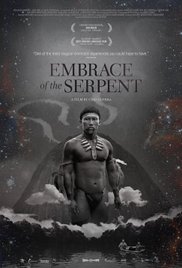
embrace Greetings again from the darkness. Breathtaking black & white photography takes us on parallel scientific expeditions down the Amazon River, with stories inspired by the travel journals of Theodor Koch Grunberg (1872-1924) and Richard Evans Schultes (1915-2001).  It’s the first ever Oscar nomination (Best Foreign Language Film) for Columbia, and director Ciro Guerra’s film certainly deserves any and all acclaim.

The common link between the two expeditions is an Amazon Shaman named Karamakate. A young and proud Karamakate (Nilbio Torres) acts as a guide in the early 1900’s for Theo (Jan Bijvoet), who is already quite ill when we first see his travel guide Manduca (Yauenky Migue) dragging him from the canoe. 30 plus years later, Evan (Brionne Davis) finds an older and wiser Karamakate (Antonio Bolivar), and the two head down the river on much the same route as the decades earlier expedition. Supposedly both trips were a search for the sacred and rare healing plant called Yakruna.

David Gallego’s cinematography is absolutely gorgeous throughout, and adds a dimension to the journeys as we see first-hand the sociological and biological destruction caused by colonialism and the rubber barons. The lost/forgotten cultures are reason enough for the natives to distrust white men, yet the mysticism and pride of the indigenous tribes are fascinating.

The character of Karamakate is a pleasure to get to know, and the film has a great deal to say … and does so while being a visual stunning experience.

watch the trailer: