BOOM BUST BOOM (doc, 2016)

March 12, 2016

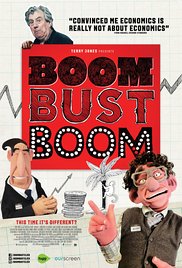
boom bust boom Greetings again from the darkness. On the heels of Adam McKay’s scathing and entertaining explanation of the 2008 financial collapse comes Terry Jones (of Monty Python fame) with a more global perspective of the same era. McKay’s Oscar nominated The Big Short was designed to let us know who did what and why, while Jones’ version applies a British spin and his wildly creative approach in breaking down the long-standing economic models that wreak havoc with our money.

Jones has joined forces with Economics Professor Theo Kocken to school us on the “leftover” strategies and economic models used by Politicians and Bankers … models that assume the market (investors and institutions) will act rationally. Our education comes courtesy of a multi-media show featuring animation, puppets, music and expert interviews (economists, authors, academic leaders, and at least 3 Nobel Prize winners).

According to the movie (and it’s difficult to argue otherwise), human nature is the Achilles heel of Capitalism. In fact, they use the term euphoria to describe the phenomenon that occurs as “stable” economic times lead to more risk and more debt. Debt clearly is the most profound 4-letter word in economics.

A film within the film … “Terry Jones’ Short History of Financial Crisis” takes us back to the 1500’s and through modern times, as the same mistakes recur. One of the more effective sequences shows State of the Union addresses from President Calvin Coolidge (1928) and President George W Bush (2006). Both speeches proclaim solid economies only 1-2 years prior to the two biggest collapses in U.S. history … just two extreme examples that the experts have no idea where the economy is headed as long as they continue to utilize the models that have proven to be ineffective.

It’s fascinating to get specifics on Hyman Minsky’s “Financial Instability Hypothesis”, as well as an explanation of the Neoclassical Economic Model (better known as the Free Market). Insight is provided by University of Texas Professor James Galbraith, son of famed economist John Kenneth Galbraith, and it’s quite enlightening to hear Allan Greenspan (a long time believer in the Free Market system) admit to being wrong about expecting rational behavior from those in the market.

The movie will forever act as a reminder for us to pinch ourselves should we think “this time is different”. In fact there is a movement by Economics students to change the way Economics degrees and PhD programs are structured – more emphasis on learning from history, and re-thinking and re-designing economic models.

The applicable websites are:

http://www.rethinkeconomics.org/

http://www.ecnmy.org/


CITY OF GOLD (doc, 2016)

March 12, 2016

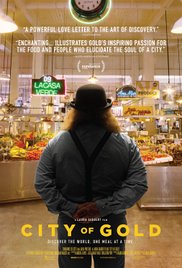
city of gold Greetings again from the darkness. “First we eat. Then we do everything else”. Filmmaker Laura Gabbert’s film kicks off with that quote from MFK Fisher, author of “The Art of Eating”. If Ms. Fisher looked at eating as art, then Jonathan Gold views it as a crucial piece of society that brings diverse cultures together.

As the subject of the film, Mr. Gold is a pretty interesting character. Sure, he is a food critic for the LA Times, an author and a Pulitzer Prize winner; but, more than that, he is a man of the streets of Los Angeles, and is described as providing a new vision of the city while also changing the food critic world. He spurns the traditional idea of anonymity that typically cloaks food critics, and mostly ignores the hoity-toity French restaurants for the Taco Trucks and mom & pop joints scattered around LA.

The real core of the story and of Mr. Gold is the cultural diversity that exists within the boundaries of an area that most TV shows and movies would have us believe is sterile, white and rich. The reality is that LA is a conglomerate of cities filled with migrants who have brought their culture, talents and especially their diverse homeland cuisine. Gold relishes the chance to explore every “hole-in-the-wall” … taste their food and learn their story. He takes us through Boyle Heights, Hollywood, the San Gabriel Valley and the full 15 mile stretch of Pico Blvd.

As a reporter, Gold struggles with structure and deadlines, but as a writer his words are as tasty as the food of which he writes. In a day where Yelp and Twitter allow everyone to pretend they are an expert, Gold reminds us of the value real critics bring to a topic … experience, knowledge and a descriptive way with words.

The film gets a bit loose in the second half as director Gabbert tries to cram in all there is to know about Gold. His background with music: cello, classical, punk, blues and hip-hop probably get more time than is necessary. The contrast with his environmentalist brother is worth it for no other reason than hearing the line: “he is eating everything I’m trying to save”.

Gold’s legacy will be the culinary map of the region he has created with his work. He encourages us not just to sample new cuisine, but also to better understand the people that make up one of the most diverse and fascinating metropolitan areas in the world. Now how about a taco?!?!

watch the trailer:


GORED (doc, 2016)

February 29, 2016

gored Greetings again from the darkness. Opinions of bullfighting seem to fall into three categories: those who admire the courage and athleticism of the matadors, those who respect the history and tradition so vital to the culture of some, and those who are outraged and disgusted by the cruelty bestowed upon the bulls. Director Ido Mizrahy and his co-writer Geoffrey Gray seemingly take no stance, and make no effort in manipulating anyone’s feelings toward bullfighting. Instead, their focus is on one man. A man with an inner-drive that even he can’t explain.

Antonio Barrera is billed as the most-gored matador in history. His official 23 times is remarkable when you consider that even once can kill a man … or at least destroy the bravura required to enter the ring. But this is not a story of numbers. It’s about Barrera’s relentless drive and passion for bullfighting, and his inexplicable (and sometimes medically impossible) ability to recover from injury and finish his duty. Once he was intubated due to lack of breathing, and as soon as he regained consciousness, he ripped out the tubes and returned to the ring … directly from the table.

Mizrahy “treats” us to more than enough clips of Barrera being gored and carried from the ring, but the most intimate and revealing moments come courtesy of interviews with Barrera’s wife, sister and father. It’s during these segments that we begin to understand that no logic can explain the matador’s need to enter the ring … or return to the ring. His wife explains how she lives in fear while understanding she is not his first love; his sister discusses his youth and early training, while his father’s inability to fulfill his own dreams probably etched in stone the destiny of the son.

The film opens and closes with Barrera’s final performance in December 2012, and it’s a breath-taking sequence featuring his crowd-pleasing Puerto Gayola – he kneels in the ring in front of the charging bull. Barrera muses on the acceptance that one must be ready to die while in search of the perfect performance, and how thoughts of dominating death seem like crazy thoughts to the rest of us.

It’s unfortunate that the film only offers a quick glimpse into Barrera’s post-matador life. It’s a brief mention of feeling “lost” after walking away from his dream, and wondering (like the rest of us mortals), what is his dream now? It’s clear managing the career of another matador does not fill the void, but we are left empty-handed and wanting to know more about Antonio Barrera … the former matador known not for his grace and elegance, but for his passion and courage.

watch the trailer:


MAJOR LEAGUE LEGENDS – The Smithsonian Channel (2016)

February 27, 2016

Major League Baseball and the Smithsonian Channel have teamed up to deliver a four-part series entitled “Major League Legends”:

February 29: “The Hammer of Hank Aaron

March 7: “American Hercules: Babe Ruth

March 14: “Lou Gehrig: Iron Knight

March 21: “Ted Williams: The Immortal

Major League Legends For us fans who have baseball history and lore as part of the fabric of our soul, we can’t help but be excited to see what happens when Smithsonian turns their attention to four legendary figures from the game we love. The result is an unusual approach that blends psychology, mythology, history, and childhood with sports achievement. Rather than the typical highlight reels punctuated with record-breaking statistics, we are instead treated to an analysis of what drove these four men to reach a level that transcended the game.

Since Henry Aaron is the only living member of this foursome, it’s especially compelling to see him interviewed and reminisce about his childhood poverty, run-ins with the Ku Klux Klan, skipping school to hear Jackie Robinson speak, and rocketing through the Nego Leagues and Minor Leagues to reach the Major Leagues by age 20. He even mentions how his father reacted when young Henry mentioned his dream of being a pilot. Much attention is given to the racism, hate mail and threats the Aaron family endured during his pursuit of the Home Run record, and it’s sobering to hear his wife Billye state “you just learn to cope”. This segment is a reminder of just how Aaron changed the world through his dignity and courage.

In what easily could be interpreted as Aaron’s polar opposite, Babe Ruth became a larger than life figure and the first modern day celebrity athlete. However, the story is never that simple. Ruth was basically a neglected kid until age 6 when Brother Matthias became a father figure at St. Mary’s Institutional School for Boys. Ruth’s prowess on the field is truly legendary, and it seems logical that his starting out in life as an unloved child possibly drove him to seek as much attention and fame as possible. This segment features some terrific photographs and clips, as well as the man and the myth.

With an incurable and devastating disease using his name for more than 75 years, Lou Gehrig is often described as the shyest and most courageous of all sports superstars. He was the wholesome All-American boy with the irrepressible work ethic. Imagine being known for never missing a day of work! A childhood of poverty and an unusually close relationship with his mother laid the foundation of a man who was focused on being the best ballplayer he could be. The personality opposite of his teammate Ruth, it was Gehrig whom the parents hoped their sons would grow up to be like. His is a story of motherhood-baseball-America-loyalty-humility- grace-endurance, and as recently as last year, ALS (Lou Gehrig’s Disease) inspired millions to participate in the Ice Bucket challenge to raise money for research. It’s little wonder why Gehrig was the first player to ever have his jersey number retired.

The greatest hitter who ever lived. A fighter pilot who served in two wars. Elected to three Halls of Fame: baseball, fishing and fishing. Ted Williams has been described as a baseball savant, but it’s likely his superiority knows no bounds … at least none he would admit to. Despite a tough childhood (alcoholic dad and absentee mother) and losing nearly 5 full baseball seasons due to military service, Williams posted incredible records (2 triple crowns) and his .406 season is one of those etched in stone baseball numbers. It was also Williams who waited until 1999 at Fenway Park to finally dispel John Updike’s proclamation that “Gods don’t answer letters”.

The series offers plenty of film clips and career highlights, but the real focus is on what made these men reach the pinnacle of their profession after significantly less than ideal starts to life. Insight comes from writers, historians, and Phil Couisineau, a learned mythologist. Also appearing in each segment is Will Leitch, founding editor of the sports blog “Deadspin”. He provides the sports and fan perspective in relation to the more psychological and mythic approach of the others. On the downside, Martin Sheen may not have been the best choice as series narrator, as his enthusiasm often seemed forced. The series is less about sports achievement than it is perseverance and personal ambition and self-motivation … certainly topics that we all can learn from and appreciate.

http://www.smithsonianchannel.com/shows/major-league-legends/1004228


KING GEORGES (doc, 2016)

February 27, 2016

king georges Greetings again from the darkness. The “foodie” fad has been in full swing for a few years now, resulting in a new generation of celebrity chefs … plus we each have that friend who believes top dollar and “hot” restaurants are the key to an enjoyable meal. First time director (and many times Producer) Erika Frankel provides a dose of history and authenticity (rather than Reality TV) as she turns her camera on Chef Georges Perrier and his Le Bec-Fin restaurant, an iconic Philadelphia dining locale for forty years.

In 2010, Chef Georges announced he would be closing the restaurant, and Ms. Frankel decided to take her camera into the kitchen to document the end of an era. Georges was a pioneer of French chefs coming to the United States and his four decade run is incredibly rare and quite a legacy. Early in the film, Georges tells us “A chef doesn’t have a normal life”, and the film documents the truth in this proclamation. His “20 hour workdays” cost him any shot at a family life, and though his daughter acknowledges as much, her comments are those of someone who has accepted that her father must cook in the way that an artist must paint. This level of food preparation is truly an art, and Georges is described as the world’s greatest saucier … the foundation of French cuisine.

Other films and documentaries have taken us into kitchens, but it’s Georges’ personality and commitment to “perfection” that add a different spin here. Sure, he is extremely vocal … at times bombastic … but it’s all related to his love of cooking. The stress and pressures in the kitchen of what has been called the finest restaurant in the country are at times almost unbearable, but the film helps us understand the staff dynamics and motivation.

The most interesting aspect of the film is the relationship between Georges and the young chef he is mentoring, Nicholas Elmi. Georges alternates between being demanding and appreciative. There is a touching scene where Georges invites Nick to share a meal and ballgame with him … in this world, it’s the ultimate display of love. Director Frankel follows the career path of Elmi, and it makes for a fascinating end to the film and fitting tribute to Georges.

watch the trailer:


CRAZY ABOUT TIFFANY’S (doc, 2016)

February 18, 2016

crazy about tiffanys Greetings again from the darkness. Where were you when you received your first “little blue box”? If one is to believe the stream of gushing talking heads in Matthew Miele’s look at Tiffany & Co, very few moments are more memorable in a woman’s life.  The giddy women and spoiled-rotten teenagers provide the emotional perspective for what can only be described as a truly amazing success story for one of the most iconic brands in the world.

Charles Lewis Tiffany founded the company in 1837 (that’s not a misprint) and the instantly recognizable robin’s egg blue packaging is officially Pantone Tiffany blue 1837. Yes, Tiffany owns a color and it’s named after the year the company was established. The color was influenced by Empress Eugenie of France, whose style and fashion sense caught the eye of Charles.

Of course, many people know Tiffany’s thanks to the hugely popular 1961 Breakfast at Tiffany’s movie starring Audrey Hepburn, and based on the novel by Truman Capote. The influences of the Tiffany brand includes other movies (The Great Gatsby, Sweet Home Alabama), music (the 1995 hit from Deep Blue Something), sports trophies (including the Vince Lombardi NFL championship), the New York Yankees logo, Steve Jobs’ design style at Apple, as well as the purchases and style of many US Presidents – Abraham Lincoln was the first President to buy a piece for his wife, and FDR regularly wore his Tiffany wristwatch.

These days, the red carpet walk at the Academy Awards has turned into an international display of bling … much of it from Tiffany. Actresses Jennifer Beal and Jennifer Tilly provide some Hollywood perspective, and a few other designers offer their sometimes snarky remarks on how judgmental the industry can be. These segments are the most contemporary and the least interesting of Mr. Miele’s film.

It’s much more fascinating to learn that Charles Tiffany introduced the Engagement Ring into society, and the Tiffany clock at Grand Central Station is more than one hundred years old. Were you aware that there are collectors of Tiffany’s famed Blue Book (the first catalog in 1845), and more surprisingly, many who present Tiffany’s Etiquette Guide for Teenagers as a gift (not always welcome) to their kids. It’s also interesting to learn about Gene Moore, the pioneering window display artist; Elsa Peretti, the fashion model-turned jewelry designer; and Johnny Schlumberger, who became the first designer to have his name affixed to a line of Tiffany jewelry.

Lest you think Tiffany & Co is some stodgy company unwilling to adapt, they were the first jewelry company to run advertisements for rings marketed to gay couples. Miele’s film is filled with “gems” and bits of trivia and history … you just have to fight through the talking heads who somehow think they are the real story. Seeing clips of Katie Couric’s birthday bash from inside the 5th Avenue Tiffany store is yet another reminder that celebrities live a much different life than the rest of us. Fortunately the historical value of the film outweighs the arrogance of those interviewed leading to the conclusion that once you’ve watched it, I believe we’ll recall we both kind of liked it.

watch the trailer:


WHERE TO INVADE NEXT (doc, 2016)

February 10, 2016

where to invade next Greetings again from the darkness. We haven’t heard much from director Michael Moore since his 2009 film Capitalism: A Love Story … and not many people have complained. While Mr. Moore’s eagerness to ask tough questions and confront the system has always been appreciated (or at least thought-provoking), his style and manner have often seemed somewhat dubious, one-sided and self-serving. And now comes the new and improved Michael Moore. Many say he has mellowed in temperament; however, a better description might be that he has achieved a level of wisdom that allows for an approach that makes us more receptive to his points.

This latest begins with a note that the U.S. has not won a war since WWII, and the farcical hook is that the Joint Chiefs of Staff have summoned Moore for advice. See, America has lost its way and is on the wrong track when it comes to such basics as personal happiness, equality and overall priorities. Moore’s solution is to “invade” other countries and stake a claim on the things they do better than us (us being the United States).

To drive home the contrast of how other nations focus on crucial topics that the U.S. seems to have forgotten, Moore cherry-picks the best parts of other societies. These include: Italy (extended vacations for less stress), France (superior school nutrition and straight-forward sex education), Finland (top rated education despite no homework, short school days, and no standardized testing), Slovenia (free college education which means no debt for graduates), Germany (strong middle class, national healthcare, high wages at small companies), Portugal (decriminalization of drugs resulting in less crime and lower drug usage), Norway (prison rehabilitation), Tunisia (women’s rights), and Iceland (gender equality).

To convince us of his kinder, gentler self, Moore obsessively flaunts the American flag throughout. It does help to distract from his trademark disheveled and bedraggled personal appearance … his usual method in attempting to convince he’s just “one of the guys” rather than the multi-millionaire he is. Still, despite his gimmicky approach, it’s impossible not to notice the obvious lack of in-your-face negativity. In fact, it could be stated that optimism exists as he tromps his way through the good news in each stop. Optimism with a bite – the comparisons aren’t favorable for the U.S. in any of these scenarios.

What Moore does best is generate debate and inspire passionate discussion on topics. His point here is that most of the ideals he is claiming from other countries actually have a foundation in America. Yes, these are ideals that America has forsaken, yet are working in other places. Of course, the cherry-picking gives the impression of idyllic societies, when in fact, each of these nations face many of their own unnamed challenges – some on the specific topics addressed by Moore.

Moore’s goal seems to be to re-focus our attention on core American values – the topics Americans care about in our daily lives. He wants us to be annoyed with the way things are … crime-fed bankers still lining their pockets, a stressed-out workforce, and an education system that is quite simply stated, a mess. Maybe this kinder, gentler (but still manipulative) contrarian is on to something, and he ends by asking us how we feel about all of this. Moore has again succeeded in getting us thinking about things, and this time it comes with quite a surreal movie moment … Moore telling a disinterested Portugal police officer that he has “cocaine in my pocket right now.”

watch the trailer:


MEET THE PATELS (doc, 2015)

January 24, 2016

meet the patels Greetings again from the darkness. These days the topic of racism is usually only addressed in the form of hatred and closed mindedness. This documentary/comedy looks at how racism within a culture is sometimes not only acceptable, but even encouraged as a tradition … and somehow it makes some sense.

You might recognize Ravi Patel. He is an actor from Transformers and “It’s Always Sunny in Philadelphia”, and here his real life search for a wife is the focus – as is the cultural contrasts between his roots in India and his single life in the United States. Ravi co-directs with his sister Geeta Patel, though Ravi is predominantly on screen while Geeta spend her time operating the camera … while simultaneously jabbing and prodding her 29 year old brother with questions on his dating approach.

The movie picks up when Ravi has recently split with his long time girlfriend, Audrey Wauchope. Despite being very close with his parents, there is one reason Ravi never informed them of the relationship: Audrey is a white girl, not an Indian. Ravi’s parents are the product of an arranged marriage, the long-standing cultural tradition that not only matches male and female Indians, but takes it a step further by only pairing up Patels with roots in the same small geographic area of India. It’s a form of selective mating that dates back many generations.

Things get interesting and the laughs pick up as Ravi agrees to let his parents work the Indian dating network so that he can test out their traditions – in hopes of finding a match as well-suited as what theirs is. This process begins with “biodata”; a type of personal resume submitted by boys and girls – a precursor to the meet-up.

It really plays like a home movie, or a video journal, as Geeta films Ravi on dates and directly after, as he provides feedback on whether it was a good match. There is also a creative use of black & white animation to fill in the interview gaps where only Ravi’s audio is available.

The family quest to find a mate for Ravi provides some interesting and entertaining insight into the culture, but the best parts of the film come courtesy of the parents. The mother and father are exceptionally intelligent and very loving and engaged in supporting the success of their kids. Whenever the film drags a bit, a scene with either parent picks us right back up. It’s their commitment to the cause that highlights the cultural customs and challenges faced by immigrants as they struggle to get in step with American society while holding onto the tradition they so respect.

watch the trailer:


LISTEN TO ME MARLON (doc, 2015)

January 23, 2016

listen to me marlon Greetings again from the darkness. Was he greatest actor of all-time? Or was he a lazy actor only in it for the payday? Was he a defender of Civil Rights and Native American rights? Or was he as disturbed as his Colonel Kurtz? This film from director Stevan Riley addresses all of these questions and more, but what makes it fascinating to watch, is that the only talking head here is that of its subject … Marlon Brando.

Utilizing a treasure trove of Brando’s private audio recordings, and blending those words with some rare photographs and clips, Mr. Riley delivers one of the most unusual posthumous autobiographical documentaries ever released. Bookended by a tragic shooting at Brando’s Mulholland Drive house, the film explores his Omaha childhood with a mother who taught him about nature and music, and a father who was abusive and not a loving man. Both parents were alcoholics, and seemed to set Marlon up for a lifetime of family issues.

Brando’s movie career can be divided into two different chapters. He burst onto the scene in 1951’s A Streetcar Named Desire, and maintained the rebellious sex-symbol status through The Wild One (1953) and On The Waterfront (1954) and Mutiny on the Bounty (1962). Ten years later, a career resurgence brought The Godfather (1972), Last Tango in Paris (1972), Superman (1978), and Apocalypse Now (1978). This second phase solidified his reputation as difficult to work with and as a man with questionable mental stability (and creative use of a hearing aid). Listening to Brando’s self-analysis during these eras provides insight into the enigma … we learn some of what was going on with the troubled genius.

Some of the film’s best segments: learning about his acting (and life) mentor Stella Adler, hearing Brando discuss his “I coulda been a contender” speech and why the masses so closely related, an explanation of his love/fascination with Tahiti (started in Military School and continued while filming Mutiny on the Bounty), and especially a glimpse into his pain-gone-public during the ordeals with his divorce, and his son and daughter (Christian and Cheyenne).

These audio tapes are more intimate and revealing than diaries would be, as we hear Brando’s unbridled emotions in his voice. He was internationally famous for playing roles, but perhaps no role was harder for him than that of being Marlon Brando. A reclusive man who values his privacy does not easily transition to 40 foot silver screen, and his own words let us in on just how difficult this was for him.

watch the trailer:


PRESCRIPTION THUGS (doc, 2016)

January 21, 2016

prescription thugs Greetings again from the darkness. United States citizens are living in a culture of addiction. That’s the key message that director Chris Bell and his co-directors Josh Alexander (also the film’s writer) and Greg Young wish to get across. Of course, this one’s not about cocaine or heroin, but rather the more rampant societal problem of overmedication via prescription drugs. It’s not really a revelation or shock-inducing theme, but it’s certainly a worthy and important topic.

The movie begins with Chris Bell introducing himself and reminding us of his first movie, the well received documentary Bigger Stronger Faster (2008). In that one, he focused on the use of steroids and Performance Enhancing Drugs (PED’s) throughout competitive bodybuilding – including him and his brother. Bell connects the two docs by explaining that the steroids lead to pain killers and other prescription drugs … legal drugs prescribed by doctors. To the detriment of the message, he chooses to focus on this for an extended period by speaking with WWE wrestlers, MMA fighters and by explaining that he believes the drugs are at least partially responsible for the death of his brother, known in the wrestling world as Mike “Mad Dog” Bell.

It’s this overly-personalized approach that limits the film’s effectiveness. Chris Bell takes the Michael Moore/Morgan Spurlock approach by putting himself smack dab in the middle of most every segment, and even using cutesy sidebars like animation and a Scarface clip. The result is a somewhat amateurish look and feel to a topic that deserves better.

In case there are doubters, Bell provides some startling statistics … the U.S. is 5% of the world’s population, but consumes 75% of the prescription drugs. One in ten American adults are on antidepressants. Keep that last statistic in mind the next time you stroll through your office, church or the neighborhood shopping mall.

Bell devotes time to “Big Pharma” and its army of lobbyists. He takes us back to the deregulation initiatives of the 1980’s which kicked off what has become the onslaught of “ask your doctor” TV ads that permeate the airwaves. The implied message is simple: if your doctor says the drug is OK, then it must be safe and effective. Our society is being marketed right into addiction. Oxycontin, Vicodin, and Codeine are all part of the Opiate family … the same as heroin. The reality is that the business of prescription drugs has evolved into a money-printing industry. Profits are the goal, which is why treatment is emphasized over cure. An addicted patient is profitable patient, and in a best case scenario for Big Pharma, the side effects of one drug lead that patient right into another drug … sometimes both are produced by the same pharmaceutical manufacturer!

The second half of the film is structured significantly better than the first, and includes what is the most impactful sequence. Bell visits with California Congressman Ted Lieu, who is jolted into action when he is sees that Oxy is readily available on Craigslist. This section also leads to a not-so-surprising confession from Bell – a confession that helps explain why he is so intent on being the center of the movie. A key point that is mentioned, but underplayed, is the admission by a doctor that an entire generation of medical school graduates has been taught that there is no downside to prescribing whatever level of pain medication is required for a patient, and even more frightening is the concern that doctors are being misled by drug companies in regards to efficacy and side effects. It’s another link in the seemingly unbreakable chain that doesn’t address the underlying issue.

This culture of addiction is now self-perpetuating. Pressure to maintain profits far outweighs the rewards of curing a disease, and the FDA approval process is highly politicized. This despite the high-profile celebrity deaths of which Bell reminds us: Michael Jackson, Heath Ledger, Whitney Houston. Prescription drugs played a role in each those deaths, as well as countless others who never had a hit record or movie. While much has been made of the failures of the “War on Drugs”, you may question why more focus isn’t given to the Rx addictions. To help in dealing with this conundrum, there are probably drugs available … just “ask your doctor.”

watch the trailer: