THE MAN WHO SAVED BEN-HUR (2016, doc)

July 28, 2016

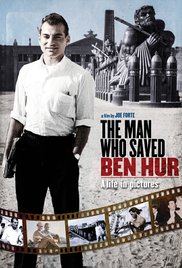
man who saved ben hur Greetings again from the darkness. The title may limit interest in this documentary as it might be mistaken for an “on the set, behind the scenes” tell-all appealing only to the most ardent film history buffs. However, this plays best as a tender tale of an elderly man who lived an exciting life, but finds things pretty empty as he nears the end.

Filmmaker Joe Forte was cautioned by his deeply Catholic family to stay away from the movie business, lest he “end up like Cousin Johnny”. Just a few years ago, Joe decided to track down Cousin Johnny, and he discovered they were separated by only a few city blocks. Johnny Alarimo was one of the most successful Assistant Directors from the 1950’s, 60’s and 70’s, and on the day he invited Joe and his camera into his home, the apartment was filled with boxes of memories.

A treasure trove of photographs – many featuring Johnny posing with the Hollywood elite – were organized in files, sleeves and boxes. And the best part was that, despite being in his late 80’s, Johnny could recall the stories corresponding with most every snapshot.

Being a relative, Mr. Forte treads lightly on the topics Johnny wishes to avoid. We learn of his close friend from WWII, Henry “Pet” Petrich. It’s clear the two shared a bond, though Johnny remains pretty tight-lipped on details … just like on his stories regarding time with Rock Hudson and Gore Vidal. The likely secret life would remain secret forever, but we find ourselves liking this charming man more and more as the film continues.

We do get the Ben-Hur story as it’s disclosed that Johnny was director William Wyler’s Assistant Director, and was an integral part of getting the movie made as he acted as on set translator between the English and Italian speaking folks. Wyler’s personal letter to Alarimo is every bit as valued as the autographed portrait sketch of Johnny by “Chuck H” between takes. Though he was the last surviving crew member of Ben-Hur, it’s also a reminder that only department heads received on screen credit until the 1970’s – robbing many contributors of their rightful place in Hollywood lore.

As Joe and Johnny grow closer as friends, we as viewers find ourselves connected to Johnny. We are saddened when he admits that his doctor’s appointments for medical issues are the highlight of his social life these days. Joe provides Johnny with exactly what he wants, needs and deserves … a chance to be the star and tell his stories. More importantly, he prevents an elderly man from living out his final days in loneliness and solitude. No matter how many celebrities one has met, nothing compares to the warmth of a friend.

watch the trailer:


ANTS ON A SHRIMP (2016, doc)

July 28, 2016

ants on a shrimp Greetings again from the darkness. One need not be a true foodie to be aware of the rise in popularity of the bombastic, egotistical chefs splattered all over TV as they strive for ratings by out-yelling the competition. Less accessible to the general population – due to cost and/or locale – is the highest level of fine dining that is a cult unto itself. One of the most successful elite restaurants is Noma based in Copenhagen, Denmark. It was named “Best in the world” for four out of five years (2010-2014), and yet the owner/chef remains unsatisfied.

Last year, filmmaker Pierre Deschamps provided a profile of Rene Redzepi and his world class restaurant in the film Noma My Perfect Storm. This time, filmmaker Maurice Dekkers takes a different approach. He follows Redzepi and his senior staff as they temporarily relocate Noma to Tokyo in a risky and difficult project.

Much more than a glimpse into a restaurant kitchen, this is an examination of collaborative artistry. Redzepi and his dedicated, enthusiastic team (Lars, Thomas, Rosio, Dan, Kim) strive for perfection in something that can’t be measured. It’s internal pressure and tension within a creative environment … something only the most internally driven can comprehend.

The structure of the film is the countdown to the opening of Tokyo restaurant. All 3000 available reservations for the 6 weeks are sold out, and the waiting list numbers more than 58,000. The team is committed to leaving behind their pure Nordic cuisine and discovering locally sourced new ingredients … a mission that finds them scavenging Nagano Forest and comingling with fish experts at market.

Food is the centerpiece here as the team learns turtle is a local delicacy; they gain respect for Japanese fruit culture that dates back thousands of years; and even tries deep fried fish sperm as a possible offering. But beyond the food, this is about a group stepping outside their comfort zone and trying to find their “voice” – despite a firm belief that nothing is ever quite good enough … a sentiment their customers don’t agree with.

watch the trailer:


FREE TO RUN (2016, doc)

July 15, 2016

free to run Greetings again from the darkness. Director Pierre Morath seemingly had three good ideas for a movie: a history of long-distance running, the fight and final acceptance of women into the sport, and an analysis of holistic running vs. competitive running. Any of the topics would make a solid documentary, but when combined, the result is a bit of a hodgepodge that is still interesting and informative.

All of the familiar names are present: Frank Shorter, Bill Rodgers, Jim Fixx, Steve Prefontaine and Joan Benoit . However, it’s Fred Lebow and Karen Switzer who prove to be the most compelling figures. In 1967, Ms. Switzer was the first woman to run the Boston Marathon, and you’ve probably seen the iconic photo of some guy trying to forcibly remove her from the race. It’s pointed out that at the time, women still didn’t have the right to vote in Switzerland – an effective means of showing that women were still fighting for basic equality. Mr. Lebow founded the New York Runners Club and was instrumental in moving the NY Marathon from The Bronx to Central Park. He was a marketing man and promoter at heart, and was a key figure in expanding the popularity of distance running.

It was 1984, before the Women’s Marathon became an official Olympic sport, the coverage of Ms. Benoit’s win is compared to women winning the right to vote. It’s also noted (somewhat facetiously) that “it’s the first time women are allowed to be exhausted in public”.

Perhaps the most interesting pieces of this running puzzle focus on the “free your mind” aspect of running that stands in stark opposition to the mega-corporate effects of Nike (and other corporations) on running events. Corporate sponsorships and vast sums of money created a global network of high-profile and finely-tuned runners, while the inner peace attained from running allowed the activity (rather than the sport) to continue to grow in acceptance from those looking to escape some of the day-to-day stresses of life.

The “dark side” of the sport reared its head in 2012 after Hurricane Sandy left destruction in the path of where the NYC Marathon (50,000 runners) was to be held. With the big money at stake, some poor decisions were made as citizens throughout the area were without power, clean water and even shelter.

Admittedly, distance runners can often be described as “oddballs”, and though it only takes a pair of sneakers and some shorts to “go for a run”, it’s the corporate sponsorships that make it big business … but at least now, women are right there with the men – whether it’s a big city marathon or a jog through the park.


AT THE FORK (2016, doc)

July 13, 2016

At the fork Greetings again from the darkness. “We need to feed the world!” is the battle cry used for years by farmers and ranchers to justify many less-than-appealing approaches to their craft. Director, and admitted omnivore, John Papola provides a mostly even-handed overview of contemporary animal farming and animal welfare as it corresponds to our food supply. However, that’s not to say the documentary is without flaws.

The heavy-handed beginning of the film plops us into the traditional family “rib-fest” at the director’s home, and introduces us to his vegan wife Lisa who cringes at the sight of so much meat on the grill. The couple then begins their journey of research at an animal sanctuary where we mostly watch some lady rubbing the belly of a pig (yes, he likes it). It’s at this point where the film almost lost me for good. Fortunately, the rest of the run time was filled with good information and thought-provoking interviews.

Papola visits multiple animal farmers across multiple channels: pig, cattle, chicken, and dairy. We get to hear first hand from the farmers themselves as they speak to the realities they face: economic vs. moral. There is the constant pressure to get more from less … much of which comes from the corporations who control the bulk of the food supply, distribution and pricing.

We also hear from industry experts like Dr. Temple Grandin and journalist Mark Dittman; the CEO of Whole Foods, John Mackey; the President of the Humane Society, Wayne Pacelle; and the Governor of Iowa, Terry Branstad … each with their own opinions and expertise within this field – some clearly defending their position.

While this is definitely not a hatchet job on animal farming, you can expect to see graphic detail of overcrowding, castration, culling and the removing of calves from their mothers after birth. Some of it is quite difficult to watch, while some segments are inspiring … like watching the hogs wander through the forest and the chickens splashing in the stream.

The film touches on some growing trends like the 5 step labeling run by Global Animal Protection (GAP), and “certified humane” labeling … though these segments seemed rushed and incomplete. We also learn about “Ag Gag” laws and how whistleblowers are dealt with, plus the catastrophic effects of Avian Bird Flu on some facilities.

Beautifully photographed by cinematographer Matt Porwol (Cartel Land), the film captures the people, the land, and the animals, while also driving home the point that consumer spending habits are like votes – they will ultimately determine the level of stewardship for animal welfare and the process of what ends up on our dinner plate. Now all we need is a documentary that teaches us how to shop in a way that leads to widespread ethical treatment of animals.


NUTS! (2016, doc)

July 10, 2016

Oak Cliff Film Festival 2016

nuts Greetings again from the darkness. Not many true life rags-to-riches stories combine snake oil, goat testicles, Wolfman Jack, early radio advancements, celebrities, a campaign for Governor and the Journal of the American Medical Association. Director Penny Lane (Our Nixon, 2013) provides some real nuggets in her telling of the life and career of Dr John Romulus Brinkley. Her inventive approach is unique both narratively and visually … and even a bit sneaky.

If Brinkley is an unknown figure to you, it might be surprising to know that he built an empire and became famous and multi-millionaire during one of the harshest depression eras in American history (the 1920’s and 30’s). Brinkley had the cajones to transform little Milford Kansas from a sleepy town of 300 to a bustling city of 5000. So what drove this growth? Brinkley built his fortune by implanting goat testicles into men for the purpose of curing impotence … a procedure he claimed to have performed more than 10,000 times.

Based on the authorized biography “The Life of a Man” by Clement Wood, director Lane’s film allows us to get to know and feel comfortable with Brinkley. We begin to appreciate and admire his entrepreneurial efforts and success, and even side with him against his challengers. The final act reminds us why we are/should be skeptical beings and that our viewpoint affects our beliefs.

Where we might normally cry “bollocks”, the blending of news clips, home movies, photographs and hand-drawn animation have us fully on board. It would be difficult to argue against the label of genius when describing Brinkley, though the specific category is up for debate. Recognizing the power of the young radio industry, Brinkley started KFKB, when U.S. radio was still in development. He used radio to market his goat procedure, and is even credited with introducing country & western music, and the first sex talk show (a predecessor to Dr Ruth) to the air waves.

JAMA editor Morris Fishbein was a long time nemesis to Brinkley. Fishbein’s years-long crusade was fought to label Brinkley as a “quack”, a charlatan and a fraud. Brinkley was forced to re-group after a losing campaign for Governor and some challenges to his radio station. He ended up in Del Rio, Texas with his beautiful house, a new hospital, and powerful one million watt radio station (XERA) becoming his family jewels. The station was located on the Mexico side of the border to avoid U.S. regulation and he was now able to broadcast not just across the U.S., but to numerous countries.

Brinkley’s particular genius might better translate to modern times. We need look no further than the current Presidential candidates, and the success of religious televangelists and Reality TV icons. These are the folks that tell us what to read, what to believe and how to act … and they each have their followers and believers.

Brinkley lost the Libel suit he brought against Fishbein, and his empire crumbled quickly. He was dead 3 years later. Milford Kansas no longer exists and goats have a newfound success (requiring significantly less sacrifice) as viral videos on social media. When XERA became XERF, Wolfman Jack worked there as a DJ becoming the radio voice for a new wave of music called rock and roll. The film names names (celebrities of the era) and reminds us that what’s claimed is not always true and accurate. Mostly, however, the film is a fascinating character study and history lesson, and as a movie to watch … it’s a ball.

watch the trailer:


DE PALMA (doc, 2016)

July 4, 2016

Oak Cliff Film Festival 2016

depalma Greetings again from the darkness. A self-inflicted career retrospective … that’s my most fitting description of this project from co-directors Noah Baumbach and Jake Paltrow. Rather than line-up a slew of third-party observers and collaborators, we get the famed director himself walking us film-by-film through his resume. That’s right, Brian De Palma discusses the De Palma film canon … and we movie lovers couldn’t ask for anything better.

Beginning with a clip of Vertigo, the doc leads with the Hitchcock influence, almost as a form of disclosure. It’s as if everyone associated is saying, Yes we admit it … Director De Palma has been heavily influenced and inspired by the works of Alfred Hitchcock. Now pay attention to what he’s done with his career – some really good, some not so good, some downright awful. “Underappreciated” might be the best label for De Palma. He was part of the “New Hollywood” with Spielberg, Scorcese, Coppola, and Lucas, yet they are worshipped, while De Palma is mostly ignored.

Mr. De Palma speaks directly to the camera and seems to thoroughly enjoy this opportunity to analyze (and at times defend) his career, providing a self guided reflective approach – a chronological retrospective that doesn’t shy away from his inability to put together a streak of successful films. This is direct talk (describing a particular bomb as “one of many disasters”) with no apologies from a filmmaker who has worked for five decades. He tells behind the scenes stories in a matter-of-fact manner, not always complimentary of himself, actors or the industry.

The stories and recollections are the highlight here. De Palma speaks highly of Wilford Leach (his mentor and professor at Sarah Lawrence), composer Bernard Hermann and Robert DeNiro, with less than flattering tales of Cliff Robertson (Obsession), Sean Penn (Casualties of War), and Oliver Stone (Scarface). It’s fascinating to hear De Palma explain the box office failure of his version of The Bonfire of the Vanities, address the scandal of Body Double, and describe in detail the simultaneous casting (with Spielberg) of Star Wars and Carrie. Even more eye-opening is his reminiscing on the back-and-forth with director Sidney Lumet as they played hot-potato with Scarface and Prince of the City.

Brian De Palma was Columbia University educated (math and physics), and has directed some of the most creative, colorful and controversial films – some of which never received their “due”. This may be mostly a film for those who want more inside-industry scoop, but it’s a man who takes pride in the fact that famed film critic Pauline Kael was a fan of his work, and that few directors have a more varied canon of film. His patented “holy mackerel” is on full display as he takes us on the journey of De Palma films, and it’s a reminder that “talking head” documentaries can still work … provided the talking head doing the talking is saying something worth listening to.

Here is a list of a few De Palma films over the years: Sisters (73), Phantom of the Paradise (74), Carrie (76), The Fury (78), Dressed to Kill (80), Blow Out (81), Scarface (83), Springsteen’s “Dancing in the Dark” video (84), Body Double (84), The Untouchables (87), Casualties of War (89), The Bonfire of the Vanities (90), Carlito’s Way (93), Mission: Impossible (96), Snake Eyes (98), The Black Dahlia (06).


MARCH OF THE LIVING (doc, 2016)

July 4, 2016

march of the living Greetings again from the darkness. Count me guilty as one of the movie lovers who have silently sworn off Holocaust movies. Actually, I’ve done so many times. Though neither Jewish nor German, revisiting these atrocities drains me of life force and has me questioning the human race … as if there aren’t plenty of current events already justifying such a reaction.

Director Jessica Sanders takes on the annual (since 1988) gathering of Holocaust survivors and Jewish teenagers as they turn what was once known as the March of Death (Auschwitz to Birkenau) into the March of the Living. It’s one of the most inspirational and life affirming presentations one could ask for. Many categorize the annual trek as a form of education, and while true, the label falls a bit a short. It’s also a legacy, a cultural phenomenon, and a reminder that the worst human beings are capable of unthinkable forms of evil, while the best possess a spirit that survives all.

Knowing this is the last generation of teenagers who will hear the stories directly from the concentration camp survivors adds a level of immediacy and poignancy. No history book can capture the soul-bearing pain as a survivor locates the stone at the Treblinka site which bears the family name Ostrowiec – her older sisters were killed there. Even when the teenagers react with such lines as “Dude, this is immense” (while viewing Birkenau), it’s obvious their normally cool façade is impacted by what they are seeing (including the mound of human ashes at Majdanek) and the personal stories being told.

Having the journey and film proceed to Israel reinforces the strength of a people, and leaves us with the film’s ultimate lesson … “not to hate, but to remember”.


LIFE, ANIMATED (2016, doc)

July 3, 2016

life animated Greetings again from the darkness. The magic of Disney takes on a whole new meaning for Ron and Cornelia Suskind, and their son Owen. Academy Award winning director Roger Ross Williams brings us the engaging story inspired by Ron’s best-selling book “Life, Animated: A Story of Sidekicks, Heroes and Autism”.

Ron, a well-respected journalist and writer, states … at age 3, our son Owen “disappeared”. Garbled talking and uneven walking took over their previously “normal” young son, and the doctor diagnosed “pervasive development disorder”. When the word “autism” was spoken, Ron and Cornelia realized their lives, and Owen’s, would never be the same.

Director Williams does an excellent job blending home movies, interviews and animation to give us a sense of what this family went through … and what an emotional wonder it was one evening when they realized that Owen was actually repeating the line “Just your voice” while watching The Little Mermaid. This led to “the first conversation we’ve ever had” as dad used an Aladdin puppet to talk with Owen.

It turns out that Owen had memorized ALL of the dialogue from that Disney classic, as well as all of the other Disney animated movies. What unfolds for the family is an ability to communicate through these movies, and with therapy, move Owen into a more mainstream lifestyle … speaking, reading, and writing. We get a peek at the professional therapy, as well as Owen leading his Disney club.

Much of the movie is structured to lead towards Owens independence at age 23 … a job and his own condo (in an assisted-living building). It’s interesting to hear the therapist discuss how the exaggerated features and emotions of the animated characters make it easier for Owen to interpret and understand – the stories and characters stay the same providing a sense of security and sameness for him.

Owen’s emotional range is on display with Emily (his first girlfriend) and his brother Walter (yep, can’t make this stuff up). It’s clear he understands the downside of independence (unpredictable life vs. scripted movies) while still leaning on his videos for the feel-good moments.

All parents have big dreams for what their kids might accomplish in life, but few parents are as thrilled and emotional as Ron and Cornelia when their son moves into his own place, and is later a featured speaker at a conference in France. Autism provides tremendous challenges for families and individuals, and if somehow animated Disney movies can provide life lessons and a forum for communication, then we should share in this family’s rejoicing. As they say … whatever works!

watch the trailer:


ROSEANNE FOR PRESIDENT! (2016, doc)

July 3, 2016

roseanne for prez Greetings again from the darkness. She was groundbreaking with her standup comedy and her top rated TV show (1988-97), and has always voiced her disdain towards the system that penalizes working class families. Roseanne Barr was a huge star with a talent for making people laugh, while also making a point. You likely know all of that, and probably don’t know that in 2012, she ran for President … of the United States … of America.

Director Eric Weinrib produced a couple of Michael Moore documentaries (Capitalism: A Love Story, Sicko), so it’s not surprising that he takes on the presentation of a comedic icon’s Presidential campaign … and includes interviews with Rosie O’Donnell, Michael Moore, and Tommy Smothers. We first see Roseanne smoking a joint while driving her car, and we soon learn her platform consists of: Legalizing marijuana, no more wars, and a bit of single-payer healthcare. Of course, this campaign (or this movie) isn’t so much about issues as it is the persona of Roseanne Barr.

She seems pretty “normal” while at home in Hawaii with her “long time boyfriend” John Argent. Things turn a bit surreal when we actually see the campaign in action as she competes against Dr. Jill Stein for the Green Party nomination. If you are unfamiliar with the Green Party, it is most noted for its 1968 candidate, Eldridge Cleaver. Roseanne’s campaign manager is Farheen Hakeem, who has almost as much screen time as the candidate herself. Why is that? Well, because Roseanne doesn’t much like to be around people, and prefers to give her speeches over Skype rather than in-person.

It’s here that we should note director Weinrib’s inclusion of Roseanne’s backstory, including her mental health issues stemming from being hit by a car while in high school. We are told she “woke up a different person”, and interviews with her brother, her sister, and her mother seem to confirm this.

Displaying her world class bitterness after losing the Green Party nomination, Roseanne rebounds by moving to the Peace and Freedom Party and naming Cindy Sheehan as her Vice Presidential running mate. We are informed she finished 6th nationally in the Presidential election, receiving more than 67,000 votes though limited to only being on the ballot in 3 states.

The campaign and the election are mere after-thoughts here, and the interest (if any exists) is derived from watching Roseanne the person/celebrity react to the moments as they come. The authenticity from her TV show is on display as her emotions prevent her from hiding her true thoughts – regardless of how brusque she might seem.

1990’s infamous rendition of The National Anthem at a Padres game is revisited, complete with the crotch grab and spit. So, when Roseanne states “They don’t recognize what I stand for or what I’ve done”, the filmmaker doesn’t let her off that easy. It’s a reminder of how sometimes one has to go along to get along, and that mere celebrity, emotion and sense of entitlement may not be enough to elicit change. Releasing the movie in the year of Donald Trump’s campaign makes the comparisons quite easy … even if the Donald has yet to join Roseanne’s now public profession of her love of pot.

watch the trailer:


EAT THAT QUESTION: FRANK ZAPPA IN HIS OWN WORDS (2016, doc)

June 24, 2016

zappa Greetings again from the darkness. “More people know my face from a poster or a TV interview than have heard my music.” It’s an odd quote and one that probably doesn’t fit any rock star other than Frank Zappa. Director Thorsten Schutte provides a no-frills look that is equal parts tribute for Zappa fans, and introduction to those who are unfamiliar with his life, words and work.

It’s always been challenging to categorize or even describe the music of Frank Zappa and the Mothers of Invention. Rarely utilizing traditional melodies, “experimental” may come closest, though most of his 60 plus albums were lumped into the Rock section. It certainly wouldn’t be considered mainstream, though he did have a cult like following for decades.

Schutte’s straightforward documentary approach uses only existing concert footage and interviews with Zappa (across the years). Plenty of music is provided to allow any first time listeners a chance to get a feel, but it’s Zappa’s own words that are most fascinating. He is mostly an open book … honest and forthcoming about his many opinions. He has been labeled as irreverent and offensive, but I prefer to view him as an observationalist or theorist … and a highly intelligent and articulate one at that.

Should one doubt his commitment to the music, listening to him elaborate on the distinction between artistic and business decisions should end the debate. As a married man with 4 kids, it’s enlightening (and surprising to some) to hear his editorials on drugs, the music business, the media, and even politics. Many will remember his Senate battles going head to head versus Tipper Gore in her quest for warning labels on music. Zappa viewed this as censorship and eloquently stated the case as protection for artistic freedom. Schutte presents not just footage from the hearings, but also follow up interviews that Zappa participated in.

He died of prostate cancer in 1993, and his band was an ever-changing ensemble over the years, but Frank Zappa never shied away from speaking out against attempts to stifle the rights of artists, and he was a trail-blazer in utilizing a computer for composing music. He also directed films and videos, wrote editorials, and in a fascinating development, was hired as a cultural consultant for Prague … yet another piece of the unique life and career of Frank Zappa. “For Gail” indeed.

watch the trailer: