DE PALMA (doc, 2016)

July 4, 2016

Oak Cliff Film Festival 2016
depalma Greetings again from the darkness. A self-inflicted career retrospective … that’s my most fitting description of this project from co-directors Noah Baumbach and Jake Paltrow. Rather than line-up a slew of third-party observers and collaborators, we get the famed director himself walking us film-by-film through his resume. That’s right, Brian De Palma discusses the De Palma film canon … and we movie lovers couldn’t ask for anything better.

Beginning with a clip of Vertigo, the doc leads with the Hitchcock influence, almost as a form of disclosure. It’s as if everyone associated is saying, Yes we admit it … Director De Palma has been heavily influenced and inspired by the works of Alfred Hitchcock. Now pay attention to what he’s done with his career – some really good, some not so good, some downright awful. “Underappreciated” might be the best label for De Palma. He was part of the “New Hollywood” with Spielberg, Scorcese, Coppola, and Lucas, yet they are worshipped, while De Palma is mostly ignored.

Mr. De Palma speaks directly to the camera and seems to thoroughly enjoy this opportunity to analyze (and at times defend) his career, providing a self guided reflective approach – a chronological retrospective that doesn’t shy away from his inability to put together a streak of successful films. This is direct talk (describing a particular bomb as “one of many disasters”) with no apologies from a filmmaker who has worked for five decades. He tells behind the scenes stories in a matter-of-fact manner, not always complimentary of himself, actors or the industry.

The stories and recollections are the highlight here. De Palma speaks highly of Wilford Leach (his mentor and professor at Sarah Lawrence), composer Bernard Hermann and Robert DeNiro, with less than flattering tales of Cliff Robertson (Obsession), Sean Penn (Casualties of War), and Oliver Stone (Scarface). It’s fascinating to hear De Palma explain the box office failure of his version of The Bonfire of the Vanities, address the scandal of Body Double, and describe in detail the simultaneous casting (with Spielberg) of Star Wars and Carrie. Even more eye-opening is his reminiscing on the back-and-forth with director Sidney Lumet as they played hot-potato with Scarface and Prince of the City.

Brian De Palma was Columbia University educated (math and physics), and has directed some of the most creative, colorful and controversial films – some of which never received their “due”. This may be mostly a film for those who want more inside-industry scoop, but it’s a man who takes pride in the fact that famed film critic Pauline Kael was a fan of his work, and that few directors have a more varied canon of film. His patented “holy mackerel” is on full display as he takes us on the journey of De Palma films, and it’s a reminder that “talking head” documentaries can still work … provided the talking head doing the talking is saying something worth listening to.

Here is a list of a few De Palma films over the years: Sisters (73), Phantom of the Paradise (74), Carrie (76), The Fury (78), Dressed to Kill (80), Blow Out (81), Scarface (83), Springsteen’s “Dancing in the Dark” video (84), Body Double (84), The Untouchables (87), Casualties of War (89), The Bonfire of the Vanities (90), Carlito’s Way (93), Mission: Impossible (96), Snake Eyes (98), The Black Dahlia (06).


MARCH OF THE LIVING (doc, 2016)

July 4, 2016

march of the living Greetings again from the darkness. Count me guilty as one of the movie lovers who have silently sworn off Holocaust movies. Actually, I’ve done so many times. Though neither Jewish nor German, revisiting these atrocities drains me of life force and has me questioning the human race … as if there aren’t plenty of current events already justifying such a reaction.

Director Jessica Sanders takes on the annual (since 1988) gathering of Holocaust survivors and Jewish teenagers as they turn what was once known as the March of Death (Auschwitz to Birkenau) into the March of the Living. It’s one of the most inspirational and life affirming presentations one could ask for. Many categorize the annual trek as a form of education, and while true, the label falls a bit a short. It’s also a legacy, a cultural phenomenon, and a reminder that the worst human beings are capable of unthinkable forms of evil, while the best possess a spirit that survives all.

Knowing this is the last generation of teenagers who will hear the stories directly from the concentration camp survivors adds a level of immediacy and poignancy. No history book can capture the soul-bearing pain as a survivor locates the stone at the Treblinka site which bears the family name Ostrowiec – her older sisters were killed there. Even when the teenagers react with such lines as “Dude, this is immense” (while viewing Birkenau), it’s obvious their normally cool façade is impacted by what they are seeing (including the mound of human ashes at Majdanek) and the personal stories being told.

Having the journey and film proceed to Israel reinforces the strength of a people, and leaves us with the film’s ultimate lesson … “not to hate, but to remember”.


LIFE, ANIMATED (2016, doc)

July 3, 2016

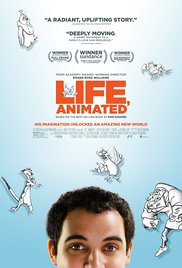
life animated Greetings again from the darkness. The magic of Disney takes on a whole new meaning for Ron and Cornelia Suskind, and their son Owen. Academy Award winning director Roger Ross Williams brings us the engaging story inspired by Ron’s best-selling book “Life, Animated: A Story of Sidekicks, Heroes and Autism”.

Ron, a well-respected journalist and writer, states … at age 3, our son Owen “disappeared”. Garbled talking and uneven walking took over their previously “normal” young son, and the doctor diagnosed “pervasive development disorder”. When the word “autism” was spoken, Ron and Cornelia realized their lives, and Owen’s, would never be the same.

Director Williams does an excellent job blending home movies, interviews and animation to give us a sense of what this family went through … and what an emotional wonder it was one evening when they realized that Owen was actually repeating the line “Just your voice” while watching The Little Mermaid. This led to “the first conversation we’ve ever had” as dad used an Aladdin puppet to talk with Owen.

It turns out that Owen had memorized ALL of the dialogue from that Disney classic, as well as all of the other Disney animated movies. What unfolds for the family is an ability to communicate through these movies, and with therapy, move Owen into a more mainstream lifestyle … speaking, reading, and writing. We get a peek at the professional therapy, as well as Owen leading his Disney club.

Much of the movie is structured to lead towards Owens independence at age 23 … a job and his own condo (in an assisted-living building). It’s interesting to hear the therapist discuss how the exaggerated features and emotions of the animated characters make it easier for Owen to interpret and understand – the stories and characters stay the same providing a sense of security and sameness for him.

Owen’s emotional range is on display with Emily (his first girlfriend) and his brother Walter (yep, can’t make this stuff up). It’s clear he understands the downside of independence (unpredictable life vs. scripted movies) while still leaning on his videos for the feel-good moments.

All parents have big dreams for what their kids might accomplish in life, but few parents are as thrilled and emotional as Ron and Cornelia when their son moves into his own place, and is later a featured speaker at a conference in France. Autism provides tremendous challenges for families and individuals, and if somehow animated Disney movies can provide life lessons and a forum for communication, then we should share in this family’s rejoicing. As they say … whatever works!

watch the trailer:


ROSEANNE FOR PRESIDENT! (2016, doc)

July 3, 2016

roseanne for prez Greetings again from the darkness. She was groundbreaking with her standup comedy and her top rated TV show (1988-97), and has always voiced her disdain towards the system that penalizes working class families. Roseanne Barr was a huge star with a talent for making people laugh, while also making a point. You likely know all of that, and probably don’t know that in 2012, she ran for President … of the United States … of America.

Director Eric Weinrib produced a couple of Michael Moore documentaries (Capitalism: A Love Story, Sicko), so it’s not surprising that he takes on the presentation of a comedic icon’s Presidential campaign … and includes interviews with Rosie O’Donnell, Michael Moore, and Tommy Smothers. We first see Roseanne smoking a joint while driving her car, and we soon learn her platform consists of: Legalizing marijuana, no more wars, and a bit of single-payer healthcare. Of course, this campaign (or this movie) isn’t so much about issues as it is the persona of Roseanne Barr.

She seems pretty “normal” while at home in Hawaii with her “long time boyfriend” John Argent. Things turn a bit surreal when we actually see the campaign in action as she competes against Dr. Jill Stein for the Green Party nomination. If you are unfamiliar with the Green Party, it is most noted for its 1968 candidate, Eldridge Cleaver. Roseanne’s campaign manager is Farheen Hakeem, who has almost as much screen time as the candidate herself. Why is that? Well, because Roseanne doesn’t much like to be around people, and prefers to give her speeches over Skype rather than in-person.

It’s here that we should note director Weinrib’s inclusion of Roseanne’s backstory, including her mental health issues stemming from being hit by a car while in high school. We are told she “woke up a different person”, and interviews with her brother, her sister, and her mother seem to confirm this.

Displaying her world class bitterness after losing the Green Party nomination, Roseanne rebounds by moving to the Peace and Freedom Party and naming Cindy Sheehan as her Vice Presidential running mate. We are informed she finished 6th nationally in the Presidential election, receiving more than 67,000 votes though limited to only being on the ballot in 3 states.

The campaign and the election are mere after-thoughts here, and the interest (if any exists) is derived from watching Roseanne the person/celebrity react to the moments as they come. The authenticity from her TV show is on display as her emotions prevent her from hiding her true thoughts – regardless of how brusque she might seem.

1990’s infamous rendition of The National Anthem at a Padres game is revisited, complete with the crotch grab and spit. So, when Roseanne states “They don’t recognize what I stand for or what I’ve done”, the filmmaker doesn’t let her off that easy. It’s a reminder of how sometimes one has to go along to get along, and that mere celebrity, emotion and sense of entitlement may not be enough to elicit change. Releasing the movie in the year of Donald Trump’s campaign makes the comparisons quite easy … even if the Donald has yet to join Roseanne’s now public profession of her love of pot.

watch the trailer:


EAT THAT QUESTION: FRANK ZAPPA IN HIS OWN WORDS (2016, doc)

June 24, 2016

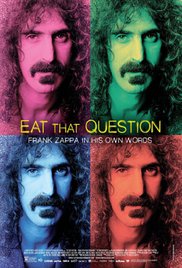
zappa Greetings again from the darkness. “More people know my face from a poster or a TV interview than have heard my music.” It’s an odd quote and one that probably doesn’t fit any rock star other than Frank Zappa. Director Thorsten Schutte provides a no-frills look that is equal parts tribute for Zappa fans, and introduction to those who are unfamiliar with his life, words and work.

It’s always been challenging to categorize or even describe the music of Frank Zappa and the Mothers of Invention. Rarely utilizing traditional melodies, “experimental” may come closest, though most of his 60 plus albums were lumped into the Rock section. It certainly wouldn’t be considered mainstream, though he did have a cult like following for decades.

Schutte’s straightforward documentary approach uses only existing concert footage and interviews with Zappa (across the years). Plenty of music is provided to allow any first time listeners a chance to get a feel, but it’s Zappa’s own words that are most fascinating. He is mostly an open book … honest and forthcoming about his many opinions. He has been labeled as irreverent and offensive, but I prefer to view him as an observationalist or theorist … and a highly intelligent and articulate one at that.

Should one doubt his commitment to the music, listening to him elaborate on the distinction between artistic and business decisions should end the debate. As a married man with 4 kids, it’s enlightening (and surprising to some) to hear his editorials on drugs, the music business, the media, and even politics. Many will remember his Senate battles going head to head versus Tipper Gore in her quest for warning labels on music. Zappa viewed this as censorship and eloquently stated the case as protection for artistic freedom. Schutte presents not just footage from the hearings, but also follow up interviews that Zappa participated in.

He died of prostate cancer in 1993, and his band was an ever-changing ensemble over the years, but Frank Zappa never shied away from speaking out against attempts to stifle the rights of artists, and he was a trail-blazer in utilizing a computer for composing music. He also directed films and videos, wrote editorials, and in a fascinating development, was hired as a cultural consultant for Prague … yet another piece of the unique life and career of Frank Zappa. “For Gail” indeed.

watch the trailer:


ART BASTARD (2016, doc)

June 23, 2016

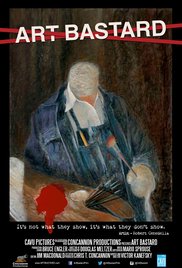
art bastard Greetings again from the darkness. Writer/director Victor Kanefsky sets out to show that both definitions of the titular “B” word are fitting descriptions of the unfairly obscure NYC artist Robert Cenedella. The artist learned at age six that the man he called Daddy was not his biological father, and then later his decades-long battle against the cliquish art world establishment relegated him to a career that was stifled at most every turn. In an interesting twist, Mr. Cenedella (now age 76) has embraced his life as an outsider, and used it as inspiration for his incredible paintings and drawings.

Much of the film comes directly from interviews with the engaging, opinionated and often quite funny Mr. Cenedella. One of his best and most insightful (to his persona) quotes is: “It’s not what they show that bothers me. It’s what they don’t show.” He is of course discussing museums and art galleries, and how the recurring theme of “legitimacy” is decided by a relative few, thereby determining what the public is allowed to see … which in turn impacts what pieces are bought and sold.

Due to his relative obscurity (I knew nothing of the artist prior this doc), Kanefsky includes a biographical structure that begins with an unstable childhood and continues with his tutelage under German artist George Grosz … Cenedella’s mentor for art and life. With direction such as “think with your hand”, Grosz inspired the young artist to transfer his observant eye to the canvas and paper.

Unfortunately for Cenedella, his development as an artist paralleled the boom of modern abstract art … something that didn’t play well for the man who captured the energy and people of NYC on the page through satirical group caricatures. He was termed the anti-Warhol, and the film presents the 1965 “Yes Art” showcase as the biggest achievement of Cenedella’s career. And this exposes the only real weakness with the film – we never really understand the economics of Cenedella’s art. Did he sell paintings?  How did he earn a living?  We know he sold a lot of “I Like Ludwig” buttons, and we know he later painted a wall mural at Le Cirque restaurant, but the movie would have us believe Cenedella was an immensely talented painter who should be living in poverty based on his inability to get accepted by the art world.

This muddled point is key because so much of the film is dedicated to Cenedella’s disgust with the commercial side of the industry, and how critics and the power brokers have turned the art world into a haven of collectors who buy and sell for profit, rather than enjoyment. What determines the value of art? It’s a question as old as the cave drawings. Is the value in the aesthetics, the emotion or the monetary return? Cenedella believes the public should be allowed to decide for themselves, rather than being spoon fed only what the elite determine “good enough”.

Robert Cenedella proves to be a fascinating subject for a film, and it’s a reminder that some of the best documentaries introduce us to interesting people to whom we might ordinarily not be exposed. When Cenedella asks “If you compromise with art, why be an artist?” he is really telling us to be true to ourselves. It’s a message we should take to heart … he certainly has.

watch the trailer:


THE WITNESS (doc, 2016)

June 2, 2016

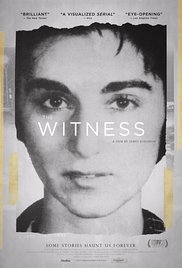
witness Greetings again from the darkness. Remember that time you told yourself “I don’t want to get involved”? We live in an era when the phrase “If you see something, say something” is more catchphrase than active philosophy, and it’s pretty easy to justify looking the other way by thinking “It’s none of my business.” In 1964, twenty-eight year old Kitty Genovese was brutally attacked and murdered in Queens. The New York Times reported that the same man attacked her three times, and that no one called the police, despite her screams and 38 people witnessing the attacks over a half hour. Her story became the symbol for “bystander apathy” and led to development of the 911 system and the “Good Samaritan Law”.

Forty years after the attack, the New York Times examined their original story, and it’s that piece that brought together filmmaker James D Soloman (he wrote the screenplay for The Conspirator) and Kitty’s brother Bill. Their goal was to research the horrible events of that night and determine once and for all if the legendary story is fact or a case of media sensationalism. With its flashbacks to multiple news stories over the years, the film begins as a procedural and evolves into Bill’s personal journey of emotional turmoil in regards to his big sister’s life and death.

Bill was only 16 years old when Kitty was killed; and three years later, he lost both legs while serving in Vietnam. It’s his calmness and intelligence that we are so drawn to as he makes his way through the crime scenes, interviews witnesses/neighbors/family members, and examines as much of the existing evidence as possible. His fascinating journey finds him crossing paths with Mike Wallace of “60 Minutes”, Abe Rosenthal (the NY Times editor who ran the original story and wrote a book about the case), the police detective who investigated the case, the prosecutor, and the defense attorney for Kitty’s confessed murderer.

As compelling as the complete film is, there are a few segments that really stand out. Mr. Rosenthal’s attitude and lack of remorse for running such a sloppy story is sickening – even 50 years after the fact. It’s an extraordinary example of how the media can manipulate a story for ratings, and of how little things have changed over 5 decades. A face-to-face sit down with the Reverend son of the confessed killer is both awkward and frustrating, while also enlightening as to how family members can revise history in order to live with it. Finally, Bill’s visit to the home of Kitty’s old friend and neighbor Sofia is heartbreaking as the woman remembers comforting Kitty in her last few moments of life.

Bill discovers numerous conflicts to the original NYT story … there were two attacks, not three; the number 38 for witnesses seems to have been fabricated; most of the witnesses were ear-witnesses, not eye-witnesses; and there is every indication that multiple calls were made to the police … thereby muting the argument that neighbors were too apathetic or frightened to get involved. While none of these points are especially surprising to us, it’s Bill’s story now and we can’t help but feel for him.

Mr. Soloman expertly structures the film so that we can experience both the highs and lows of Bill’s efforts. We hear the recording of Kitty’s former roommate as she shed lights on Kitty the person, rather than Kitty the victim. Bill reads the letter from Rocco, Kitty’s ex-husband as he declines an interview. We are in the room when Bill is questioned as to whether he is part of the infamous Genovese crime family, and we see Bill tackle the trial transcripts with the words “heard screams, saw nothing” repeated many times. If this is a study on social behavior, it may be more pertinent to media motives than human reaction … but this isn’t the place to bash the media – it’s a compelling look at one man’s quest to find peace with the past.

watch the trailer:


IT’S SO EASY AND OTHER LIES (doc, 2016)

June 2, 2016

Its so easy Greetings again from the darkness. This biopic will probably be a ‘can’t miss’ for fans of Guns ‘n Roses and Velvet Revolver, while registering not so much as a blip for the rest of the universe. From a filmmaking perspective, director Christopher Duddy takes a different approach, as the core of the film has subject Duff McKagan onstage (at Seattle’s Moore Theatre) reciting passages directly from his own autobiography … while being backed by a soft playing band in front of a live audience.

The film begins with an Upton Sinclair quote as if that will somehow add literary authenticity to the memoirs of a rock star and recovering addict. It’s not surprising that the most interesting parts of McKagan’s life story are the bits and pieces of his numerous band projects … beginning when he was 15 years old and drawn to the Punk Rock world at Seattle’s The Gorilla Room in 1979. After having played with dozens of bands, a meeting with guitarist Slash changed his life. Soon, Guns ‘n Roses was opening for Motley Crue (Nikki Sixx is interviewed) and not long after they were headlining their own stadium shows and selling millions of records.

What doesn’t really work is the rehash of McKagan’s abuse of vodka that led to the life-threatening pancreatitis. We’ve heard the story (or those like it) so many times before … especially from well worn rockers looking to make another buck. Of course it’s startling to see the names flash across the screen – those he knew and played with who weren’t able to come out of their addiction and abuse.

The film doesn’t spend much time on Guns ‘n Roses or his time with Velvet Revolver, though we get the gist of each. It’s McKagan’s insistence on telling us how close to death he was, and how lucky he is now, that really slows down the pace … listening to his confessions comes across a bit like a musical AA meeting. McKagan’s business school background is impressive and helps set him apart from many of the other train wrecks in his industry, but what’s missing is any indication that he is an extraordinary musical talent … it leaves us feeling he is just a lucky guy who was in the right place at the right time, then messed it up with addiction, managed to clean up and get a real life, and then nearly messed it all up again. While we may be happy for his success and the fact that he has survived, there’s not much here to set his story apart from many others … and certainly nothing that leaves us in awe of his talent.

watch the trailer:


HOLY HELL (doc, 2016)

May 26, 2016

holy hell Greetings again from the darkness. David Koresh and the Branch Davidians. Marshall Applewhite and Heaven’s Gate. Jim Jones and People’s Temple. Charles Manson and The Manson Family. For most of us, this list just about sums up our insight into the world of cults … and the horrific and violent endings of each are probably the only reason we know as much as we do. Filmmaker Will Allen, and his library of archival footage spanning more than 25 years, takes us behind the scenes of The Buddahfield, a cult run by an exceedingly odd man named Michel Rostand … or Jaime Gomez … or Andreas … or Reyji … depending on what time period and location we are discussing.

The film begins in 1985 West Hollywood as Mr. Allen joins his sister in her search for enlightenment and spiritual awakening. “Why am I here?” he asks … not referring to the commune of young men and women, but rather why is he on earth – what is the meaning of life? We have all wondered if it’s simply life and death, or if there is a greater purpose. These unanswered questions are how massive churches are built … and how cults are formed. The early film footage reveals exactly what one would expect: young people frolicking in the type of freedom that comes from dropping out of society. It’s an innocence that is ripe for plucking, and that’s exactly what “The Teacher” Michel does.

Trained as a hypnotherapist, Michel is the guru who claims to possess “the Knowing” – true enlightenment and the path to God in the purest form. At this point, I should mention that Michel is seemingly always strutting around in a Speedo and Ray-Bans. If he is a man of the cloth, it’s an awfully small swatch. He also wears heavy eye-liner and strikes many pensive poses for the camera and his followers.

The last thing that I want to do is judge these followers on decisions they made early in life. Feeling lost or emotionally empty and aimless can lead to desperation. In filmmaker Will Allen’s defense, this documentary acts as personal therapy or even catharsis for his fellow cult members who judge themselves harshly for the two decades of belief in a cause and a man that ultimately proved to be something much less than spiritual. Many of these followers are interviewed on camera and are clearly struggling even years after leaving the cult. It’s not just the awareness of so many wasted years, but also the guilt in following a man who was not merely odd, but who also victimized so many.

Creepiness plays a big part here. It’s creepy how one guy can so influence the lives of so many others. It’s creepy how no one was able to expose this fraud before so many were hurt. It’s creepy to hear these folks talk about their mindset during that time. And mostly it’s creepy to view the incredible footage shot by Mr. Allen during his two decades on the inside. Lastly, the stalking (with camera) in 2012 which allows Mr. Allen to get the ending for his movie is in itself a special form of creepy … one that had me thinking that ALL of these people need psychological help.

If you want to see the internal workings of a cult (from California to Texas to Hawaii) – one with Speedos, plastic surgery, ballet, brainwashing, two kinds of peacocks – and the subsequent fallout, then you’ll agree the film delivers a type of eavesdropping and peeking that is both rare and fascinating … in a creepy kind of way.

watch the trailer:


WEINER (doc, 2016)

May 14, 2016

Dallas International Film Festival 2016

Weiner Greetings again from the darkness. Normally I would have no interest in a movie with this title, but in this case, it’s a chance to get a glimpse into the psychological make-up of a guy who obliterated his own political career … by simply being unable to keep his privates private. The end result of the efforts from filmmakers Josh Kriegman and Elyse Steinberg is nearly unrestricted access to a NYC mayor candidate’s campaign, as well as a look at a politician that is at times tense, and other times funny (in a laughing AT you kind of way).

In 2011, seven-term New York Congressman Anthony Weiner resigned in the aftermath of a sexting scandal made worse by (what else?) … his lying and attempted cover-up. The film begins with a clip of one of Weiner’s explosive speeches, meant to portray his expertise as a legislator and politician. This is quickly followed by the pun-filled headlines that exposed his sexting habit, seemingly leaving his political career in the dust.

Picking up two years later, the film finds the disgraced former Congressman running a campaign for NYC mayor. We can’t be too surprised as we have learned numerous times that many politicians are addicted to power and life in the public eye. What makes this an interesting subject is two-fold: how publically humiliated Weiner had been, and the fact that his wife is Huma Abedin, long-time Hillary Clinton advisor and aide.

We don’t learn how it happened, but we do find Anthony and Huma are still married, are parents to a young child (she was pregnant when the first scandal hit), and that Huma fully supports his mayoral candidacy. As the campaign kicks off, Weiner is a frontrunner, proving that we are a forgiving lot. The cameras capture him in full candidate mode – making calls to potential donors, giving speeches, dealing with staffers, and working the crowds at his energy-filled parades. Of course, it’s all a façade … or at least half of one.

When the second sexting scandal hits and “Carlos Danger” makes headlines as Weiner’s online pseudonym, the real trainwreck begins, and we find it impossible to turn away. It’s at this point where our feelings are confirmed … Huma is by far the more interesting of these two personality polar opposites. Where Weiner is two-faced – bouncing between humbled and overly ambitious; Huma is cool, collected and (seemingly) smart.

Weiner remains clueless about his chances, and the level of tension skyrockets in meetings and during spousal moments. It’s impossible not to believe that the energies used towards the campaign would have been better spent in therapy – both individual and as a couple. His stream of lies proved he had not changed his ways, and his periodic reflective and apologetic moments are diminished by his true color nastiness, which is more pervasive.

The film gets unnecessarily sidetracked during a segment that features one of Weiner’s phone sex relationships – codenamed “Pineapple”. Entirely too much time is spent on her pathetic publicity grab, and fortunately it all falls flat. It is a reminder that the media never misses a chance to film a frenzy … even if they have to manipulate it. There is no room in a documentary for TWO trainwrecks!

After the film and the irresistible draw of watching this ego-driven dude never once come to grips with why he is socially unacceptable as a leader, we realize there are unanswered questions. Why did Huma stick with her husband? Why was she onboard with him getting back in the game … did she really miss the public eye? The filmmaker flat out asks Weiner “Why have you let me film this?” Perhaps the answer to that last question is somewhat explained when you know that Anthony Weiner made an appearance in Sharknado 3. Some people just need the spotlight.

The hecklers, the eye rolls, the angry outbursts all lead up to Lawrence O’Donnell asking Weiner “What’s wrong with you?” I asked myself that same question after the movie when I realized that I was mesmerized the entire time. As for Huma ever allowing herself to be the subject of a documentary, we can only assume that she is too sagacious to allow such unfettered camera access to her work. I suppose her appearance in the next “Sharknado” is equally unlikely.

watch the trailer: