VOYEUR (2017, doc)

November 30, 2017

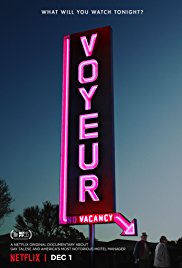
 Greetings again from the darkness. We are watching the final product of filmmakers watching a reporter watching a man whose hobby is watching those who don’t know they are being watched. Lacking a single redeeming individual, the film’s creep factor slithers towards 11 on the (“SPINAL TAP”) scale.

It’s understandable if you assume this is the story of a pathetic and disgusting Aurora, Colorado motel owner who, for many years, quietly leered at his guests from a self-constructed perch in the attic. Gerald Foos methodically documented the sexual actions of the Manor House Motel guests, which numbered 2000-3000 per year. If his actions aren’t remarkable (not in a good way) enough, Mr. Foos actually married not one, but two women who were complicit in his hobby.

In 1980, renowned reporter and author (“from age 15 to 80”) Gay Talese received a letter from Gerald Foos, kicking off a three decade relationship culminating in a controversial feature article in “The New Yorker” and a book entitled “The Voyeur’s Motel”. Once Mr. Foos agrees to have his name published, co-directors Myles Kane and Josh Koury jump on board to document the final steps in Mr. Talese’s writing and research process. It’s here that we enter the oddest man cave you’ll likely see. In the basement of Talese’s immaculate Manhattan brownstone is not just his writing office, but also a lifetime of research and writing … boxes and shelves of material that will surely one day be part of a museum or university collection.

The unexpected parallels between writer and subject are made clear. Both are voyeurs and both are collectors. As a journalist, Talese observes the actions of people, while Foos is quite obviously the definition of a Peeping Tom. Talese collects the years of research for his writings, while Foos shows off his extraordinary sports memorabilia collection (also in his basement). Beyond these similarities, what stands out most are the unbridled egos of these two men. Both seemed most focused on getting or keeping their names and stories in the headlines. Of course, Talese has built a career on his name and reputation, while the aging Foos simply sees this as his legacy that somehow deserves historical prominence.

The filmmakers remain more focused on Talese than Foos, and that takes us inside “The New Yorker” where the editors are justifiably concerned about a single-source story – one that without Talese’s name attached would likely have never made it past an initial perusal. The aftermath of publication reminds us that we’ve seen con men before, and there is little joy in being taken on a long ride of deceit. Perhaps the best description of what we see on screen is that it’s a sideshow of ego and the need to be seen (watched).

watch the trailer:


BIG SONIA (2017, doc)

November 18, 2017

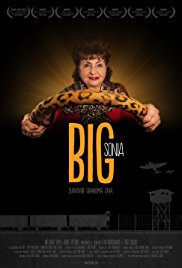
 Greetings again from the darkness. Some people anxiously await the day they can retire and spend their days fishing or reading, while others put it off as long as possible since they find their identity through work. The diminutive subject of this terrific documentary is 91 year old Sonia Warshawski. Her reasons for maintaining a 6 day work week (and doodling) are both heart-warming and chilling, and make for a fascinating story.

Filmmakers Todd Soliday and Leah Warshawski (Sonia’s granddaughter) do their part in allowing the charming and fiery lady to deliver her own message and recount the horrors of her childhood. Sonia is a Holocaust survivor. As a 13 year old in 1939 Poland, she and her family were taken. She never again saw her father or brother, took multiple beatings while being shuffled through 3 death camps (including Auschwitz and Bergen-Belsen), and ultimately watched her mother led into the gas chamber. In her own words, she says she “was in hell”, and it’s “a miracle” she made it out.

You might assume that anyone who has experienced so much pain would be bitter and cynical, but that’s not Sonia’s way. In addition to running her tailor shop for 35 years, she is also an inspirational speaker at churches, schools and prisons. We get to see her in these presentations and we are struck by how her words carry such weight with the audiences – young and old. One of the convicts provides insight when he states, “It takes people who’ve been through something to reach those going through something”. We also witness the way she connects with teenage students … something most of us have little success with.

Of course, Sonia has embraced her story, but the emotions and pain are never far from her. She stays busy to keep the memories at bay, and finds the idea of retirement somewhat frightening. We meet her 3 children and hear stories of their childhood and her husband John, also a Holocaust survivor. John died from Alzheimer’s complications, but he is remembered fondly by all. It’s so touching to watch as Sonia shows us her mother’s 75 year old scarf which she keeps under her pillow, and we are mesmerized as she recounts the incredible story of her liberation day.

An NPR radio interview provides some structure throughout, but it’s not necessary as we would follow Sonia wherever she leads. It’s so much fun to watch her Overland Park customers greet her in the now-defunct shopping mall, and it’s downright hilarious as she sports her favorite animal prints on her coat, shoes and purse … and even the cover on the steering wheel that she can barely see over! Mostly this is a life lesson from a master who teaches us “don’t carry hate” … even though she admits to being unable to forgive. She leaves that to a higher power. She is the best example we could have for keeping history alive and spreading love and goodness.

watch the trailer:


FRANK SERPICO (2017, doc)

November 2, 2017

 Greetings again from the darkness. Deciding whether a whistleblower is a hero or a “rat” usually depends on which side of the issue you fall. The line is not quite so clear in the case of Frank Serpico, the New York cop who exposed massive corruption in that city’s police department in the late 1960’s and early 1970’s. Of course the crooked cops vilify him as a rat, but even the good cops are divided … some believing a cop should never break ranks and go against another cop.

After testifying in 1972, Frank Serpico left it all behind (spending time in Holland). It’s now 45 years later, and director Antonino D’Ambrosio allows him to tell his own story directly to the camera. If you have seen the 1973 film SERPICO (directed by Sidney Lumet and starring Al Pacino), you will recognize some of the referenced stories and situations, and realize how closely the movie followed the Peter Maas book. Despite his theatrical nature – he seems to be a thespian at heart – Mr. Serpico is so committed to truth that we find it difficult to question much of what he says. This is a man that yelled “cut” during the filming of a scene in the movie … he claims the events depicted in the scene never happened, so they shouldn’t be part of the movie. Yes, he was then banned from the set.

Serpico’s stories are irresistible and we are captivated by the charm and personality of the now 81 year old who seems both at peace with the past, and crystal clear on what it has meant to his life. There can be a fine line between hero and villain, and sometimes the legend holds up when the facts are known. Through the years, Serpico has remained true to his ideals … the same ideals that were present when he was a kid working at his immigrant father’s shoe shine store.

The film’s presentation is terrific as Serpico takes us on a tour of that old family business (now a diner), his childhood home, and first Greenwich Village apartment. He then meets up with Arthur Cesare, one of his partners that fateful night of February 3, 1971. A drug bust resulted in Frank being shot in the face and leading to questions of a set-up and slow police response. These are straight talking New Yorkers who uncharacteristically dance around the topic, leading us to believe there is something to the rumor. It’s a powerful segment.

The clips and photographs take us back to that era, and there are interviews from neighbors, friends, partners, Ramsey Clark (his attorney), journalists, writers, and other cops. It seems clear that payoffs were “part of the scene”, and that some cops were simply too afraid to not go along. We see the distinctive New York magazine cover showing Serpico’s skull with the bullet visible in the x-ray. Actor John Turturro describes him as an inspiration, while others state Serpico suffers from PTSD (who could blame him?).

Never run when you’re right.” That’s the advice Frank says he got from his father, and what we see on screen is a man who refused to accept the corruption of an institution he believed should be above it all. He accepts the hate from those who see him as anything but true blue, and also refuses to see himself as the hero who stood up when someone needed to. On what side of the line do you fall?

watch the trailer:


WAIT FOR YOUR LAUGH (2017, doc)

November 1, 2017

 Greetings again from the darkness. Rose Marie. There is a fear that her name and legacy are unknown to many these days, and director Jason Wise (SOMM, 2012) sets out to ensure that this giant of entertainment receives her due. Not many are famous at age 4 and go on to have an 87 year career singing and making people laugh. In fact, she’s likely the only one.

A big chunk of the film has 94 year old Rose Marie in the place where she is most comfortable – under the lights, looking directly into the camera. She shares some remarkable stories of her life, and walks us through a time line of the history of entertainment. It’s a history in which she played a significant role. We learn about her singing Sophie Tucker songs on stage in 1923 at age 4 (as Baby Rose Marie), and we hear her final credit as a voice actor on “Garfield” in 2013. In between, she received an NBC radio contract at age 5, and proceeded to star in Vaudeville, Radio, Broadway, Las Vegas, the nightclub circuit, and of course, Television. She was often referred to as “one of the boys”, but the reality is, she was a trailblazer for women performers.

In addition to Rose Marie’s own words, there is insight from Dick Van Dyke, Carl Reiner, Peter Marshall, her daughter Georgana Rodrigues, a long-time close friend, and many others. We learn that her “Uncle Al” was actually what Al Capone suggested she call him, and the other mobsters of the era were just “the boys”, all whom “were wonderful” to her. In 1944, during WWII, she met the love of her life. Bobby Guy was the lead trumpet for “The Bing Crosby Show”, and an extremely successful musician who played live in big bands, as well as on albums and film soundtracks.

The fascinating stories come fast and furious, and director Wise uses reenactments for some segments and actual photos and clips for others. Rose Marie working opening night with Jimmy Durante at Bugsy Siegel’s Flamingo in Las Vegas is particularly compelling, as Mr. Siegel’s career and life didn’t last much longer than opening weekend. Familiarity strikes once we reach the 1950’s boom era for television. A rare clip of Rose Marie’s first episode of “Gunsmoke” transitions into her wildly popular run on “The Dick Van Dyke Show” (1961-66). On the movie side, should you find yourself watching Gus Van Sant’s PSYCHO, you’ll now impress your friends with the knowledge that Rose Marie voiced Norman’s mother in that remake.

If this sounds like a recap of her career, you should know this barely scratches the surface, and half the fun is in feeling like she is telling her story directly to us. A 14 year run on “Hollywood Squares” is further testament to her comedic skills and quick wit. Rose Marie is comparable to Lucille Ball and Carol Burnett in both talent and impact, and deserves to be respected as such.

This is a well-made and important documentary about the history of entertainment, one remarkable woman’s career, her wonderful and tragic love story, and above all, a lesson in perseverance. At age 94, Rose Marie’s mind is razor-sharp despite the failings of her physical body. As she waits for her next job, she proves she can still tell a joke … and that even today, she never has to wait long for the laugh.

watch the trailer:


HEAL (2017, doc)

October 22, 2017

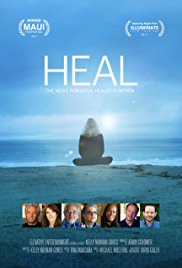
 Greetings again from the darkness. Self-healing has been done in many futuristic and science fiction films, and in the recent BLADE RUNNER 2049 we watched Ryan Gosling instantaneously recover from severe wounds. Of course, most of us aren’t replicants, so we follow along with what our doctors typically do … treat the symptoms rather than the cause. Director Kelly Noonan Gores explores the theory that our bodies are quite capable of self-healing even when serious disease is involved.

The Mind-Body connection is explored through case studies and interviews. It’s the intersection of science and the spiritual that forms the basis of the thoughts from experts such as Deepak Chopra (who seems to be in every other documentary these days), Marianne Williamson, Anita Moorjani, Bruce Lipton, Michael Beckwith and others. They subscribe to the notion that your thoughts, beliefs and emotions directly affect your health. Change your perspective and it allows your body to heal itself. We’ve always believed that illness is inevitable, but maybe it’s time to question this.

It seems logical, and has been proven, that we can activate our immune system through a regimen of exercise, nutrition, and supplements. The film covers this and more, including stem cell research, alternative treatments, and the use of healers – holistic energy for chronic pain and disease. As we would expect, the effects of stress are key to any film or study on healing. It’s a known evil and the depth of its impact is only now beginning to be understood. There are some interesting discussions regarding “fight or flight” and “rest and repair”, and the belief that toxins are affecting newborns. These toxins likely lead to future disease and are the key to finding the cause, as opposed to treating the symptom. Director Noonan-Gores follows at least three people on their journeys of discovery and healing, providing hope that self-healing may become a true path for many. For more information, visit www.healdocumentary.com


DEALT (2017, doc)

October 19, 2017

 Greetings again from the darkness. One of the sub-genres of film documentaries involves profiling those folks who are doing extraordinary things in life. Sometimes these people are changing the world, sometimes they are sharing their talents, and other times they are overcoming challenges that most of us don’t have. Richard Turner of San Antonio, Texas is one who checks all three boxes.

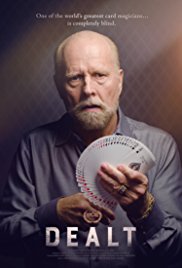
Mr. Turner is the world’s best card mechanic … a magician, if you will – although he doesn’t much like that word. Now you might be asking how a card trickster is changing the world, and it’s a fair question. The answer becomes clear when we see him quietly bonding and sharing some card secrets with a young, similarly visually-impaired girl late in the film. That’s correct, Mr. Turner is himself blind, and if you assume that a blind man cannot possibly execute highly complex and entertaining card tricks, you are encouraged to learn more about this remarkable man.

Mr. Turner is quick to recall what drew him to cards. He references the James Garner TV series “Maverick” as an inspiration, and soon decided that would make a pretty good way to earn a living. He has used his touch of hyper-activeness to relentlessly master his card skills, while also honing his stage presence. We hear others discuss his impact, and watch vintage clips of his TV appearances. “Blind” was a word he spurned for years, as he was driven to let his skills stand on their own against all others (skills that would be mind-blowing and world class even if he weren’t blind). Turner’s adamant refusal to admit his disability (no Braille, no cane, no dogs) was enabled by his dependence on his son, whose departure for college left a gaping hole in dad’s life. We also meet Richard’s sister Lori. She owns and runs her own construction company … and is also blind.

Director Luke Korem expertly provides the necessary background for us to understand how Turner has become the star he is. Rather than focus on the technical aspects of card “magic”, he focuses on the man and his personal journey. It’s fascinating how he delivers a personal profile of the family man – the flawed man – who has slowly, but surely come to accept his disability after a life of denial. So while we “ooh and ahh” and gape in amazement at his card skills, our hearts are touched by the relationships he has with his wife Kim, his son Asa (yes, Asa Spades Turner), and his self-reflective drive that allowed him to reach 5th degree black belt. Mr. Turner likely fine-tuned his card skills for nearly16 hours today … how was your day?


WASTED! THE STORY OF FOOD WASTE (2017, doc)

October 13, 2017

 Greetings again from the darkness. “Clean your plate!” Many of us heard those words at the dinner table as we were growing up. At the time, we assumed it was yet another way our parents conspired to keep us from going back outside to play. Co-directors Anna Chai and Nari Kye explain the much bigger picture – the global issue of wasted food.

The opening has culinary expert Anthony Bourdain wondering aloud if we even deserve to live. Merely mentioning the topic of food waste disgusts him. His philosophy is “Use everything. Waste nothing”. Over the course of the film, some startling statistics are thrown at us: one-third of produced food is never eaten, and 90% of wasted food (U.S.) ends up in landfills at a cost of 1 trillion dollars and elevated methane levels.

Some influential chefs discuss their approach to creatively utilizing what was previously considered waste. Dan Barber, Mario Batali, and Massimo Bottura are all on the leading edge of experimenting with new approaches to create delicious dishes from what once was wasted food products. Barber offers Bouillabaisse as an example of a tasty, acceptable dish made from what is actually food waste.

We learn that food is wasted at every link in the supply chain: on the farm, at the grocery store, in restaurants, and on our plates. In response, the EPA has established a food waste pyramid with the goal of preventing, or at least minimizing waste. The upcycle is described as the prioritization of food waste: people-livestock-generate energy-create nutrient rich soil.

The film takes us through each level of this, and we make our way around the globe. The United States , Europe, Japan, Sweden and South Korea all have specific programs designed to reduce food waste. Writers, journalists, farmers, chefs, and food activists all offer insight and specifics on not just what the problem is, but also some of the possible solutions (which is quite refreshing).

Some unconventional approaches include beer made from bread, better distribution methods, stores and shelters serving creative dishes, feeding waste to pigs for improved pork flavor, fishing initiatives, converting yogurt to energy, and educating kids on growing and eating their own food. The most extreme routes involve Japan chefs using pig parts that even the most adventurous among us might balk at.

The Rockefeller Foundation sponsored the film and has pledged millions towards reducing food waste. The filmmakers leave us with the clear message that we don’t need to produce more food, we simply need to act differently. There is an opportunity here for capitalism, and each of us can make a difference by paying attention to what we buy and what we throw away. The closing credit outtakes with Bourdain are comical, and of course, any film that includes Oscar the Grouch singing “I Love Trash” has something going for it.

watch the trailer:


78/52 (2017, doc)

October 12, 2017

 Greetings again from the darkness. Does it make sense to create an entire movie about a single scene from another movie? Director Alexandre O. Philippe answers with a resounding “Yes” and proves it with thorough and varied analysis of the infamous and iconic shower scene from Alfred Hitchcock’s classic PSYCHO.

“The death of a beautiful woman is, unquestionably, the most poetical topic in the world.”

That quote from Edgar Allan Poe opens the film, and reminds us that the hullabaloo surrounding PSYCHO would never have been possible if Janet Leigh hadn’t been a beautiful movie star … and if Hitchcock hadn’t shocked us with the timing … and if so many other pieces hadn’t fallen into place. It’s those pieces that are the focus of Mr. Philippe’s expository on the immediate and lasting impact of the scene.

The film’s title comes from the 78 pieces of film and 52 cuts that make up the 3 minute sequence being adored, admired and argued here. The interviews and insight come fast and passionately from filmmakers, writers, educators, film historians, and actors. We meet the ultra-charming Marli Renfro, who was Janet Leigh’s body-double for the film – and also graced the September 1960 cover of Playboy. There is also Tere Carrubba, Mr. Hitchcock’s granddaughter and the daughter of Patricia Hitchcock, who has a minor role in PSYCHO. A few of the others who discuss the scene and film’s influence include directors Peter Bogdanovich, Guillermo del Toro, and Karyn Kusama (JENNIFER’S BODY); writers Leigh Whannell (SAW, INSIDIOUS) and Bret Easton Ellis (AMERICAN PSYCHO); and  Janet Leigh’s daughter, actress Jamie Lee Curtis.

True technical analysis and peek behind the mysterious filmmaking curtain kicks into high gear when Walter Murch speaks. Mr. Murch is a 3-time Oscar winner and 9-time nominee for such timeless films as APOCALYPSE NOW and THE CONVERSATION. He is an expert on sound and film editing, two vital components to the shower scene, and he literally guides us through the individual cuts. Most fans of the film know of the chocolate syrup, but the casaba melon and the painting on the wall might be new territory. The film ties together, like never before, the script of Joseph Stefano, the storyboard of Saul Bass, the editing of George Tomasini, and the scene score of Bernard Hermann … all giants of the industry.

Whether you are a film lover, Hitchcock fanatic, or film theorist, you are likely to find something new here. The film represents so many “firsts” and was truly a turning point in the film industry, while also being a cultural phenomenon. When Martin Scorcese talks about the PSYCHO influence on RAGING BULL, it’s the culmination of a blissful 90 minutes.

watch the trailer:


TAKE EVERY WAVE: THE LIFE OF LAIRD HAMILTON (2017, doc)

September 28, 2017

 Greetings again from the darkness. The face of his sport. An American icon. A living legend. Each of these would be accurate in describing super-surfer Laird Hamilton. Oscar nominated in 2014 for her LAST DAYS IN VIETNAM, documentarian Rory Kennedy (daughter of Ethel and Robert F Kennedy) delivers the most in-depth look yet at Hamilton and his unconventional life.

Before he was born, his pregnant mother underwent a procedure that basically created free-swim time for the fetus (Laird). Whether this played a role in his life as a water man can be debated, but after his dad left the family to join the Merchant Marines, Laird’s mom Joann Zerfas moved with her young son to Hawaii. Her free-spirited nature certainly influenced Laird’s approach to life, and we are led to believe that as a 4 year old, he encouraged the union between his mother and Bill Hamilton, the best known surfer of the time.

We view some incredible archival footage of Laird’s early years, along with photographs leading through his childhood. In fact, it isn’t always easy to tell what is “old” footage and what is new from the lens of cinematographers Alice Gu and Don King. Even if you find Hamilton’s personality and approach off-putting, you will likely be awed by the surfing footage. His younger brother Lyon describes him as a 100% disobedient child, and we learn Laird was often picked on as one of the few white kids in a Hawaiian school in the 1970’s. He found solace from school and an abusive step-dad in the “honesty of the ocean”, where if you do it right – you are rewarded, and if you make a mistake – you pay the price.

It doesn’t require a psychology degree to see that Laird eschews most rules and has pretty much lived his life according the tide patterns and swells of Maui’s north shore. He has been heavy on ambition and conquering fear, and a bit light on societal norms and loyalty (ex-wife and his fellow Strap surfers). Director Kennedy is balanced in her approach here. As we begin to judge him by our standards, she reminds us of his unique nature … stand-up barrels in 7th grade, refusing to join in the parade for a high-paying career in modeling or acting, etc.

Known as the master of big wave surfing (he never competed on the traditional pro surfing tour), Laird’s life as a true Water Man took him paddle surfing through the English Channel, and the early stages of wind-surfing, connected surfing, tow-surfing, and hydro-foil boarding. He and his buddies were the first to ride the infamous Jaws waves of Pe’ ahi.

Along the way, we learn about the beginnings of his relationship with former pro volleyball player Gabrielle Reece and how he shifted ever-so-slightly into a family man role … without losing his desire to continually conquer the ocean. We see his intense training program and the beat up body he now has to work around. There is a bit of a peek into the surfer community and the jealousies and tension that aren’t obvious to outsiders. Laird’s “fear defect” is accompanied here by periodic punk rock music that seems the perfect fit for a man who is a natural phenomenon in the water and on a board, while showing no interest in the conventions most of us live by. You might not appreciate his personality, but there is nothing but respect for his courage in riding those 80 foot waves.

watch the trailer:


TROPHY (2017, doc)

September 28, 2017

Dallas International Film Festival 2017

 Greetings again from the darkness. Totally unexpected is a documentary on big game hunting that doesn’t come down squarely on one side of this argument. Co-directors Christina Clusiau and Shaul Schwarz do an admirable job of laying out the facts and leaving the viewer to contemplate how these moving pieces create a blurred line between conservation and commerce.

Expect a couple of scenes that might be difficult to watch – after all, it is a documentary on hunting animals. There are plenty of facts and statistics provided, with one of the most staggering being since 1970, the world has lost 60% of its wild animals. Rhinos alone are down from 500,000 to 30,000, and we meet a rhino breeder who has devoted his life and fortune to saving the species. On the surface, his stance seems difficult to debate, but African law prevents the sale of rhino horn, which means this breeder is sitting on millions of dollars of warehoused horns, while poachers profit by picking off his animals and selling the horns on the black market. Not so clear now, is it?

Additional segments involve elephants, alligators, and other species. We visit the massive Safari Club hunting convention in Las Vegas, as well as stock auctions where breeders battle over the next generation. The safari clubs argue that much of the money paid by big game hunters is distributed back into the conservation efforts of the country, though the corruption of politicians can’t be ignored.

The contrast between shooters and hunters, killers and sportsmen, is noted and legitimate detailed information is provided. Focus goes to the “Big 5”: hunters trying to bag each of water buffalo, leopard, elephant, lion and rhino. The process is slow and expensive, and the three affected tentacles – hunting, breeding, conservation – have evolved to facilitate the future of the species and those dependent on the industries.

Hunter’s remorse is admitted, as is a connection to the animals by the otherwise stoic and businesslike breeders. When one hunter quotes the bible in saying that man shall have dominion over animals, it’s a reminder that no matter one’s stance on these topics, there is always an argument to be had and a defense to be made. The still unanswered question is, can the industry be run in a manner that allows the animals to survive, the villagers to benefit, and the vendors to profit? In theory, this seems doable … but reality and self-interest often destroy best intentions.