 Greetings again from the darkness. There have been many great writers over the years, yet only a handful of these have become celebrities themselves … in contrast to celebrities who become “writers”. Tom Wolfe was one whose personality was as big (sometimes larger) than his books. Sporting the trademark white suits that had him labeled “a dandy”, making frequent talk show appearances and numerous public book readings and speeches, Wolfe achieved the celebrity status that evidently was important to him. Richard Dewey’s documentary is based on the “Vanity Fair” article written by Michael Lewis (“Moneyball”, “The Big Short”, “The Blind Side”), who also appears on screen here providing insight into Wolfe the writer and Wolfe the man.
Dewey presents a pretty basic chronological biography of this man whose mastery of word usage has led him to be recognized for introducing some familiar phrases into the language. These include: “the right stuff”, “good ol’ boy”, and “the Me decade”. Wolfe penned many bestsellers across multiple genres, as well as countless articles and essays with his observations and commentary on society and counterculture. Some of his most famous works are “The Right Stuff” (adapted into an exceptional 1983 film), “The Bonfire of the Vanities” (adapted into a regretful 1990 DePalma flop), and “A Man in Full”. It’s that latter 1998 novel that kicked off the high-profile literary feud between Wolfe and rival writers John Updike, Norman Mailer, and John Irving.
Wolfe’s background as a newspaper journalist certainly contributed to his long-standing commitment to research and details. Among those interviewed here and speaking to his expertise are Gay Talese, Christopher Buckley, Tom Junod, and the aforementioned Michael Lewis. Also included are numerous clips of Wolfe’s TV appearances, and even comments from his daughter, Alexandra. Talese in particular captures the essence of Wolfe when he describes him as (something along the lines of) an extremely polite man who transitions into a terrorist with a pen in hand. Not many can be described as an elegant gentleman AND with adjectives such as cynical, mean, outlandish, and contrarian. Tom Wolfe can … and has been.
As a writer, Wolfe turned his focus on Black Panthers, Leonard Bernstein, astronauts, New York City, Junior Johnson’s NASCAR, and Ken Kesey’s LSD hippie counterculture. Sure, he was often criticized for his use of exclamation points and ellipses (a habit we share), yet he was also behind “New Journalism”, aka literary journalism – making stories more interesting to read. He suffered through depression after a heart attack, but the man did things with words most of us can only dream of. Tom Wolfe passed away in 2018 at age 88, but his white suit lives on in images, and magical words live on through publications. For a man who adored adoration, he would likely be fine with that.
The film will debut in limited theaters beginning September 15, 2023


 Posted by David Ferguson
  Greetings again from the darkness. Let’s begin with this: Danny Wu’s documentary ties legendary filmmaker Orson Welles into one of the most tumultuous periods of history. This is done not so much in a FORREST GUMP or ZELIG style, but more like one of those push pin boards Claire Danes used in “Homeland” by looping red thread around all the key characters and events. Wu opens with Webster’s 1913 definition of an “American” – originally applied to the aboriginal inhabitants, now applied to descendants of Europeans born in America, and especially to the citizens of the United States.
 Greetings again from the darkness. Although not one of those Americans mesmerized by every move made by the Royal Family, I have long admired Queen Elizabeth II for the manner in which she conducted herself in public. Having served as Monarch for seventy years at the time of her death, the Queen displayed a rare and much appreciated decorum throughout her lifetime in the public eye. In fact, director Fabrizio Ferri begins the film by asking citizens to describe her in one word, and what we hear is no surprise: consistency, constraint, strong, constant, respect. Obviously, she was Queen for the entire life of most British citizens, so her passing was an emotional jolt.
 Greetings again from the darkness. Obsession. Commitment. Dedication. Devotion. Pursuit of perfection. Whatever this is, it goes deeper than imitation. Akio Sakurai has spent thirty-plus years trying to become … well, let’s use his quote: “I want to be Jimmy Page.” Yes, Akio is not paying tribute to his guitar hero, and he zooms past the definition of fanboy. Director Peter Michael David chronicles Akio’s dream (over 8 years), and the film left me with conflicting emotions. Should I be in awe of Akio’s guitar-playing, or should I be worried about the mental state of someone so focused on being someone else?
 Greetings again from the darkness. When the musical geniuses we respect and admire speak in awe and wonderment about another musician, we know it’s time to pay attention. Of course, Wayne Shorter has long been recognized as a Jazz giant, and unfortunately he passed away earlier this year. For this three-plus hour documentary, director Dorsay Alavi interviews such renowned artists as Joni Mitchell, Sonny Rollins, Carlos Santana, and Herbie Hancock. It’s fascinating to hear those on top of the mountain express high-level respect for Shorter using such descriptions as greatness, visionary, and genius.
 Greetings again from the darkness. Let’s face it. The vast majority of U.S. educated folks have “learned” most of their Native American history from short segments in high school classes and from the portrayals in movies and TV shows. It seems fair to admit that these have been mostly one-sided tales. Well, here comes co-directors Laura Tomaselli and Jesse Short Bull to provide a detailed history from the Native American perspective, and I feel confident that many of you will find it as disturbing as I did.
 Greetings again from the darkness. “Wish you were here” is one of the songs Pink Floyd wrote in tribute to the band’s enigmatic founder, Syd Barrett. These days, fifty-five years after he left the band and seventeen years after his death, Barrett remains a mysterious cult figure in rock lore, enveloped by rumors and conjecture. Co-directors Roddy Bogawa and Storm Thorgerson (graphic designer of such classic album covers as Pink Floyd’s “Dark Side of the Moon”) attempt to present the facts by talking to a stream of folks who were there.
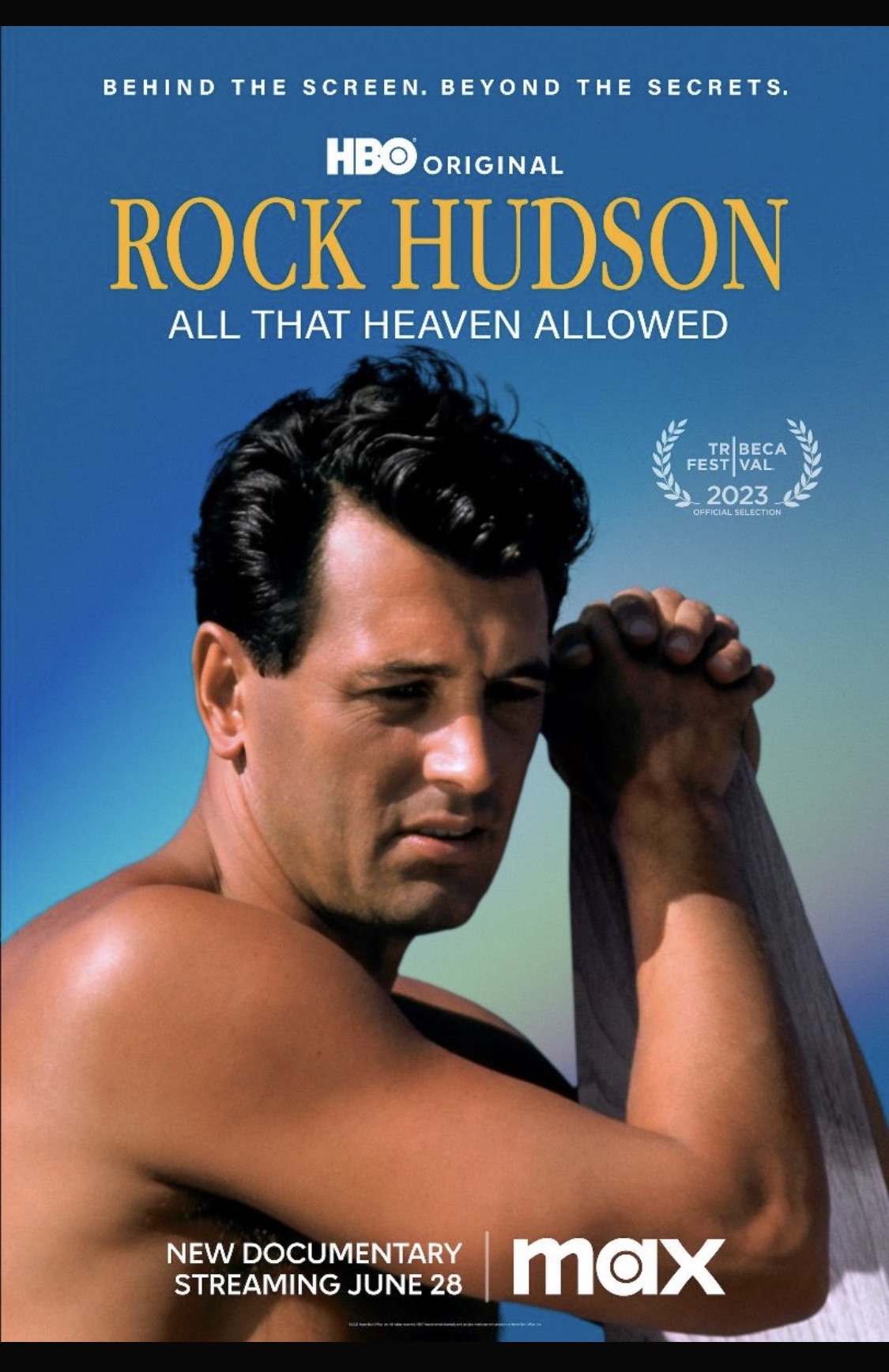 Greetings again from the darkness. Actors earn a living thanks to their ability to perform in front of the camera (or a live audience) as someone else … making the audience believe they are a particular character of interest. But what happens when an actor must continue acting once the cameras stop rolling? Such was the life of Roy Fitzgerald, a man known worldwide as Rock Hudson. Documentarian Stephen Kijak chronicles the complications faced by Rock Hudson – maintaining the All-American public persona, while hiding a personal life that likely would have ended his career had his secret life as a gay man been publicized.
 Greetings again from the darkness. PBS excels at documentaries that bring to light a subject or topic which has been overshadowed or overlooked. In conjunction with WORLD channel and filmmakers Dru Holley, Jerome Young, and Jerry Bell Jr, this latest focuses on the previously uncelebrated role of African American soldiers in numerous wars dating back more than 150 years.
 Greetings again from the darkness. In a perfect world we would judge each other by character, personality, integrity, and accomplishments. Unfortunately, too many still judge the book by its cover, and therein lies the only explanation for why Yogi Berra was not on the field at the 2015 All-Star game with Hank Aaron, Willie Mays, Sandy Koufax, and Johnny Bench as one of the greatest living players. Berra, though he never cut the imposing athletic figure as those players, certainly fulfilled the four attributes listed above … including his accomplishments in the very game that was offering tribute to the greats of the game. Director Sean Mullin expertly proceeds to prove that Lorenzo Pietro “Yogi” Berra was not just one of the best baseball players of all-time, he was also a war hero, beloved father, grandfather, husband, public figure, and above all, a world-class person.
 Movie Reviews from the Dark