 Greetings again from the darkness. Let’s begin with this: Danny Wu’s documentary ties legendary filmmaker Orson Welles into one of the most tumultuous periods of history. This is done not so much in a FORREST GUMP or ZELIG style, but more like one of those push pin boards Claire Danes used in “Homeland” by looping red thread around all the key characters and events. Wu opens with Webster’s 1913 definition of an “American” – originally applied to the aboriginal inhabitants, now applied to descendants of Europeans born in America, and especially to the citizens of the United States.
For cinephiles, much of Welles’ personal and professional story is well-known. Born in 1915, his mother died when he was ten. His father shipped him off to a liberal boarding school where he was free to pursue his passion in the theater, and all things creative. Fellow actor Simon Callow spends a good amount of time on camera recounting Welles’ passion for the theater, and especially acting, and how playwright Thornton Wilder and another legend, John Houseman, were instrumental in assisting Welles with early career breaks.
It’s at this stage where Wu drops in some ‘strange bedfellow’ politics, showing media mogul William Randolph Hearst playing a key role in getting Franklin Delano Roosevelt elected President. As the film progresses, we learn how this relationship shifted 180 degrees, and also how Welles later bore the brunt of Hearst’s powerful reach. FDR pushes through the Federal Theater Project, which keeps Welles working, and it’s in 1938 when Welles’ infamous broadcast of H.G. Well’s “War of the Worlds” puts folks on edge, and it’s the year Howard Kakita is born. We only get bits and pieces of Kakita’s story, but he and his family are linked to the United States, Hiroshima, and the internment camps established by FDR during the war.
By this stage, we have a grasp on what Wu is doing with his film – a blend of historical and biographical material. As a 25-year-old wunderkind, Welles secured an unprecedented contract with RKO, giving him total control of his work. The rough draft of his initial project is co-written with Herman Mankiewicz and John Houseman, and is titled “American”. This work is fine-tuned and becomes the 1941 classic, CITIZEN KANE. It’s at this point that Welles experiences the power of William Randolph Hearst, who crushes the distribution and box office of the film. Of course, even more than 80 years later, it’s still considered a cinematic masterpiece.
What many may not know is how Welles used the theater for many projects promoting anti-racism, at a time when Jim Crow laws were booming. Wu uses the example of Isaac Woodard to bring home the often-disgusting nature of this era. Sgt Woodard was headed home after serving in the war, when he was severely beaten to the point of having his eyes gouged out by a small-town sheriff and deputy. The tragic story is told by Woodard’s nephew and author Laura Williams. The blinding of Isaac Woodard is described as igniting the Civil Rights Movement.
Mr. Kakita offers more details of his family revisiting Hiroshima after the bomb, and we learn how J Edgar Hoover started a file on Welles during the era of McCarthyism and blacklisting suspected communists. After RKO re-edited (butchered) Welles’ film, THE MAGNIFICENT AMBERSONS, Welles felt rejected at most every turn and decided to move to Italy and live a quiet life focusing on the art of moviemaking. Described as transitioning from “Boy Wonder” to the “youngest has-been”, Welles did visit the U.S. periodically, and here his life has provided quite the perspective for Danny Wu’s innovative storytelling.
The film has a limited theatrical release on Sept 8, 2023 and digital release on Sept 12.


 Posted by David Ferguson
  Greetings again from the darkness. Although not one of those Americans mesmerized by every move made by the Royal Family, I have long admired Queen Elizabeth II for the manner in which she conducted herself in public. Having served as Monarch for seventy years at the time of her death, the Queen displayed a rare and much appreciated decorum throughout her lifetime in the public eye. In fact, director Fabrizio Ferri begins the film by asking citizens to describe her in one word, and what we hear is no surprise: consistency, constraint, strong, constant, respect. Obviously, she was Queen for the entire life of most British citizens, so her passing was an emotional jolt.
 Greetings again from the darkness. Obsession. Commitment. Dedication. Devotion. Pursuit of perfection. Whatever this is, it goes deeper than imitation. Akio Sakurai has spent thirty-plus years trying to become … well, let’s use his quote: “I want to be Jimmy Page.” Yes, Akio is not paying tribute to his guitar hero, and he zooms past the definition of fanboy. Director Peter Michael David chronicles Akio’s dream (over 8 years), and the film left me with conflicting emotions. Should I be in awe of Akio’s guitar-playing, or should I be worried about the mental state of someone so focused on being someone else?
 Greetings again from the darkness. When the musical geniuses we respect and admire speak in awe and wonderment about another musician, we know it’s time to pay attention. Of course, Wayne Shorter has long been recognized as a Jazz giant, and unfortunately he passed away earlier this year. For this three-plus hour documentary, director Dorsay Alavi interviews such renowned artists as Joni Mitchell, Sonny Rollins, Carlos Santana, and Herbie Hancock. It’s fascinating to hear those on top of the mountain express high-level respect for Shorter using such descriptions as greatness, visionary, and genius.
 Greetings again from the darkness. Let’s face it. The vast majority of U.S. educated folks have “learned” most of their Native American history from short segments in high school classes and from the portrayals in movies and TV shows. It seems fair to admit that these have been mostly one-sided tales. Well, here comes co-directors Laura Tomaselli and Jesse Short Bull to provide a detailed history from the Native American perspective, and I feel confident that many of you will find it as disturbing as I did.
 Greetings again from the darkness. “Wish you were here” is one of the songs Pink Floyd wrote in tribute to the band’s enigmatic founder, Syd Barrett. These days, fifty-five years after he left the band and seventeen years after his death, Barrett remains a mysterious cult figure in rock lore, enveloped by rumors and conjecture. Co-directors Roddy Bogawa and Storm Thorgerson (graphic designer of such classic album covers as Pink Floyd’s “Dark Side of the Moon”) attempt to present the facts by talking to a stream of folks who were there.
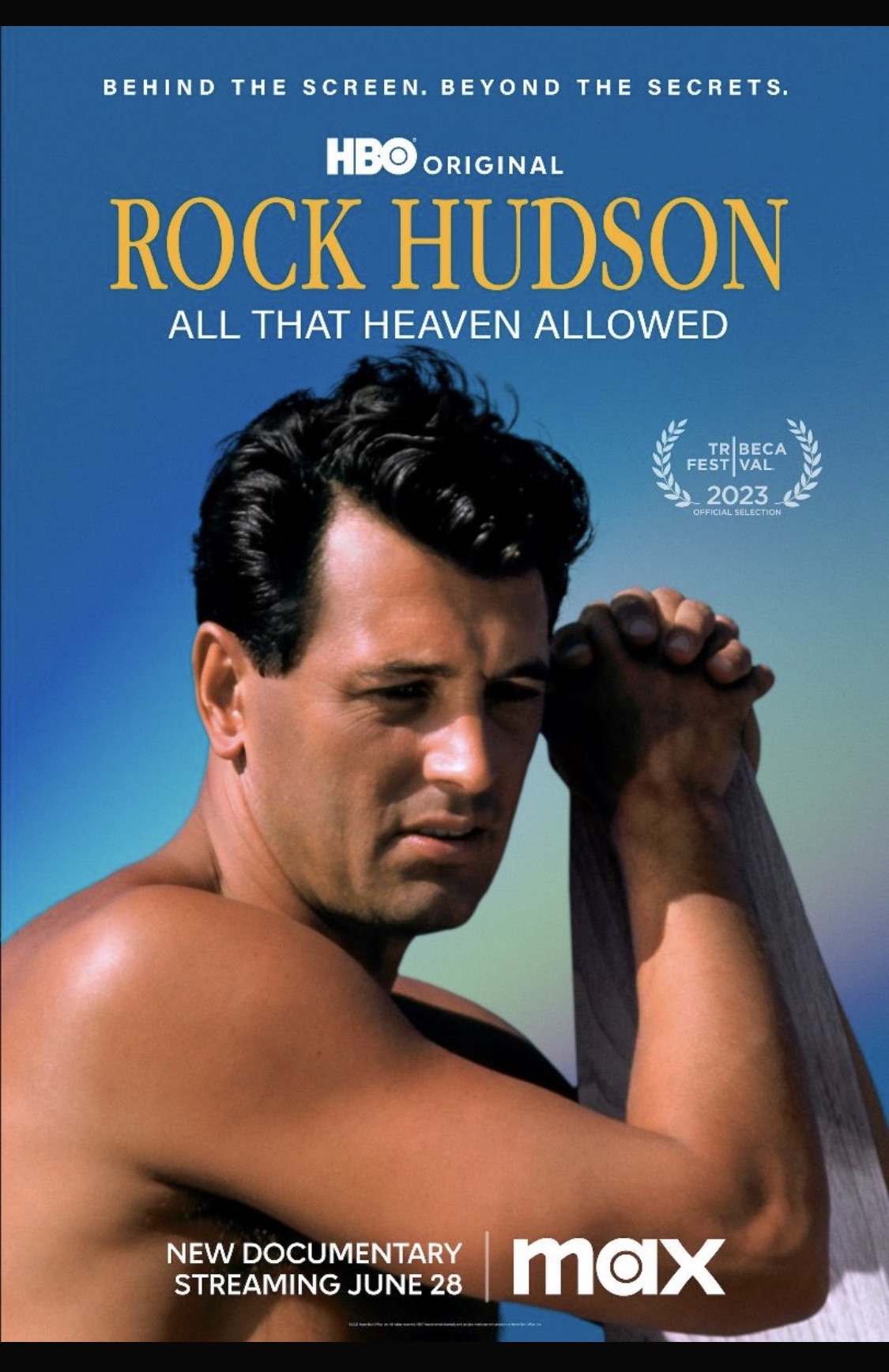 Greetings again from the darkness. Actors earn a living thanks to their ability to perform in front of the camera (or a live audience) as someone else … making the audience believe they are a particular character of interest. But what happens when an actor must continue acting once the cameras stop rolling? Such was the life of Roy Fitzgerald, a man known worldwide as Rock Hudson. Documentarian Stephen Kijak chronicles the complications faced by Rock Hudson – maintaining the All-American public persona, while hiding a personal life that likely would have ended his career had his secret life as a gay man been publicized.
 Greetings again from the darkness. PBS excels at documentaries that bring to light a subject or topic which has been overshadowed or overlooked. In conjunction with WORLD channel and filmmakers Dru Holley, Jerome Young, and Jerry Bell Jr, this latest focuses on the previously uncelebrated role of African American soldiers in numerous wars dating back more than 150 years.
 Greetings again from the darkness. In a perfect world we would judge each other by character, personality, integrity, and accomplishments. Unfortunately, too many still judge the book by its cover, and therein lies the only explanation for why Yogi Berra was not on the field at the 2015 All-Star game with Hank Aaron, Willie Mays, Sandy Koufax, and Johnny Bench as one of the greatest living players. Berra, though he never cut the imposing athletic figure as those players, certainly fulfilled the four attributes listed above … including his accomplishments in the very game that was offering tribute to the greats of the game. Director Sean Mullin expertly proceeds to prove that Lorenzo Pietro “Yogi” Berra was not just one of the best baseball players of all-time, he was also a war hero, beloved father, grandfather, husband, public figure, and above all, a world-class person.
 Greetings again from the darkness. It’s borderline unfathomable that someone who has worked for almost 20 years as a cinematographer and a decade as a TV director could be “unfamiliar” with the work and career of one of the industry giants, yet that’s the claim of director James Adolphus (“Soul of a Nation” mini-series) when it comes to Mary Tyler Moore. His film does play a bit as if he’s opening a Christmas present that everyone else in the room knows what’s under the wrapping, and it’s because of this, the film works as not just a retrospective of her career, but also a tribute to a woman who influenced so many.
