FRIENDLY PERSUASION (1956)

December 29, 2013

friendly p Greetings again from the darkness. Released in 1956, this William Wyler film holds up today because some of the debate and dilemmas touched on remain unresolved 57 years (and numerous wars) later. The film takes place in 1860’s Indiana as the Civil War rages. The story is told from the perspective of a pacifist Quaker family and is based on the 1945 book by Jessamyn West.

The patriarch of this Quaker family is played by Gary Cooper, who was four years past his Oscar winning performance in High Noon, and five years from his death due to cancer. His wife, the Minister Eliza, is played well by Dorothy McGuire, who the following year would play the mother in Old Yeller. The film’s best performance comes from young Anthony Perkins (his second film) who of course made cinematic history as Norman Bates in the 1960 classic Psycho. Both of these Perkins characters share mommy issues and complicated decisions of conscience, and in this one he has a remarkable scene when he crosses that line.

The opposition to war and violence is the main theme here, and there have been many interpretations over the years. Is it religious belief or fear that prevents the men from joining the cause? At least Perkins’ character is honest enough to wonder. Cooper kind of plays against type here since he was so often a man of movie action, but in reality his strength of character and belief allows him to maintain his strong leading man image.

Comedy relief is at hand given the youngest son’s ongoing battle with Samantha the Goose, a family pet with devious attack modes. Daughter Mattie, played by Phyllis Love, falls madly in love with a soldier played by Peter Mark Richman. See, every character has their own personal battles and decisions regarding conscience and violence.

The great Margaret Main has a sequence as a single mother of three daughters (every one a gem!). The daughters introduce Cooper and Perkins to the joys of music … forbidden by the Quaker church. One of the daughters is played by Marjorie Durant, whose father was a writer and assistant to Charlie Chaplin. Her grandmother married EF Hutton, so Ms. Durant could have spent a great deal of time researching her only family stories.

While it’s difficult to understand these days, screenwriter Michael Wilson was not originally credited for his work. He was on the Hollywood Blacklist, and his screen credit was not reinstated until 1996. William Wyler was one of the most successful directors in Hollywood history and his resume includes Jezebel, Mrs Miniver, The Best Years of Our Lives, and of course, Ben-Hur. Though this movie was nominated for 6 Academy Awards, it didn’t win any and lost out to Best Picture winner Around the World in 80 Days.

**NOTE: This was Ronald Reagan’s favorite movie and he presented a copy to Mikhail Gorbachev in hopes the message would prove perspective and alternatives to a war between the super powers.

watch the trailer:

https://www.youtube.com/watch?v=xmK3iPSNtCQ

http://www.youtube.com/watch?v=xmK3iPSNtCQ


THE NIGHTMARE BEFORE CHRISTMAS (1993)

December 21, 2013

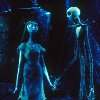
nightmare1 Greetings again from the darkness. Somehow it’s been a full 20 years since this groundbreaking film was released. It’s a rare combination of cult and holiday, and even all these years later, it’s incredibly entertaining. It shouldn’t surprise anyone that the lead character is a societal misfit who means well. After all, the story is based on a Tim Burton poem.

While watching the film, what strikes me is that this was a totally unique and creative world designed by Burton and director Henry Selick. Mr. Selick is a stop-motion expert known also for Coraline (Oscar nominated) and James and the Giant Peach. Complimenting the fantastical look and characters are the witty songs penned by Danny Elfman. Mr. Elfman is now one of the most prolific and successful composers working in the movie industry. At the time, he was better known as the front man for the party band Oingo Boingo (his Batman score changed that!).

nightmare2 Since Pixar began it’s (well earned) domination of the animation world in 1995, we have come to expect major stars as voice actors. However, we landed inn Halloween Town prior to Pixar, so instead of big stars, we get Danny Elfman (singing) and Chris Sarandon (speaking) teaming up for Jack Skellington, the Pumpkin King of Halloween Town. Catherine O’Hara is effective as Sally, Paul Reubens (Pee Wee Herman) stands out as Lock (of Lock, Shock and Barrel). The two most outstanding voice performances come from the late William Hickey as Dr Finkelstein (mad scientist), and Broadway star Ken Page as bad guy (and worm-infested) Oogie Boogie.

There has been debate on whether this is best served as a Halloween movie or Christmas movie. The desire and hope to bring positive change to the world seems to fit the Christmas spirit, but the goblins and ghouls are sure to provide a nightmare3nice scare for young kids. Especially fun are the “new toys” created by the work crews in Halloween Town as they prepare for a good will holiday they don’t quite understand.

Whatever your preferred time of year, this one is to be appreciated for it’s creative look and imaginative story and songs. Rather than being created to sell toys, this 3 year production changed the standards for animation films … that’s the gift that keeps giving every year!

Instead of my usual posting of the movie trailer, I thought you might enjoy this rendering of the original Tim Burton poem that inspired this movie.  As an added bonus, it’s recited by the great Christopher Lee:

https://www.youtube.com/watch?v=XbPCwc_Cdz0


THE SWIMMER (1968) revisited

December 1, 2013

swimmer1 Greetings again from the darkness. Having first been drawn into this film by watching it on a 13 inch black and white TV in my dorm room, I have long wanted to experience it on a larger, full color screen. With this “dream” finally attained, the film remains a very odd, hypnotic, stylistic 1960’s film. Based on a John Cheever short story published in the “New Yorker”, it works as a dual allegory to: the failed American Dream and one man’s life.

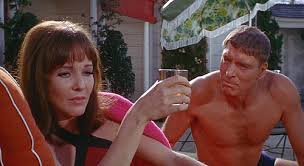
Burt Lancaster stars as Ned Merrill, a long-lost neighbor who shows up one morning to take a swim at the house of some friends. A little conversation leads to the formulation of Ned’s plan to “swim home” through each of the backyard pools in the valley. This is a chlorinated road trip and it’s quite an adventure. Along the way, Ned meets those that are happy to see him and those that aren’t. The former babysitter (Janet Landgard) follows him for part of the trip. He swimmer2also has an extended visit with a former lover (whom he clearly spurned) played by Janice Rule (pictured left) … a visit that starts poorly and goes downhill from there.  Various other interactions occur during his pool crawl, including some face time with a young Joan Rivers (who plays a pool party girl).

As we can tell from the delivery of the dialogue, something isn’t quite right with Ned. He has been “missing” for awhile and he seems to be oblivious to the changes in his life, while everyone else is quite aware. It seems Ned is swimming right through the stages of his life. The movie takes him: from morning to evening, from sunshine to rain, from warm to cold, from energetic to tired, and from healthy to hurt. By the end of his trip, we understand the current state of Ned’s life, even if he prefers to believe his wife and daughter remain part of his idealistic suburban paradise.

Eleanor Perry wrote the screenplay, while her husband Frank Perry (Mommie Dearest) directed. They also collaborated on Diary of a Mad Housewife. A minor bit of trivia notes that Fred was singer Katy Perry’s uncle. Due to creative differences with Lancaster, Mr. Perry left the film before it was completed. Sydney Pollack was brought in to re-shoot the scene with Lancaster and Ms. Rule. It had previously been shot with Barbara Loden. A 24 year old Marvin Hamlisch composed the somewhat heavy-handed score … it was the first of many film scores he would compose.

This is an unusual looking film – very stylistic and impressionistic for the times. It flows more like a play than a traditional movie and the dialogue is more literary than conversational. Lancaster’s performance is exceptional, and it should be noted, he was 52 years old at the time of shooting. If you have seen the movie, you understand why that is so impressive.

watch the trailer:


THE BICYCLE THIEF (1948, Italy, Ladri di biciclette)

October 31, 2013

bicycle1 Greetings again from the darkness. To understand why this is considered a masterpiece of cinema and one of the best films ever made, one must put the era of its release into perspective. It’s 1948 – post war Italy and poverty mandates the fabric of society. Humanity is difficult to come by. Self-interest controls actions and emotions. Hollywood is in a glitz and glamor mode, while Italian cinema has been dominated with light-hearted and simple films. Vittorio De Sica is a matinée idol as an actor and also, as a director, one of the driving forces of Neo-realism … a genre that focused on the struggles of real people.

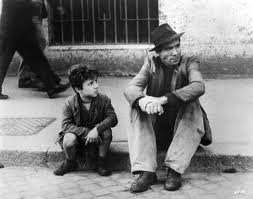
There is nothing fancy or complicated about this story. Ricci is one of the masses looking for work at a time when jobs are beyond scarce. One day he is extremely fortunate to be offered a job posting signs around town. He is elated at the bicycle4opportunity to again provide for his wife and young son. The only catch … he must have a bicycle for the job. His wife pawns their bedsheets to retrieve the bicycle and we join in with their pride and happiness brought on by this job.

We see Ricci on a ladder posting a Rita Hayworth movie advertisement … an example of Hollywood’s polar opposite approach to movies as compared to the Italian neo-realism. While on the ladder, Ricci witnesses the theft of his precious bicycle. His frantic reaction demonstrates the loss means so much more than the loss of two-wheeled transportation. It’s actually the loss of hope.

Soon enough Ricci and his young son Bruno are searching the streets of Rome trying to find the bicycle. It plays like a road trip movie as they experience many interactions on the streets and back alleys. Their search is painful to watch, and father and son endure many emotions, none more powerful than the last few minutes and a touching final shot that is a tribute to the great Charlie Chaplin.

All three lead actors are first timers which adds to the realistic look and feel of the characters and stories. Lamberto Maggiorani (Ricci) was a factory worker who showed up for auditions. He is a very striking man with a Daniel Day-Lewis appearance. Enzo Staiola (Bruno) was a 7 year old boy just watching the whole movie process when he was picked out of the crowd and cast. Lianella Carell (Maria) was a journalist on set to interview De Sica when he cast her as the wife/mother. Additionally, most of this was filmed on the streets and on location in Rome (very few sets).

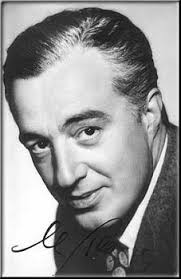
de sica The actual Italian title is “Ladri di biciclette” which translates into Bicycle Thieves, but it has been best known in the U.S. as The Bicycle Thief, the title I prefer. It’s based on a novel by Luigi Bartolini and the screenplay comes from the incredibly prolific screenwriter Cesare Zavattini, who worked with most of the great filmmakers from the 1940’s through the 1970’s. Also of note, Sergio Leone was an assistant to director Vittorio De Sica (pictured left) during production. De Sica directed many wonderful films including Sunshine (1947), which looked at juvenile corruption, and Umberto D. (1952) which examined old age.

The film received an honorary Oscar in 1950, as there had been no category yet established for Best Foreign Language film.  Many question the status of this film as a masterpiece all these years later, but I certainly still experience it’s powerful and sensitive message, and would recommend to anyone who admires world cinema and the classics.


watch a trailer from one of the re-releases:


BONNIE AND CLYDE (1967) revisited

October 25, 2013

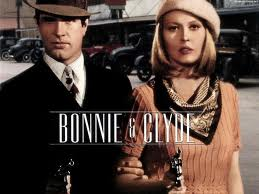
bonnie1 Dramatizations focusing on real life people, be they famous or infamous, require a certain mindset from the viewer.  First, understand that it’s not a documentary.  What you see may be different than what you have read.  Second, expect the filmmakers to take some dramatic license in order to add interest and color to the story.  All of this is in play for the wonderful and classic Bonnie and Clyde from 1967.

To put this time period into perspective, know that the movie was released 46 years ago, and depicts a period during the Great Depression that was approximately 32 years prior to filming.  That’s correct. The film’s release date was closer in time to the Great Depression than today is to the film’s release date. It’s also important to note that Bonnie Parker and Clyde Barrow were 23 and 24, respectively, at the time of their violent deaths at the 1934 Gibsland Ambush.  Their ages and the times certainly played a role in their reckless ways and poor judgment.

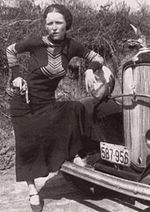
bonnie 3 Sadly, there is a generation of movie-goers who have little knowledge of Warren Beatty’s place in Hollywood history … or worse, their only recollection is of his clunky political rapping in 1998’s Bulworth.  By 1967, Beatty was already a heartthrob and up-and-coming actor, but it’s his role and contract as producer of Bonnie and Clyde that set him up as a Hollywood power player (not to mention, financially set for life).  His 40% of gross pay plan has made him tens of millions over the years.  In addition to his producer duties, Beatty is at his physical peak here … a glamorous actor going all out in a career-defining role. Pictured left, is the real Bonnie and Clyde.

Faye Dunaway plays Bonnie as first, a bored youngster who comes to life due to the danger and sexual attraction she senses with Clyde.  She then transitions into a spirited woman very comfortable with the spotlight of notoriety and fully understanding how to pull the strings of her man.  Dunaway’s career is best marked by her work as Bonnie, and her roles in Chinatown and Network … though many know her best as the mother with an aversion to wire hangers.

There are three writers associated with the film: David Newman (he also wrote the Christopher Reeve Superman scripts), Robert Benton (Oscar winner for Kramer v Kramer and Places in the Heart) and Robert Towne (known best for his Oscar winning Chinatown script).  Mr. Benton was inspired by the fact that his father had attended the Texas funerals of both Bonnie and Clyde. The basic outline is based on the true stories – Joplin, Missouri; Ruston, Louisiana; Texas Ranger Frank Hamer; the numerous stolen cars; the role of Clyde’s brother and his wife; the visit to Bonnie’s mother; and even Bonnie’s poem “The Trail’s End” (aka The Story of Bonnie and Clyde).  But as expected, many liberties are taken.  Unlike in the movie, bonnie 2Frank Hamer never crossed paths with Bonnie and Clyde prior to the final ambush.  Blanche (played by Estelle Parsons) was very upset at her portrayal after seeing the movie … she claims to have not been such a lunatic.  The CW Moss character is actually an amalgam of drivers affiliated with the gang.  Also, there is no mention of the horrible accident that left Bonnie’s legs badly burned … to the point where Clyde had to carry her everywhere those last few months. Pictured left is the famous photo of Bonnie with cigar and gun.

Director Arthur Penn was an Oscar winner and also gave us such fine films as The Miracle Worker (1962), Alice’s Restaurant (1969), and Little Big Man (1970). He and Beatty had many arguments while on set, but the finished project is packed with energy, emotion and action. Beatty and Dunaway give us an engaging couple with a dark destiny.  Excellent support work is provided by Gene Hackman (as Clyde’s brother Buck), Michael J Pollard (as CW Post), Denver Pyle (as Frank Hamer), Dub Taylor (as CW’s dad), Evans Evans (the real life wife of director John Frankenheimer), Gene Wilder (in his film debut), Mabel Cavitt (as Bonnie’s mom, she was literally yanked from the group of Red Oak, Texas onlookers during filming), and Patrick Cranshaw (you might know him as Blue in Old School). It should also be noted that the violence displayed was groundbreaking at the time. The use of squibs … packets of stage blood used to enhance the gunfights … were used generously throughout.  Previously, gunshot wounds rarely had blood shown onscreen.

The film received 8 Oscar nominations with wins for Estelle Parsons (Best Supp Actress) and Burnett Guffey (Cinematographer). The Best Picture winner that year was In the Heat of the Night, and nominations also went to The Graduate and Guess Who’s Coming to Dinner.  This was one of the first 100 movies inducted into The National Film Registry, and it brought Lester Flatt and Earl Scruggs into the mainstream with their “Foggy Mountain Breakdown”.  Initially released as a “B” movie playing drive-ins, things changed dramatically once critic Pauline Kael’s raving review was published in The New Yorker.

this is not the most artistic trailer, but it will give you a taste of the film’s style:

http://www.youtube.com/watch?v=3ACCpXaA-MU


THE LAST PICTURE SHOW (1971) revisited

September 27, 2013

last pic1 Greetings again from the darkness.  Tuesday night was a real treat for this movie lover.  Thanks to the Dallas Film Society, Frost Bank and Alamo Drafthouse, the first in a Texas-themed film series was presented … The Last Picture Show.   As I have stated many times, seeing the classics in a theatre goes far beyond reminiscing. It is experiencing the best of cinematic art in the forum its creators meant for it to be seen.

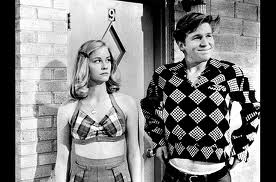
Forty-two years ago, director and co-writer Peter Bogdanovich and writer Larry McMurtry (screenplay and novel) assembled a cast that blended veteran stage, screen and TV actors such as Ben Johnson, Cloris Leachman, Ellen Burstyn and Eileen Brennan, with an energetic and fresh-faced group of relative unknowns such as Jeff Bridges, Timothy Bottoms, Randy Quaid and Cybill Shepherd.  It was the first screen appearance for Quaid and Shepherd (who had been a successful last jeff cybillteenage model), as well as Sam Bottoms (Timothy’s brother) who plays Billy, the smiling, sweeping mute boy who so adores Sonny and Duane.  Of course, Bridges had been acting off and on through his childhood thanks to his dad Lloyd, but this was his breakout role.

It’s not unusual for this film to be pre-judged as some simplistic, outmoded black and white movie with no relevance to today’s world.  In fact, a better argument can be made that this is one of the finest commentaries ever made on human nature, friendship, growing up, mentoring and personal dreams.  You might wonder how a story that takes place in some tiny, desolate, wind-blown rural Texas town in 1951 (the start of the Korean War) has anything to do with society today.  The small town setting actually strips away all distractions of today’s stories and focuses on what makes people tick … why they do the things they do.  We see the strong, the weak, the disabled, the rich, the poor, the innocence of youth, the melancholy middle-aged and the impact our decisions and actions have on others.  It’s easy to ask “why do they stay” or “what makes life worth living” in Anarene.  Those same questions are asked by many people every day in any town or city you can name, regardless of size or location. This is also one of those rare movies that causes your outlook and perception to change depending on your age.  When I first watched, I was seeing through the eyes of Sonny (Timothy Bottoms), while now I relate much more to Sam the Lion (Ben Johnson).  Not many movies have that kind of generational power.

last ben The film was nominated for 8 Academy Awards: Picture, Director, Cinematographer, Screenplay, Supporting Actress (Ellen Burstyn), Supporting Actor (Jeff Bridges), with wins for Supporting Actress (Cloris Leachman) and Supporting Actor (Ben Johnson).   The French Connection was the big winner that year, and other nominees included A Clockwork Orange and Fiddler on the Roof.  What a year!  Ms. Leachman and Mr. Johnson (pictured left) are both heart-breakingly terrific in the movie. Johnson’s scene at the fish tank is mesmerizing and he perfectly captures the wistful wonderings of so many middle-aged men who feel like life has passed them by.  I’ve often interpreted Sonny and Duane as the two sides of Sam the Lion (what he once was and what he is now). Johnson passed away in 1996, but used his wonderful slow drawl and strong presence in such films as The Wild Bunch, Dillinger and many John Ford westerns. Ms. Leachman (still working today in “Raising Hope” after striking it big in “Mary Tyler Moore” and Young Frankenstein) generates such empathy from the viewer as she re-discovers a reason to live.  She is also the key to what I consider one of the most powerful closing scenes in cinematic history.  As for the others, Jeff Bridges and Ellen Burstyn are both in their 5th decade of Hollywood stardom and have each won Oscars.  Eileen Brennan has a very memorable moment in this film where she shoots one of those filled-with-disgust glares at Jacy (Shepherd). It’s one of those looks that only exists between one woman and another. Ms. Brennan (who passed away earlier this year) was Oscar nominated for her supporting role in Private Benjamin (1980).

last bog Equally fascinating are the stories of the creative forces behind the film.  Peter Bogdanovich (pictured left) was a film historian and film critic when he broke into Hollywood as a bit actor and filmmaker.  He later had some directorial success with such films as Paper Moon (1973) and Mask (1985), but he never again reached this level as a director (though very few do).  In fact, much of his career has been spent as a supporting actor (including a psychiatrist in “The Sopranos”).  Bogdanovich can be heard as the DJ on the radio during this film … a New Yorker giving his best impression of a Texan.  Married to his artistic collaborator and (later) producer Polly Platt while filming this movie, he soon began a very public affair with young Cybill Shepherd. They made quite the high profile couple for a short while.  You might remember the story of 1980 Playboy centerfold Dorothy Stratten, who was murdered by her ex-boyfriend Paul Snider, and was the subject of Bob Fosse’s film Star 80.  At the time of her death, Stratten was dating Bogdanovich.  A few years later, Bogdanovich married Dorothy’s younger sister Louise.  Even in Hollywood, this was greeted with raised eyebrows.  Bogdanovich worshipped the films of Truffaut, Ford and his friend Orson Welles … the influence of each is visible in The Last Picture Show. Unfortunately, Bogdanovich was never able to re-capture the magic of this 1971 gem.  Some blame his divorce from Polly Platt, while last mcmothers claim it was writer Larry McMurtry’s input that helped make the film something special. In addition to this novel and screenplay, McMurtry (pictured left) is also known for his Pulitzer Prize winning novel “Lonesome Dove” (later an award winning TV mini-series),  his novel “Terms of Endearment” (adapted into an Oscar winning movie), and his screenplay for Oscar winning Brokeback Mountain.  Despite all the success, it’s The Last Picture Show that hits closest to home … it’s a semi-autobiographical rendering of his life in Archer City, Texas (renamed Anarene in the film).  Even today, McMurtry is a book seller and frequent resident in Archer City.  In 2011, he married the widow of author Ken Kesey (“One Flew Over the Cuckoo’s Nest”).  Lastly, cinematographer Robert Surtees captured the desolate landscape of Anarene through his horizontal pans of a landscape that never seems to change.  Mr. Surtees was a 16 time Oscar nominee for such films as Oklahoma!, The Graduate, A Star is Born and one of his three wins came for the classic Ben-Hur.  His son Bruce followed in his shoes and was Oscar nominated for his work on Lenny (1975)

last tim cloris There are a few other things I like to point out in regards to the film.  The high school teacher reciting Keats’ “Truth and Beauty” to a class who couldn’t care less is John Hillerman (a native Texan), who went on to stardom in “Magnum P.I.” in the 1980’s.  Randy Quaid received an Oscar nomination just two years later for his work in the great The Last Detail. Of course, he later went on to star as Cousin Eddie in the ‘Vacation’ movies. Clu Gulager plays town lothario Abilene. He is the son of vaudeville star John Gulager, who worked with George M Cohan. Clu has had a long career in TV and movies and even appeared in last year’s Piranha 3DD … at age 84!  The music in the film corresponds closely to the story and much of it is the work of the great Hank Williams, Sr. Check out the two versions of “Cold, Cold Heart” as they are performed by both Williams and Tony Bennett.  Now THAT’s how you use music in a flm!  Cybill Shepherd became a star thanks to her work here, then in Taxi Driver, and in the hit TV show “Moonlighting” (with Bruce Willis), her own show “Cybill”, and the Showtime series “The L Word”.  She continues her work in both TV and movies.  As previously mentioned, she began a very public affair with director Peter Bogdanovich while filming this movie. What many don’t know is that she was actually seeing Elvis Presley at the time, and chose Bogdanovich over the King of Rock and Roll.

In 1990, director Bogdanovich revisited Anarene and caught up with the characters 30 years later in the sequel Texasville.  While it’s based on Larry McMurtry’s novel of the same name, Mr. McMurtry was not involved in the production and Bogdanovich wrote the screenplay himself.  Many of the original cast reprised their roles, but the film was not well received either critically or at the box office.   On the bright side, The Last Picture Show was selected to become part of The National Film Registry in 1998.  Maybe the film deserved a happy ending after all.

**NOTE: I have elected not to post the original movie trailer as it is my opinion that if you have not seen the movie, it’s best to view it with fresh eyes … in other words, the trailer shows too much of a few critical scenes.


LAWRENCE OF ARABIA (1962) revisited

March 28, 2013

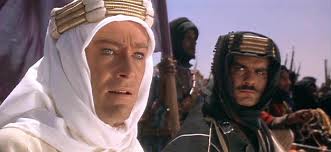
lawrence Greetings again from the darkness. It’s been over 50 years since the film’s initial release and more than 20 since I last viewed it on the big screen. When Cinemark announced it as part of the Classic Film Series, I circled the date on my calendar. While most movies are best viewed in a theatre setting, no other film absolutely demands such a setting.

There are many elements that contribute to the well deserved “classic” label: David Lean‘s direction, Freddie Young‘s photography, the star-studded support cast, the historical significance, Maurice Jarre‘s iconic score, and of course, Peter O’Toole‘s standout and unusual performance. This is an action-adventure film with up close battle scenes filmed with no CGI aid. The famous shot of Omar Sharif‘s Sheriff Ali slowly making his initial appearance on the desert horizon is breathtaking on a 60 foot screen. Watching Lawrence’s victory dance on top of the train is majestic in the theatre, and the big screen provides the necessary ominous feeling as the Arabs slowly navigate the blowing sands of the Nefud Desert culminating in an amazing single shot of the attack on Aqaba.

lawrence2 T.E. Lawrence was a fascinating man, though there has been much debate about the film and his legend. Lawrence’s own writings in “Seven Pillars of Wisdom” provided many details used by screenwriters Robert Bolt and Michael Wilson, as well as the writings of American photo-journalist Lowell Thomas … depicted in the film as Jackson Bentley (Arthur Kennedy). The real life Thomas was looking for a hero and likely sensationalized his story of Lawrence, but most believe the foundation is fairly accurate.  As if to offer an upfront disclosure, Lean begins the film with notice that no one really knew the man.

While the story of T.E. Lawrence is incredibly interesting, the story in the film is somehow just part of the experience. Director David Lean’s movie is a true experience for movie lovers. This was Mr. Lean’s middle film of an incredible streak of three … The Bridge on the River Kwai (1957) and Doctor Zhivago (1965) being the others. Lean insisted on filming on location, rather than in studio despite the nearly four hour run time, and the nearly insurmountable challenges faced when filming in the desert. This decision drove the cost up, but allowed for the stunning visuals that set it apart … and influenced so many future films, not the least of which were Star Wars2001: A Space Odyssey, and of course the Indiana Jones franchise.

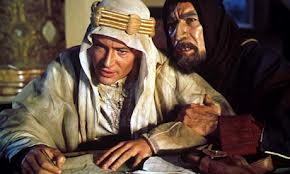
lawrence3In addition to O’Toole’s performance, it is quite exciting to see the dynamic Omar Sharif, the powerful Anthony Quinn (as Auda abu Tayi), the classy Alec Guiness (as Prince Faisal), the kinda creepy Jose Ferrer, the familiar Jack Hawkins and the slightly slimy Claude Rains. Missing from this list is any actress. The movie features exactly zero speaking roles for women … allowing for even more focus on the tendencies and mannerisms displayed by Lawrence.

Maybe the only two actors of the era who could have competed with this fabulous landscape were Peter O’Toole and Marlon Brando. Brando was actually first cast as Lawrence, but soon dropped out to star in Mutiny on the Bounty. O’Toole’s blue eyes and white robe create quite the contrast to the sandy desert. Speaking of contrast, the two times he admires his reflection in his knife are visual keys to his evolution from God complex to broken man. After attending the premiere, writer Noel Coward told O’Toole, “If you had been any prettier, the film would have been called Florence of Arabia.”

The movie received 10 Oscar nominations. It walked away with 7 wins including Best Picture, Director, Cinematogapher, and Score. O’Toole lost out to Gregory Peck (To Kill a Mockingbird). Mr. O’Toole has received 8 Best Actor nominations without ever winning (he does have an honarary Oscar). Watching this film (more than once) is a must for any movie lover. The opportunities to view it in a theatre setting are quite rare, so please seize the chance should it present itself. Your four hour commitment will be rewarded with a movie memory you’ll never lose.  And keep in mind, if the movie makes you feel small, “we can’t all be lion tamers“.

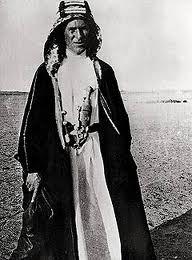
Here is a photo of the real T.E. Lawrence:

lawrence4


TOP GUN (1986) revisited

February 13, 2013

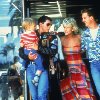
top gun1 “I feel the need … the need for SPEED!”  A recent one week run of the re-mastered 3D IMAX version of Top Gun provided the opportunity to re-evaluate the 1986 film that catapulted Tom Cruise to the highest level of movie stardom.  It seems my initial reactions 27 years ago were spot on.  The best parts are still exhilarating and pure joy to watch, while the worst parts are still cringe-inducing and torturous to sit through.

Testosterone overload, hyper-competitiveness, and Type-A personalities were perfectly displayed thanks to the cocky actors that made up the Navy pilot training class: Tom Cruise, Val Kilmer, Anthony Edwards, Rick Rossovich, Barry Tubb, Tim Robbins and Whip Hubley.  Whether these guys are prepping for flight, ruling the skies, or peacocking afterwards, they are a blast to watch and perfectly capture that familiar pilot-persona. The Navy cooperated with the filmmakers … producers Don Simpson and Jerry Bruckheimer, and director Tony Scott … to ensure the top gun2training was realistic and the flight sequences were breath-taking.  Additionally, some high-powered and experienced Navy pilots were brought in as consultants.

Tom Cruise was considered an up-and-coming actor when cast as “Maverick”. His 1983 film Risky Business brought him much notice … especially for dancing in his tighty-whities … but this is the role that vaulted him into leading man status.  What’s interesting is that many critics pegged Val Kilmer (Iceman) as the future star.  While Mr. Kilmer has had a very impressive career, it certainly doesn’t compare to that of Mr. Cruise.  The female lead went to Kelly McGillis (Charlie), whose star was rising quickly after Reuben, Reuben (1983) and Witness (1985).  Instead of this being her breakout, that label instead went to Meg Ryan (Goose’s wife) who turned a minor role into almost two decades of cute blonde roles in box office favorites.

top gun5 The sequences featuring the fighter jets and pilots in action are some of the best ever captured on film. We never get the feeling that we are being tricked with slick editing or special effects.  On the contrary, it feels like we are in the cockpit and involved in extended dogfights. Another superb element comes courtesy of the two Commanders featured.  James Tolkan plays the cigar chomping Commander of the USS Enterprise, while Tom Skerritt plays Viper, the super pilot and Commander of NAS Miramar’s Fightertown, USA … better known as Top Gun. The real life Viper, Pete Pettigrew, is seen on screen as Charlie’s date Perry in the first bar scene (just after Maverick sings “You’ve Lost That Lovin’ Feeling”).

Over the years, there has been much analysis, speculation and even spoofs concerning the supposed homo-erotic undertones … especially the infamous volleyball game. At the time, no one would have guessed that the real sexual complexity and confusion would come courtesy of a Kelly McGillis confession twenty years later.

top gun3 The “worst” parts referred to earlier include the post-production add-on scenes filmed to allow for a wider audience (interpretation: to appeal to more women). The love scene between Cruise and McGillis is filmed in the shadows and made even more painful by the blasting of Berlin’s “Take My Breath Away”.  The shadows were necessary due to hair style and color changes of the leads since production had wrapped weeks before. That scene and the elevator scene were added because test audiences were disappointed the sparks between Cruise and McGillis had previously dead-ended. Those scenes combined with the “Miami Vice” feel of many of the non-pilot sequences, and the Kenny Loggins “Danger Zone” agony, provide the Jekyll and Hyde feel that wreaks havoc on the viewer.

top gun4 The changes translated into major profits for the filmmakers as Top Gun became the highest-grossing film of the year. It was nominated for four Academy Awards and won for Best Song (“Take My Breath Away”).  Although composer Harold Faltermeyer was not nominated for his Top Gun score, he was nominated the following year for his song “Shakedown” from Beverly Hills Cop II.  Simpson and Bruckheimer were the Super Producers of the 1980’s with other hits like Flashdance and Beverly Hills Cop.  Mr. Simpson died in 1996 at age 52, and Bruckheimer has gone on to produce Pearl Harbor, the Pirates of the Caribbean franchise, and TV series such as “The Amazing Race” and “CSI: Miami”.  He is consistently rated as one of the most powerful people in Hollywood. Director Tony Scott mastered his domain in the Action-Thriller genre with Crimson Tide, Man on Fire, and Unstoppable. Mr. Scott, who is the brother of director Ridley Scott, died in 2012.

Should you feel “the need for speed”, Top Gun is a great call … except when it’s not.

**NOTE: It’s difficult to imagine anyone but Tom Cruise as Maverick, but the role was first offered to others, reportedly including Michael J Fox and Scott Baio. Oh my.

**NOTE: Rick Rossovich who plays Slider is the brother of Tim Rossovich. Tim was a Pro Bowl Linebacker for Philadelphia Eagles, Tom Selleck’s roommate at USC, and had a nice acting career as a movie and TV tough guy.

**NOTE: The Navy capitalized on the popularity of the film by setting up recruiting tables at the largest theatres where the movie was showing.

watch Tom Cruise (Maverick) put his best move on Kelly McGillis (Charlie):

http://www.youtube.com/watch?v=HVNWSEX-WqU


SATURDAY NIGHT FEVER (1977) revisited

February 11, 2013

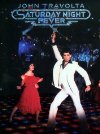
sat night Strutting, Smiling, Smirking, Sulking.  This was a young John Travolta at his best.  It was also director John Badham at his best, as he and screenwriter Norman Wexler adapted a New York Magazine article written by Nik Cohn entitled “Tribal Rites of the New Saturday Night”.  Their work, along with Travolta’s dance moves, changed the way young adults spent their weekend nights.

Given his recent disturbing mentions in the news, it might be difficult to imagine, but in the mid-1970’s, Travolta as Vinnie Barbarino on “Welcome Back Kotter” was idolized (and lusted after) by just about every teenage girl on the planet.  At the peak of that TV show’s popularity, Travolta exploded onto the big screen as Tony Manero, the king of the disco dance floor.  It wasn’t long before every guy’s wardrobe included multi-colored polyester shirts and maybe even a white 3 piece suit.  This movie now serves as a time capsule of the disco era.  But it’s also much more.

Saturday Night Fever can be viewed from a couple of different perspectives.  Many view it as a snapshot of the short-lived disco era, replete with the clothes, music, drugs and preening.  I have always found it even more effective as a coming-of-age story for working class youngsters trying to make sense of the world as they head into adulthood.  Tony realizes he won’t fit in much longer living with his family, but the tough love and advice provided by his paint store boss (Sam Coppola) falls on deaf ears. When Stephanie (Karen Lynn Gorney) starts spouting off her “whole other world” stories from Manhattan, Tony realizes brawling with his buddies is no answer to life’s mysteries.

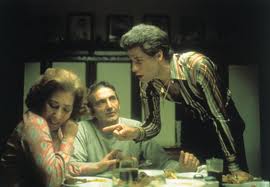
sat night4 Tony is a 19 year old living at home with his traditional Italian parents. His mother, played by Julie Bavasso, is a religious woman who takes great pride in her eldest son Frank Jr (Martin Shakar) being a Priest.  His father, played by Val Bisoglio, is a recently unemployed emotional man who takes his anger out on the family by lashing out. Their family meals are loud and aggressive events filled with pride, physicality and hurtful words. Tony’s joy in receiving a raise at work is quickly shut down thanks to the belittling reaction from his father. Dancing at 2001 Odyssey is Tony’s escape from the realities of his world … and the only place where he is admired for being something special. It’s a feeling he relishes and one everyone should experience.

As viewers, we recognize that this little world of Tony’s threatens to lead him down an obvious path where he will wake up 20 years later as a bitter 39 year old, not so different from his father.  Hanging out with his friends, each searching for their own path while trying not to appear desperate, provides momentary escape but no promise of a brighter tomorrow. When Stephanie enters the scene, Tony sees her as a guiding light to a new world. As viewers, we easily see her insecurities and faux-cultural maturity, but to Tony she offers a ray of hope.  A way out.

sat night5 Tony’s buddies are entertaining in their own ways. Joey (Joseph Cali) and Gus (Bruce Ornstein) are just good, solid guys.  Double J (Paul Pape) is the quietly aggressive one.  He’s the guy that views every day as a chance to seek revenge on anyone who might have done him wrong, even if accidently. Mr. Pape went on to become a prolific voice actor (more than 500 credits).  That’s a bit ironic since he is the quiet one of the group.  Bobby C (Barry Miller) and Annette (Donna Pescow) are the ones who break your heart. Bobby’s girlfriend is pregnant and he is desperate for a magical solution, while longing to be as cool as Tony … or at least not invisible.  Annette is a sad creature who just wants to be loved.  She misreads Tony’s signs and covers her grief with booze, drugs and regrettable sexual activity.

John Badham was mostly a TV director when he assumed the helm for Saturday Night Fever.  He had some Hollywood success the year before with a Negro League baseball comedy featuring Richard Pryor and James Earl Jones called The Bingo Long Traveling All-Stars & Motor Kings. Mr. Badham, the brother of Mary Badham (Scout in To Kill a Mockingbird), went on to have some box office success with War Games and Stakeout, but in 1997, he returned to TV projects and has remained there since.  The film is also known for launching the hugely successful soundtrack, which was the top selling album of all-time until passed by Michael Jackson’s “Thriller” in 1983.  Many of the Bee Gees songs are still played on classic stations today, and “Stayin’ Alive” became the title for the film’s sequel.  The 1983 movie followed Tony’s attempt to break through on Broadway and was directed by Sylvester Stallone. It received brutal reviews and has since faded into oblivion.  In another example of how small the Hollywood community is, Stallone’s girlfriend in Rocky was played by Talia Shire.  Ms. Shire’s first husband was David Shire, who composed the score for Saturday Night Fever.  When they divorced, Mr. Shire married Didi Conn, who co-starred with Travolta in Grease.

Travolta is clearly the most interesting story here. Seemingly at his peak, his career took another leap forward when Saturday Night Fever producer Robert Stigwood hired him for the musical Grease the following year.  In 1980, Travolta was again front and center in a cultural shift as his turn in Urban Cowboy shifted focus from disco dancing to the Texas Two-Step, and the subsequent trend towards mainstream “country” music.  Travolta’s career then went quiet until his first comeback with Look Who’s Talking in 1989.  His second comeback came thanks to Quentin Tarantino casting him in Pulp Fiction.  What many don’t know is that while filming Saturday Night Fever, Travolta’s love interest, actress Diana Hyland died of cancer.  Ms. Hyland had appeared as Dick Van Patten’s wife in season one of “Eight is Enough” and upon her death, his character was presented as a widower.

sat night2 It’s interesting to note that a substantial number in the cast were making their feature film debuts.  That includes Fran Drescher (“The Nanny”) who plays local girl Connie.  Her dancing skills, or lack thereof, lead Tony to make assumptions about her other talents. Also making quick appearances are Travolta’s sister Ann (as the pizza girl) and his mother Helen, who scolds him in the paint store for making her wait so long.  The posters in Tony’s room include Al Pacino in Serpico, Stallone in Rocky, and the iconic Farrah Fawcett swimsuit poster.  Travolta had a key role in the horror classic Carrie, and just missed out on being cast as Meadows in one of my favorite movies The Last DetailRandy Quaid was ultimately cast.  The great film critic Gene Siskel always said Saturday Night Fever was his favorite all-time movie and he even purchased and displayed Tony’s white suit from the film’s climax.

Regardless of how you view it, this little film certainly has its place in Hollywood lore. It launched the film career of John Travolta, changed the cultural nightlife for a generation, taught us not to play on bridges, to take only your allotted time when sharing the backseat, to always chew your food, and whether you are feeling up or down … it helps to strut.

watch a clip of dinner with the Manero’s:

http://www.youtube.com/watch?v=GSruhwZsc9c


GOODFELLAS (1990) revisited

February 7, 2013

goodfellas1 “As far back as I can remember, I always wanted to be a gangster.”  That’s how Henry Hill introduces himself.  He is the narrator and key figure in director Martin Scorcese’s 1990 masterpiece.  What follows Mr. Hill’s intro is the film version of Nicholas Pileggi’s non-fiction book, Wiseguy: Life in the Mafia Family (published 1986).  Every so often the perfect match of writer, director and cast occurs, and Goodfellas is one of those rare treats.

Viewing a 35mm print at the historic Texas Theatre just seemed apropo.  Knowing that this is the realized vision of Mr. Scorcese and his long time editor, Thelma Schoonmaker, caused the numerous VHS and DVD viewings over the years to simply fade away.  The silver screen works wonders for a film with such “big” characters, such startling violence, and such a perfectly inter-woven soundtrack.

Ray Liotta plays Henry Hill, the real life gangster who ended up snitching on the mob and entering the Federal Witness Protection program.  This should not be considered a spoiler because Hill’s story is known worldwide and, well, the movie is 23 years old!  Liotta was a relative newcomer when he exploded onto the screen in Jonathan Demme’s Something Wild in 1986.  His manic performance in that movie led Scorcese to cast him as Henry Hill.   The real life Hill spoke at length with Pileggi for the novel, and the result is a very detailed and nuanced look into the life inside a New York crime family.

goodfellas4 The fascinating aspects are too numerous to touch on them all, but there are some that really stood out in this latest viewing. First, Lorraine Bracco plays Hill’s wife Karen. Watching the development of her character is pure gold on screen. She starts out as a fresh-faced blind date, who pulls no punches in putting Hill in his place after he stands her up … and right in front of his fellow gangsters, no less.  Watching her fall for “the life” is like watching someone get gradually intoxicated.  She seems aware but numb to the rational side of her brain. As Karen develops, she battles through some really tough situations, continues to be Hill’s biggest supporter, and finally his cohort in crime near the end.  She is one of the most interesting and best developed female characters from any gangster movie.

Another really fascinating character to follow is that of Tommy Devito played by Joe Pesci. Tommy is a tough guy born into the life, but the prime example of just never being satisfied. His short fuse temper is responsible for some of the most memorable scenes in the movie.  The “funny like a clown” scene and the fallout from “go home and get your shinebox” are two of the more goodfellas2frightening sequences ever seen on screen, and are perfect examples of what a loose cannon Tommy is. This character is based on the real life Tommy “Two Gun” DeSimone, muscle for the Lucchese crime family.

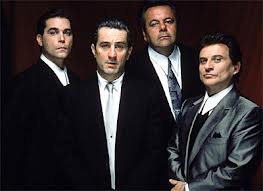
In addition to Karen, Henry and Tommy, the other main character is Jimmy Conway, played by Robert DeNiro. Conway is based on the real life Jimmy “The Gent” Burke, who was supposedly the mastermind behind the infamous Lufthansa heist depicted in the movie.  The Conway character perfectly represents paranoia and greed, while hiding behind the mob loyalty pledge. DeNiro never once overacts here, but his Conway dominates the screen despite the strong presence of Liotta and Pesci … and even Paul Sorvino, who plays mob boss Paulie.  Paulie is based on Paul Vario, the head of the Lucchese crime family. Sorvino plays him as quietly powerful and a guy with a phone phobia (for good reason). Sorvino’s Paulie is the centerpiece of the mob and is totally believable as a guy you better not cross.

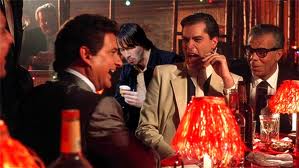
goodfellas One of the more memorable scenes features Jimmy, Henry and Tommy stopping off at Tommy’s mother house to pick up a shovel … and a large, useful knife.  While there, Tommy’s mother (played by Catherine Scorcese, Martin’s mother) not only makes them a huge 3 am Italian meal, but also shows off some of her artwork, and even tells a joke!

What’s really fun to watch as the film progresses is the change of pace and camera work. Watching young Henry earn his stripes is treated with a light, almost comical touch.  As he becomes fully entrenched, we see a young man enjoying the power and respect of his position. This is crystallized by Scorcese’s infamous long-tracking shot through the back entrance and kitchen of the Copacabana as Henry and Karen end up front row by the stage. The downward spiral is much more frenetic with fast cuts and a desperate feel. Scorcese helps us feel the drug-induced paranoia that dominates Henry.

David Chase has stated that Goodfellas had quite an impact and inspired him to create “The Sopranos”, and the marks are goodfellas3quite clear. There is even a significant crossover in the cast as both feature Frank Vincent, Tony Sirico, Frank Pellegrino, Michael Imperioli and, of course, Lorraine Bracco (who was Tony Soprano’s psychiatrist).

Goodfellas was nominated for six Academy Awards, and Joe Pesci was the only winner (Best Supporting Actor).  It lost out in the Best Picture category to Dances with Wolves.  Scorcese has since directed two other critically acclaimed gangster films: Casino (1995, from another Nicholas Pileggi book), and The Departed (2006, which won Scorcese his first Oscar and also won Best Picture). You might also like to know that Pileggi is the creator of “Vegas”, the new TV show starring Dennis Quaid and Michael Chiklis.  The show is about the mob’s influence in the early “wild west” days of Las Vegas.

For years, movie lovers have been debating whether The Godfather or Goodfellas is the best gangster film. As much as I love debate, I see no reason to choose … they are both exquisite filmmaking, though quite different in style. Both films have provided us direction in life.  The Godfather informed us that “It’s not personal, Sonny. It’s strictly business”.  Goodfellas counseled us “Never rat on your friends, and always keep your mouth shut.”   Far be it from me to question the source of good advice!

***PROFANITY WARNING***  This is the unedited “funny like a clown scene” and it’s definitely NSFW!!!

http://www.youtube.com/watch?v=E84VqqCPI7w