DOUBLE INDEMNITY (1944) revisited

November 12, 2011

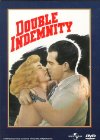
 “I wonder if you wonder.”  Every time I hear Walter Neff say those words to Phyllis Dietrichson as their intial encounter concludes, I smile and settle in for another round of Double Indemnity (1944).  Chris Vognar, Film Critic for the Dallas Morning News kicked off his Fall Film Noir Series (co-sponsored by Dallas Film Society) with one of my all-time favorites.  Though I have seen it many times over the years, this was my first time on the big screen … and from a 35mm print!  So much of the subtle filmmaking becomes apparent – the variance of lighting, the intensity of shadows, and the vividness of close-ups.  This reinforces my belief that we should never miss an opportunity to view good films in a theatre setting … just as the director intended.

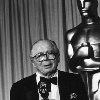
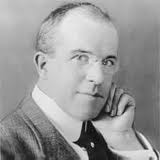
 Since this film was released 67 years ago, I won’t bother about noting “SPOILERS“.  If you haven’t seen it and plan to, you might stop reading here.  If you would like a little insight, then let’s keep going.  Billy Wilder (left) directed the film and his place as a Hollywood legend is quite secure.  He was nominated for 21 Oscars (Director, Writer, Producer) and had 3 wins.  Some of his classics are: The Lost Weekend, Sunset Blvd, Witness for the Prosecution, Some Like it Hot, The Apartment, The Front Page.  Many think of Wilder as a comedic filmmaker and he certainly had success in that genre, but if you watch closely, even his comedies have a dark element to them.

Double Indemnity is based on the novella by James M Cain, who also wrote Mildred Pierce and The Postman Always Rings Twice.  Wilder was a fan of Cain’s book, but knew the dialogue wouldn’t work well on screen.  So together with Raymond Chandler they wrote a screenplay filled with crackling lines and a constant feeling of dread and pending doom.  As great as the script is, it is heightened by a wonderful cast that includes Fred MacMurray, Barbara Stanwyck, Edward G Robinson, Porter Hall, Jean Heather, Tom Powers, Richard Gaines and Byron Barr.

For me, MacMurray’s performance is what brings the words to life and jumps the film to the “must see” category. He is playing against two Hollywood heavyweights in Stanwyck and Robinson, but we are somehow sympathetic to this not-so-bright guy who gets played like a fiddle by the villainous, wily woman he lusts after.  Even as he is recording his confession, a part of us understands how he got drawn into MURDER!  Not just any murder, but one for money and love … only there is no money, and there is no love.

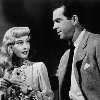
 Ms. Stanwyck is perfectly cast as the femme fatale who weaves her web of deceit and destruction.  She quickly spots the vulnerability of MacMurray’s character and uses her assets just enough to hold the leash tight.  It is a testament to her screen presence that she can pull off the sultry siren while sporting a less-than-desirable blonde wig.  At the time, the wig was so controversial that the producers compared it to George Washington and wanted it trashed.  However, filming was too far along and now it’s impossible to imagine her looking any other way.  Besides, MacMurray only seems to notice her anklet!

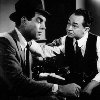
 Edward G Robinson made a name for himself as a tough-guy actor … cop and mobster all rolled into one.  Here he plays the insurance investigator with a sixth-sense for fraudulent claims.  He is a hard-nosed, dedicated employee who takes his responsibility very seriously and has no sympathy for those who cheat his cherished system.  He has a soft spot for co-worker MacMurray, even though he is one of the back-slapping salesmen he so loathes.  Their relationship in the film is one of respect and about as close as two professional men could be, given the era.  When Robinson goes off on his rant about suicide research, he is a joy to behold.  This guy could flat chew scenery.

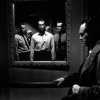
 In addition to the infamous wig, you might also notice that MacMurray is wearing a wedding band throughout the film, even though his character is clearly a single man.  Wilder and MacMurray stated many times over the years that was simply a mistake and not “caught” until post-production.  Expect a chuckle when MacMurray, as the narrator, enviously describes a Spanish style Los Angeles home as costing $30,000 … probably less than the property taxes would be on that house today.  The film originally was to end with MacMurray in the Gas Chamber and Robinson looking on (inset), but this was deemed inappropriate.  One last little nugget: early in the film, MacMurray walks out of Robinson’s office and past a man sitting on a hallway chair reading a paperback book.  That man?  Raymond Chandler, in his only on screen appearance.

The film is often described as quintessential Film Noir.  Another prime example of Film Noir would be The Big Sleep (1946), based on a Raymond Chandler novel, directed by Howard Hawks, and starring Humphrey Bogart and Lauren Bacall.   While Film Noir might not be an easily definable term, there are certain elements that must be present.  Lighting is key.  Shadows must be prevalent.  Some type of detective story is usually at the center, and we typically get some poor schlub of a guy being yanked around by the femme fatale.  The right “mood” is essential … as a viewer we know things are headed down the wrong path, but we just can’t save the characters from their own poor choices.  But neither can we look away.  That helpless feeling is a strong indicator that you just watched a terrific Film Noir.

watch the original trailer:


BASEBALL MOVIES: Readers Poll Results

October 26, 2011

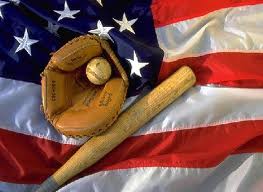
The one constant through all the years, Ray, has been baseball. America has rolled by like an army of steamrollers. It has been erased like a blackboard, rebuilt and erased again. But baseball has marked the the time. This field, this game: it’s a part of our past, Ray. It reminds us of all that once was good and it could be again.” —Terence Mann (James Earl Jones) in Field of Dreams

Thanks to all of you who particpated in the Readers Poll for Favorite Baseball Movies. Although I sensed a minor conspiracy amongst women voters, the final results were pretty close to other published baseball movie lists.  I won’t name names, but the most creative write-in votes were for The Untouchables – noting the scene where Al Capone makes use of a Louisville Slugger, and Touching Home – a vote based, I believe, solely on the blue eyes of Ed Harris.

FINAL RESULTS

1. THE NATURAL

2. FIELD OF DREAMS


3. (tie) BULL DURHAM


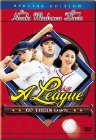
  (tie) A LEAGUE OF THEIR OWN


5. MAJOR LEAGUE


One can’t go wrong with any of the Top 5 as they are all quite entertaining. On the list are a few laugh out loud moments, some high baseball drama, a touch of historical significance, and a heavy shot (or two) of melodrama.

One of the frustrating things about baseball (and most sports) movies is that no matter how talented an actor might be, it’s very difficult to look like you can play the game if you really can’t.  Still, it’s the game, and the memories it creates that have such a grip on us.  Whether playing a pick-up game with our buddies (The Sandlot), watching our team play that magical season (Angels in the Outfield) or simply playing catch with dad (Field of Dreams), most of us carry a connection to the game of baseball and a corresponding special memory. That’s why there are more movies about baseball than football, basketball, hockey, golf and tennis combined.  It truly is the great game.

If you are interested in going a little deeper into the baseball vault, allow me to recommend a few that often get overlooked.

IT HAPPENS EVERY SPRING (1949) – comedy about a scientist who discovers a substance that makes baseballs repel wood. It stars Ray Milland and Jean Peters (who became Mrs. Howard Hughes)

THE WINNING TEAM (1952) – the comeback story of Grover Cleveland Alexander, starring Doris Day and Ronald Reagan.  Yes, the same Mr. Reagan who would go on to become Governor of California and President of the United States.

THE BINGO LONG TRAVELING ALL-STARS and MOTOR KINGS (1976) – comedy about a barnstorming Negro League team from the 1930’s featuring Billy Dee Williams, Richard Pryor, James Earl Jones and directed by John Badham

EIGHT MEN OUT (1988) – the story of the 1919 Chicago White Sox (Black Sox) scandal. It features a couple of then 22 year-olds named Charlie Sheen and John Cusack, and is directed by the great John Sayles.

THE SANDLOT (1993) – a story about kids being kids and the role baseball can play in family, friendship and growing up

KEN BURNS’ BASEBALL (1994) – if you have seen Mr. Burns’ documentary work on The Civil War or Jazz, then you have some sense of the detail and level of research that went into his multi-volume history of baseball

SUGAR (2008) – following the story of a talented Dominican minor league pitcher who dreams of the major leagues.

Thanks again to all who voted.  Pass this along to any baseball and/or movie lovers you know.  The final pitch is two more quotes:

It’s a great day for a ball game, let’s play two!”Ernie Banks

I’ve tried ’em all, I really have, and the only church that truly feeds the soul, day in, day out, is the Church of Baseball.” — Annie (Susan Sarandon) in Bull Durham


FATHER OF AMERICAN ANIMATION

October 14, 2011

 British born and NYC-raised, J. Stuart Blackton has been called the “Father of American Animation”.  As a reporter in 1896, he was fortunate enough to be assigned an interview with Thomas Edison.  The two men hit it off and that meeting inspired Blackton to become expert at stop-motion animation, and combine that skill with his vaudevillian talent of lightning sketches.


His oldest surviving animation is from 1899 and copyrighted in 1900.  It’s called THE ENCHANTED DRAWING


Blackton’s most famous animation is from 1906 and is entitled HUMOROUS PHASES OF FUNNY FACES


Blackton enjoyed a long and prolific career as a film director; however, it’s his pioneering of animation for which he is best remembered.  His early stop-motion work continues to influence animators more than a hundred years later.


STEVE JOBS remembered

October 6, 2011

 When writing about movies, I will sometimes use the words “genius” and “brilliant” to note a particularly standout acting performance, script writer or director.  The use of those same two words to describe Steve Jobs seems almost comical.  He truly was a GENIUS and a BRILLIANT man.  He was transcendent for our time.  He has been labeled a modern-day Thomas Edison, and such a claim doesn’t even raise an eyebrow. 

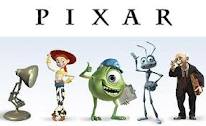
Mr. Jobs’ legacy at Apple is well documented and widely known.  The iPhone is a staple of everyday life and Mac users go way beyond brand-loyal.  But what of his impact on movies?  Are you aware?  In typical fashion, Jobs never really discussed his impact on Pixar.  The studio began as a division of LucasFilm, the production arm of George Lucas’ movie world.  In 1986 Jobs acquired Pixar and quietly began changing the way movies get made.  His time away from Apple allowed him to assemble an amazingly talented team and work diligently to push the envelope on technological capability.

 In 1995, after much success with experimental short films, Pixar released its first full length feature.  Perhaps you have heard of it … Toy Story.  The story of Woody and Buzz was a hit with kids and adults and went on to gross $360 million.  And that was just the beginning.  Pixar continued to produce top quality, highly creative, and incredibly entertaining films that were a visual feast.  In 2001, a new Academy Awards category was created … Best Animated Feature.  Since then, Pixar has taken home the Oscar in this category SIX times and their 12 features have taken in over $7 billion worldwide!

In 2006 Jobs sold Pixar to Disney for $7.4 billion and he became the largest single shareholder for Disney.  As he re-immersed himself in Apple, his influence on Pixar was lessened, but his impact was clear and lasting.  John Lasseter, the famous Pixar producer, writer and director stated that the single most impactful directive that Jobs left at Pixar was “Make it Great”.  Whether phones, portable music, computers or movies … Steve Jobs strove for greatness and showed us the true meaning of Genius and Brilliant.


Last Chance to VOTE – Baseball Movies

October 5, 2011

 We baseball fans take the American Pastime very seriously.  That is especially true every September when we hold our collective breath in hopes that our team doesn’t join the 1964 Philadelphia Phillies as infamous chokers.  Baseball movies are an entirely different world for us.  We are forced to flip off the swich to the portion of our brain that instantaneously and simultaneously calibrates the pitch count, number of outs, who’s warming in the bullpen, positioning and arm strength of the outfielders, and the speed of the runner on second base.

 Over the years, baseball movies have subjected us to such cringe-inducing moments as Jimmy Stewart pitching, John Goodman swinging a bat, Shoeless Joe Jackson hitting right-handed, Robert DeNiro’s throwing motion, and walk-off home runs by the visiting team.  Yet, we continue to give most every baseball movie a chance because the magic of baseball can only be rivaled by the magic of movies.  Every so often we are rewarded with a perfect moment such as James Earl Jones‘ eloquent soliloquy or catcher Crash Davis mentoring Nuke on dealing with reporters … and all is right with field and film.

 September has passed and October baseball is here.  Moneyball has entered baseball movie discussions during this year’s playoff series.  The Red Sox and Braves have now joined the ’64 Phillies in the lore of historic collapses.  The dreams of their fans were sufficiently deflated and Late Night jokes aplenty.  It seems the perfect time to elicit responses for your favorite baseball movies of all time.  Since there are more than 200 baseball movies, I have tried to jog your memory by listing about 40 of the most famous.

Please VOTE for your 3 favorites in the COMMENTS section below.  Write-in votes are welcome and please send this to your friends and any baseball fans you know … results will be announced during the World Series.  If you ever doubt the emotion and life lessons of baseball, just watch Steve Martin in this clip from Parenthood:

A League of Their Own (1992)           Amazing Grace & Chuck (1987)

Angels in the Outfield (2000)                  Babe (2000)

The Babe Ruth Story (1948)                    Bad News Bears (1976)

Bang the Drum Slowly (1973)              Baseball: by Ken Burns (1994) 

Bingo Long & Traveling All-Stars (1976)       Bull Durham (1988)

Cobb (1994)                                                       Damn Yankees (1958)

Death on the Diamond (1934)                     Eight Men Out (1988)

The Fan (1996)                                               Fear Strikes Out (1957)

Fever Pitch (2005)                                           Field of Dreams (1989)

For Love of the Game (1999)                         Game 6 (2005)

The Heckler (1940)                           It Happens Every Spring (1949)

Little Big League (1994)                                        Long Gone (1987)

Major League (1989)                                            Mr. Baseball (1992)

Mr. Destiny (1990)                                                Mr. 3000 (2004)

Moneyball (2011)                                                  The Natural (1984)

The Pride of St. Louis (1952)           The Pride of the Yankees (1942)

The Rookie (2002)                                      Rookie of the Year (1993)

Safe at Home (1962)                                            The Sandlot (1993)

The Scout (1994)                                                       61* (2001)

The Stratton Story (1949)                                    Sugar (2008)

Up for Grabs (2004)                                  The Winning Team (1952)

Check back during the World Series for the results and an article on baseball movies.  Just click on “Leave a Comment” to type in your 3 favorite baseball movies (in order)!


September 11: In Remembrance

September 11, 2011

 This is a movie blog, so it seemed appropriate to honor the World Trade Center with a short video of the 700 or so movies that have featured the towers.  I did not make this video, but found it interesting to see just how often the stunning towers played a role … and just how for granted I once took their presence.


JAWS (1975) revisited

July 15, 2011

 Greetings again from the darkness.  Ba-dum.  Two of the more recognizable notes from any movie musical score are courtesy of 5-time Academy Award winner (45 nominations!), composer John Williams.  A truly great score plays a vital role in the emotional connection that a viewer makes with a movie.  In some movies, we barely notice the music.  Not so with the Jaws theme.   In 1975, it signaled an immediate jump in our blood pressure and has since glided right into becoming part of our societal lexicon – musical slang for “danger is on the way”.

You are probably wondering why I am writing about a 36-year old movie … especially one that revolves around shark attacks.  Haven’t we had more than our share of monster and disaster flicks?  Well, my friends, it’s time for you to re-discover the wonderment, joy, anxiety, humor and humanity of Jaws.  I did just that last evening at a screening provided by the Dallas Film Society, Dallas Morning News and film critic Chris Vognar.

 When Jaws was first released in 1975, I saw it three times over three consecutive days.  I couldn’t get enough!  It was, after all, the first “summer blockbuster”.  At the time, I was the ultimate beach lover, and along came a movie that was so frightening, it convinced people to stay out of the water!  Over the years, I have watched it quite a few times on cable/tape/DVD, but not until last evening was I able to re-live that theatrical experience from the summer that changed movies forever.  Last night the theatre was full, and nearly a third of those in attendance claimed to have never before seen the movie.  So my hope is that you will make time for this classic film … whether it’s your first time, or your twentieth.  Introduce it to your kids, grandkids, nieces and nephews (if they are ready).   Talk about what makes it great, and about all the movies it has since influenced.

Rather than “review” the movie, I will point out some interesting details on how it was made, its legacy and even some of my favorite moments from the movie.

Director Steven Spielberg was 28 years old when the movie was released.  He had already made some noise as a filmmaker with Duel and Sugarland Express, but it was the success of Jaws that labeled him wunderkind.  The now-legendary Spielberg went on to direct such classics as Close Encounters of the Third Kind, three Indiana Jones movies, The Color Purple, the first two Jurassic Park‘s, Schindler’s List, and Saving Private Ryan.  He is also listed as Producer on more than 120 other projects.  He is the ultimate ‘mover and shaker’ in Hollywood.   But Jaws was his last movie where the burden of expectations and box office results were minimal.  Jaws went on to gross almost a half billion dollars worldwide … an unheard of level at the time (movie tickets cost about $2.oo each in 1975).

 The story is based on the first novel by Peter Benchley, who would later write “The Deep” and “The Island“.  Mr. Benchley also appears briefly in the film version of Jaws as a reporter on the Amity beach.  The novel was a best seller, but much darker in tone than the Spielberg film.  Spielberg turned the book’s key characters into less abrasive personalities, while maintaining the colorful attitudes.

 Speaking of characters, many people tend to focus on Roy Scheider‘s Martin Brody,  Chief of Police on Amity Island.  He really does a nice job as the no-nonsense non-islander attempting to fit in without poking too much fun at the “problems” of the locals.  Others are drawn to the performance of Richard Dreyfuss as Oceanographer Matt Hooper.  Dreyfuss is far and away the most energetic of the actors, and his cocky, know-it-all, rich boy makes for a terrific contrast with the other more subdued characters.

The guy to really watch in this movie is the great Robert Shaw as Quint, the crusty local fisherman who vows to kill the shark for a huge fee.  Spielberg originally wanted Lee Marvin for the role, but it’s difficult to imagine anyone other than Shaw as the tough-as-nails Quint.  His sililoquy regarding his USS Indianapolis ordeal is mesmerizing and fascinating … and that scene alone should have won him the Best Supporting Actor.  Yet somehow, he wasn’t even nominated in the year that had, yes, George Burns winning for The Sunshine Boys.  Shaw’s character comes across as true salt of the sea, and watching him co-exist on a small boat with Scheider and Dreyfuss for the entire second half is movie-watching glory.  As they compare scars and enjoy an adult beverage, we are afforded a brief laugh outloud moment.  And don’t miss Scheider giving momentary consideration to flaunting his appendix scar.

 Much has been written over the years about the animatronic shark.  It was nicknamed Bruce, after Spielberg’s attorney.  Bruce gave the filmmakers a great deal of trouble and, because of that, the film works even better.  We don’t glimpse the shark until well into the movie, giving tension and anticipation much time to build.  Until the last few minutes, we really don’t get a full-on view of the shark, but it SEEMS like we do!

The Mayor of Amity is played by Murray Hamilton.  Mr. Hamilton is well remembered as Mr. Robinson … husband to THAT Mrs. Robinson … in The Graduate (1967).  In that movie, he refused to shake Dustin Hoffman‘s hand.  Here, he refuses to close the beaches, for fear of losing tourist revenue.  He only has a hand full of scenes in Jaws, but each is quite memorable.  Watching him speechify to the cameras, politicize to the citizens, and nearly break down while smoking in the hospital, adds depth and intensity to the film.

The trivia associated with Jaws is abundant.  What’s really important is that this is an incredibly well made movie that holds up extremely well today.  When you watch it, notice how you immediately understand the feelings of the locals at the town hall meeting, the desperation of the deputy, the shame of the Medical Examiner, the bravado of the fishermen and the confusion of Brody’s wife.  Notice the camerawork as it varies between the viewpoint of the shark, the viewpoint of a character, or interested onlooker to the beach happenings.  Check out the masterful film editing with three characters battling for space aboard the Orca.  Great stuff.

Jaws was nominated for Best Picture, but lost out to One Flew Over the Cuckoo’s Nest.  It did win for Best Editing, Best Sound, and Best Music (score).  Its lasting impact includes the genius of Spielberg, turning Summer into Movie time, and that iconic score.  Ba-dum.  Stay out of the water!

Check out the original trailer from 1975:


2011 – FIRST HALF RECAP

July 4, 2011

Greetings again from the darkness.  Yep, it’s mid-year again.  So you can stop holding your breath waiting for me to recap the movie year thus far!  You will also get a glimpse into what’s coming up in the next 6 months.  Even in a year like this, when the overall film quality has been mediocre at best, I always hold out hope for an exciting second half … and this year is no different.

Let me remind you that it will be next January before I publish my list of favorite films in order.  What I provide below is groupings of what I think are the best so far.  Some of these may make the year-end list, while most will not.  Just for fun, I also include my list of most disappointing movies through June.  As always, these represent my opinion and may or may not be aligned with your tastes, beliefs or standards.

 So, as usual, let me start by contradicting what I just said.  Far and away my favorite cinematic experience in 2011 has been Terrence Malick‘s The Tree of Life.  It also happens to be one of the most divisive films of the year.  People either connect with it or they walk out absolutely frustrated and annoyed.  Some theatres have taken to posting a warning to patrons that the film does not follow a typical Hollywood narrative or story arc.  Mr. Malick’s latest work is either inspiration for introspection or it’s motivation to request a refund.  I understand both reactions.

Now that I cheated at my own game … here is the best (so far) of 2011, by category … and notice, they are in alphabetical order:

COMEDY

 Bridesmaids – raunchy women’s comedy that even men can appreciate

Cedar Rapids– underrated script with laughs and a message

Midnight in ParisWoody Allen’s terrific homage to literary giants

Rango – animated hilarity and genius (for all ages)

DRAMA

 Beginners – touching story showing it’s never too late to love

The Conspirator – historical drama around Lincoln assassination

Hanna – action thriller that defies description

Jane Eyre – expert version of the iconic novel

Win Win – terrific script highlighting doing right by others

DOCUMENTARY

 Bill Cunningham New York– NYC fashion through a brilliant man’s eye

Buck – Cowboy zen

Hot Coffee – things you don’t know about the justice system


OTHER

 Barney’s Version – cynical dramedy with Paul Giamatti at his best

In a Better World – stark drama from Denmark

Pirates of the Caribbean: On Stranger Tides – Captain Jack is back

Source Code – thrilling and humanistic sci-fi from son of Bowie

Super 8 – nostalgic Speilberg courtesy of JJ Abrams

MOST DISAPPOINTING

Atlas Shrugged: Part 1 – embarrassingly bad version of classic novel

The Greatest Movie Ever Sold – not Morgan Spurlock’s best work

The Hangover Part II – same jokes, different city

Larry Crowne – a thesis on bland and generic moviemaking

Sucker Punch – should have been greatness

Now, let’s look ahead at the second half “Coming Attractions”.  Here are a few movies that have piqued my interest.  They are separated by wide release films versus independent or smaller budget types that may only receive limited release.

Big Budget Releases:

 Captain America: The First Avenger – will the next Superhero come on down!

ContagionSoderbergh sci-fi with Kate Winslet and Matt Damon

Cowboys & Aliens – James Bond and Indiana Jones, together at last

Dream House – newlyweds Daniel Craig and Rachel Weisz

The Girl with the Dragon TattooFincher re-do of Swedish cult classic

Harry Potter and the Deathly HallowsJK Rowling may have to get a job

 The Help – film version of best seller featuring Emma Stone

The Ides of March – Dirty politics with Clooney, Giamatti, PS Hoffman, Gosling

The Iron LadyMeryl Streep as Margaret Thatcher

Moneyball – Baseball, Oakland A’s style

Wanderlust – raunchy comedy with Paul Rudd and Jennifer Aniston

War Horse –  Steven Spielberg WWI Oscar entry


Independent Films/Limited Release:

 Attack the Block – Sundance favorite as London teens battle alien invasion

The DescendantsSideways director is back w/ Clooney as mourning dad

The Devil’s Double – chilling story of Saddam Hussein’s son

Drive – action film with Ryan Gosling and Carey Mulligan

Page One: A Year Inside the New York Times – doc on print v. social media

The Rum DiaryJohnny Depp in Hunter S Thompson story

Sarah’s KeyKristin Scott Thomas solving puzzle of Vel d’Hiv

While it will be 6 months before we know how many of these actually make their mark, let me know which were  your favorite and least favorite movies of the first 6 months.  I see a lot of movies, but I don’t see everything … so let me know what I missed!

See you at the movies!!


ELIZABETH TAYLOR remembered

March 23, 2011

Even though she flirted with illness and death countless times over the last 50 years, it still came as a shock to hear the morning news of Elizabeth Taylor‘s passing.  Unless you are a movie buff or over 40 years old, you can’t understand what a glamorous, elegant movie star she was.  She truly was the last of Hollywood’s Golden Era.

She burst onto the scene as a 12-year-old in 1944’s National Velvet, but with the current release of Jane Eyre hitting theatres, it should be noted that she had a small, yet eye-opening role as a dying girl in the 1943 version with Orson Welles and Joan Fontaine.  For the next 68 years, Elizabeth Taylor never stopped opening eyes!

 Don’t make the mistake of thinking her popularity and notoriety came only from her beauty.  She was an immensely talented actress who received 5 Oscar nominations and won the award twice.  At the age of 18, she seduced (onscreen) Montgomery Clift into killing his girlfriend (Shelley Winters) in A Place in the Sun.  Movie watchers totally understood why he did it.  Those unique violet eyes set off by rare double eye-lashes (a genetic mutation), made her a stunning beauty to go along with her captivating spirit.

 She sizzled onscreen in back-to-back Tennessee Williams scripts: Cat on a Hot Tin Roof (1958) and Suddenly Last Summer (1959).  In 1963, her life changed dramatically.  When approached to play the title role in Cleopatra, she laughed off the producers and told them “only for a million dollars”, which was an unheard of salary for an actress in the day.  When they agreed, she became the first million dollar actress, and more importantly, met and fell in love with Richard Burton during filming.  “Liz and Dick” became worldwide phenomenons as stars and celebrities.  Living the “high life” was a normal day for these two.

 1966 brought about what I call the first Reality Show … Elizabeth Taylor and Richard Burton in Who’s Afraid of Virginia Wolfe?  With an explosive performance by Liz,  many assumed their characters mirrored the couple in real life.  The film received a dazzling 13 nominations, including a win for Ms. Taylor.  There were many additional performances after this, but by 1967’s The Taming of the Shrew, she had a 20 year career that was multi-dimensional and astounding.

Speaking of astounding, the only thing more amazing than her career was Elizabeth Taylor’s personal life.  She grew up in the public eye and never left.  EIGHT marriages, including two to Mr. Burton.  When husband Mike Todd was killed in a plane crash, she fell into the arms of his best friend, Eddie Fisher.  Unfortunately, Mr. Fisher was married at the time to American icon Debbie Reynolds (Singin’ in the Rain) and they had a daughter, Carrie Fisher (the future Princess Leia of Star Wars).  Of course, Mr. Fisher ended up on the short end after Liz met Burton … but you start to get the idea.

After she divorced Burton the second time, she married U.S. Senator John Warner and became a true politician’s wife.  Her final starring role was in 1981, but she became renowned for her charity work … best known for her tireless fundraising for AIDS research – stemming from the loss of her friend, Rock Hudson.  They remained close after filming Giant (James Dean‘s last role).  Later, she became a friend and trusted advisor to the enigmatic Michael Jackson.  She was probably one of the few who could relate to his level of fame and the baggage it brought.

 While there will be no shortage of obituaries and tributes to Ms. Taylor, this may be one of the few that ends with a SPORTS story.  In 1989, Jerry Jones invited Elizabeth Taylor to perform the official coin toss at a Dallas Cowboys – Washington Redskins football game.  Ms. Taylor flubbed the moment when she actually called “heads” after flipping the coin … thereby requiring a re-toss.  Even at mid-field, she was a star!


THE LAST DETAIL (1973) revisited

March 11, 2011

 Greetings again from the darkness.  Last evening I attended the second film in the monthly 1970’s series being presented by the Dallas Film Society, Landmark Magnolia Theatre and Chris Vognar of the Dallas Morning News.  This one happens to be one of my all-time favorites and one that seems to have been forgotten by many … THE LAST DETAIL.

It would be easy enough to understand how the film has drifted into oblivion and become just another one of the many fine films that were born during an incredibly prolific and ground-breaking era, if not for these factors:

1. It received 3 Academy Award nominations: Best Actor (Jack Nicholson); Best Supporting Actor (Randy Quaid); Best Adapted Screenplay (Robert Towne)

2. It features what may be Jack Nicholson’s finest performance, and certainly one of his top 5.

3. The screenplay was written by the great Robert Towne from the novel by Darryl Ponicsan

4. The film was directed by the beloved (but troubled) Hal Ashby, who had a remarkable string of films that garnered a very faithful following

5. Its humor and poignancy hold up very well today as evidenced by last night’s audience response

 Admittedly, I have always viewed this as a “Guy’s movie” – one of those movies that guys love to quote and girls love to hate.  The audience last night was at least one-third female and the overall response was very strong, especially from those who had not previously seen the movie.  Sure, there was one lady who called the film “despicable”, but as Mr. Vognar pointed out, she was probably bringing her own values and morals into the story. 

To do that is to miss the point entirely.  No denying, there is an enormous amount of booze, fighting, shoplifting, prostitution and swearing.  Oh my, the amount and severity of swearing never ceases to amaze. What’s important to note, and has been stated by Mr. Towne on numerous occasions, these are lifelong military men who feel trapped and powerless most of their waking hours.  The swearing and bravado serve as their defense mechanism … their last grasp of independence. 

Though I have seen the film numerous times over the years, I was struck by two things last night.  First, Randy Quaid’s performance brings an incredible amount of humanity and sympathy to a character that demanded a certain approach.  Many actors would have over-played it, but 22 year old Quaid’s baby-face works magic in the scenes where we see the two hard-nosed sailors begin to soften their stance.  Second, Otis Young as Mulhall showed much more range than I had remembered.  He is the perfect centerpiece between Nicholson and Quaid.  As a side note, this was Gilda Radner‘s big screen debut and a couple of years before the birth of Saturday Night Live.

 A quick note on Nicholson.  This is a far different Nicholson than what we have seen recently in The Bucket List or Something’s Gotta Give.  He was coming off a star-making turn in Five Easy Pieces and was on his way to Chinatown and One Flew Over the Cuckoo’s Nest.  This is a great actor at his absolute peak.  Sure, there is the infamous “I am the bleepity-bleep Shore Patrol” outburst in the bar, but more impressive are his scenes on the trains, or at the picnic.  Great stuff.

Lastly, I’ll mention director Hal Ashby.  His string of fabulous “little” films include Harold & Maude, The Last Detail, Shampoo, Bound for Glory, Coming Home and Being There … each quirky, but incredibly insightful, and proof of just what a fine filmmaker he was.

Next month’s screening is the political conspiracy thriller The Parallax View.  It was directed by Alan Pakula and stars Warren Beatty.  For all you youngsters, there was a time when Warren Beatty was Hollywood royalty and not just the old guy who hangs around Annette Bening.