THE SECRET GARDEN (2020)

August 6, 2020

 Greetings again from the darkness. In the years since Frances Hodgson Burnett’s novel was first published in 1911, “The Secret Garden” has become one of the most popular and oft-read children’s books. Previous film adaptations include the 1949 version with Margaret O’Brien and Dean Stockwell, and the 1993 version with Kate Maberly and Maggie Smith. Additionally, the novel has been adapted numerous times for the stage and television. Director Marc Munden is working with the screenplay adapted by Jack Thorne (WONDER, 2017), and the two had previously collaborated on the BBC series “National Treasure”. Readers of the beloved novel will certainly recognize the changes and differences within this version, both in characters and theme.

As the film begins, we are told it’s “the eve of Partition”, which was the 1947 division of British India into two separate states: India and Pakistan. This timing is, of course, quite a bit later than Ms. Burnett’s setting, but the effect is the same – young Mary Lennox (Dixie Egerickx) is orphaned when her parents die, and left alone when the servants desert her. She is shipped off to live with an uncle (Oscar winner Colin Firth) she doesn’t know. Accompanied to massive Misselthwaite Manor by the housekeeper, Mrs. Medlock (Julie Walters), Mary quickly understands that Uncle Archibald Craven is a grieving widow (his wife was Mary’s mother’s sister) who is not to be disturbed, and his hunchback is not to be stared upon. Mary soon learns that her spoiled brat manner will not be tolerated, though her natural spunk will prove advantageous. The young girl is one who is accustomed to be waited on, while also wanting to prove her independence.

Mary’s imagination is extraordinary and she often asks, “Do you want to hear a story?” CGI effects allow us to see what she has envisioned, whether it’s the wallpaper coming to life, or her mother and aunt frolicking through the halls or swinging in the garden. Mary soon befriends Martha the maid (Isis Davis), and then happens upon “Jemima” the dog while wandering the estate grounds. It’s here where the fantastical and supernatural meet reality, and a helpful Robin leads Mary to the key that unlocks the gates of the gardens that have been locked away since Uncle’s wife died. Mary and her new friend Dickon (Amir Wilson) go on adventures through the garden – a garden which has mystical powers.

One evening Mary hears cries echoing in the halls of Misselthwaite. Despite being forbidden from exploring, she discovers her cousin Colin (Edan Hayhurst) locked away in a far off bedroom. Colin is a sickly child, supposedly stricken with a spinal problem that keeps him from going outside. Mary continues to visit Colin, and soon she and Dickon are sneaking Colin into the secret garden, where the magical healing powers begin to take hold. The titular garden doesn’t make an appearance until about one hour in, but its beauty and wonder are on full display.

This is a story about the power of loss and grief and depression, and it offers the life lesson that the things we care for blossom and grow and thrive. This version has some elements of such classics as “Peter Pan” and “The Chronicles of Narnia” in that fantasy and magic play a much larger role than in the novel. Director Munden employs a darker approach and seems to emphasize self-discovery. Young actress Dixie Egerickx was a standout in the recently watched SUMMERLAND, and she is terrific here – despite the changes to the story that some fans might not embrace. The film seems a bit disjointed at times, but it’s always a feast for the eyes, and offers up one of the year’s best scores, courtesy of Oscar winner Dario Marianelli (ATONEMENT, 2007).

Available Video on Demand August 7, 2020

watch the trailer:


WAITING FOR THE BARBARIANS (2020)

August 6, 2020

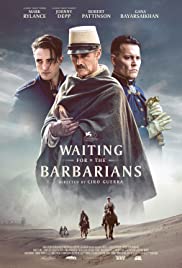
 Greetings again from the darkness. Nobel Prize winning author J.M. Coetzee’s revered novel was first published in 1980, and renowned composer Philip Glass later adapted the South African writer’s work into a 2005 opera. It’s a fascinating piece of literature that, on the surface, doesn’t lend itself easily to the silver screen. Perhaps it works because Mr. Coetzee wrote the screenplay himself, and rising star director Ciro Guerra brings it to life. Mr. Guerra’s two most recent films were both excellent: BIRDS OF PASSAGE (2018) and EMBRACE OF THE SERPENT (2015).

Mark Rylance (Oscar winner for BRIDGE OF SPIES, 2015) stars as The Magistrate of a desert outpost on the fringes of territory controlled by ‘The Empire’. The Magistrate is mild-mannered and non-confrontational. He’s a fair administrator, and Rylance’s outstanding performance ensures he’s a sympathetic figure, yet not a perfect man. The Magistrate’s approach is to maintain a peaceful co-existence with the local nomads, who are described as ‘barbarians’ by others in The Empire.

Things change quickly and severely when Colonel Joll (Johnny Depp) arrives at the settlement. We see his approach thanks to cinematographer Chris Menges’ beautiful wide shot of Joll’s horse-drawn carriage surrounded by desert and mountains. Depp plays Colonel Joll as a stoic man committed to a mission he never fully states. Instead he sermonizes about his interrogation process with such gems as “patience and pressure” are the key, and “truth has a certain tone”. It’s not long before we learn, right along with The Magistrate, that Joll’s definition of ‘pressure’ would be termed torture and brutality by any reasonable person. His ruthless ‘interrogations’ lead to the result he was sent to obtain: the local barbarians are planning an uprising.

Director Guerra provides sub-chapters for the various seasons through which the story progresses. The Colonel arrived in “Summer” sporting sunglasses, and proclaiming “Pain is truth. All else is subject to doubt.” It’s a mantra that plays out in various ways. “Winter” brings ‘the girl”, a native with two broken ankles and other signs of torture. The Magistrate and the girl (Gana Bayarsaikhan, EX MACHINA) have an unconventional relationship, one that doesn’t go over well with Joll’s police force or the other locals, including Mai (Greta Scacchi), one of the loyal outpost staff members.

“Spring” is subtitled ‘The Return’, and it includes The Magistrate returning the girl to her people, and his subsequent return to the outpost where Joll’s second-in-command, Officer Mandel (Robert Pattinson), has him arrested and tortured for consorting with the enemy. Pattinson plays his role in wild-eyed contrast to Depp’s stoicism. When “Autumn” rolls around, it becomes clear that the real question is, “Who is the enemy?” or, perhaps, “Who are the real Barbarians?” The Magistrate is viewed as a traitor and laughingly referred to as “one just man”.

It’s frustrating at times to think about the modern day application of this story. What is an empire? The violence, narcissism, and lust for power lead to a loss of humanity that is painful to observe. Filmed in Morocco and Italy, the oppressive nature of the frontier makes this quite a downer, and one that requires effort and time to connect as a viewer. It also allows Menges and his camera to capture the details of the office and apartment, along with the sparseness of the jail … both in contrast to the vast frontier. This is a either a tale of morality or a cautionary warning shot that solidifies Joll’s adage. Perhaps pain is indeed required for truth.

Available On Demand August 7, 2020

watch the trailer:


MADE IN ITALY (2020)

August 6, 2020

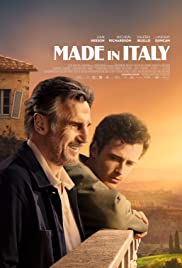
 Greetings again from the darkness. The Tuscan region of Italy is one of the most beautiful places on earth. It’s a terrific choice for the setting of one’s first screenplay and directorial debut. It’s also a marvelous spot for real life father and son actors to work together. All of that is in play here as noted actor James D’Arcy delivers his first feature as writer-director, and the father-son team of Liam Neeson and Micheal Richardson star as, yes, father and son. This is a story of estrangement and re-connecting amidst the glorious wonder of Tuscany.

Jack (Micheal Richardson) has delayed signing the divorce papers delivered by his wife Ruth (Yolanda Kettle, “Marcella”) in hopes of buying her family’s art gallery, which he has been managing. Ruth gives him one month to come up with the money. Jack knows his only hope is to sell the Tuscan estate he co-owns with his estranged father Robert (Liam Neeson). Father and son have rarely spoken since the mother-wife was killed in a car accident while Robert was driving. Like most any parent under duress, Robert made decisions he thought were best for his son, but were actually made with self-interest. In the wake of tragedy, rarely is shipping the kid off to boarding school a better choice than pulling them closer. This prevented the development of any relationship, though it also created a block in bohemian artist Robert’s work.

When they arrive at the home, the men are shocked at the advanced state of disrepair. Sharp-tongued local real estate agent (and ex-pat) Kate (Lindsay Duncan) gives them little hope for a sale unless renovations are made. The manual labor drives yet another wedge between father and son, and Jack finds an attractive good listener in local restauranteur and chef Natalia (Valeria Bilello). She happens to love the house he owns and, in jest, offers a dish of her “amazing” risotto as down payment.

The challenges of home renovations coupled with the locked away memories lead Jack and Robert to a breakthrough, but Jack’s issues with his wife and Natalia’s troubles with her ex-husband mean nothing goes smoothly for anyone. Most of the movie is spent with each of these folks trying to come to grips with the personal waters they themselves muddied.

Micheal Richardson does a very nice job here, and actually holds his own on screen with his powerhouse father. Richardson is the son of Liam Neeson and Natasha Richardson, and the grandson of Oscar winners Vanessa Redgrave and Tony Richardson, and the great-grandson of actor Michael Richardson. It’s nice to see father and son working together, though the story line might have hit a bit too close to home, given the death of Natasha Richardson in 2009 (a skiing accident). Writer-director James D’Arcy is known for his fine work in front of the camera, including Christopher Nolan’s DUNKIRK. Thanks to the work of cinematographer Mike Eley in capturing Montalcino, Mr. D’Arcy’s first feature behind the camera is watchable, despite being easily predictable and formulaic.

watch the trailer:


OUT STEALING HORSES (2020, Norway)

August 6, 2020

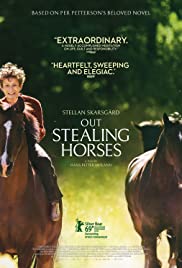
 Greetings again from the darkness. Contrasts are plentiful in this film. The bleakness of winter versus the greenery of summer. The resignation of old age versus the naivety of youth. Pet Petterson’s award-winning novel was released in Norway in 2003, and then in English version in 2005. Norwegian director Petter Moland tackles it with the best intentions, though the nuances prove too much for one movie. Mr. Moland is a fine director as evidenced by his excellent IN ORDER OF DISAPPEARANCE (2014) with Stellan Skarsgard and the English remake COLD PURSUIT (2019) with Liam Neeson.

Morland and Skarsgard reunite as the actor takes on the role of the elder Trond, who we first see as he has relocated to Norway from Sweden. Through his narration, we learn Trond has lived in Sweden for 42 years, and it’s a chance meeting with his new neighbor Lars (Bjorn Floberg) that triggers memories of one summer when he was 15 years old. It’s now 1999, and the impending new millennium has Trond self-isolating on top of the grief and loneliness he has carried since his wife was killed in a car crash. Skarsgard is an actor who can be either sympathetic or powerful, and he brings gravitas to a character who is mostly lost at this late stage in life.

Much of the film is spent in Trond’s flashback to 1948, when he lived the summer with his father, a “practical” man, at his cabin in Norway. Young Trond is played very well by Jon Ranes in his first role. He clearly admires his father (Tobias Santelmann, KON-TIKI, 2012) and enjoys working beside him and taking rain showers alongside. Over the weeks, Trond and his father become entangled with a village family after a tragedy involving Lars (the future neighbor) when he was very young, and Lars’ father and mother (Danica Curcic). What follows for Trond are the things in life that cause us to alter our view of people and the world. Lost innocence is rarely easy.

Cinematographer Rasmus Videbaek (A ROYAL AFFAIR, 2012) captures the beauty of nature during the 1948 summer, as well as the stark white stillness of 1999 winter. Some of the look and feel and symbolism reminds of the work of Terrence Malick. The stunning Norwegian landscapes play a role for us as viewers and for Trond. There are also some quiet moments that carry weight between the elder Lars and Trond, as the missing pieces of life slowly fall into place.

The elder Trond states his goal is “to sleep as heavily as possible without being dead”, but we see part of him may have already died. Flashbacks to that summer, and even earlier during the war, combine with some awkward conversations with Lars to fill in gaps that had blurred over the years. Childhood memories from old age are often not to be trusted, but coming to grips with one’s family and the past may bring peace – or it may not. Trond is an avid reader of Dickens’ “David Copperfield” and there are many references throughout. He’s even given life advice: “Don’t be bitter”, which is a worthy goal for all. It’s an odd film with multiple timelines and damaged characters at different stages. It may not reach the level of Petterson’s novel, but director Moland gives us plenty to mull.

watch the trailer:


PSYCHOMAGIC, A HEALING ART (2020, doc)

August 5, 2020

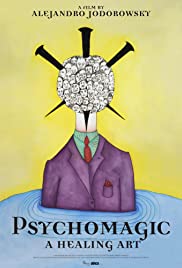
 Greetings again from the darkness. Alejandro Jodorowski is a long-time avant-garde and visionary director known for cult classics EL TOPO (1970) and SANTA SANGRE (1989). He’s now 91 years old, and this is his first film since ENDLESS POETRY (2016) – only categorizing this as a “film” is a bit of a stretch. More in line with what we see would be, ‘a procession of demonstrations of Jodorowski’s own trauma therapy that he calls Psychomagic’.

Fortunately, we kick off with Jodorowski himself explaining his therapy. He defines Psychoanalysis, founded by Sigmund Freud, as being based on science and words. In contrast, he defines his Psychomagic as based on acts and touch. We then transition directly into an ongoing session – a sequence likely to be the last one many people watch, as only the most curious (or those charged with reviewing the film) will subject themselves to more.

The rest of the runtime is broken into “cases” distinguished by the specific reasons people are seeking treatment. Few can argue that treatments for emotional trauma can vary widely, and that not everyone will be affected the same, and that we should all be open to whatever works. However, I can assure you, Psychomagic treatment is unlike anything you have seen or experienced. These filmed sessions come off more like an acting workshop than therapy, though we are to assume they are legitimate.

Not to spoil anything, but rather to offer a taste of what’s in store, you should brace for full body shoe polish while dancing at night, the shattering of dinner plates on the patient’s chest in nature, pouring cold milk on an unclothed person, the simulation of birth for ‘grown ups’, sledgehammers on pumpkins decorated with family photos (OK, this one actually makes some sense!), sprinkling water on a massive tree to treat depression, burying a wedding dress, and participating in Mexico City’s Walk of the Dead. And I have skipped over the connection between menstruation and finger-painting and cellos.

Artists often thrive with great freedom, and the therapeutic effects of art have certainly been proven many times. It’s just that watching this, I became something beyond skeptical. It reminded me of the old-time healers, and the fine line between healing and scamming. Perhaps it was the regular inclusion of clips from Jodorowski’s films that put me on high alert, or maybe it was simply the progression of segments that each struck as more outrageous than the last. Jodorowski is an old man with a history of creating art, so I’m choosing to give him the benefit of the doubt, though it’s not an easy task after enduring this.

watch the trailer: