IN SEARCH OF FELLINI (2017)

April 30, 2017

USA Film Festival 2017

 Greetings again from the darkness. Even In this age of “helicopter parenting” it’s disconcerting to see such flagrant over-protectiveness as that perpetuated by Maria Bello’s character on her daughter Lucy. For film lovers, it’s even more disheartening to see how the mother uses “happy ending” movies such as It’s a Wonderful Life to create the social bubble that results in 20 year old Lucy having never been kissed, and having no concept of reality (outside of what she has seen in movies).

Contrary to what that set-up would have us believe, director Taron Lexton’s film is actually less Coming-of-Age and more ‘Welcome to the Universe’, and Lucy’s journey of self-discovery is quite enjoyable to behold. Co-written by Nancy Cartwright and Peter Kjenaas, it’s the ‘based on a true story’ of Ms. Cartwright’s own personal journey prior to her nearly 30 year run as the voice of Bart Simpson.

Lucy (Ksenia Solo, Black Swan) is off on an interview-gone-wrong when she stumbles into a Fellini film festival. She is immediately entranced by the obscure imagery and often less-than-happy endings. In fact, she connects with the films in such a manner that she is inspired to travel to Italy and meet with the Maestro himself. Ms. Cartwright’s real life motivation stemmed from watching Fellini’s La Strada (1954), and she instantly saw herself in Gelsomina (played by the spirited Giuletta Masina).

Her travels through Italy are filled with ups and downs, and Lucy crosses paths with good people and bad. It’s her first true life experience and we are along for the ride. The structure of the story is such that as Lucy is discovering life, her mother (Bello) is back home in Ohio slowly losing her battle with cancer while being nursed by her straight-talking sister (Mary Lynn Rajskub, Chloe from “24”). Such contrasting elements would fit right in to a Fellini film.

At some point, most movie lovers experience the awakening that occurs when graduating from pleasant, feel good family movies to more esoteric and philosophical cinema. Fortunately, this awakening typically occurs before age 20 and does not require an international trip or dying mother to allow us to grow as a person. Ms. Cartwright’s willingness to share her story makes for interesting filmmaking and one of the more unusual coming-of-age (or Welcome to the Universe) twists that we’ve seen on screen.

**I couldn’t find a trailer to post


UNLEASHED (2017)

April 29, 2017

USA Film Festival 2017

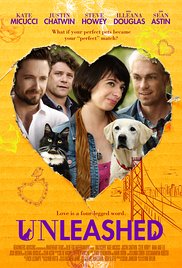
 Greetings again from the darkness. Quirky is an overused word to describe far too many offbeat independent movies and unconventional actors. However, sometimes no better word exists, and that’s exactly the situation with writer/director Finn Taylor’s latest. A full moon cosmic event results in a collision between astronomy and astrology, and just like that … Emma’s faithful pet dog and cat are transformed into hunky human boyfriend material.

Adding to the high level of quirk (in the role of Emma) is the extraordinarily multi-talented Kate Micucci (“Garfunkel and Oates”) – an actress, comedian, writer, musician and artist. Plus, she is just so darn likeable and nice! In fact, “nice” may be the only challenger to quirky in how best to describe this film. Sure it’s cute and sweet and delightful, but above all, it’s a nice movie whose nice characters will leave you with a nice feeling.

Steve Howey and Justin Chatwin (both from “Shameless”) are spot on in their portrayals of Sam and Diego – the humanized dog and cat, respectively. Howey and his bleach blonde hair and boundless energy capture the devoted pooch, while Chatwin is downright hilarious with his feline tendencies that attract a public following. Given much leeway with the roles, we never lose sight of their original connection to love-lost Emma.

While the premise may offend some (though nothing else in the film will), the humor stems from this being a woman’s fantasy. Her beloved pets, with full knowledge of her likes and dislikes, and with blind commitment, take on beautiful male human form without losing the lovable pet traits. What more could a women-done-wrong desire? It’s also quite a scathing commentary on modern day dating, with the ne’er-do-well Luke (Josh Brener, “Silicon Valley”) contrasted to the too-nice Carl (Sean Astin). Hana Mae Lee (Pitch Perfect) is Emma’s spunky best bud and co-worker, and Illeana Douglas plays their boss.

There are some terrific Bay Area film locations utilized, and the music is so perfectly matched that we find ourselves saying “of course” as each new song pops up. Filmmaker Taylor certainly could have gone a bit harsher with the commentary and humor, but let’s enjoy this quirk for what it is … a really nice time.

watch the trailer:

http://themovieunleashed.com/?page_id=12


VOICE FROM THE STONE (2017)

April 29, 2017

USA FILM FESTIVAL 2017

 Greetings again from the darkness. A painful death bed scene and a teary-eyed child saying goodbye to their beloved caregiver kick off this film that immediately downshifts to a deliberate pace after those two emotional peaks. The first feature from director Eric Howell is adapted by Andrew Shaw from Silvio Raffo’s novel, and it excels in delivering atmosphere and visual unease created by the stunning setting of a fogged-cloaked Tuscan castle that is itself a key character in the film.

Emilia Clarke (“Game of Thrones”), and those expressive eyebrows of hers, stars as Verena, a rehabilitation nurse who specializes in helping traumatized children. Verena is spunky and confident as she arrives at the Gothic-esque home of artist/sculptor Klaus (Marton Csokas) and his son Jakob (Edward Dring). It’s been more than 7 months since the death of his mother (Caterina Murino, Solange in Casino Royale), and also since young Jakob last spoke even a single word. Verena expects to succeed where other nurses have failed.

1950’s Tuscany is beautiful despite, or maybe because of, the dreary and minimal natural lighting and the mysterious elements of the ancient castle and surrounding forest and stone quarry. It’s also a bit creepy and that allows the measured pace of the story to work – it comes across as we are going through the slow process with Jakob and Verena. Well, it works until it doesn’t. The character shifts for Verena and Klaus occur too abruptly – almost as if pages in the script were skipped. Both transformations seem out of place with the film and are jarring to watch … and not jarring in the way that we expect from a suspense thriller.

Most won’t be surprised at where the story goes, but just in case, no spoilers will be discussed here. It should be enough to state that the look and feel of this one should appeal to those who enjoyed such films as The Others, Rebecca, The Sixth Sense, Crimson Peak, and the stories of Edgar Allan Poe. The execution of the story might not be at that level, but the atmosphere and mood certainly are. Oversized sculptures, life-sized portraits, an untouched death bed, and even a grand piano allow for more texture than any cheap jump-scares.

Gothic, romantic, supernatural suspense thrillers are pretty tough to pull off, but even getting close allows for some cinematic viewing pleasure. As an added bonus, the lovely score from Michael Wandmacher never screams at us, and Amy Lee (Evanescence) delivers a beautiful and fitting song “Speak to Me” as the film ends.

watch the trailer:


JEREMIAH TOWER: THE LAST MAGNIFICENT (2017, doc)

April 27, 2017

 Greetings again from the darkness. Maybe the line between megalomania and genius doesn’t exist, or a more likely explanation has the two as mutually exclusive. Director Lydia Tenaglia (an Emmy winner) tackles the profile of ultra-fascinating Jeremiah Tower, one of, if not the first U.S. celebrity chef. Her approach seems to carom between idol worship, psychoanalysis and mythology, often creating a rudderless feeling for viewers – viewers who remain captivated by the man and the story.

Mr. Tower performs voiceover during much of the segment on his childhood, and one of his first lines, “I have to stay away from human beings because somehow I’m not one”, sets the stage for a childhood that explains much. His wealthy parents took a hands-off approach, though young Jeremiah (when not in elite boarding school) often accompanied them on international travels, luxurious Ocean cruises (including the Queen Mary), and first class resorts and hotels. The solitude of these trips invariably found the young boy in the kitchen with food, his favorite travel companion. An evening on a beach with a stranger who is grilling a barracuda provides a particularly harrowing memory, and clearly helps us understand how that 6 year old grew to be an adult who never found a humanistic rhythm with others.

Anthony Bourdain is a producer on the film and also provides commentary throughout. He states “We should know who changed the world”. Specifically he is referring to the pioneers of food, and he puts Jeremiah Tower as high on the pedestal as any. Bourdain, other chefs, Tower’s Harvard friends, and even food critics chime in on the impact of Tower joining Alice Waters at her Berkeley Chez Panisse in 1972. The idealism of the times and the people created a cultural clash that resulted in what Martha Stewart termed New American cuisine, or perhaps more accurately, California cuisine. Some terrific photos and clips of those early days really add an element of depth to an era which is typically lacking in such documentation.

After the split between Ms. Waters and Mr. Tower, his explosion into the global food world occurred with his Stars restaurant in San Francisco in the mid-1980’s. This seemed to be the meld of Tower’s personality, his creative menu ideas, and his quest for the perfect eating establishment, and soon became known worldwide as a must-visit for traveling foodies.

It’s at this point where the timeline becomes muddled – seemingly on purpose by the filmmaker – in an effort to add mystery to what otherwise would be expected erratic behavior from an artist who just can’t be satisfied. Tower’s self-imposed exile leaves his friends befuddled, and we get interspersed shots of him climbing pyramids and cooking in his Merida apartment. Philosophical meanderings are used to fill the gaps. “What are my great expectations?” How could such a genius be expected to live with “the horror of mediocrity”? On more than one occasion, we hear Tower’s life philosophy stated as “I long for the crown, but know the guillotine is close”. This would all seem overly dramatic if it didn’t so perfectly fit the profile of the man. The incomprehensible “comeback” at NYC’s Tavern on the Green after 15 years away, does allow us to more closely view his endless pursuit of perfection, and the price paid for a life of loneliness and ego. True innovators and true genius are often painful to look at once the curtain is pulled back.

watch the trailer:


DANGER CLOSE (2017, doc)

April 27, 2017

 Greetings again from the darkness. This is the third in a series of unparalleled looks at war from the front line courtesy of co-directors Christian Tureaud and David Salzberg. Their 2014 documentary The Hornet’s Nest followed war correspondent Mike Boettcher and his son as they covered the most violent era of the Afghanistan War, and 2015’s Citizen Soldier went inner circle with the Army National Guard’s 45th Infantry Combat team in Afghanistan. This time the focus is on the work of war correspondent Alex Quade, a female reporter (yes, her gender is worth noting) who documented missions carried out by Special Forces teams.

Ms. Quade’s interviews with Wendy R Anderson provide structure to the film and a chance for viewers to catch their breath in between combat videos. The interviews allow us to get a better feel for Ms. Quade’s personality and motivation. She states that after being around soldiers in such stressful and life-threatening times, she believes “I have to tell their stories”. These are stories we aren’t usually privy to on network news reports. These situations go beyond dangerous and require courage most of us can’t imagine.

There is some incredible early footage, much shot with night vision, which chronicles a large scale air assault ending in tragedy. The helicopters are being fired upon from ground-based weapons, and one is shot down. We then see how fast the rescue and recovery mission is implemented and how there is no hesitation in going in.

Ms. Quade makes this the personal story for one soldier – Rob Pirelli. She interviews his fellow soldiers, and even visits with Rob’s parents at their home. The film begins in 2007 and goes into 2008 where she tracks the progress of Combat Outpost Pirelli – a home for a Special Forces team.

This is outstanding and eye-opening journalism, and forces viewers to confront the atrocities and always present danger of war. There are times during the interviews where Alex Quade comes off a bit arrogant, but we are reminded of a quote that at times has been attributed to Muhammad Ali, Bear Bryant, and Dizzy Dean … “It ain’t bragging if …” Ms. Quade deserves much respect for her tenacity and bravery for doing what’s necessary to tell these stories.


EARTHxFilm 2017 and CHASING CORAL

April 21, 2017

EARTHxFilm Opening NightChasing Coral

 The official Opening Night of the inaugural EARTHxFilm event proved to be an evening of hope buoyed by passion, optimism and commitment. Scheduled in conjunction with the seventh annual EARTH Day Texas, the reception, introductions, and opening film Chasing Coral were held at Dallas Music Hall at Fair Park.

EARTHxFilm President Michael Cain, one of the most influential forces on the Dallas film scene for years, expressed that this is a “gift to the city” from philanthropist and businessman Trammell Crow, and that many worked diligently to bring it all together – including Ryan Brown and Dennis Bishop. Notably, Mr. Cain acknowledged the support of both The Dallas International Festival and Dallas Video Fest. This type of support and collaboration is not typical of all cities, but DIFF’s Lee Papert and James Faust, and DVF’s Bart Weiss are all extraordinary ambassadors for the Dallas film industry, and we are quite fortunate to have them working in our city.

Filmmakers in attendance were recognized, and Mr. Cain said the group ranged from 12 year old first-timers to Oscar winners. His stated wish was for everyone in the audience to become EARTHxFilm missionaries and encourage others to join in. Education is a key focus of the organization, and we were shown about 15 one-minute films created around the idea of nature, conservation, environmentalism, etc. It was a very nice way to kick off the evening and prepare us for the featured screening of Chasing Coral.

CHASING CORAL

 Whether you have spent vacation time snorkeling, watched the National Geographic channel, or even paid a bit of attention during high school science class, you likely have some level of understanding of what a vital ecosystem coral reefs are to Ocean life. Director Jeff Orlowski has a track record of important environmental documentaries with his 2012 Chasing Ice. Both of these movies have been well received at Sundance and other film festivals, as well as by scientific experts.

Mr. Orlowski was contacted by underwater photographer Richard Vevers once the Vevers team recognized the accelerated breakdown of corals as the ocean water temperature rose slightly. The film takes us to such places as The Great Barrier Reef in Australia, the Florida Keys, American Somoa, Hawaii, Bermuda and the Bahamas. The obvious message is that concern exists around the globe, not just in one particular locale.

The film does an excellent job of defining and explaining the importance of coral, and once Zach Rago is introduced, the energy and passion jump significantly. A charming, self-described “coral nerd”, he is also an extremely knowledgeable and committed scientist dedicated to saving this ecosystem that he worships, and he understands the important role it plays to all life.

Little doubt exists that those involved fully believe carbon emissions are to blame for the warming waters resulting in coral bleaching and finally coral death. They also believe that by reducing said emissions, there is still time to prevent the total global coral destruction predicted for the next quarter century.

If the film has any misguided moments, it would be related to the screen time spent on the challenges and frustrations associated with underwater time-lapse photography, especially from a hardware standpoint. As viewers, we are far more interested in the coral endangerment and the photography shots that do exist … especially some of the stunning before/after looks as coral reefs are quickly destroyed.

A trip to the Coral Convention provides us a glimpse at how research and information is shared by those who are working on this and other environmental issues. With limited resources, it’s crucial that access to information is available to those who need it. Finally, the film leaves us with a reminder that forests, reefs, and other ecosystems are all vital to our lives; and while the current path is quite saddening, there is optimism that we have time to stop the damage if we act now.

For more information: EARTHxFilm.org EARTHDayTX.org


BORN IN CHINA (2017, doc)

April 20, 2017

 Greetings again from the darkness. You’d be hard-pressed to name or find anything cuter than a baby Panda, and the folks at Disneynature don’t hesitate in taking full advantage of our affinity for such fuzzy black and white cuddliness. Am I upset with them after watching this documentary? Only because they periodically cut away to a herd of antelope.

This is the next in a line of Disneynature films dating back to 2007 (Oceans, Bears, African Cats) that usually hit theaters in close proximity to Earth Day. This particular screening was also affiliated with the inaugural year of EARTHxFilm, a Dallas-based festival dedicated to all things nature, natural and earthy. Acclaimed Chinese director Chuan Lu and his photography crew take us into some stunning wilderness areas and parts of China that we rarely, if ever, get to see … all to witness intimate wildlife moments in shockingly close proximity.

If what comes to mind are those charming Disney animal features from the 1960’s – the ones that featured the great Rex Allen as narrator, you’re in for a surprise. Hey, I loved Charlie, the Lonesome Cougar and Yellowstone Cubs as much as the next kid, but rolling down a leaf-covered hill with a baby Panda that can’t walk yet is a whole new level of awe. Watching a mother Snow Leopard (what an incredible creature!) hunt so her two cubs can eat takes us to the highest standard of respect and admiration for this elusive species. Heck, even the rebellious Golden snub-nose Monkey teaches us about family and community within the monkey world … and how they don’t appreciate cold weather any more than I.

Director Lu provides a loose ancient Chinese structure to the film by explaining that every time a crane takes flight, it’s believed to be relocating the soul/spirit of one dying being into that of a newborn. The spectacle of watching these creatures majestically soar through the orange-sun soaked sky is merely one of the many breathtaking examples of spectacular photography during the film. We are bounced between mountains and forest and rocky vistas and are taken closer than you’ve ever been to a Great Panda scratching her baby, a Snow Leopard on the prowl, or a monkey rescuing his baby sister from an ominous winged predator. The only downside for grown-ups is the over-narration from John Krasinski, an admitted necessity for the youngsters in the audience who will appreciate the one-liners that go along with the cuteness. In Disney fashion, most of nature’s violence takes place off screen, but what we do see are parts of nature that will amaze.

Be sure to stay for the closing credits for a glimpse at how the photographers managed to get some of their shots – as well as how they sacrifice for their work.

watch the trailer:


THE LOST CITY OF Z (2017)

April 20, 2017

DALLAS INTERNATIONAL FILM FESTIVAL 2017

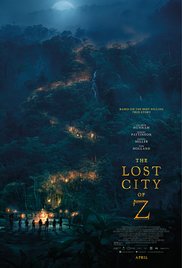
 Greetings again from the darkness. We aren’t likely to watch a more beautiful or expertly photographed film this year. Director James Gray’s (The Immigrant, We Own the Night) project looks and feels like a throwback to days of epic filmmaking, and cinematographer Darius Khandji (Se7en, Evita, The Immigrant) fills the screen with green and gold hues (similar to Out of Africa) that deliver both a sense of realism and a touch of romanticism. The minor quibble here is with the emphasis on the biographical rather than the more interesting and compelling and adventuresome expeditions to the “new” world.

Our true to life hero (and the film’s portrayal provides no other description) is military man and explorer Percy Fawcett played by Charlie Hunnam. Based on the book by David Grann, the film divides focus into three areas: the stuffy, poorly lit backrooms of London power moguls; the 1916 WWI front line where Fawcett proves his mettle; the jungles of Amazonia wherein lies Fawcett’s hope for glory and redemption. It’s the latter of these that are by far the most engaging, and also the segments that leave us pining for more detail.

The three Fawcett expeditions form the structure for the quite long run time (2 hours, 21 minutes). In 1906 the Royal Geographic Society enlisted Fawcett for a “mapping” journey to distinguish boundaries around Bolivia in what had become a commercially important area due to the black gold known as rubber. Fawcett was not just a manly-man, he was also obsessed with overcoming his “poor choice in ancestors” and gaining a position of status within society. Using his military training and personal mission, that first expedition (with help from a powerful character played by the great Franco Nero) was enough to light Fawcett’s lifelong fixation on proving the existence of Z (Zed) and the earlier advanced society.

Back home, Fawcett’s wife Nina (Sienna Miller) shows flashes of turn-of-the-century feminism, though lacking in judgment when she suggests a ridealong with her husband on his next expedition. Although the couple spends little time together, given the years-long trips, they do manage to produce a hefty brood of kids, the eldest played by Tom Holland (the new Spider-Man).

1912 brings the second Amazonia expedition, the one in which renowned Antarctic explorer James Murray (a snarly Angus Macfayden) joins Fawcett and his by now loyal and expert travel companion Henry Costin (a terrific Robert Pattison). The trip proceeds as one might expect when an ego-driven, unqualified yet wealthy passenger is along for only the glory. Murray’s history is well documented and here receives the treatment he earned.

It’s the third trip in 1925 that Fawcett makes with his son that will be his last, and the one that dealt the unanswered questions inspiring Mr. Grann to research and write his book. It’s also the segment of the film that leaves us wanting more details … more time in the jungle. With the overabundance of information and data available to us these days, the staggering courage and spirit of those willing to jump in a wooden canoe on unchartered waters and trek through lands with no known back story, offer more than enough foundation for compelling filmmaking. It’s this possibility of historical discovery that is the real story, not one man’s lust for medals and confirmation. More jungle could have elevated this from very good to monumental filmmaking.

watch the trailer:


TRUMAN (2017)

April 20, 2017

 Greetings again from the darkness. Is this a cancer movie? A dog movie? A buddy movie? Well, the answer is yes – at least somewhat – to all three. Writer/director Cesc Gay and co-writer Tomas Aragay offer up an unusually paced and uniquely focused film that is likely to strike a chord with many viewers, while leaving some others thinking, what’s the point? For those of us in that first group, it’s an absorbing ride-along with a not overly likeable character who is out to put his proverbial “affairs in order”.

Two exceedingly talented actors take the lead here and draw us right in. Ricardo Darin (terrific in The Secret in Their Eyes, 2009) is Julian, and Javier Camara (an Almodovar regular, so shuddersome in Talk to Her) is his long time friend Tomas. Knowing his friend is dying, Tomas hops on a plane back to Madrid, from his new life in Canada, in order to spend four days and yes, to say goodbye.

The surprise visit sends the two long-time buds on a kind of (mostly) inner-city “road trip”. Their daily outings include: a trip to the veterinarian so Julian can prepare his dog Truman (a non-puppy Bullmastiff) for the coming change; a doctor visit to convey the desire to cease treatment on the tumors; a bookstore to search for material on pet psychology; a diner where Julian confronts old friends – a lunch that provides significant insight into Julian’s mindset; an in-home visit to a potential pet adoption family; a direct chat proving ‘the show must go on’ with the owner (Jose Luis Gomez) of the theatre where Julian works as an actor; a spur of the moment flight to Amsterdam for lunch with Julian’s estranged son Nico and wife Sophie; and a meet on the street with Julian’s ex-wife. In between, there are exchanges with Julian’s cousin Paula (a very good Dolores Fonzi) who can’t hide her frustration despite offering unwavering support.

There are many wonderfully subtle moments that keep the story grounded and prevent anything approaching the typically over-dramatic movie that we have become so accustomed to. Death and comedy don’t tend to blend well, but there are some charming and even comical moments that sneak in … sometimes during the moments that Julian is expressing regret for things said or done, or not said or done. He attempts to make amends, but this isn’t about the profound moments – no, it’s about the small ones. When Julian mutters the brilliant line, “I used to be a romantic hero”, we know exactly what it means. This isn’t the usual tear-jerker, but it will likely tug at the heart strings, even as it touches on death on one’s own terms (a common cinematic theme these days).

watch the trailer:


FRANTZ (2017)

April 20, 2017

Dallas International Film Festival 2017

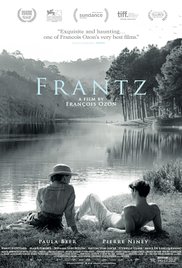
 Greetings again from the darkness. Director Francois Ozon won me over as a fan for life with his 2003 writing-mystery Swimming Pool. His latest stands in stark contrast to that gem, as there are no mind games for the viewer, other than those the characters play on each other. Actually, this is quite a straightforward story of romance, loss and hope; and it’s an example of expert filmmaking from a director in full control of story, setting, character and camera.

It’s 1919 in historic and ancient Quedlinburg, Germany. WWI has recently ended and the loss of her soldier fiancé is still so fresh for Anna (an excellent Paula Beer) that she makes daily treks to lay flowers on the grave of Frantz. She spots an unknown foreigner paying respects to Frantz, and since it’s a small town, the two are soon enough sitting together in the parlor of Frantz’ parents’ house where Anna lives. It’s an awkward encounter between a grief-stricken German family and a Frenchman paying respects to the family of a fallen “friend”.

That these folks are so quick to accept and encourage these recollections of Adrien (Pierre Niney) speaks loud and clear to human nature in times of grief – we desperately cling to any connection, positive memory, or new strand of information. Then again, Adrien’s perspective is every bit as interesting as that of the parents and Anna. He seeks forgiveness and inclusion, yet is unable to come clean on his motives and past.

More human nature is on display as we initially see how the Germans treat the (outsider) Frenchman, and then later as Anna travels to France, we see how the French treat this (and presumably all) German. Anger, mistrust and deceit are ever-present amongst this group of people who seemingly only want a touch of happiness, and it’s fun to note the parallels between the initial story in Germany and the later time in France.

Director Ozon flips between black & white and the periodic use of color when hope and new direction exists. It provides a personal and dramatic look to the film, along with visual clues as to what’s really occurring on screen, and is nicely complemented by the flowing score from Phillipe Rombi (Swimming Pool, Joyeux Noel). Ozon also selects one of Manet’s lesser known paintings, Le Suicide, as a link between the past and the terrific ending that reinforces the movie’s message, “life goes on”.

watch the trailer: