ARRIVAL (2016)

November 12, 2016

arrival Greetings again from the darkness. Our cinematic love affair with aliens goes back decades, and these films typically fall into one of two categories: evil aliens attack earth, or aliens come in peace and humans react poorly. We’ve seen aliens trying to provide us with righteous advice (The Day the Earth Stood Still, 1951). We’ve connected via a few musical notes (Close Encounters of the Third Kind, 1977) and radio frequencies (Contact, 1997). And we have certainly had our share of surprise and unwanted meetings (Alien, 1979; The Thing, 1982). Leave it to cutting edge director Denis Villeneuve (Sicario, Prisoners, Incendies) to find a new, more head-and-soul approach for the genre.

This high concept project is born from Eric Hiesserer’s screenplay of Ted Chiang’s short story “Story of Your Life” … a title that makes sense by the end of the movie, but one a bit too blah for a big time production with Oscar hopes. Five time Oscar nominee Amy Adams plays Dr. Louise Banks, a renowned linguist and interpreter. There is an interesting and well done sequence at the beginning of the film that provides the back story for her character and the foundation for the final reveal.

A dozen oddly shaped spaceships have docked (mid-air) at various points around the globe. The one in the U.S. is hovering over … no, not Area 51 … Montana of all places. Forest Whitaker plays the military officer charged with assembling the team that will try to communicate with the aliens. He chooses Dr. Banks due to her remarkable track record with languages. She is joined with uber-Science and Math guy, Physicist Ian Donnelly played by Jeremy Renner.

We do see the aliens and their artsy style of communicating (a touch of Rorschach), but this is about so much more than learning a new inner-galactic language. It’s about how the military reacts, how the general populace reacts, how the world leaders work together (or not), and even how the military, intelligence agencies and academia coexist. It’s about smart people working out a plan when the problem isn’t even clear … a between-the-ears head-scratcher.

Mr. Villeneuve utilizes what appear to be flashbacks in helping us better understand Dr. Banks, but the element of time may not be what we typically accept in story-telling. The story, characters, cinematography and score (one of the best matches of music and movie all year thanks to composer Johann Johansson) work together to provide an engaging, nearly hypnotic movie going experience. Plus, I’m fairly certain this is the first alien movie to reference Abbott and Costello and crack a Sheila Easton joke. This is beautiful filmmaking that is also thought-provoking and encouraging of some species self-analysis (our species).

watch the trailer:


LOVING (2016)

November 12, 2016

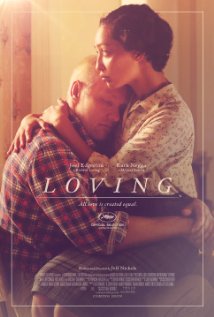
loving Greetings again from the darkness. Imagine you are sound asleep in bed with your significant other. It’s the middle of the night. Suddenly, the sheriff and his deputies crash through your bedroom door with pistols drawn and flashlights blinding you. You are both taken into custody. For most of us, this would be a terrible nightmare. For Mildred and Richard Loving, it was their reality in June of 1958. Their crime was not drug-dealing, child pornography, or treason. Their crime was marriage. Interracial marriage.

Writer/director Jeff Nichols (Mud, Take Shelter) proves again he has a distinct feel and sensitivity for the southern way. There is nothing showy about his style, and in fact, his storytelling is at its most effective in the small, intimate moments … he goes quiet where other filmmakers would go big. Rather than an overwrought political statement, Nichols keeps the focus on two people just trying to live their life together.

Joel Edgerton plays Richard Loving, a bricklayer and man of few words. Ruth Negga plays Mildred, a quietly wise and observant woman. Both are outstanding in delivering understated and sincere performances (expect Oscar chatter for Ms. Negga). These are country folks caught up in Virginia’s Racial Integrity Act of 1924, though as Richard says, “we aren’t bothering anyone”. The counterpoint comes from the local Sheriff (an intimidating Martin Csokas) and the presiding Judge Bazile (David Jensen) who claim to be enforcing “God’s Law”.

Nichols never strays far from the 2011 documentary The Loving Story from Nancy Buirski, who is a producer on this film. When the ACLU-assigned young (and green) lawyer Bernard Cohen (played with a dose of goofiness by Nick Kroll) gets involved, we see how the case hinges on public perception and changing social mores. Michael Shannon appears as the Life Magazine photographer who shot the iconic images of the couple at home … a spread that presented the Lovings not as an interracial couple, but rather as simply a normal married couple raising their kids.

In 1967, the Supreme Court decision in Loving v. Virginia, unanimously held Virginia’s “Racial Integrity Act of 1924” as unconstitutional, putting an end to all miscegenation laws (interracial marriage was still illegal in 15 states at the time). In keeping with the film’s direct approach, the Supreme Court case lacks any of the usual courtroom theatrics and is capped with a quietly received phone call to Mildred.

Beautiful camera work from cinematographer Adam Stone complements the spot on setting, costumes and cars which capture the look and feel of the era (over a 10 year period). Nichols forsakes the crowd-rallying moments or even the police brutality of today’s headlines, but that doesn’t mean there is any shortage of paranoia or constant concern. We feel the strain through these genuine people as though we are there with them. The simplicity of Richard and Mildred belies the complexity of the issue, and is summed up through the words of Mildred, “He took care of me.”

Watch the trailer:


PENCILS DOWN! THE 100 DAYS OF THE WRITERS GUILD STRIKE (2016, doc)

November 6, 2016

pencils-down Greetings again from the darkness. This documentary from director Brian S. Kalata (a successful Location Manager) details the 100 day strike of the Writers Guild of America, and more interestingly, provides a peek behind the curtain of the business side of the entertainment industry. It’s an industry that continually cries financial wolf, while green-lighting the construction of new theatres and producing ever-bigger budget projects. Though this documentary won’t clear up any of the voodoo economics (to borrow a phrase), it does shed some light on who the power players are and who are the ones typically drawing the short straw.

On November 9, 2007, 4000 picketers joined the rally outside the Fox Studios as the WGA strike began. Numerous interviews with industry insiders provide us a basic education on what makes the entertainment world unique when it comes to labor disputes. Here, the leading studios … competitors, mind you … bond together to go up against each of the separate unions (DGA, SAG, WGA, Teamsters, etc) at contract time. Historically, this has resulted in contracts that heavily favor and maintain the largest piece of the pie for the power studios – now run by major media conglomerates, rather than the hands-on studio heads of early Hollywood (Mayer, Warner, et al).

What made this particular strike more interesting was the strong support the WGA received from its members – both past and present, the acting community (SAG), and the viewing public, thanks to an online media blitz telling the story. At the heart of the negotiations was this (at the time) new and rapidly expanding digital media. The studios claimed they didn’t have a business model yet for streaming, iTunes, Netflix, etc, so this was all to be categorized as “home video”, which short-changed the writers from previous contracts.

Those being interviewed include Alan Rosenberg, Harlan Ellison, Howard Rodman and Patric Verrone … all key players in the strike and the vision for the WGA. Each is very forthright in the past shortcomings of contract negotiations, as well as how they felt this strike offered the first real opportunity for fairness.

Labor issues are commonplace in most industries, but the fascination here is derived from the creative artists going up against powerful corporate forces. Even with a show of solidarity between the various entertainment unions, the cause is severely impacted when the DGA cuts their own deal. The film acts as a primer on both entertainment economics and labor relations … two topics we rarely have much access to, though we only get the labor (writers) side of the story.

The film trudges through the different stages of the 100 days, and makes it clear that the WGA felt back-stabbed by the DGA at a time when the industry was in danger of having its most important event canceled … Oscar night. In the end, the writers got their “toe in the door” for digital media, but Julia-Louis Dreyfus said it best … “Without the writers, we are speechless.”


HACKSAW RIDGE (2016)

November 3, 2016

hacksaw-ridge Greetings again from the darkness. Why doesn’t every high school student learn about Desmond Doss in History class? Beyond that, why isn’t Desmond Doss profiled in every Psychology and Philosophy class? It’s inexplicable that more Americans aren’t familiar with his story, much less failing to honor his legacy with a well deserved tribute. Fortunately director Mel Gibson (Braveheart) and screenwriters Andrew Knight (The Water Diviner) and Robert Schenkkan (“The Pacific”) bring us a spirited look at this underappreciated American war hero.

Andrew Garfield (The Amazing Spider-Man) plays Desmond Doss and perfectly embodies the conviction and dedication of this extraordinary (not hyperbole in this case) man. See, Desmond Doss was one of the first conscientious objectors in the U.S. Army. His religious beliefs (Seventh Day Adventist) prohibited him from using a weapon or killing another person … two things that don’t go over well with fellow soldiers or commanding officers. Yet, Doss was committed to serving his country as a medic and saving lives, rather than taking them.

Unbelievable may be the best description even though his story is absolutely true. Credited with saving the lives of at least 75 wounded soldiers, Doss and his fellow soldiers are depicted in the film fighting the Battle of Okinawa at Hacksaw Ridge … a topographical challenge punctuated by the need to climb a rope wall in order to scale the face of the cliff. Their reward was facing thousands of Japanese hiding in tunnels and bunkers, waiting patiently to kill in mass. There will be no spoilers here on the courageous actions of Doss … you should see for yourself.

The early part of the film features a heart-warming first love story involving Desmond Doss and Dorothy Schutte (Teresa Palmer, The Choice). Watching young love bloom is precious and provides a stark contrast to the battle scenes. The two make a lovely couple and we can’t help but root for them. Once Doss hits basic training, we find Vince Vaughn in the role of Sergeant Howell, Sam Worthington (failing to hide his Aussie accent) as Captain Glover, and Luke Bracey (Point Break, 2015) as Smitty, one of the soldiers who initially has no interest in serving with Doss. The Army Psychologist is played by Richard Roxburgh, whom movies lovers will recognize as The Duke from Moulin Rouge! (2001).

Some of the best scenes involve Desmond’s parents played by screen vets Hugo Weaving and Rachel Griffiths. Both are excellent in roles requiring very different and extreme emotional moments. It’s a credit to Gibson’s filmmaking expertise that he is able to add depth to all aspects – family turmoil, a classic love story, the brutality of war, and the deep religious convictions. There are a few moments of “artistic license” and some of the CGI is inconsistent and even over-produced at times, but the intensity of the battle scenes rival that of Saving Private Ryan and the landing at Omaha Beach. It’s a passionate piece of filmmaking centered on a most passionate man. You may disagree with much of what Mel Gibson has said and done in his personal life (and I hope you do), but as a film director he has earned much respect. And speaking of respect … Desmond Doss. Enough said.

watch the trailer:


CHRISTINE (2016)

November 3, 2016

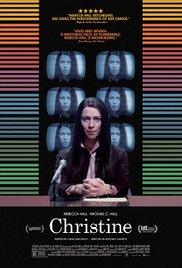
christine Greetings again from the darkness. On July 15, 1974, television news reporter Christine Chubbuck read a prepared statement and then committed suicide on-air by putting a gun to her head and pulling the trigger. You may not recognize her name, but you have likely heard the story … it’s no urban legend. Director Antonio Campos and writer Craig Shilowich offer up a biopic with some insight into Ms. Chubbuck’s personal and professional life so that we might better understand what drove her to such a public and tragic end.

Rebecca Hall takes on the titular role (don’t mistake this for the 1983 John Carpenter/Stephen King film), and despite her usual stilted on screen mannerisms, she delivers what is an emotionally raw and nuanced performance that is the best of her career … and one that keeps us glued to a story of which we already know the ending. We see a woman dedicated to her vision of the profession, while being maddening to those who know her, love her, and work with her. She has an awkward intensity that compounds her lack of social skills and an ongoing struggle with depression. Somehow, Ms. Hall allows us to understand the personal and professional struggles and how things could have spiraled into hopelessness for Christine.

The commentary on the early days of tabloid journalism (“If it bleeds, it leads”) is especially interesting given how the current Presidential campaigns have been covered more than 40 years after the film is set. One might also note the parallels to the character of Howard Beale in Network (1976) … though Christine Chubbuck was less vociferous and never took to yelling “I’m mad as hell, and I’m not going to take it anymore” while on camera (though she evidently felt that way).

Support work comes from Tracy Letts as the frustrated news director, Michael C Hall as the mixed-signals anchorman on whom Christine has a quiet crush, J. Smith-Cameron as her mother and housemate, Maria Dizzia as her friend and co-worker, and Timothy Simons as the misunderstood and ignored weatherman.

The film clearly makes the point that Christine was a misfit in her work and personal life, and though some of the timeline and known specifics are either re-worked or ignored for artistic purposes, Ms. Hall must be commended for highlighting the effects of depression. Even the best meaning friends and family can unintentionally make things worse. We see a clip of Walter Cronkite’s actual report of her death, and Christine’s own words – “The latest in blood and guts” – were actually ahead of her time.

watch the trailer: