SICARIO (2015)

September 24, 2015

sicario Greetings again from the darkness. Really good thrillers – the kind that make our palms sweat and cause us to forget to blink – are increasingly rare in the world of cinema these days. Writer Taylor Sheridan’s script doesn’t choose the good guys, but instead highlights the terror and lack of rules and morality that guide the border wars and drug cartels. It turns out the border isn’t the only line being crossed. Director Denis Villeneuve (Prisoners, Incendies) elevates Sheridan’s excellent script further with a strong cast and some outstanding camera work from the best Director of Photography working today, Roger Deakins.

The opening sequence is about as tense as anything we could ever hope for on screen, and it introduces us to FBI Agent Kate Macer, played by Emily Blunt. We soon learn Kate is a focused and dedicated tactical expert, who also happens to be idealistic enough to believe the raids conducted by her team are making a difference … at least until this belief is later challenged.

Kate quickly finds herself “volunteering” for a special task force with muddled goals, uncertain tactics, and secretive leadership. Josh Brolin plays Matt, the leader of the team. He charms his way through answering Kate’s questions without offering any substantive intel. When asked about the mission objective, Matt responds with “to create chaos” and a smirk. Adding to her confusion and wariness is the mysterious “consultant” Alejandro (the “hitman” of the title) played by Benecio Del Toro. Part of the brilliance of the script is that everyone seems to know what’s happening except Kate and us (the viewers)!  Our understanding comes through the slow-drip method and keeps us fully engaged.

Similarities to both Zero Dark Thirty and Apocalypse Now struck me as the film progressed, but the sheer number of stress-inducing sequences set this apart as something different. A family dinner with a drug lord is one of the more fascinating and tension-packed scenes of the year. The moral complexity is thought-provoking, and the abundance of corruption and politics in relation to the cartels and war on drugs, leave us wondering not just whether this war can be won, but through what methods is it being fought.

Welcome to Juarez”, says Alejandro, as the SUV motorcade makes its way past the remnants of a brutal crime scene. Although there are some tremendous sequences of tactical raids (and the best traffic jam you’ve seen), this should not be labeled as an action film … it’s so much more. Ms. Blunt’s character is the conscience of the film, but it’s Brolin’s Matt that makes us curious as to his background and motivation. And as interesting as are those two characters, they pale in comparison to Benecio’s man on a mission. Del Toro doesn’t act frequently, but he possesses the gift that has him dominating the screen … forcing our eyes to follow his every movement. Rumors have a prequel in the works that will focus on Alejandro’s roots. It’s the “land of wolves”, and Alejandro is an alpha.

Lastly, it must be stated that the film is a technical treat. The unique score from Johann Johannsson is never overbearing, and often mimics our pounding hearts. It’s worth taking note. Best of all is the work of the great Roger Deakins. His photography is astounding and this could be his best work yet. The desert landscapes are just as crucial as the claustrophobic raids or the impromptu strategy sessions, and Deakins puts us right where we need to be. As a companion piece to this excellent film, I would recommend Matthew Heineman’s extraordinary documentary from earlier this year, Cartel Land.

watch the trailer:


THE INTERN (2015)

September 24, 2015

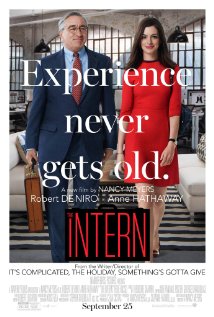
intern Greetings again from the darkness. A feel-good mainstream movie featuring two big time movie stars will likely have box office success and cause a lot of people to laugh out loud. In other words, the latest from writer/director Nancy Meyers should be celebrated for its entertainment value, rather than picked apart by film critics. Ok, I’ll give it a try.

Robert DeNiro stars as Ben Whittaker, a retired 70 year old widower, who just can’t seem to find meaning in hobbies and the leisure life. He applies and is selected for the “Senior Intern” program at About the Fit, a fast-growing online clothing company run by its founder Jules Ostin (Anne Hathaway). In addition to being a Type A driven and obsessed-with-details company leader (the type that rides her bike through the office to save time), Jules also has a husband, a young daughter and a fabulous brownstone. What she doesn’t have is enough sleep, any friends, or enough time to enjoy any of the good stuff.  You aren’t alone if a buddy flick with DeNiro and Hathaway seems unusual to you.

At the same time Ben arrives on the scene, Jules is struggling with her investors’ decision to hire a more experienced CEO so that the company can maintain its phenomenal growth. That’s about as deep as the business talk ever gets (but just try to keep track of all the Apple product placements). Jules initially spurns Ben, but of course, he soon becomes invaluable around the office, and while blinking his eyes, becomes her most valued confidant and adviser.

Much of the comedy is derived from Ben’s interactions with the young employees. It’s quite simply a ‘generation gap comedy’ that makes all the points it needs to make without really breaking a sweat: senior citizens are a wealth of knowledge and can bring value to an organization or relationship, young people can learn from elders (it’s OK to shave everyday and dress for success) … and vice versa (computers are our friend), there still exists some animosity between stay at home moms and working moms, stay at home dads face challenges of their own, running a company is hard work both physically and mentally, communication often requires more than a text or email, and staying true to one’s self is not always easy.

Ms. Meyers has brought us other mainstream films such as It’s Complicated (2009) and Something’s Gotta Give (2003), and she has a feel for presenting the upper-middle class as a punchline for the masses. She likes showing successful people in uncomfortable situations … leaning heavy on awkward, while avoiding dangerous altogether. Her latest is a feel good movie that makes you laugh, without causing you to think about anything in your life that might bring you down. And there is real value in that.

Ok, I tried, but there are some things that must be pointed out. There was so much of Ms. Meyers’ script that was begging to be pushed to the edge and analyzed from a societal aspect. Her specialty is rounding off the corners so that no one gets hurt, and because of that the film is bereft of conflict … the single most important element for a meaningful scene. For example, the conflict between Jules and her husband occurs in a hotel room, which would be fine except … only one of them is there!  Also, we never really get any of the story from Ben’s perspective. Instead, we are just to believe that his Gandhi-like influence on co-workers is the only reward he seeks. I also found myself bothered a bit in the quick glimpse we get into Ben’s personal life. He blows off the advances of Linda Lavin and pursues Rene Russo … understandable, but a bit off-putting given that this female writer chose to have him hook up with the 11 years younger character, rather than the one closer to his own age.  There are many other similar type issues that warrant discussion, but that’s why it’s best to just sit back and enjoy this one, rather than asking “what if?”

watch the trailer:


STONEWALL (2015)

September 24, 2015

stonewall Greetings again from the darkness. Dramatized versions of real life events are always a bit tricky, and hindsight often proves it’s best left to the documentary format. However, sometimes, a dramatized version helps us more easily relate to, and empathize with, those who were involved. That seems to be the approach taken by director Roland Emmerich in his re-telling of events so important to him and the LGBT movement … the Stonewall Riots of 1969.

The Stonewall Riots of June 1969 are often cited as the beginning of the Gay Liberation movement. Of course, there had been many previous clashes between gays and police, as discrimination was so extreme that these folks were labeled as mentally ill, and it was actually unlawful for gays to be hired for many jobs. On the streets of many big cities there existed a melting pot of minorities and the LGBT community. Many were young and homeless, and did whatever necessary to survive. So how best to tell this story?  Director Emmerich and writer Jon Robin Baitz put blonde, white, Midwestern, pretty boy Danny (Jeremy Irvine, War Horse) front and center.  How insulting to those involved.

To his credit, Emmerich does cast actors of various races in many roles, and he does seem to treat this as a sincere tribute or homage to those street kids who finally pushed back. Unfortunately, it’s these characters that seem to be the drag on the story. Despite such names as Queen Cong, Little Orphan Annie, Quiet Paul, and the inclusion of real life activists as Marsha P Johnson (Otoja Abit), Bob Kohler (Patrick Garrow) … and other key players like Ed Murphy (Ron Perlman) and Deputy Seymour Pine (Matt Craven) … the film comes off more like a staged musical sans music. Street life here is more gloss than grit, and the closest thing to a developed character is Ray, played with aplomb by Jonny Beauchamp (“Penny Dreadful”).

Having the Columbia University-bound pretty white boy as the focus might make it easier for mainstream audiences to connect, but it skims over the real struggles going on at the time. We see Danny at home with his worried mother, observant little sister (Joey King), and macho football coach/father (David Gubitt). Everyone is uncomfortable over what is not being said, and the breaking point occurs when a tryst with the star quarterback becomes public knowledge. Just like that, Danny is booted from home (Indiana, not Kansas) and lands on the streets of New York. The comparisons to Dorothy (gay icon Judy Garland) and the Land of Oz are obvious, and repeated numerous times for those a bit slow on the take.

Christopher Street and the Stonewall Inn are the main settings. The mob involvement is noted, as is the desperation of the community, the use of flop houses, and the long-standing “quiet” demonstrations. Even the practice of gays trying to “fit in” to society – to prove they belong – by wearing suits and acting “normal” is addressed. The riots are reduced to a single evening in the movie, and of course, the pretty white boy gets to heave the first brick. As a ‘roots of the movement’ film, it’s hard to believe this film won’t create more anger and frustration than thanks and awareness. Fortunately, there are many exceptional books and yes, documentaries that provide a better perspective on the events that occurred more than 45 years ago. We do see the first Gay Liberation Parade held the following year in honor of the riots – a tradition that continues today. The closing credit sequence catches us up on the key activists, and even provides a startling statistic: 40% of today’s homeless youth are LGBT.

watch the trailer:


MISUNDERSTOOD (Incompresa, Italy, 2015)

September 23, 2015

misunderstood Greetings again from the darkness. Asia Argento is a multi-talented filmmaker – actress, writer, director and producer. Her father is Dario Argento, well known for directing gialo horror films, and her mother is Italian actress Daria Niccolodi. Add in her grandmother, who was famed documentarian Leni Riefenstahl, and it’s understandable why Asia has created (with co-writer Barbara Alberti) this semi-autobiographical story of Aria … a young girl struggling with self-absorbed parents and a world where she doesn’t seem to fit.

It doesn’t take long before we realize the film is poorly titled. “Abused and Mistreated” or “Sucky Parents” would be more accurate. Aria, wonderfully played by Giulia Salerno, is a very observant, tougher than we might expect, skinny kid who is fifth in the household pecking order behind her bombastic parents (Charlotte Gainsbourg, Gabriel Garko) and her two older sisters (Carolina Poccioni, Anna Lou Casoudi).  Aria has a good friend at school, but is mostly an outcast due to her superior essay writing ability and her semi-famous, but rarely present parents.

Featuring one of the more dysfunctional family dinners you’ll ever see, the filmmaker’s deft touch allows us to pull for Aria as she is booted from her mom’s house, and then from her dad’s … and then the cycle repeats. Realizing that a connection with her parents (or sisters) will never be more than surface, Aria adopts a wild cat named Dac and proceeds to tote him everywhere. Dac’s blackness plays off the color surrounding others – especially her flashy dad and always pink sister.

Being as this is Italian cinema, the characters are always emotional (sometimes way up, sometimes way down), periodically violent, and always passionate. Aria is the tortured young soul simply trying to survive this coming-of-age story with a socially and morally unacceptable parental structure. It’s so apparent that with some semblance of love, Aria would fully blossom.

There are flashes of levity, including the dad’s over-the-top superstitions, and the expert use of Lou Christie’s “Two Faces Have I”, that provide us a glimmer of hope. However, when Aria says “There are many ways to cry”, we know those flashes and that glimmer are all but gone. Though the film is set in 1984, Aria’s plea for us to “Be Nice” is as timely today as ever.

watch the trailer:


BLACK MASS (2015)

September 19, 2015

black mass Greetings again from the darkness. Movie goers tend to fall into one of two groups when it comes to Johnny Depp – big fans or denigrators. Whichever side of the line you fall, there are few actors who can claim such a diverse career of on screen characters ranging from Edward Scissorhands to Gilbert Grape; from Donnie Brasco to Captain Jack Sparrow; from Willy Wonka to Sweeney Todd; and from John Dillinger to Tonto. Depp now turns his talents towards one of the most unsympathetic real life characters imaginable … South Boston’s infamous crime lord James “Whitey” Bulger.

Director Scott Cooper (Crazy Heart, Out of the Furnace) proves yet again that he is an actor’s director, rather than a visual technician or story addict. In this adaptation of the book from “Boston Globe” reporters Dick Lehr and Gerard O’Neill, Cooper has Depp and Joel Edgerton as his two leads, and an incredibly deep supporting cast that provide the look and feel for this period piece dramatizing the crime and corruption during Bulger’s reign.

When one thinks of the memorable kingpins of crime/gangster movies, those that come to mind include Michael Corleone (The Godfather movies), Tony Montana (Scarface), Jimmy Conway (Goodfellas), and Frank Costello (The Departed). The Costello character was supposedly partially inspired by Bulger. What made each of these characters fascinating to watch was the insight we were given into the psychological make-up of each and the inner-workings of their organization.  And that’s the disappointment of Cooper’s film.

For the Whitey Bulger story, there are two distinct directions to explore: the building of Bulger’s criminal empire, or the motivation of the FBI Agent John Connolly (Edgerton) as he juggled his job and relationship with Bulger. Unfortunately, the approach here is to show a hand full of cold-blooded murders to prove Bulger’s management style, and a few FBI meetings that show the obvious uncertainty within the agency. Rather than a muddled mash-up, a more interesting movie would have chosen a path and dug in deeply.

Despite the story issues, it is fun to watch how Depp and Edgerton tackle their roles. Under heavy make-up (wrinkles, receding hairline, hillbilly teeth, and crazy contact lenses), Depp becomes the intimidating force of Whitey Bulger. Just as impressive is Edgerton as Agent Connolly, as we witness the Southie neighborhood boys all grown up, but still playing cops and robbers … and it remains difficult to tell who the good guys from the bad. Edgerton’s cockiness and strutting capture the ego and ambition necessary for a federal agent to bend so many rules. In fact, despite the vastly different approaches, it’s not entirely clear which of these two fellows possesses the greatest ambition.

Benedict Cumberbatch plays Billy Bulger, Whitey’s younger brother who became a State Senator. We get very few scenes featuring the brothers, and in fact, Cumberbath’s best scenes are instead shared with Edgerton. It’s difficult not to chuckle at their first meeting in a restaurant as we watch a Brit and Aussie talk it out with south Boston accents. Kevin Bacon, David Harbour and Adam Scott play Edgerton’s fellow FBI agents, while Jesse Plemons, Rory Cochrane (especially good) and W Earl Brown make terrific Bulger crew members. Peter Sarsgaard leaves quite the impression as a doped-up associate, while Julianne Nicholson, Dakota Johnson and Juno Temple provide the film’s minimal female presence. Corey Stoll storms onto the screen as a Federal Prosecutor who is not amused by the relationship between Connolly and Bulger, but this movie belongs to Depp and Edgerton.

The concern is that any viewer not already familiar with the Whitey Bulger story may find the story not overly interesting, despite the terrific performances. Fortunately, this viewer was mesmerized by last year’s exceptional documentary entitled Whitey: United States of America v James J Bulger … a must see for anyone who wants full details into the Bulger reign of crime and terror, as well as his 20 years on the lam.

watch the trailer:


PAWN SACRIFICE (2015)

September 17, 2015

pawn sacrifice Greetings again from the darkness. Being such a fan of the expert documentary film Bobby Fischer Against the World (2011), I found it a bit challenging to clear my head and accept a dramatized approach to the story. This was after all, one of the most fascinating reluctant public figure during one of the most energizing signature events of the Cold War between Russia and the United States … it was even described as World War III on a chess board.

Director Edward Zwick (Glory, Blood Diamond) and writer Steven Knight (Locke, “Peaky Blinders”) wisely focus the story on the infamous World Chess Championship match in 1972 between American Bobby Fischer and Russian Boris Spassky. This was 8 years prior to the “Miracle on Ice” when the USA Olympic hockey team upset the powerhouse Russian hockey team, but this chess match caused every bit as much media frenzy and national pride as that day in Lake Placid. This international attention is as important to the story as the psychological state of Bobby Fischer and his genius-level chess skill. And it’s the media and citizenry reactions that provide the contemporary comparison to what we see too often these days thanks to social media … icons are born, chewed up, and forgotten.

Tobey Maguire plays Fischer, and despite lacking the height and physical presence of the real chess champion, he expertly conveys the paranoia, fear, and arrogance that burdened the man and created even more suspense for those of us keeping a watchful eye at the time. Liev Schreiber (“Ray Donovan”) plays Boris Spassky, and even speaks his lines in Russian. Schreiber captures the iciness for which the Russians were known, but also interjects subtle personality and insight in a story where his adversary is constantly over-the-top. Chess strategy isn’t so much the story here, as are these two men from different worlds forced together on a stage in Iceland – with the full attention of the world.

Supporting work is varied, but exceptionally strong. Robin Weigert plays Bobby’s mother, and we get glimpses of why he later suffered from Mommy issues – in no small part to her intimate gatherings of Communist friends. Lily Rabe is touching as Bobby’s sister and possibly the only person who ever had his best interest at heart. However, the real intrigue comes in the form of Peter Sarsgaard as Father Bill Lombardy, and Michael Stuhlbarg as Paul Marshall. Lombardy was Fischer’s coach and confidant, and seemed to be the only one who grasped the severity of Bobby’s mental state. Marshall, a well known attorney in the Music industry, is a shady fellow who seems connected to the government, and is really the driving force behind getting Fischer to play Spassky. More background and the motivation for these two gentlemen would have been welcome and filled a gap. The soundtrack of the era compliments the tone and is used smartly throughout.

The story of the tortured genius always makes entertaining fodder – think Van Gogh, Mozart, and John Nash. Bobby Fischer certainly fits that description, but his story is frustrating because we just don’t understand the mental issues that caused him to evolve from teenage chess prodigy to World Champion to literal anti-social outcast spewing hateful words (watch the end credit film clips). This film is a worthy primer for the man and the times, and a reminder that we are always searching for the next hero … the next person to hoist up on the pedestal, only to be replaced soon after with another, and then another. Perhaps the film says as much as about us as a people, as it does about Bobby Fischer as a person.

watch the trailer:


ADDICTED TO FRESNO (2015)

September 17, 2015

addicted to fresno Greetings again from the darkness. It’s not quite a unicorn, but it seems fair to call it a White Harbour Porpoise. Yes, it’s that rare to see a Comedy movie written by a woman, directed by a woman, starring women in a story about women. And it’s that rarity which makes it all the more disappointing when the finished product doesn’t match the expectation.

The cast is loaded with funny people, many of whom are best known for their work on TV. However, that’s not what makes this feel like an aimless TV sitcom straining too hard to make us laugh, often through cheap shock value. The movie leaves us with the feeling that writer Karey Dornetto (“Portlandia”) and director Jamie Babbit (But I’m a Cheerleader, “Gilmore Girls”) have spent too many hours studying the work of Judd Apatow, rather than letting their own voices speak. We are teased with glimpses, but mostly just left wanting.

On the bright side, Judy Greer finally gets a lead role after seemingly hundreds of support roles where she has often been the best thing about a movie. Yet somehow the filmmakers manage to dull Ms. Greer’s natural glow as she plays Shannon, a registered sex offender with little desire to break her sex addiction, or even become the least bit likeable. The very talented Natasha Lyonne plays Martha, Shannon’s younger lesbian sister who is her personality polar opposite, yet never can quite escape the “bad luck” following her around.

Martha decides to make Shannon’s recovery her mission in life, and secures her a job so they can work together as maids at a local motel. What follows is an accidental murder, a frantic attempt to dispose of the body, a mentally challenged housekeeping supervisor, multiple instances of sexual confusion, a sex shop hold-up, blackmailing pet cemetery owners, a profane rapping boy at his bar mitzvah, an inappropriate relationship with a therapist that breaks up a marriage, and a running gag with a chubby hotel guest in a Hawaiian shirt carrying a little dog. All of that zaniness leads to a disproportionately few number of laughs, although we do get a terrific Cousin It impersonation and an extremely rare (maybe a first ever?) Hammer-throw joke.

What’s lacking here, despite the best efforts of Ms. Greer and Ms. Lyonne, is any semblance of humanity or realism … necessities for comedy. We just never make any connection with the main characters. The supporting cast provides numerous diversions and feature the familiar faces of Ron Livingston (the therapist mentioned above), an underutilized Aubrey Plaza, Molly Shannon, the duo of Fred Armisen and Alison Tolman playing opportunistic small business owners, Jessica St Clair as one of the more emotional front desk clerks you’ll ever see, Jon Daly as one of the more unfortunate characters, and Malcolm Barrett as Shannon’s latest love interest/poet.

Of course, in keeping with the film’s title there is a never-ending stream of insults directed at the city of Fresno. If that much attention had been paid to the sister relationship and the forming of characters, perhaps the comedy would have been more effective. Instead, if you are all set on watching sisters working together in the clean-up business, the better recommendation would be Sunshine Cleaning.

watch the trailer:


LEARNING TO DRIVE (2015)

September 10, 2015

learning to drive Greetings again from the darkness. Many movies have utilized the career-focused husband who is oblivious to how his inattentiveness leads to a crumbling marriage and estranged family. It’s much rarer to have a professionally successful woman at the core of a story where she is the neglectful one, and the dissolved marriage leaves her in emotional shambles.  The metaphor here is obvious yet effective, as the woman tries to put her life back together and discover herself in the process … by “learning to drive”.

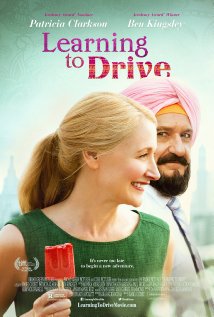
Patricia Clarkson stars as Wendy, a very successful New York book critic, who is blindsided when her husband (Jake Weber, “Medium”) dumps her for another woman. It turns out Wendy is infinitely more attentive to her computer screen than to her husband and daughter (Grace Gummer). In a fortuitous turn, the cab driver during the marital break-up is a Sikh Indian-American named Darwan, played by Sir Ben Kingsley.

Darwan’s second job just happens to be driving instructor, which means he can provide life lessons and philosophy to Wendy while simultaneously reminding her to fasten her seatbelt and check the mirrors. During this time, Darwan is also taking on a wife via arranged marriage to Jasleen (Sarita Choudhury, “Homeland”). His patience and way of life is challenged by both women, so the teacher also becomes a student.

The scenes featuring Clarkson and Kingsley are the film’s best, and inject some moments of humor to go along with the force-fed melodrama. Ms. Clarkson is at her best here flashing anger, vulnerability and a realization that life opens up for those who open up themselves, but she can’t overcome what amounts to a film that should air on Oprah’s network.

Director Isabel Coixet also worked with Clarkson and Kingsley in her 2008 film Elegy. Though it teases some interesting topics, this story sticks mostly to the surface, never digging too deeply. Because of this, it’s a pleasant film that will easily entertain adult audiences who prefer their movies with no real surprises or suspense.

watch the trailer:


SLEEPING WITH OTHER PEOPLE (2015)

September 9, 2015

sleeping with other people Greetings again from the darkness. In 1989, Rob Reiner’s When Harry Met Sally hit theatres, and many described it as an updated/contemporary version of Woody Allen’s 1977 classic Annie Hall.  It’s been 26 years since Billy Crystal and Meg Ryan debated whether guys and girls could be “just” friends, and now writer/director Leslye Headland shows us that same debate continues to this day.

Jason Sudekis (“Saturday Night Live”, Horrible Bosses) stars as Jake, and Alison Brie (“Mad Men”, “Community”) stars as Lainey. These two characters meet in college and promptly lose their virginity to each other. (It takes a little imagination to accept these two thirty-somethings as college kids) Twelve years later, they meet again by happenstance at a meeting for sex addicts. It turns out, Jake’s biggest phobia is related to commitment, and he’s a womanizer who has mastered the break-up (yep, he slept with your sister).  Lainey’s issue is commitment as well, only it’s her misplaced commitment to a married doctor (Adam Scott) instead of her boyfriend (Adam Brody) that causes problems.

Jake and Lainey quickly pick up their legendary (in their own mind) repartee, and it becomes a friendship comprised of rapid-fire one-liners. Yes, I used the F-word to describe their relationship. To protect their platonic bond, they go to the extreme of creating a safe word as an admission/warning if one is feeling overly amorous towards the other … it’s like a fire hose to extinguish any thoughts not related to being a good buddy.

While Sudekis and Brie are both talented and likeable, it’s the outdated pop culture references that create such an out-of-place feeling for the viewer. How many thirty-somethings these days reference Bobby Fischer, Anne Sullivan and Madame Butterfly during conversation? And the “Pontiac Aztec” line may be the best line in the movie, but how likely is it to resonate with most audience members?  There is certainly no shortage of dialogue committed to laughs, but so much of it seems out of step with the young adults it’s clearly targeting.

The obvious comparisons/tributes to When Harry Met Sally come in the form of the split screen during a text conversation (in contrast to Harry and Sally’s phone chats), and the uncomfortable scene featuring a glass tea bottle is the answer to Sally’s infamous diner scene. What’s lacking is the intellect and heart so prevalent in the 1989 film. It may be contemporary, but it’s missing any subtlety or nuance. Perhaps that’s the influence of Producers Will Ferrell and Adam McKay, both who specialize in laughs over nuance.

Additional support work is provided by Amanda Peet, as Jake’s boss and love interest; and Jason Mantzoukas and Andrea Savage, the married couple trying hard to help while delivering the film’s best and funniest scenes (the closing credits – wow!). Also contributing are Natasha Lyonne, Margarita Levieva, and Katherine Waterston (as the doctor’s wife).

Though they deliver some easy laughs (a good thing), if this movie and Amy Schumer’s recent Trainwreck are accurate social observations of the times, it’s difficult to have much hope for modern day relationships (not a good thing).

watch the trailer:


A BRILLIANT YOUNG MIND (2015)

September 9, 2015

a brilliant young mind Greetings again from the darkness. Somewhat surprisingly, mathematics has been the basis for some pretty interesting movies, including Good Will Hunting and A Beautiful Mind.  Equally surprising are the quality movies with lead characters struggling with Asperger Syndrome or Autism – Adam and Rain Man, to name a couple.  Also fascinating, albeit in a different way, are movies that have depicted child prodigies or geniuses. Examples of these are Little Man Tate, Searching for Bobby Fischer, and Akeelah and the Bee. However, it’s this film from director Morgan Matthews that is the first I can recall to combine all three elements.

Mr. Matthews’ directorial resume is filled with documentaries and he brings that no-nonsense approach to this story based on the life of David Lightwing, a young math genius with Asbergers. Asa Butterfield plays Nathan, a boy whose only love is mathematics. He lost his beloved father at an early age, and has since not connected with anyone … even his most devoted and long-suffering mother, played by Sally Hawkins.

Nathan begins studying under Rafe Spall’s Martin, himself a former child math prodigy, whose struggles with Multiple Sclerosis act as a defense mechanism that prevents him from having any semblance of a well-rounded life. The two are a perfect match, and within a few years, Nathan is competing to join the prestigious International Mathematics Olympiad held at Cambridge. Martin has his own personal history with both the event and the team’s coach, played by Eddie Marsan.

The film does a really nice job of illuminating the pressures on both loved ones (parents, teachers, etc) and the prodigies themselves. It explores the question of whether being “gifted” is really a gift or a burden. This is brought to life through the performances of Butterfield (and his many pained faces), Spall (as a man searching for meaning), and Hawkins (as a mother who yearns for nothing but a flash of reciprocity from her son). Also effective is Marsan as the coach, and Jo Yang as Nathan’s Chinese study buddy.

It’s a very touching story, and easily accessible for those of us who fall a bit short of the genius level. It also takes a shot at explaining love in math terms – not something previously featured on screen. And finally, it has one of the most heart-warming and sincere movie hugs one could ask for. In simple terms, it all adds up to a fine movie.

watch the trailer: