LES MISERABLES (2012)

December 30, 2012

les mis Greetings again from the darkness. One of the most anticipated films of the year is the first from director Tom Hooper since his Oscar -winning The King’s Speech. It also happens to be based on one of the true literary classics by Victor Hugo (first published 1862). And yes, it is presented as a true musical … the dialogue is sung and story advanced through forty-something songs. The latter feature gives it more of an opera feel than the stage version I saw more than 20 years ago.

The biggest question and curiosity going in was whether the cast of top notch movie stars could hold their own vocally. Sure, Hugh Jackman (Jean Valjean) is a Tony winner, Anne Hathaway (Fatine) has some Broadway chops of her own, Amanda Seyfried (Cosette) sang in Mamma Mia, and Russell Crowe (Javert) has toured with his own band. But this is a whole new challenge, as director Hooper decided to have the actors sing “live” during les mis4filming, providing a more intimate feel to the film. Throw in two exceptionally strong vocal performances from Eddie Redmayne (Marius) and Samantha Barks (Eponine) and only the harshest critics will claim the singing disappoints.

Seinfeld” fans will enjoy the comic relief from thieving innkeepers Sacha Baron Cohen and Helena Bonham Carter as they take advantage of their customers while belting out “Master of the House“. And it’s pure joy to hear Colin Wilkinson‘s wonderful voice as The Bishop who offers Valjean his chance for redemption. Mr. Wilkinson is legendary as the original Valjean in the London and New York stage versions from the mid-80’s.  The historical les mis3relevance of the material includes the 1832 student-led June Rebellion and it’s adequately staged here.

There were a few things that distracted me at times. The most annoying being the incessant facial close-up on every song. This is typically a device to cover-up weak set design, but here the sets are spectacular and really capture the nastiness of 19th century France. And while I certainly enjoyed Ms. Hathaways’ show-stopping “I Dreamed a Dream“, I found her overall acting to be quite distracting during her few scenes. Russell Crowe’s physical presence perfectly captures the omnipresent Javert, though the lack of punch in his vocals les mis2prevented the boom needed in a couple of songs. Lastly, Mr. Jackman seemed to strain on the high notes in my favorite “Bring him Home“, though again, none of these things ruined the experience for me.

As with most film musicals, the best approach is just to allow the story and songs to wash over you … don’t dwell on the minor issues. Keep in mind that this is a powerful and interesting production thanks to Victor Hugo’s source material. It’s a privilege to enjoy a first rate presentation seen through new eyes and heard through new vocalists.

SEE THIS MOVIE IF: you are a fan of the stage version OR you enjoy well made movie musicals

SKIP THIS MOVIE IF: you are expecting the movie stars to have operatic voices OR nearly three hours of close-ups is more than you can take

watch the trailer:

http://www.youtube.com/watch?v=EkHHHUk8RCw


A ROYAL AFFAIR (En kongelig affaere, Denmark, 2012)

December 23, 2012

royal affair Greetings again from the darkness. I would venture a guess that most are as uninformed as I about this brief, but altogether impactive and fascinating period of history in Denmark. The story is bookended with the (late 17th century) letter that a seriously ill and deposed Queen Caroline sent to her children, the eldest who would later become King Frederick VI. Director Nikolaj Arcel co-wrote the script with Rasmus Heisterberg (the two also collaborated on the original The Girl with the Dragon Tattoo), and present insight into a most bizarre love triangle andpolitical power struggle that instigated national change … and then a severe reversal … and then change again.

We meet the luminous Caroline (Alicia Vikander from Anna Karenina) as she is traveling from England for her initial meeting with her new husband, King Christian VII of Denmark. Unfortunately, this intellectual and talented woman is stuck with a mentally unstable and childlike spouse. Once she fulfills her duty by delivering a son, the chamber visits are cut off and the two live mostly separate lives. The king is manipulated and controlled by the court and mostly just does what he is told to do, and signs royal affair2what he is supposed to sign. This keeps the aristocracy fat and happy, while continuing the harsh policies against the poor peasants.

A local doctor is arranged for the king’s European tour and we discover that this doctor has learned how to co-exist and gain the trust of the odd king. What few know is that this doctor … Johann Struensee is a revolutionary thinker and follower of Voltaire and Rousseau. He seeks social reform in Denmark and soon schemes with the idealistic queen to use Christian as their mouthpiece and gain control of the court.

It’s not long before Caroline and Struensee are sharing much more than ideas, and the big question is … will their downfall be their ideas for enlightenment or their dangerous love affair? Speaking of the love affair, it bears mention that this is one of those rare, royal affair3believable stories of true soul mates. Most movies, especially costume dramas, have us believe that soul mates are created by an exchange of glances across a crowded room. Here, the love between these two grows in step with their ideas for social reform. In other words, there is more than lust between Caroline and Struensee.

Sometimes the story gets a bit muddled between the love affair and the political maneuvering, but it’s not difficult to imagine that these conflicts actually occurred during this period. These are real people with real issues and it’s a pleasure to watch the tangled web.

Mads Mikkelsen is known to most as the villain Le Chiffre in Casino Royale. Here he captures the nuances of Dr Struensee as both a revolutionary figure and an illicit lover. Alicia Vikander is clearly on the verge of stardom and is wonderful as the complex Caroline. The real scene stealer here is Mikkel Boe Folsgaard as Christian. This key role could have easily spoiled the film in the wrong actor’s hands. Instead he balances the mental issues with enough doubt that we viewers are left wondering how much is illness and how much is insecurity … just how much did he understand?

This is a very well crafted, if somewhat conventional film that tells a remarkable story from a turbulent time in Denmark. It’s a story that deserves a greater audience … despite it’s lame title … and this Oscar contender (Foreign Language category) should provide just that.

SEE THIS MOVIE IF: you are fan of costume dramas, especially when steeped in historical accuracies

SKIP THIS MOVIE IF: you believe all things are rotten from Denmark (see what I did there?)

watch the trailer:

http://www.youtube.com/watch?v=FGXNQu3fpP8


JACK REACHER (2012)

December 22, 2012

jack Greetings again from the darkness. Lee Child has written 17 Jack Reacher books since 1997, and it’s a bit surprising that it took Hollywood this long to latch on to this enigmatic lone wolf drifter who doesn’t so much care about laws as he does right and wrong. Fans of the books were outraged when it was announced Tom Cruise would play the 6’5 hulking Reacher, as much of the character’s appeal stems from his ability to physically dominate a situation while using very few words.

Unfortunately I can’t ease the minds of those fans of the pulpy series, but rather to encourage them to give this a shot. Author Child was probably ecstatic when Mr. Cruise took an interest in the character, despite the obvious conflicts. Very few actors can command screen presence like Cruise, especially in action sequences. That’s where this gets a bit jack2dicey. This is not an action movie. It’s an investigative mystery thriller that includes 3-4 action sequences.

The film has a real 1970’s feel to it along the lines of Billy Jack or Walking Tall mixed with Dirty Harry and numerous westerns with strong, silent types, and of course, the timeless pulpy detective stories. See, Reacher is a former military investigator with a mind that is always a step or two ahead of everyone else. He looks at the obvious evidence and immediately notes a list of doubts where none previously existed.  So, he is smarter than you.  He can fight better than you.  And he is travels much lighter than you.

jack4 A seemingly random sniper attack is a bold way to begin a movie given recent real-life events, but the opening sequence is executed with methodical precision and daring so that we can quickly believe in Reacher’s conspiracy theories. In the blink of an eye, Reacher has appeared out of nowhere (his usual address) and is in the middle of the investigation being conducted by the lawyer of the wrongly accused James Barr (Joseph Sikora). The defense lawyer is played by Rosamund Pike, whose character is the daughter of the District Attorney (Richard Jenkins). The police detective is played by David Oyelowo and it’s easy to tell something isn’t completely right within the walls of city hall.

Reacher roams the beautiful city of Pittsburgh asking questions and piecing together the puzzle left behind by creepy villain The Zec (Werner Herzog) and his henchman Charlie (Jai Courtney). We get three Reacher fistfights, a Bullit type car chase in a muscle-bound 1970 Chevelle, and some military sharp-shooting from the depths of a quarry. What we don’t get is the Hollywood jack5tradition of a Cruise sprint. Not once do we see his trademark all-out dash to or from something. In fact, his attempt at moving like a larger man often reminded me of his Stacee Jaxx strut from the recent musical Rock of Ages.

Director Christopher McQuarrie won an Oscar, and my ever-lasting respect, for his The Usual Suspects screenplay. This story is infinitely less-complicated, but it does offer some fun moments thanks to the Reacher character. Maybe things would be a little better if a guy like Reacher really existed … totally off the grid and taking down the bad guys that the cops can’t quite catch. Sounds a bit like “Dexter”, only Reacher’s code includes doling out physical pain and then moving on to the next town … with a new set of Goodwill duds and a fresh toothbrush.

Caleb Deschanel (Director of Photography) provides a really sharp look to the film and, thankfully, doesn’t cheat on the action scenes. Herzog (a highly respected director) has a great look for a bad guy, but is painfully under-utilized here. Rosamund Pike jack3may simply be my least favorite actress working today. Bug eyes and long legs do not an actress make.  Even Reacher had little “interest” in her. Robert DuVall makes a colorful appearance as the late-arriving character that breaks open the case, and he seems to relish the reunion with his Days of Thunder co-star. The most interesting character and actor to me was Jai Courtney (pictured, left), who will be seen next as Bruce Willis’ son in A Good Day to Die Hard.

If you haven’t read the Lee Child books, you will probably readily accept Cruise as Reacher. If you are a fan of the franchise, your eyes and brain will have massive conflicts for the first hour, but then acceptance creeps in, and you’ll probably agree that it’s a simple, effective piece of entertainment … far superior to most Nicolas Cage movies these days!

**NOTE: don’t miss Lee Child as the policeman who releasaes Reacher’s personal items back to him.

SEE THIS MOVIE IF: you are a fan of investigative thrillers that are sprinkled with actions scenes and car chases OR you just want to see and hear a very cool ’70 Chevelle

SKIP THIS MOVIE IF: you are such a devoted fan of Lee Child’s books that you refuse to accept the 5″7 Tom Cruise as the 6’5 Jack Reacher OR like me, you hope the kidnappers had struck much earlier on Rosamund Pike’s character.

watch the trailer:

http://www.youtube.com/watch?v=kK7y8Ou0VvM


HYDE PARK ON HUDSON (2012)

December 16, 2012

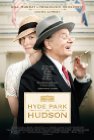
hyde Greetings again from the darkness. It’s a bit of a curiosity why the only four-times-elected US President has been portrayed so few times on screen. Without putting much thought into it, the most memorable non-documentary occurrence may have been by Jon Voight during Michael Bay’s Pearl Harbor. Bring on Bill Murray as Franklin Delano Roosevelt during the 1939 first ever US visit by British monarchs … King George VI(“Bertie” played by Samuel West) and Queen Elizabeth (Olivia Colman) … and the stage is set for a behind-the-scenes political tale of the “social” meeting that led to the US and England joining forces in WWII. Unfortunately, that’s not really what we get.

Director Roger Michell (Morning Glory, Venus) and noted playwright and screenwriter Richard Nelson (Ethan Frome) just can’t seem to make up their mind which story they want to tell. Is it the historical meeting between FDR and the King? Is it the hyde3fling between FDR and his 6th cousin Daisy (Laura Linney), whose relationship was uncovered through the diaries and letters left behind when she passed in 1991? Is it the ongoing manipulations by Mrs Roosevelt (FDR’s mother, played by Elizabeth Wilson) and the cagey Eleanor (Olivia Williams)? Is it a political statement that all powerful men have insecurities and needs? The film is narrated and mostly told through the viewpoint of Daisy, a local 47 year old spinster, who gets dragged wide-eyed into the FDR mayhem. Mrs Roosevelt, Eleanor and FDR’s assistant Missy (Elizabeth Marvel, The Bourne Legacy) all understand the President’s reason for allowing Daisy into their inner sanctum. Daisy, a bit slow on the take, learns why once FDR stops the car in a meadow during one of their private, scenic drives. The running story of Daisy is probably the least interesting within the film, and it often deflates whatever momentum might get started.

hyde2 The best and most interesting portion involves the private meeting between FDR and the King that takes place in the study after hours. The two bond as men who are in positions of power, share the same insecurities, and who both curse their afflictions … the King and his stuttering, and the President with his polio. The best line of the film occurs during this meeting when the President asks “Can you imagine the disappointment when they find out what we really are?” It’s a reminder that all great men are just that … men.

This barely qualifies as a historical drama, and the far more interesting personal topic (rather than Daisy) would be the ongoing power struggle between Eleanor and Mrs Roosevelt. FDR does have to remind them that HE is the President! There is acknowledgment of Eleanor’s sexual preference, as well as her acceptance of FDR’s extra-marital desires and needs.

hyde4 Much is made of the famous American picnic where the King and Queen are served hot dogs, and this story highlights the Queen’s paranoia that this is yet another slap in the face meant to dishonor their presence. In fact, it is presented as a shrewd move by FDR to introduce the British royalty as people to be embraced by the American public.

It must be noted that though the film plays much like a made for TV movie, Bill Murray does a solid job portraying FDR as a man filled with humor, mischief and in full command of the burden he carries. His need for “me” time is understandable and his agreement with the press photographers explains why so few pictures exist of his wheelchair or other challenges in living with the polio. Unfortunately, the film just doesn’t keep up with Murray’s performance or with the powerful subject he portrays. Sound familiar Mr. Voight?

**Note: stay for the credits and see footage of the infamous “hot dog picnic”

SEE THIS MOVIE IF: you enjoy Hallmark-style movies dwelling on interpersonal relationships OR you still need proof that Bill Murray is a legit actor.

SKIP THIS MOVIE IF: you are looking for a historical drama centered around Franklin Delano Roosevelt

watch the trailer:

http://www.youtube.com/watch?v=UQaScjiWDyY


Christmas movie mash-up

December 13, 2012

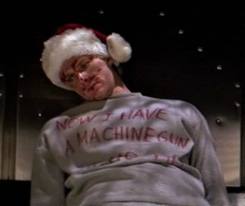
die hard “Ho-Ho-Ho.  Now I have a machine gun.”  Those words appear in a most creative manner, and jolt us back with a violent reminder  that the action in Die Hard is actually taking place during an office Christmas party!  The Christmas holiday … and all that entails … has played a role in countless movies over the years.  Some of these are sweet, some are funny, some are action-packed, some play to our family emotions and insecurities, some are downright crass, and many are blatant reminders of what’s really important in life.

The following Christmas movie mash-up was posted to YouTube and does a pretty interesting job of capturing the many approaches we have seen in this genre.  It starts nice and easy with Bing Crosby singing, and ends with the glorious sound of Judy Garland.  In between you will see a bit more action within the holiday spirit!

http://www.youtube.com/watch?v=hnqe0_z2UAk&feature=youtu.be


PULP FICTION (1994) revisited

December 9, 2012

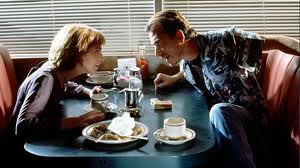
pulp5 Greetings again from the darkness. Typically, I don’t get too serious about a film’s place in history until at least 20 years pass since release. Cinemark presented Pulp Fiction in its Classic Film Series, so the timing seems right … despite it being only 18 years (1994) since Quentin Tarantino’s film won the Palm d’Or (best film) at Cannes Film Festival.  While challenging today to understand the buzz created as it made the festival rounds, there is no question it solidified Mr. Tarantino as the next generation’s auteur … though some would argue that occurred with Reservoir Dogs two years prior.

The lasting impact of some classic films stems from the emotional connection of their loyal viewers.  Casablanca and The Sound of Music are two examples. Others, like Citizen Kane and 2001: A Space Odyssey made their mark through technical achievements.  Adapting a classic novel was the key for To Kill a Mockingbird and The pulp2Godfather.  Still others reached the classic level via spectacle and by becoming an event unto themselves … Jaws and Star Wars.  Pulp Fiction is one of the few films that has so clearly defined a generational change in filmmaking style by influencing and motivating writers and directors.

When asked, I never really answer the “What’s your all-time favorite film?” question. I can name my favorite car, my favorite boss, and even my favorite dessert.  I can’t name my favorite kid or my favorite film … for much different reasons.  Without a doubt, there are numerous films that belong to the “list” of my all-time favorites, but not one is clearly THE best or most favorite on every single day.  There are a few that fall into the elite category AND also into ‘must stop’ category – should they happen to pop up on a movie channel.  Pulp Fiction is one of the chosen few for me.  I realize this opens me up for less-than-flattering judgment, but sometimes we don’t choose the movie … the movie chooses us.

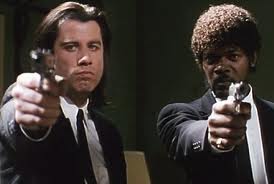
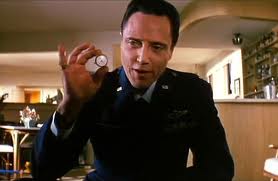
pulp3 Unfortunately, this movie proved to be the end of the highly creative partnership between Tarantino and Roger Avary.  Former video store co-workers, these two had a nice run with True Romance, Reservoir Dogs and Pulp Fiction (for which they won the Best Original Screenplay Oscar), but ego conflict messed up The Beatles and had no less effect on these two writers.  Still, the stars aligned and provided us a non-linear collision of multiple story lines and dialogue unlike we had previously heard on screen. Additionally, it proved to be the career defibrillator for John Travolta, and allowed Samuel L Jackson to deliver one of the most powerful non-biblical bible verses ever.  For most us, it was the first time we had ever seen the plunging of an adrenaline filled syringe through a comatose woman’s breastplate. Quentin Tarantino made no effort to hide his fascination with Uma Thurman’s bare feet … a fetish we would again experience in Kill Bill. We were reminded of the cool effect provided by the “trunk shot” and baffled by the MacGuffin (the glowing briefcase). Vincent Vega (Travolta) taught us that due to the metric system, we would need to order a Royale with Cheese while visiting France, and Christopher Walken explained the, um, depths some would go to pass along a gold watch to a soldier’s son.  The debate of what constitutes a miracle was no less than interesting than watching The Wolf (Harvey Keitel) take charge of a messy situation.  It’s kind of funny to watch Steve Buscemi as Buddy Holly the Waiter since as pulp4Mr. Pink in Reservoir Dogs, he refused to tip for food service.  While Tim Roth and Amanda Plummer discovered the brilliance of holding up restaurant patrons, we were also shown the possible downside to such a plan.  However, the key lesson we all learned, and all hope to avoid ever needing, was that if you are dumb enough (Bruce Willis) to double-cross a gangster (Ving Rhames), you sure as heck better rescue that same gangster from Deliverance-style pawn shop owners.

Tarantino showed us how multiple viewings are rewarded by keeping track of the numerous pop culture homage’s and by realizing just how perfect were his choices of single songs (no film score) for particular scenes.  Listening to Dick Dale strum “Misirlou” over the opening credits still gets me going!  In fact, the only two things I picked out that show a bit of aging are Vincent’s disbelief in a $5.00 milkshake and when Jules calls one of Big Brain Brad’s team “Flock of Seagulls”.  So if you are taken aback by Pulp Fiction as one my all-time classics, my only response is … “Say ‘what?’ again”.

here is a video of Dick Dale playing “Misirlou” in 1963:

http://www.youtube.com/watch?v=ZIU0RMV_II8


ANNA KARENINA (2012)

December 9, 2012

anna Greetings again from the darkness. We are all familiar with the phrase “All the World’s a Stage”, and director Joe Wright and writer Tom Stoppard twist the phrase into “All the Stage is the World” in their re-imagining of Leo Tolstoy‘s literary classic. With a bold and ambitious vision, the story plays out mostly within the confines of a theatre … utilizing not just the stage, but the rafters, backstage and all nooks. This is pulled off in a most operatic manner with heavy production, remarkable sets and costumes, and the use of curtains and doors for a change of scene. Additionally, most of the actors move like dancers and, at times, the dialogue delivery borders on musicality.

Tolstoy’s story has been adapted for the screen in more than two dozen versions, including two from screen legend Greta Garbo (1927, 1935). Who better to take on the role of Anna than Keira Knightley, the ultimate period actress of our generation. It’s her anna2third film with Joe Wright (Atonement, Pride and Prejudice) and by far, the least traditional in presentation. This version focuses on the affair between Anna and Vronsky (Aaron Taylor-Johnson from Kick-Ass), and her resolve in tossing aside her standing in Russian high-society … and even giving up her son.

We do gets bits and pieces of the other story lines: Oblonsky (Matthew Macfadyen) provides some comic relief from the start despite his extra-marital wanderings from his wife (Kelly Macdonald); the stoic determination of the bureaucrat Karenin (Jude Law) as he insists on maintaining the proper illusion; and the down-to-earth landowner Levin (Domhnall Gleeson, Brendan’s son) with his pursuit of perfect farming and the beautiful Kitty (Alicia Vikander). Some viewer anna4disappointment creeps in when we realize that Levin’s story is minimized here for the torrid love affair of Anna and Vronsky. Levin’s story is allowed to sneak outside the theatre setting … presumably since he is the only character living in the real world.

Tolstoy’s powerful story is stymied to some degree by the lack of sympathy we feel for Anna … while we certainly understand her lack of connection to the cold Karenin, we never sense more than a physical attraction and unreasonable wish between she and Vronsky. The strength of the story stems from Anna’s knowing willingness to surrender her anna3place in society for the sake of what should interprets as true love. When one of the society ladies states she could forgive Anna for breaking the law, but not for breaking the rules, we fully comprehend what a ridiculous state those in high society exist.

It’s difficult to imagine a wide acceptance of this unique presentation; however, the technical aspects of the film deserve much Oscar consideration – cinematography, set design, costumes, etc are all first rate. And Keira Knightley proves again that costume dramas are where she is at her best.

SEE THIS MOVIE IF: you thought all possible presentations of literary classics had been explored OR you need further proof that no actress today seems more natural in the unnatural costume dramas than Keira Knightley

SKIP THIS MOVIE IF: film interpretations of the elite literary classics leave you with an empty feeling

watch the trailer:

http://www.youtube.com/watch?v=rPGLRO3fZnQ


HITCHCOCK (2012)

December 5, 2012

hitch Greetings again from the darkness. Here goes: John J McLaughlin wrote this Hitchcock screenplay based on Stephen Rebello‘s book “Alfred Hitchcock and the Making of Psycho”, which was based on the filming of the Psycho screenplay from Joseph Stefano, which was loosely based on Robert Bloch’s book, which was based on the grizzly real life crimes of Ed Gein. Whew!

It’s kind of interesting that Alfred Hitchcock is hot again some 36 years after his final movie.  His Vertigo recently displaced Citizen Kane as the all-time greatest film. HBO is still running their recent production of The Girl, which is based on Hitchcock’s making of The Birds and his unhealthy connection to Tippi Hedren. And now, we get this Hollywood production, supposedly based on the master of suspense. I say supposedly, because this film plays like it was written by the heirs of Alma Reville, Hitch’s long time wife and collaborator. We all knew she worked on his films and hitch2contributed ideas, but the film wants us to believe she was the real genius behind the public genius.

The movie is entitled “Hitchcock” and is based on the making of Psycho, but in fact, it’s more the story of Alma and her husband. While there is nothing wrong with that story … in fact, it is quite interesting and entertaining … it’s also a bit of false advertising.

Helen Mirren portrays Alma, and instead of the mousy woman who usually faded into the background, we see a fairly strong and talented woman who goes toe-to-toe with Hitch in her best scene. Sir Anthony Hopkins dons some facial appliances and a fat hitch3suit and does a solid job of capturing the odd, creepy, leering, disturbed, insecure genius we recognize as Alfred Hitchcock. He comes across as louder and more in-motion than what we have previously seen. And while director Sacha Gervasi makes it clear that Hitch is not a “normal” guy, he doesn’t dwell too much on the blond fixations.

The emphasis on the skills and importance of Alma would be fine were it not so exaggerated. Surely every great director and writer and artist has a muse and/or support system; and, there is no question Alma was a very talented lady, but her strength here bordered on distracting to the overall picture. Especially needless was the storyline of Alma being attracted to screenwriter Whitfield Cook (Danny Huston), who wrote Strangers on a Train for Hitchcock.

hitch4 The Hitchcock humor is allowed to shine through (“call me Hitch, hold the cock”) and his battles with Paramount Studio head Barney Balaban (Richard Portnow) and the censorship board (Kurtwood Smith) are excellent. Hopkins finds the humanity under the fat suit and is especially good in his work with Scarlett Johansson (as Janet Leigh) and Jessica Biel (as Vera Miles). I also got a kick out of James D’Arcy as the affected Anthony Perkins and all his quirky mannerisms.

Though this barely qualifies as a story on the making of Psycho, it was chilling to watch the addition of Bernard Herrmann’s iconic score added to the shower scene. In fact, Danny Elfman does a nice job of subtly adding a Herrmann-type score to this film. I’m not sure if the film will play well with all Hitchcock aficionados, but if you can forgive the Alma slant, it’s actually quite interesting and entertaining and kind of a sweet film at its core.

SEE THIS MOVIE IF: you want to see what would happen if Alfred Hitchcock took personal advice from serial killer Ed Gein OR you want to see two great actors (Mirren, Hopkins) having a really good time OR you want to see Scarlett Johansson play Jamie Lee Curtis’ mother.

SKIP THIS MOVIE IF: you expect to learn much about the making of Psycho

watch the trailer:

http://www.youtube.com/watch?v=3rQuRLERl6A


DETROPIA (2012)

December 3, 2012

detropia2 Greetings again from the darkness. Admittedly, I am tough on documentaries. My expectations are quite high. After all, documentary filmmakers need not be burdened with fluffy entertainment requirements. Instead, they can tell a story, debate an issue, or expose a wrong. Wasted opportunities annoy me.

Have you heard anything about the economic hardships in the city of Detroit? Of course you have. It’s been a story for more than two decades. So a documentary “exposing” the hardships in Detroit should at least offer a different perspective, debate options, or discuss the challenges of progress. Otherwise, it’s a wasted opportunity, which is what we have here.

The film is beautifully photographed and very well put together. It lacks only a reason to exist. The film comes from co-directors Heidi Ewing and Rachel Grady, Oscar nominated for Jesus Camp. This one is a clump of different pieces that don’t fit and provide little insight. We get a clueless local union president who is clinging to the past and offering no help to his constituents. We get some obscure video blogger whose main credentials seem to be that she lives in Detroit and has her own camera (and can climb in a window). We get a couple of guys sitting on a front porch cracking wise of any efforts by local officials to develop solutions.

detropia4 There seems to have been a very narrow focus on choosing who to interview. At least Tommy Stevens, a local bar owner, is an interesting guy to follow around. He holds out hope that GM will open a Chevy Volt plant and spur business at his club, so he can re-hire his cook. His hopes are dashed when he attends a local auto show and finds out that China offers an electric car at a significantly lower price than Chevy. He recalls the days that stubborn US automakers refused to acknowledge upstart Honda in the US.

We are offered brief glimpses into some type of town hall meeting and the absolute rejection by the union of the “final” offer from American Axle. We are shown a few clips from inside the Detroit Opera, which the Big 3 automakers continue to finance. Lastly, we are introduced to a couple of young artists, who are part of a growing trend of relocations to inner city Detroit to take advantage of the low housing costs.

DetropiaTT All of the above are interesting enough, but again, it’s been two decades and we already know this stuff.  We only get one angry lady spouting off about Mayor Dave Bing’s seemingly appropriately creative idea of consolidating the outlying areas into a smaller geographic area, so the city can provide services for its citizens and start the process of healing and growing. Her reason for bashing the idea?  She doesn’t want to move.

There seem to be two real issues worth analyzing. First is the unwillingness of so many to accept that change has already occurred … so fighting change is a lost cause. Your city is broke. No need to make things worse. Secondly, looking into the true cause of the downturn could lead to interesting discussions of greed. Corporate greed as well as the greed of the people. The Chinese can make a car (and electronics, etc) so much cheaper because they are not holding on to our standard of living. Detroit has been called the birthplace of the middle class, but just what is that definition today? These are some of the discussions that need to be had. One more look at houses being torn down and empty hotels … all with the shiny GM towers in the background … is just a re-hash of what we already know. So yes, the wasted opportunity has me annoyed.

**Note: this film made the cut down list to 15 for documentaries under consideration for the Academy Award.

watch the trailer:

http://www.youtube.com/watch?v=SRce1KFsH-g


KILLING THEM SOFTLY (2012)

December 1, 2012

killing Greetings again from the darkness. No apologies will be made in regards to my fondness for mob, organized crime and hit-man movies. The underworld grit and quest for power makes for a colorful and meaty topic for books and movies. Still, with such a long and varied history of mob tales, we have come to expect a certain amount of action and a turf war for power and control. Director Andrew Dominik, working from a George V Higgins novel, delivers an artsy look at the emotional side of mobsters and then adds a heavy-handed slap of political and economic editorials.

Who knew hit men and mobsters TALKED so much? This plays like Dr Phil on The Sopranos.  So often they are portrayed as men of few words who specialize in suppressing their emotions. Imagine how differently The Godfather movies would have played if Don Corleone had chatted about his feelings over tea with Barzini.  Here we get Mickey the hit-man, played by killing3James Gandolfini, as a man lost in booze and sleazy sex-for-pay. He has clearly lost his once sharp edge and now loves to tell stories that do nothing but showcase his lack of resolve. We get a few talky scenes with local criminal Johnny Amato (Vincent Curatola) and his small-time recruits Frankie (Scott McNairy) and Russell (Ben Mendelsohn). We even get a talky high-stakes card game stick-up where mob guy Markie (Ray Liotta) tries to negotiate an end to the heist.

By far, most of the blabbing comes from mob fixer Jackie (Brad Pitt). It matters not whether he is in the car with the Driver (Richard Jenkins), in a bar with one of the punks, or in the hotel with schlubby Mickey, this guy just talks incessantly. Luckily killing2for us viewers, the dialogue is extremely well written and often entertaining.  But it still boils down to too much emotional baggage … especially from a guy who likes to kill ’em softly (from a distant).

The individual pieces of the film work very well. Ben Mendelsohn, who was so frightening in Animal Kingdom, is terrific here as the strung-out hoodlum always looking for a quick score. Liotta adds a sense of humor and realism, Gandolfini dominates the screen, and Pitt proves once again that he is at his best in a tough/bad guy role, rather than as a strutting poser.

killing4 Where the movie goes wrong is with the obnoxious and numerous attempts to make sure we catch the parallels between the US economic woes and those of the mob. The faceless “committee” mob clearly symbolizes our government’s inability to make wise decisions, and if somehow we miss all of that … Pitt’s final monologue spells it out for us. He firmly believes the US is not a country, but rather a business … and each of us is on our own.  How ironic that the only mob business we witness is their killing off of each other. It’s always frustrating when the individual parts are greater than the movie as a whole, but an artsy looking mob film that beats us upside the head with a 90 minute message just can’t overcome the coolness of Brad Pitt with a shotgun and Johnny Cash singing (“The Man Comes Around”).

SEE THIS MOVIE IF: you appreciated the artsy approach that director Andrew Dominik took with the western genre in The Assassination of Jesse James by the Coward Robert Ford OR you just want to see Brad Pitt looking cool brandishing a shotgun

SKIP THIS MOVIE IF: you prefer mob movies to be about the inner-workings of mobsters seizing power OR you prefer pretty boy Brad Pitt to tough guy Brad Pitt

watch the trailer:

http://www.youtube.com/watch?v=tDyaNnrgdp4