WENT UP THE HILL (2025)

August 15, 2025

Greetings again from the darkness. In the Mother Goose nursery rhyme, Jack and Jill not only went up the hill together, they also tumbled down. This latest from writer-director Samuel Van Grinsven and co-writer Jory Anast spin a Jack and Jill yarn that’s not nearly as cutesy, yet does involve some emotional tumbling … and one creepy spirit.

Horror film aficionados are accustomed to possession-themed stories, where someone from beyond takes over the body of one still living. The twist here … and it’s a good one … is that the spirit of Elizabeth actually (and regularly) switches between not one, but two characters who are both important to her. Elizabeth was a renowned artist who opted for a way out, leaving behind her two great loves – her wife Jill (Vicky Krieps, PHANTOM THREAD, 2017) and their stunning mountain lake home (the Southern Alps of New Zealand).

On the day of the funeral, Jack (Dacre Montgomery, very good in the upcoming WHAT WE HIDE, 2025) shows up, claiming Jill invited him by phone. It’s clear Jill has no idea who he is, or that Jack is Elizabeth’s only child – one given up many years ago for reasons that aren’t clear until much later. Elizabeth’s sister, Helen (a terrific Sarah Peirse) has kept the family secret all this time.  Jill invites Jack to stay at the house, despite Helen making it obvious his presence is not appreciated.

Speaking of presence … we never see Elizabeth, but we know she’s there (and there). Jill sleeps next to the coffin, and every time she and Jack fall asleep, Elizabeth’s spirit does her thing. Mood and atmosphere are key here, and everyone (including Jack, Jill, and us viewers) is confused as to what the spirit of Elizabeth is trying to accomplish. Does the spirit want Jack and Jill to have the relationship that mom and son never did? Or is the spirit focused on having her beloved wife, and possibly the long lost son as well, join her in her new locale? The goal isn’t always clear, but it is always a bit creepy … which is good for the movie.

Cinematographer Tyson Perkins likely had a blast working with the combination of skilled actors, a stunning modern house, and the geographic terrain which could be both beautiful and treacherous – although the number of ‘eyeball shots’ were a bit eerie. A not so minor complaint is in regard to the low-level dialogue, which was exceptionally difficult to hear at times. Still, the acting here is superb, as is the piano-based score from composer Hanan Townshend (TO THE WONDER, 2012), and kudos to a horror movie that’s neither slasher, sequel, nor re-tread.

Opening in theaters on August 15, 2025

WATCH THE TRAILER


THE DEAD DON’T HURT (2024)

May 28, 2024

Greetings again from the darkness. It’s fairly common for a film to open with a dramatic scene and then take us back for a period of time to show how the story arrived at this point. Of course, the other logical option would be to have that scene serve as the beginning of the story. What happens with this film is rare: The storytelling goes backwards AND forwards. We learn how the characters got to this point and we learn what happens after this moment. The person to thank for this is writer-director Viggo Mortensen. Highly regarded as an actor for years, Mortensen had one previous filmmaking project, FALLING (2020), which made the festival rounds.

Starring as Holger Olsen, Mortensen is a man trying to live a quiet life on the frontier in the 1860’s. He spots lovely Vivienne (Vicky Krieps, excellent in PHANTOM THREAD, 2017) having a spat with her well off boyfriend, and very quickly she’s drawn to Holger’s flirtations. Her making the choice to leave a comfortable upper-crust life for a more challenging one with Holger, gives us a glimpse into the inner-strength and determination of this woman. Soon she is turning his dusty cabin into a home by cleaning, planting a garden, and adding touches of convenience … such as they were 160+ years ago. And speaking of decisions, Holger makes a life-changing one when he decides to enlist to go fight in the Civil War. It’s a decision she tries hard to talk him out of.

While he is soldiering, we learn much about the little town where Vivienne is stuck. A corrupt Mayor Schiller (the always smarmy Danny Huston) is in cahoots with his equally sleazy business partner Alfred Jeffries (Garret Dillahunt, NO COUNTRY FOR OLD MEN, 2007), as they work their master plan of getting rich at the expense of others. Alfred tries his best to control his combustible son, Weston (Solly McLeod), who takes his entitlement to sometimes violent extremes against those weaker than him. Weston takes a real interest in Vivienne, and despite her best efforts, things go wrong between them.

A few years pass and Holger returns. In a brilliant bit of acting and surgical dialogue, Vivienne asks him, “How was your war?” The two work to re-establish their relationship in the wake of the changes that have occurred. When that opening scene comes back around, Holger sets off on a journey for personal revenge. In addition to the two timelines mentioned above, we also get flashbacks (sometimes via dreams) of Vivienne’s childhood. By this time, we understand Vivienne and Holger very well. ‘Still waters run deep’ is a passage that came to mind while watching, and it should also be noted that filmmaker Mortensen and cinematographer Marcel Zyskind (DALILAND, 2022 and a frequent collaborator with Michael Winterbottom) include some wonderful shots of waterfalls, rivers, mountains, and vistas … the breathtaking shots we appreciate from the western genre. The film deliberately moves slowly (as the times dictate) and captures the hardships of living off the land, and the struggles of separation; yet it also addresses one man’s vengeance as necessary before he can move on. We find ourselves not one bit surprised that Viggo Mortensen the talented and intelligent actor is also Viggo Mortensen the talented and intelligent filmmaker.

In theaters May 31, 2024

WATCH THE TRAILER


CORSAGE (2022)

December 23, 2022

Greetings again from the darkness. Royals are having a moment. Well, actually, the Royals have had a few hundred years of moments … but now, they are having their moment in the entertainment world. It seems almost everyone watched “Downton Abbey” and now “The Crown”, and last year we saw Kristen Stewart’s Oscar nominated performance as Lady Di in SPENCER. Of course, there have been countless other films focused on Kings and Queens and other royal types, and now writer-director Marie Krutzer (THE GROUND BENEATH MY FEET, 2019) serves up a (mostly) fictional account of Empress Elisabeth of Austria from the 19th century.

Vicky Krieps (PHANTOM THREAD, 2017) delivers a wonderful performance as Empress Elisabeth, also known as Sissi. It’s late 1877 and we follow her through one year of life … the year she turns 40. Now that’s an age that generates consternation amongst many, but for an Empress obsessed with age and beauty, and one considered a fashion icon of the era, it’s nearly traumatizing for her. She struggles with her weight and though she’s not often seen in public, she constantly worries about the people’s perception of her physical appearance. This leads to the torturous tightening of her corset (referenced in the film’s title).

Filmmaker Krutzer presents Sissi as the epitome of a life of entitlement, and one who has little purpose or happiness. Her young daughter and older son are mere afterthoughts to her, and instead she pursues hobbies such as horseback riding and fencing. Her marriage to Emperor Franz Joseph (Florian Teichtmeister) seems mostly absent of love (although history tells us otherwise), and his affairs feed her insecurities surrounding her age.

On screen captions walk us through the timeline and numerous locations so that we always know where the Empress is and how long she stays. There is a particular sequence that historians should appreciate, as the Empress meets Louis Le Prince (Finnegan Oldfield), the inventor of an early motion picture camera. He chooses the Empress as a subject for his camera, and we witness the results. The historical relevance is with Le Prince and not the action shots of the Empress, as those (and their meeting) are quite fictional.

An unusual mix of music includes a version of Kris Kristofferson’s “Help Me Make it Through the Night” and an especially enjoyable version of “As Tears Go By” (written by Mick Jagger and Keith Richards), as well as terrific music from Camille Dalmais. In many ways, this is Marie Krutzer’s love letter to a long ago royal, however it’s clearly a fictional depiction since the manner of death is so dramatically changed in type and timing. Ms. Krieps allows us to feel the frustrations of time felt by the Empress, and we understand the body double approach (replete with matching anchor tattoos). Subtle humor is injected periodically, and maybe the best is the doctor explaining how “harmless” the new drug heroin is. There is plenty here for those attracted to “royal” stories.

Opens in theaters on December 23, 2022

WATCH THE TRAILER


OLD (2021)

July 23, 2021

Greetings again from the darkness. THE SIXTH SENSE (1999) and UNBREAKABLE (2000) created a movie bond with filmmaker M Night Shyamalan that will always exist. In other words, I continue to go into each of his projects with hopeful expectations of another classic. Of course, some have been pretty good (SPLIT, 2016), while others are barely watchable (THE LAST AIRBENDER, 2010). His latest lands somewhere in the middle, but does feature a stunning beach setting (Dominican Republic) – one whose tropical beauty hides a sinister reality.

The film’s synopsis is captured in the trailer: tourists experience a mystifying and terrifying phenomenon while on a day trip to a gorgeous secluded beach. The director adapted the film from the 2010 graphic novel “Sandcastle”, written by Pierre-Oscar Levy and Frederick Peeters. Shyamalan specializes in one thing: big and creative ideas. He is a risk-taking filmmaker, but one not always focused on execution, coherence, or details. Especially awkward here is the dialogue. None of these characters talk like real people. Lending to the awkwardness is the attention given to each character’s name and occupation … except for the kids, where age is the significant data.

Due to the nature of the story (and the effects of the beach), the cast is significantly larger than the number of characters. We ride along with one family as they first approach the luxury resort. Insurance actuary Guy (Gael Garcia Bernal) and his wife, museum curator Prisca (Vicky Krieps) are vacationing with their 11 year old daughter Maddox (Alexa Swinton) and 6 year old son Trent (Nolan River). The couple clearly have a strained relationship and appear headed for a break-up. Encouraged by the resort manager to spend the day at a secret remote beach, they are joined by Charles (Rufus Sewell), a surgeon, his calcium-deficient trophy wife Chrystal (Abbey Lee), their young daughter Kara, and the doctor’s elderly mother Agnes (Kathleen Chalfant). Another couple is there as well, nurse Jarin (Ken Leung) and his wife Patricia (Nikki Amuka-Bird), a psychologist. Already at the beach when they arrive is rap star Mid-sized Sedan (Aaron Pierre), replete with bloody nose and the corpse of the woman who accompanied him.

It’s best not to go into specifics about the progression of things for these folks on the beach, but it can be noted that they frantically try to find a way back to the resort. When all attempts prove unsuccessful, that ridiculous dialogue fills in many of the gaps for us, though you should know the science doesn’t hold up … think of it as fantasy instead. As their day at the beach moves forward, other actors take over: Alex Wolff and Thomasin McKenzie are teenage Trent and Maddox, Eliza Scanlen is Kara, and later, Emun Elliott and Embeth Davidtz become Trent and Maddox. It becomes frustrating for viewers as the professions are emphasized: Guy spouts statistics at every turn, Prisca discloses she’s not a pathologist, and Patricia attempts to get everyone to bring their feelings to group. Ugh.

Despite the many missteps and the overall mess of characterizations, Shyamalan (who also appears as the driver who drops them at the beach) does serve up a creative idea – one that will likely get viewers questioning their own mortality and how best to spend time. Mental illness is addressed in a crude manner with Rufus Sewell (a fine actor) bearing the brunt of a poor script, while physical afflictions and the effects of age come off a bit better. The strange looking woman serving up custom cocktails at the resort is Francesca Eastwood (Clint’s daughter), and Shyamalan’s patented plot twist ending does make sense and even has a contemporary feel to it.

Opening in theaters on July 23, 2021

WATCH THE TRAILER


THE LAST VERMEER (2020)

November 19, 2020

 Greetings again from the darkness. Knowing the film is based on Jonathan Lopez’s 2008 book, “The Man Who Made Vermeers” removes some of the mystique from the story; however Dan Friedkin’s (stunt pilot on DUNKIRK) directorial debut is an enticing look at a blending of art history and world history. The screenplay was co-written by John Orloff, Mark Fergus, and Hawk Ostby.

It’s May 29, 1945, three weeks after the fall of Hitler’s Reich, and the Dutch military is on a mission to reclaim valuable art and collectibles confiscated by the Nazis during the war. Some of these were hidden in Austrian salt mines by order of Hermann Goring, actions also depicted in the 2014 film, THE MONUMENTS MEN. After serving in the war, Captain Joseph Piller (Claes Bang, “Dracula” 2020) is tasked with tracking down those who stole the art, and those who sold the art to Germans. It’s a task meant to preserve his country’s culture. One particular piece, “Christ with the Adulteress” held special significance, as it was billed as ‘the last Vermeer’, a long lost painting by Dutch master Johannes Vermeer (“The Girl with the Pearl Earring”), for which Goring had paid a record price.

Investigation on this painting led Piller and his assistant Minna (Vicky Krieps, PHANTOM THREAD 2017) to Han Van Meegeren (played with panache by Guy Pearce and his stylish eyebrows). Piller is also helped by his friend Esper Vesser (Roland Moller, ATOMIC BLONDE 2017) who supplies a bit of muscle and brawn. Van Meegeren has a fancy manner of speech, and Piller determines he’s the key to the case, and to unlocking what occurred and how. At the same time, the Ministry of Justice (August Diehl, INGLORIOUS BASTERDS 2009) is after Van Meegeren for conspiracy, and the parties end up in court.

Piller and Van Meegeren existed in real life, and though some dramatic license is taken, much of what we see actually happened. Art experts and politics collided. And it’s not surprising that egos ruled the day (not unlike today). The twist may or may not be a shocker to those who know the story, but it’s still fascinating that folks would risk their lives in such a manner during the darkest of times. It seems opportunists exist regardless of the era. Mr. Bang and Mr. Pearce are both excellent here, and it’s quite fun to watch their verbal wranglings. Director Friedkin adds an Epilogue that will surely bring a smile to most viewers.

Opening in theaters November 20, 2020

watch the trailer


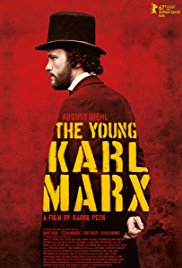
THE YOUNG KARL MARX (2018)

February 24, 2018

 Greetings again from the darkness. When the name Karl Marx comes up, most of us recall that iconic photo of the older gentleman with the large grey beard. As with all older gents, they were once young men, and that’s the focus of this film from writer/director Raoul Peck and co-writer Pascal Bonitzer.

The story kicks off in 1843 when young Marx was the editor of “Rheinische Zeitung” and carries us through the 1848 publication of “The Communist Manifesto”. We progress chronologically through Paris, Brussels and London and witness how Marx’s personal life and ideological mission intertwined, leading ultimately to the birth of Communism.

August Diehl (INGLOURIOUS BASTERDS) plays Karl Marx and Stefan Konarske plays Friedrich Engels. Their mutual admiration brought them together and their commitment, along with the support of their wives Jenny Marx (Vicky Krieps, PHANTOM THREAD) and Mary Burns (Hannah Steele), carried them through and cemented their legacies.

With the endless string of debates and discussion, and the constant struggle with poverty for Marx and his family, the film at times seems repetitive and tedious. It does, however, succeed in making comprehensible the timeline and constant struggle to continue the fight. The process of societal-changing writing is not simple, and we see the different approaches taken by Marx and the upper-crust rebel Engels. The obvious battle between Bourgeoisie and Proletariat remains at the forefront, but we also witness the painstaking networking and research that goes into the work. The two gentlemen share a drink over this toast: “to minds that truly think”.

Today, many in their 20’s, are focused on which direction to swipe, yet at the same age, Marx and Engels were committed to changing the world. The ideals and issues that so dominated their writings (and led to revolution) are every bit as relevant today. We no longer use the terms Bourgeoisie or Proletariat, but class distinction continues to be debated as a source of many global issues – both social and economic. Director Peck (Oscar nominated for last year’s I AM NOT YOUR NEGRO) uses Bob Dylan’s “Like a Rolling Stone” over the closing credits montage of revolutions and historic turning points to ensure we understand that rebellions and convictions do still exist.

watch the trailer:


PHANTOM THREAD (2018)

January 11, 2018

 Greetings again from the darkness. There is a certain feeling that envelops me while experiencing exquisite filmmaking. It’s a singular blend of peacefulness and excitement as an anticipation of greatness builds in those early scenes. That feeling has rarely swept over me as quickly as the opening moments of this new film from writer/director Paul Thomas Anderson, a six-time Oscar nominee.

We need only watch Reynolds Woodcock (Daniel Day-Lewis) go through his morning ritual to understand that he is a fastidious individual to the point that could easily be described as obsessive-compulsive. It’s 1955 London, and this is the House of Woodcock. He lives and works in a home that serves as the canvas for his art, as well as a place to lay his head for sleep. His art is dressmaking. It’s also his obsession and purpose for living. This is the story of a man with transformative talent, who, despite his stated lack of need for those outside his solitary realm, is dragged into the humanity of love and caring.

This is an odd film about odd people. It’s about a dressmaker and it features people making beautiful clothes … yet it’s not a fashion movie. No, this is the study of a genius man and his muse – who is also his lover – and their unconventional saga of love. It’s also a consistently funny movie (and surprisingly so). Evidence that that 3 will always be a crowd, Woodcock’s devoted sister and buttoned-up business partner Cyril (a terrific Leslie Manville) runs a tight ship, while simultaneously using her near preternatural ability to read his moods and idiosyncrasies and respond accordingly. He refers to her as “my old so-and-so” in a way that reflects a lifelong bond unlikely to be broken.

The woman who prevents this from simply being a story of a reclusive genius is the aforementioned muse Alma (played by the effervescent Vicky Krieps). Is she his muse, a model, or his lover? Well, yes to all. And yet those labels fall short in describing the subtleties and nuances of their relationship. When does she play which role in order to maintain the balance so key to his work? Alma is often confused about the best approach in any moment, but she reaches him as none before. When she tells Woodcock that a certain client “doesn’t deserve your dress”, it strikes a chord with him that no one else has ever understood. It’s as close to ‘getting him’ as one can attain.

Ms. Krieps goes toe-to-toe with Daniel Day-Lewis in their scenes. He is simply the greatest living actor, and maybe the best ever at his profession. Her blushy cheeks and determined eye of observation bely an inner strength that isn’t necessarily obvious at first glance. The twist in this “romance” is unlike any other love story from the big screen. While he is haunted by the memories of a cherished mother, Alma presents a more immediate force of reckoning. Is she his tender savior or a menace of danger? It’s fascinating to watch this unfold.

Most know by now that Daniel Day-Lewis has announced this will be his final acting role. We can only compare this to the retirements of Sandy Koufax or Jim Brown. We feel cheated by the void of greatness left by their departures, and if this is truly his final role, the DDL legacy is supremely secure. His meticulous performance shines not only through the quirky OCD moments, but even moreso in the seemingly spontaneous moments of bickering and annoyance … moments that come across ad-libbed instead of scripted – these sound (and feel) like real life arguments!

Supposedly, filmmaker Anderson based the character on Spanish-Basque designer Cristobal Balenciaga, and Day-Lewis research added other elements of authenticity. It’s their first movie together since the fantastic THERE WILL BE BLOOD ten years ago, and theirs seems to be a synchronicity that few actors and directors ever share. Mr. Anderson shot the movie himself, and his use of close-ups – faces, fingers, sewing needles – capture the delicacies as well as the power. The final piece of this glorious puzzle is the orchestral score provided by Radiohead’s Jonny Greenwood. It’s both prominent and intricate, with stunning piano work that stands on its own. This is a movie about greatness by those who are also great.

watch the trailer: