BALLAD OF A SMALL PLAYER (2025)

October 29, 2025

Greetings again from the darkness. It’s not Las Vegas. It’s not Monte Carlo. Somehow even more gamblers head to Asia, specifically the gambling capital of Macau … and that’s where this film from director Edward Berger (Oscar nominated for CONCLAVE, 2024) is set. Rowan Joffe (son of Roland Joffe, who directed THE KILLING FIELDS, 1984) has adapted the 2014 novel by Lawrence Osborne. That may be the last part of this that makes any sense.

Colin Farrell stars as Lord Doyle, a gambling addict laying low in his swanky hotel suite as he dodges those from whom he’s run up massive debts ($350k to the hotel). Lord Doyle presents himself as a high-roller aristocrat, but we quickly note he’s little more than a fraudster both in identity and wealth. A casino floor manager named Dao Ming (a lovely Fala Chen) takes pity on him as a ‘lost soul’ for no apparent reason, but it significantly impacts his direction. Hot on his trail is a Private Investigator named Cynthia Blithe (Oscar winner Tilda Swinton), hired by a woman whom Lord Doyle (under his real Irish name) bilked out of a large sum of money.

“All I need is one big score”. How many times have we heard a gambling addict state this? It’s a cliché, yet there are a few elements here that seem interesting and unusual. For some reason, the film seems to hit and run to the next point without ever giving us what we need. In other words, the structure is as messy as the constant rain on the streets of Macau. On the other hand, cinematographer James Friend (Oscar winner for Berger’s ALL QUIET ON THE WESTERN FRONT, 2022) turns Macau into a kaleidoscope of color and texture and beauty and danger. There are even a few times that the film tends to mirror the iconic visual style of director Wes Anderson.

For a guy that thrives on scamming folks, Lord Doyle’s choice of baccarat never makes any sense. Why choose a game that’s purely a game of chance/luck? As we struggle along with Doyle to keep up with the loose ends, a supernatural element appears, causing a shift in tone. It’s like dinner and dancing really did lead to an arrangement – only we weren’t present for it. The frantic pace is something Colin Farrell works very well. As I’ve stated in other reviews, he’s turned into a terrific actor who elevates every project. And though she’s underutilized here, Tilda Swinton continues to be an actor worth watching in any role. Watching the movie is entertaining enough, yet at its conclusion, we feel a bit cheated. Many that’s fitting after following Lord Doyle for 101 minutes.

Begins streaming on Netflix on October 29, 2025

WATCH THE TRAILER


THE ROOM NEXT DOOR (2024)

December 21, 2024

Greetings again from the darkness. I’ve said it many times, and it still holds true, Oscar winner Pedro Almodovar is the most accomplished male filmmaker when it comes to creating interesting female characters and spinning female-centric stories. Almodovar’s first English-language feature-length film is one he’s adapted from the 2020 novel, “What Are You Going Through”, by Sigrid Nunez. It features two Oscar winners, Julianne Moore and Tilda Swinton, both extraordinarily talented.

Noted author Ingrid (Julianne Moore) is at a book signing for her latest work on the fear of death. Jumping the line and surprising her is her long ago friend Martha (Tilda Swinton). The two previously worked together, are genuinely happy to embrace, and meet up after the signing. Martha informs Ingrid that she has stage 3 cervical cancer and is beginning an experimental treatment. While visiting Martha at the hospital, Ingrid not only learns the treatment has failed, but soon after is hit with what can be termed, “a huge ask”. Having no interest in continuing treatment, Martha informs Ingrid that she wants a friendly face ‘in the room next door’ when she takes the magic “goodbye” pill.

What follows is not a moral debate about fighting to live or taking one’s own life. Ingrid has made her decision. The lingering question is, how much can be expected in a friendship? Ingrid admits Martha was not her first choice – the others turned her down. Once Martha reluctantly agrees, Ingrid rents a stunning home in the woods … very private and very serene. As you might expect, Almodovar highlights many shots throughout with his trademark use of color, geometric lines, and architectural design. The women, the house, the setting, the art, the clothes, and the sets are all gorgeous. Special recognition goes to Cinematographer Eduard Grau (the equally gorgeous A SINGLE MAN, 2009), Production Desiger Inbal Weinberg (THE LOST DAUGHTER, 2021), and Costume Designer Bina Daigeler (VOLVER, 2006).

With the two women sharing the house, Ingrid anxiously keeps an eye on whether the bedroom door is closed or open (the ‘sign’), while Martha has flashbacks to her time as a war journalist on the front lines. Ingrid meets up with Damian (John Turturro), her former lover and something else the two women shared. Damian is a doom and gloom type focused on climate change and global crisis. This stands in stark contrast to Ingrid’s optimism. Of course, Martha has planned everything so that Ingrid is not in danger of being charged with assisting euthanasia, although a religious fanatic police officer (Alessandro Nivola) questions her aggressively.

There are some lovely moments shared between friends, and yet there are also scenes that could have used a sharper edge to the dialogue – especially the exhaustive exposition early on as Martha runs down the timeline of her entire life (much that Ingrid would have already known). There are references to Buster Keaton and John Huston’s movie, “The Dead”, and Almodovar throws in a nice touch when Martha’s daughter makes an appearance towards the end. Martha’s need/desire for connection, familiarity, and companionship are all believable, yet that “favor” remains a whopper.

Opens in NYC AND LA theaters on December 20, 2024, expanding in January

WATCH THE TRAILER


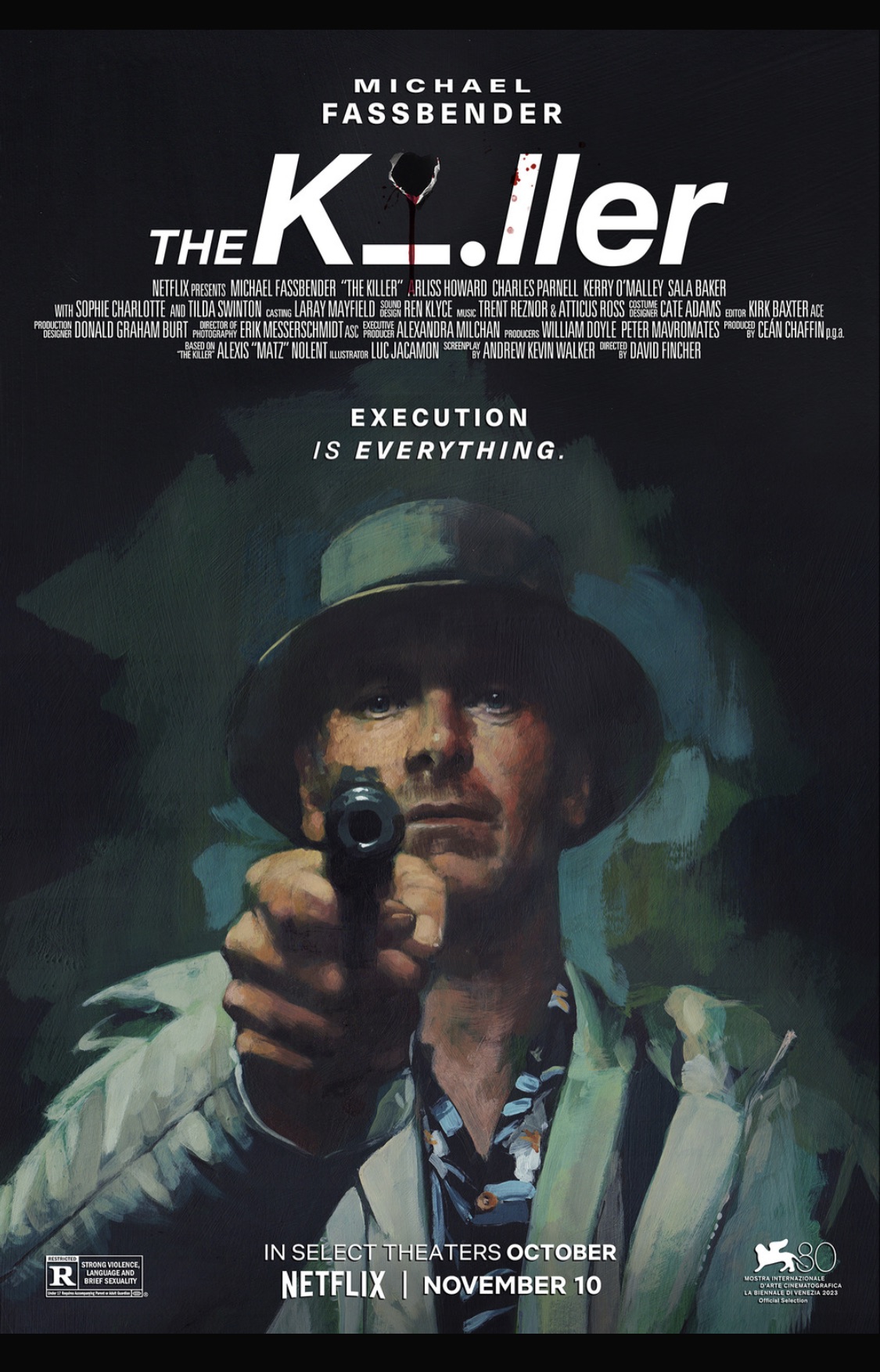
THE KILLER (2023)

October 27, 2023

Greetings again from the darkness. There is a reason I choose not to interview directors, writers, actors, or anyone else involved with the movies I watch and review. It’s because I prefer to evaluate based on what we see on screen rather than whether it’s the product of someone likable or not, quick witted or not, or passionate about their work or not. Anytime I start to waver on this approach, I’m quickly reminded why the decision was made. David Fincher is unquestionably one of the finest filmmakers working today. His work includes such films as SEVEN (1995), THE GAME (1997), FIGHT CLUB (1999), PANIC ROOM (2002), ZODIAC (2007), THE SOCIAL NETWORK (2010), THE GIRL WITH THE DRAGON TATTOO (2011), GONE GIRL (2014), and MANK (2020). Despite this remarkable resume of successful films, each new one deserves to be judged on its own … there is no extra credit for past brilliance.

The all-too-brief and remarkably cool opening credit sequence sets the stage for a film that looks absolutely marvelous. This leads us to an extended opening sequence where we learn about our titular cold-blooded assassin played by Michael Fassbender. It’s through his redundant narration that we learn about his meticulous and detail-oriented approach to a job that has made him a very wealthy man. He listens to various songs by The Smiths, does yoga in the dark, and repeats his mantras to keep himself centered and focused on the job at hand. After all, he cautions us that this job is only for those who can handle boredom – as if committing cold-blooded murder is somehow a more natural trait than handling down time on the job.

Getting to know the quirks and nature of this hitman is actually the highlight of the movie, because he botches this job in the worst possible manner, and then must step outside his norm to handle this ‘new’ development. When he discovers that his partner has been seriously wounded as fallout for his blown job, the Killer conveniently drops his ‘nothing personal’ mantra and proceeds to pursue very personal revenge.

SEVEN screenwriter Andrew Kevin Walker has adapted the graphic novel written by Alexis Nolent and illustrated by Luc Jacamon, and Fincher is clearly having fun with the material. It’s not accurate to call this a dark comedy, but there are some comedic elements included to lighten things up a bit. Most of these struck me as a bit lame: shots at our societal dependence on name brands (Amazon, WeWork, Starbucks, etc), the Killer’s disguise as a ‘German tourist’, and the endless string of 1970’s sitcom names used in his travels (think “The Odd Couple”, “Happy Days”, and even “The Partridge Family”).

To ensure no viewer is left behind, the film is divided into six chapters highlighted by the geographic location and the reason for being there: Paris – the Target, Dominican Republic – the hangout, New Orleans – the lawyer, Florida – the brute, New York – the expert, and Chicago – the client. Each of these chapters involves a piece of the revenge puzzle, and include fine actors Charles Parnell, Tilda Swinton, and Arliss Howard. Ms. Swinton’s segment offers the most, but her presence is over much too soon. It’s the mano-y-mano fight with the brute that is the weakest, since the fight is so over-the-top that neither would walk away … yet Killer departs with only a scratch over his eye.

While most of the story seems too familiar and kind of ludicrous, the film itself is a work of art. Fassbender perfectly captures the icy killer, and Oscar winning cinematographer Erik Messerschmidt (MANK, 2020) delivers in the multitude of locales, as well as the action shots. Two-time Oscar winners Trent Reznor and Atticus Ross handle the score of this film that will undoubtedly be regarded more highly by most other critics than by me, since a line like WWJWBD simply falls flat in my mind.

Opens in theaters on October 27, 2023 and on Netflix beginning November 10

WATCH THE TRAILER


GUILLERMO DEL TORO’S PINOCCHIO (2022)

December 9, 2022

Greetings again from the darkness. Looking for someone to create the opposite of a whimsical childhood fairy tale? The obvious answer is filmmaker Guillermo del Toro (an Oscar winner). He has built his career on delivering dark thrillers that dig into the recesses of our nightmares (PAN’S LABRYNTH, THE SHAPE OF WATER). In fact, he’s a master of this, which makes his vision of Carlo Callodi’s 1883 book a must see. GDT shares a director credit with animation expert Mark Gustafson (FANTASTIC MR FOX, 2009) and screenwriting credit with Patrick McHale. Matthew Robbins has a ‘screen story’ credit, and of course it all links back to Callodi’s source material.

From scene one we immediately sense the different approach than both the light-hearted Disney animated classic from 1940 and Robert Zemeckis’ sentimental live-action version starring Tom Hanks released just a few months ago. It’s darker and gloomier with a unique stop-action look saturated in browns. We also recognize that GDT has chosen a different timeline, as the effects of one of the last WWI bombs takes the life of Geppetto’s beloved young son, Carlo, and Mussolini and fascism are referenced throughout the story.

Everyone knows the story, and the core remains intact – though GDT adds his special touches and twists. One night, a drunken grieving woodcrafter carves a wooden puppet. As Geppetto sleeps it off, the Wood Sprite brings the puppet to life, and just like that, Pinocchio is born and Geppetto has his new son. Another unexpected twist is how much of the film is musical with song lyrics and music by del Toro and the film’s composer, two-time Oscar winner Alexandre Desplat. But don’t mistake songs for an upbeat movie. It’s still dark and bleak, and of course, GDT nails the sea beast whose belly houses Geppetto and Mr. Cricket in the most thrilling segment.

Young Gregory Mann voices Pinocchio and Carlo, Ewan McGregor voices Sebastian J Cricket, and David Bradley is Geppetto. Beyond that, the all-star voice cast features Ron Perlman, John Turturro, Finn Wolfhard, Cate Blanchett, Tim Blake Nelson, Christoph Waltz, Tilda Swinton, and Burn Gorman. No one does fantasy-horror better than Guillermo del Toro, and even with his first foray into animation, delivers a unique look and spin on a familiar story. He even makes it easy to pick up on the Frankenstein (the Mary Shelley novel) influence, so I’ll say it again … don’t mistake this for the family-friendly Disney fare you grew up on.

Opens in theaters and Netflix on December 9, 2022

WATCH THE TRAILER


THREE THOUSAND YEARS OF LONGING (2022)

August 25, 2022

Greetings again from the darkness. I should start by admitting I would purchase a ticket to watch Tilda Swinton jaywalk on a country road or sit in a corner reading quietly to herself or carefully slice the crust off a PBJ. In other words, I find her to be a fascinating performer who takes risks and whose characters and movies are consistently worthy of attention. This film is directed by Oscar winner George Miller and he adapted the script with co-writer August Gore (Mr. Miller’s daughter) from the 1994 short story, “The Djinn in the Nightingale’s Eye” by AS Byatt. This is Mr. Miller’s first film since MAD MAX: FURY ROAD (2015) and fits into his diverse filmography that also includes the original MAD MAX (1979), THE WITCHES OF EASTWICK (1987), LORENZO’S OIL (1992), BABE: PIG IN THE CITY (1998), and HAPPY FEET (2006). This is a filmmaker who chooses his own projects.

Oscar winner Tilda Swinton stars as Dr. Alithea Binnie, a narratologist and literary scholar who describes herself as “a solitary creature by nature.” She’s in Istanbul to present at a conference ‘to tell stories about telling stories.’ Alithea preaches that science can explain all, even as she’s experiencing vivid visions that she herself cannot explain. After purchasing a handcrafted bottle, she returns to her hotel (in the Agatha Christie room) and cleans it with her electric toothbrush. When a Djinn swooshes from the bottle in a plume of purple smoke, she’s beyond skeptical of making that first wish – all too aware of the legendary tales around just such circumstances. But this giant Djinn is played by Idris Elba and he’s quite persuasive.

The Djinn explains the rules of her 3 wishes, and then regales Alithea with four tales of his escapades, most of which involve love and betrayal, and all of which resulted in him being trapped in a bottle. The first story involves the Queen of Sheba (a stunning Aamito Lagum) and how the Djinn was in love until a sly King Solomon messed it up and banished him to the ocean floor. All of the tales are played out in vibrant colors and fascinating detail, with the Djinn explaining that in order to gain his freedom, he must grant Alithea “her heart’s desire.”

Reminding me a bit of Tarsem Singh’s THE FALL (2006), each of the four tales told by the Djinn explode in color from a different era. Even the Djinn and his Spock ears begins too large for the screen, and certainly too large for the hotel room. And oh, that hotel room. For the vast majority of their time together Alithea and the Djinn are stuck in a bland – mostly white – room that contrasts with the stories he tells, but gives Ms. Swinton little to work with. Each of the stories is beautifully told, though a bit more humor would have been beneficial, and it should be noted that this one takes some definite “buy in” from the viewer. However, there is certainly no reason to complain as we are treated to two stellar actors and multiple stories of love and fate.

Opens in theaters on August 26, 2022

WATCH THE TRAILER


THE SOUVENIR: PART II (2021)

November 12, 2021

Greetings again from the darkness. We tend to think of ‘coming-of-age’ movies as centered on teenagers as they face the challenges of transitioning into adulthood. The reality is that folks come of age during different phases of life (and some seemingly never do). Filmmaker Joanna Hogg continues her autobiographical look back with the follow-up to her exceptional 2019 arthouse film. Is it a sequel? Technically, yes; but it’s more of a continuation, and the two parts actually function best as a single 4-hour story.

Starting off shortly after the first movie ended, part two finds Julie (Honor Swinton Byrne) in bed at her parents’ house. They try to comfort her as she grieves the death of Anthony (played so well in the first by Tom Burke). For those who have not seen the 2019 film, I’ll tread lightly as it should be seen prior to this one due to the continuing story line and numerous references. Despite her confusion and despondency, Julie heads back to film school. Using art to deal with her emotions, she starts all over with the script for her graduation film. The Film School committee of like-minded middle-aged men thrash her idea of dealing with her situation on film. Despite their harsh words, she persists.

For such a ‘quiet’ movie, it’s astonishing how many things are going on in Ms. Hogg’s film and in Julie’s world. The jealousies of film school students are noted, as are the discrepancies between overly confident young filmmakers (a brilliant Richard Ayoade) and those still trying to find their voice (Julie). Ayoade’s arrogant Patrick is recognizable to us as a big production filmmaker in the vein of many who have come before him. On the other hand, Julie stumbles over how best to convey the emotions for the actors in her film … a film that is so personal she’s dealing with memories even while setting up scenes.

Honor Swinton Byrne (Tilda Swinton’s daughter) excels at relaying a certain sadness in Julie as she pushes onward. Anthony’s ghost hovers everywhere for her. She bravely visits his parents. The confusion over Anthony’s story, and her shock at not having recognized the signs, are exemplified as she presents the common façade of appearing OK while struggling inside. Julie’s parents, played by (the always great) Tilda Swinton and James Spencer Ashworth walk on egg shells around her, while trying to offer support, despite their detachment – not just from the relationship, but from Julie’s life in general (other than lending her money in times of need).

Supporting work comes from Charlie Heaton, Harris Dickinson, and Ariane Labed, as student actors. In Julie’s film, Ms. Labed plays the role of Julie, which in reality, is the role of Ms. Hogg as a young aspiring filmmaker. Joe Alwyn has a terrific cameo as Julie’s editor in one of the most awkward and tender scenes. Ms. Hogg did not film the two parts simultaneously, but her style is so unique (as an example, songs cut off abruptly mid-scene) that it’s a challenge not to rave about the look and feel. Her talented collaborators include Film Editor Helle le Fevre, who serves up some creative transitions; Production Designer Stephane Collonge, whose sets are crucial in a film with minimal dialogue; and Cinematographer David Radeker whose lensing gives the film the perfect look for its time. Tilda Swinton stars in Ms. Hogg’s upcoming film, THE ETERNAL DAUGHTER; however, we will have to be patient to see if Honor Swinton Byrne continues to pursue acting, a profession to which she seems destined.

In theaters beginning November 12, 2021

WATCH THE TRAILER

*link to my review of THE SOUVENIR (2019)


THE FRENCH DISPATCH (2021)

October 28, 2021

Greetings again from the darkness. Few things in the cinematic world are more instantly recognizable than a Wes Anderson movie. In fact, historically speaking, perhaps only Jacques Tati comes as close to having a signature style easily spotted by viewers (unless you want to count Tom Cruise sprinting or Julia Roberts cackling). This is Mr. Anderson’s 10th feature film in 25 years, and I now rate 5 of these very highly, though all 10 have a certain appeal. This latest, co-written by Anderson with frequent collaborators Roman Coppola, Hugo Guinness, and Jason Schwartzman, could be considered his most ambitious to date … and likely the most ‘Wes Anderson’ of all.

Billed as a love letter to journalists, it becomes crystal clear, that by this, Anderson means the esteemed stable of writers from the early days of “The New Yorker”. In fact, Anderson structures the film as if it were following the path of a magazine being published. We are informed upfront that this edition features “an obituary, a travel guide, and 3 feature articles”. An episodic format is not unusual for films, yet Anderson never does anything by the book. Each piece takes place in its own time period, and there appears to be little connection or crossover among key characters. Still, somehow he makes this work by ensuring each piece stands on its own and is filled with unusual characters and those patented, fabulous Anderson visuals.

The obituary is that of Arthur Howitzer Jr (a deadpan Bill Murray), the founder and publisher of “The French Dispatch” magazine, a spin-off from The Liberty Kansas Evening Sun … a move from a small town in Midwestern United States to a charming small town in France (hilariously and fittingly) named Ennui-sur-Blasé. Howitzer adores his writers, and the only guidance he offers them is, “Just try to make it sound like you wrote it that way on purpose”. He also has a “No Crying” sign posted in his office, likely as much as a reminder to himself as a rule for the staff.

Our travel guide section is fortunately quite brief since it involves Owen Wilson as a bicycle tour guide showing us around the town – the “Local Color”- of Ennui-sur-Blasé. This takes us to the first feature story, and the best of the lot. Tilda Swinton excels (doesn’t she always?) as a writer and art expert giving a colorful lecture entitled “The Concrete Masterpiece”. She tells the story of Moses Rosenthaler (Benecio del Toro), a genius modern artist serving a life sentence for murder, and as she lectures, we see it play out. While incarcerated, Moses continues to work and his muse is a prison guard named Simone, played exceptionally well by Lea Seydoux. Her nude posing for him leads to his signature modern art piece, which attracts the attention of an ambitious art dealer played by Adrien Brody.

“Revisions to a Manifesto” is the next feature, and it involves a young activist named Zeffirelli (Timothee Chalamet). He’s a chess expert, quite moody and has a questionable quest. He’s being covered by writer Lucinda Krementz (Frances McDormand), who is unable to maintain objectivity, and inserts herself right into the story, amongst other things. The segment pays tribute to the activism of the 1960’s and is filmed mostly in black and white.

The third feature, “The Private Dining Room of the Police Commissioner” involves writer Roebuck Wright (Jeffrey Wright) telling his story while a guest on Liev Schreiber’s Talk Show in the 1970’s. Roebuck is obviously inspired by James Baldwin, and he famously recalls every line he’s ever written. The story he recites involves a legendary chef played by Steve Park.

Actors mentioned so far are just the headliners, and Anderson has packed the film with his usual troupe, as well as dozens of others – some you’ll recognize, and some you won’t. There are at least seven Oscar winners involved: Christoph Waltz, Fisher Stevens, and Angelica Huston (as narrator), in addition to the aforementioned Swinton, McDormand, del Toro, and Brody. Numerous Oscar nominations and awards are included in the group of other familiar faces like Willem Dafoe, Saoirse Ronan, Edward Norton, Lois Smith, Henry Winkler Bob Balaban, Elisabeth Moss, and Mathieu Amalric.

Other frequent Anderson collaborators who deliver standout work include Production Designer Adam Stockhausen, Cinematographer Robert Yeoman, Editor Andrew Weisblum, and composer Alexandre Desplat. The film looks and sounds remarkable, and somehow it doesn’t feel like it’s moving fast – although we can barely keep pace. The film can be compared to ordering a flight at your local distillery. Each flavor is tasty, but they may not add up to a full drink.

Wes Anderson has delivered another stylish, fun film to watch, and one that is endlessly entertaining. It may not have as many moments of laughter as some of his previous films, yet there are still plenty of sight gags, insider references, and light-heartedness bathed in nostalgia – even if it’s not quite as whimsical. Shot in the French town of Angouleme, the visuals are as impressive as any you’ll find, serving up a collage of time, caricatures, color, and topics.

Opening nationwide in theaters on October 29, 2021

WATCH THE TRAILER


THE PERSONAL HISTORY OF DAVID COPPERFIELD (2020)

August 27, 2020

 Greetings again from the darkness. One need not be a Dickens expert to enjoy this re-imagining of his “The Personal History, Adventures, Experience and Observation of David Copperfield the Younger of Blunderstone Rookery (Which He Never Meant to Publish on Any Account)”. Yes, that’s the novel’s actual title, so there is little wonder it’s typically referred to by only the main character’s name.

The film opens with David Copperfield (Dev Patel, SLUMDOG MILLIONAIRE) reading his autobiography to a mesmerized audience in a beautiful theatre. Yes, we hear the iconic opening line, “Whether I shall turn out to be the hero of my own life …”, and then Copperfield turns and walks into the backdrop which comes alive as he, in fact, steps into his own life. The film is episodic in structure as we are presented with segments of Copperfield’s life that shaped his writing – from his birth at The Rookery, to his inquisitive nature as a young boy, through his cruel banishment to factory work, on to his life living with his eccentric aunt and his time at boarding school, and finally, with his time as a proctor, courting Dora, and focusing on writing. It’s a fascinating life, with many elements pulled (or enhanced) from Dickens’ own.

Director Armando Iannucci (IN THE LOOP, creator of “Veep”) and co-writer Simon Blackwell are frequent collaborators renowned for their expertise in satire. Iannucci is an admitted fan and student of Dickens, and he’s assembled quite a sterling cast for his take on the classic story. In addition to Patel as the older Copperfield, we have Jairaj Varsani in his first film as young David, rising star Morfydd Clark (PRIDE AND PREJUDICE AND ZOMBIES, 2015) in dual roles including the enchanting Dora Spenlow, Hugh Laurie as the King Charles (and his head) obsessed Mr. Dick, Aneurin Barnard (DUNKIRK) as David’s friend Steerforth, Darren Boyd and Gwendoline Christie as the wicked Murdstones, Peter Capaldi (“Doctor Who”) as the dodgy Mr. Micawber, Daisy May Cooper as trusted handmaid Peggotty, Nikki Amuka-Bird as the concerned Mrs. Steerforth, Benedict Wong as the sherry-loving Mr. Wickfield, and Ben Whishaw is a standout as conniving Uriah Heep. And if somehow that’s not enough, the brilliant and eclectic Tilda Swinton shines as Aunt Betsey Trotwood.

Each of the segments brings something different to the party – some of it bleak, and some of it cheery. Of course the dialogue has dashes of humor, but much of the comedy comes courtesy of the talented cast. It’s been said of writers that they should write what they know, and David Copperfield literally writes what he lives … through piles of scraps of paper, each holding a moment of life or the essence of a character. Watching this is a bit like camping out in a writer’s head and twisting through their thoughts … Mr. Dickens would be proud.

Opens wide in theaters on August 28, 2020

watch the trailer:


THE DEAD DON’T DIE (20190

June 13, 2019

 Greetings again from the darkness. Love it or hate it. Sometimes it’s not that easy. Sometimes it is. Filmmaker Jim Jarmusch has been making his own brand of videos, shorts, documentaries and features since the 1980’s. He has a loyal following of viewers who “get” him, and even within those ranks there is debate about which of his projects work and which don’t. You know who doesn’t care?  Jim Jarmusch, that’s who. He creates the work he wants to create and works with the actors and crew that he wants to work with … he’s best described as the type who lets the art speak for itself.

As we pull into town, the billboard states “Welcome to Centerville. A real nice place. Population 738”. It’s a bland town with a bland name filled with bland people whose bland conversations focus on doughnuts and pie from the town’s only diner. The police force totals 3 (seems high for such a small town). Cliff Robertson (Bill Murray) is the veteran police chief, while Ronnie Peterson (Adam Driver) and Mindy Morrison (Chloe Sevigny) are the deputies … all three are bespectacled.

Initial interactions provide a quick lay of the land. Farmer Frank (a loud-mouthed Steve Buscemi) accuses Hermit Bob (Tom Waits) of stealing his chicken. Hermit Bob lives in the woods and doesn’t take kindly to accusations. Frank, despite his racist core, is somehow friendly with Hank (Danny Glover), a mild-mannered local who chats it up at the diner. Bobby Wiggins (Caleb Landry Jones) is the town’s pop culture guru who runs the gas station/comic book store.

Even this law enforcement team recognizes strange things are happening: the sun doesn’t set when it should, watches are stopped, and animals are disappearing. We hear news reports that ‘polar fracking’ has knocked the earth off its axis, coupled with government denials stating jobs are plentiful and profits are up. Obviously this is Jarmusch taking his shots at the environmental policies and focus on the economy of the current administration. Our first zombie attack happens at the diner (of course) and features Sara Driver (Jarmusch’s long-time partner) and Iggy Pop (who requires little make-up to be convincing as a zombie). Many more zombies follow.

While Murray’s Cliff and Mr. Driver’s Ronnie maintain their deadpan conversations and reactions, it’s Ms. Sevigny’s Mindy who is terrified in the face of their nonchalance. Adding color to the mix is Tilda Swinton as Zelda, the samurai sword wielding mortician with a Scottish accent, a flair for make-up and an other-worldly secret. Also appearing are Selena Gomez, Carol Kane, Rosie Perez and RZA.

As the opening film at this year’s Cannes Film Festival, it’s a blend of comedy, fantasy, horror, zombie, and social commentary … but none of the pieces are particularly effective. It’s somehow both wry and mundane, and not meant to be traditionally scary or laugh out loud funny. Jarmusch has delivered such diverse films as PATERSON (2016), ONLY LOVERS LEFT ALIVE (2013), and BROKEN FLOWERS (2005). “This isn’t going to end well” is a line Driver’s Ronnie states a few times, and it’s both foreshadowing and self-awareness from the filmmaker. It’s his commentary on the state of the world, as well as the movie.

Zombie-comedies have been done (SHAUN OF THE DEAD, DAWN OF THE DEAD and many others), and it’s usually best to bring something new to a tired genre. Instead, Jarmusch pays tribute to such films as NIGHT OF THE LIVING DEAD, KILL BILL, CLOSE ENCOUNTERS OF THE THIRD KIND, PSYCHO, and STAR WARS. He even tips his cap to Samuel Fuller (gravestone) and George Romero (a 1969 Pontiac LeMans). As if to acknowledge the love-hate factor that goes with his movies, Jarmusch allows Sturgill Simpson’s (also appearing as the guitar-zombie) theme song to exemplify such division. Selena’s character and Ronnie love the song, while Murray’s Cliff can’t stand it and flings the disc out of the car window.

You are likely wondering if the world needs yet another take on the zombie apocalypse. Of course, the answer is no … which means in Hollywood, there are countless more zombie apocalypse TV series and movies (numerous sequels) in the works. Jarmusch isn’t here to simply add another number to the genre. No, he uses the format to proclaim that our society is soul-dead. He believes we are all stumbling, zombie-like, through life, rattling off our favorite products. He may be right.

watch the trailer:


THE SOUVENIR (2019)

May 30, 2019

 Greetings again from the darkness. Viewers of writer-director Joanna Hogg’s semi-autobiographical feature will likely be divided into two distinct groups: those who find it to be a beautifully artistic psychological study, and those who find it to be a painfully slow watch. Fortunately, most who would fall into the latter group will likely skip it altogether, and we can only hope those in the first group will seek it out and encourage similar-minded film fans to attend. Surely both groups can agree that it features a terrific breakout lead performance from Honor Swinton Byrne (daughter of Tilda Swinton).

Ms. Swinton-Byrne stars as Julie, a young London film school student. She’s soon drawn to Anthony (Tom Burke), an odd man who is somehow simultaneously laid back and condescending. Their relationship builds as he works some vague job at the Foreign Office, and giving every indication that something’s not quite right. Many moments of normal life are shown; however we soon learn that Anthony is a master manipulator, and his off-handed requests for ‘a tenner’ or sticking Julie with a restaurant tab go deeper than being a simple jerk. We know heartbreak is coming for her; we just don’t know how when or how hard.

Tilda Swinton (a long-time friend of director Hogg) appears in a few scenes as Julie’s mom, and as you would expect, she perfectly captures the mother-daughter dynamics. Of course Julie is a film student struggling to make ends meet, but with her frequent requests for ‘mom loans’ coinciding with the Anthony relationship, mother knows best. Jean-Honore Fragonard’s 18th century painting gives the film its title, and provides a terrific scene with Julie and Anthony.

Later, when Anthony tells Julie, “You’re inviting me to do this to you”, we recognize this is an abusive relationship similar to those many women have endured. Set in the 1980’s, a doomed relationship looks eerily similar regardless of the era. The film serves as an example of how we sit in judgment of the love lives of others, while often remaining blind (or is it hopelessly optimistic) to our own relationship issues.

Ms. Hogg shot on film and there are some memorable shots throughout – especially within Julie’s apartment. There is a recurring split-screen shot where a wall divides what we see in the kitchen with what’s happening in the living area – we see characters on each side. This is the anti-Marvel movie. No special effects. No superheroes. And the only worlds in peril are those of average, flawed people like us.

There is a segment involving an analysis of Hitchcock’s PSYCHO, and it’s clear director Hogg learned lessons about what not to show. There is also a reference to another Hitchcock classic with the tailored grey suit Tom buys for Julie and their trip to Venice. Alfonso Cuaron scored big with ROMA, a very intimate look at his personal life, and filmmaker Hogg’s film is in that same vein. It’s extremely well made and beautiful to look at, and is likely to be quite challenging for viewers. The payoff comes after much patience and effort and investment into figuring out these characters. It’s an arthouse film with improvised dialogue (bonus points for Joe Jackson’s “Is She Really Going Out with Him?”). This was a grand jury prize winner at Sundance, and the sequel is already in production … good news for some of us, while inexplicable to others.

watch the trailer: