KILLERS OF THE FLOWER MOON (2023)

October 18, 2023

Greetings again from the darkness. Read the book and see the movie. The order doesn’t much matter, as David Grann’s best-selling non-fiction novel is an incredibly emotional read, while Martin Scorsese’s film is an example of elevated filmmaking. Of course, it’s understandable if a book detailing a repulsive historic travesty is not your cup of tea, or if a three-and-a-half-hour movie on the same subject holds no appeal for you. However, if you are up for the challenge, both are extraordinary works of art, though surprisingly, quite different experiences.

Oscar winner Scorsese worked on the script adapting Grann’s novel with Oscar winning screenwriter Eric Roth (FORREST GUMP, 1994), and Scorsese has stated Leonardo DiCaprio encouraged some changes in perspective. Scorsese also spent a great deal of time with Osage folks making sure to gain insight on how to properly tell their story with all due sensitivity and respect. And what a story it is. While reading Grann’s book, I remained in a state of disbelief that this tragic story from the 1920’s was not common knowledge. In contrast, I felt the telling of this story in the movie, softened the edges just a bit.

Oscar winner DiCaprio stars as Ernest Burkhart, a man returning to town after serving in WWI. Ernest is a simple man, and DiCaprio plays him with a SLING BLADE jaw line and a constant state of being a half-step behind goings on. He’s not a total sap, but close enough that he can be manipulated. This is especially true when it comes to his rancher Uncle William King Hale played by two-time Oscar winner Robert DeNiro. The two men are related but seemingly share no other characteristics. “King” is a master schemer who has spent decades cultivating a relationship and image with the Osage, only to secretly take advantage of their trust at every opportunity. Ernest is a self-described lazy man who ‘loves money’, though he has little interest in earning it the hard way.

There are multiple relationships that are crucial to follow closely. Ernest and his Uncle, Ernest and his Osage wife Mollie (a brilliant Lily Gladstone), Hale and the Osage, Federal investigator Tom White (Jesse Plemons) and everyone to whom he speaks, and then the network of interactions between Ernest and the locals. The long roster of characters jumps in numbers again during the final act, which offers a courtroom drama and interrogations that deliver the conclusion. It’s the first act where Scorsese portrays the dramatic shift from the “old” Osage culture to their staggering newfound wealth. Of course, at the core of all of this is the despicable scheme used by Hale in a heartless strategy to steal the wealth. For those who haven’t yet read the book, it’s best if no more of the story is known prior to seeing the movie. One thing that can be disclosed is that this true story proves the exception to “them with the gold make the rules.” This was also the first case of the newly formed FBI under J Edgar Hoover.

As always, Scorsese has assembled a deep supporting cast to complement the stellar leads. A few of those playing key roles include Tantoo Cardinal, Gene Jones (the coin flip clerk in NO COUNTRY FOR OLD MEN), John Lithgow, Oscar winner Brendan Fraser, Cara Jade Myers, Jason Isbell, Jillian Dion, Scott Shepherd, William Belleau, Sturgill Simpson, Ty Mitchell, Tommy Schultz, (personal favorite) Barry Corbin, Pete Yorn, and Jack White. With apologies to Jesse Plemons who is solid as Tom White, it’s the three leads who captivate us. DiCaprio turns in what is likely his best ever performance, while DeNiro eerily captures the sneaky and devastating evil of Hale (and we get a nod to his Al Capone role from 36 years ago). What can we say about Lily Gladstone? She was a standout in CERTAIN WOMEN (2016), and here she is the heart and soul of the story (though DiCaprio’s Ernest gets much more screen time). Her expressive eyes convey so much, even when she speaks no words.

In addition to the talented cast, Scorsese’s technical group is just as outstanding. Cinematographer Rodrigo Prieto (BROKEBACK MOUNTAIN, 2005) perfectly balances the vastness of the setting with the intimate moments. Production Designer Jack Fisk (THERE WILL BE BLOOD, 2007) delivers the look and feel of the times, while three-time Oscar winner Thelma Schoonmaker works her magic as an Editor to create a manageable flow of this epic. The film’s score, expertly tied to the story’s measured pacing, comes from Robbie Robertson (longtime leader of The Band), who passed away soon after. There is a Scorsese cameo, and I left the theater thinking how usual it is to find a movie so ambitious in scale, yet so intimate and searing in its personal moments. Some may find the larger story a bit difficult to grasp, and that’s likely due to our humanity and desire to believe in the non-existence of this level of evil.

Opens in theaters nationally on October 20, 2023

WATCH THE TRAILER


THE IRISHMAN (2019)

December 1, 2019

 Greetings again from the darkness. The Copacabana tracking shot in GOODFELLAS is etched not only in my brain, but in cinema lore. Filmmaker Martin Scorsese teases us with a similar shot as the opening sequence in his latest. The camera snakes through the dank halls and rooms of an assisted-living center before settling on the well-worn face of wheelchair-bound octogenarian Frank Sheeran (Robert DeNiro). Mr. Sheeran is the titular Irishman, and he narrates the story of his life, at least as he recalls it. His is a life story that connects the mob to history and politics in a no frills manner surely to provoke thought, skepticism, and a knot in the tummy.

Oscar winning writer Steve Zaillian (SCHINDLER’S LIST, also GANGS OF NEW YORK, THE FALCON AND THE SNOWMAN) adapted Charles Brandt’s book “I Heard You Paint Houses” for the film. Mr. Brandt was Sheeran’s attorney and worked with Sheeran on his memoir. The book title is highlighted by Scorsese at both the beginning and end of the film, as well as through a line of dialogue in the first phone conversation between Sheeran and Jimmy Hoffa. Mr. Sheeran was a WWII veteran turned truck driver turned mob hit man (and good soldier). He tells his story with little fanfare and in a way that we understand no glamour is associated with this lifestyle.

For those looking for the next GOODFELLAS or CASINO, you’ll likely be disappointed. This one is not as flashy or stylish as those two classics, and instead is a 3 and a half hour introspective look at the men who are efficiency experts in power. Violence is merely one of the tools in their box. The presentation is contemplative, not action-centric. The hits are abrupt and jerky and realistic, not the stylistic choreography of shootouts in films like JOHN WICK. There is a skewed theme of friendship and male bonding … even mentorship. It’s unlike what we’ve seen before from mob movies.

After a chance meeting over a timing belt on a delivery truck, Sheeran is taken under the wing of Philadelphia mob boss Russell Bufalino (Joe Pesci). This is Pesci’s first onscreen appearance since 2010, and he is absolutely brilliant in his portrayal of “the quiet Don.” His performance is 180 degrees from his comedy in LETHAL WEAPON (2.3.4) or HOME ALONE, and 180 degrees the opposite direction from his roles in GOODFELLAS and CASINO, where he was a bombastic man (not a clown) on the edge of violence at all times. Mr. Pesci has spent the last decade playing jazz under the name Joe Doggs. It’s such a joy to have him back on screen, especially as the father figure-friend-ruthless businessman. His Russell is always calm and calculating, whether plotting the next kill or putting up with his wife’s frequent smoke breaks on a road trip.

It’s Russell who directs Sheeran to connect with Jimmy Hoffa (Al Pacino), President of the International Brotherhood of Teamsters. Pacino flashes his blustery best as Hoffa in a couple of scenes, but is also terrific while spewing one of his countless “c***suckers”, or savoring one of his beloved ice cream sundaes – a simple pleasure in a complicated life. Sheeran and Hoffa develop an unusual friendship in their many years together, and Hoffa’s real life unsolved disappearance in 1975 is the basis for Sheeran’s recollections.

We learn that Sheeran’s time in WWII taught him to kill … there is a scene involving POW’s digging their own grave while his rifle is pointed at them. In fact, most of the story is told in flashbacks that bounce between different eras. Scorsese, as has been reported ad nauseam, has utilized the de-aging process from Industrial Light & Magic to show DeNiro, Pesci, Pacino and others over the years. The effect is a bit distracting at first, but the story and these characters are so intriguing that we simply roll with after the initial jolt. It’s also obvious how Scorsese worked to make DeNiro look like the hulking presence Sheeran was in real life (think Tom Cruise in the Jack Reacher movies). Camera angles, should pads, and shoe lifts are used to make us think DeNiro towers over the others the way Sheeran really did. DeNiro is excellent in portraying Sheeran as a good soldier, reserved in mannerisms – even flashing a slight stutter at times. He’s a proud man who simply looks at the mob work as his job.

In addition to the three stars who each excel in their roles, Scorsese has assembled a huge and talented cast. Harvey Keitel is chilling in a couple of scenes as Angelo Bruno, Ray Romano plays mob lawyer Bill Bufalino, Bobby Cannavale is steak-loving Skinny Razor, Jesse Plemons is Hoffa’s adopted son Chuckie O’Brien, Domenick Lombardozzi is Fat Tony Salerno, comedian Sebastian Maniscalco is “Crazy Joe” Gallo, Louis Cancelmi is bespectacled Sally Bugs, Jack Huston plays Attorney General Bobby Kennedy, and even Steven Van Zandt plays crooner Jerry Vale.

You are probably wondering, ‘Where are the women?’. While there is no Lorraine Bracco (GOODFELLAS) or Sharon Stone (CASINO), Scorsese makes the point that with Sheeran, and these other mobsters, it’s all business and real family relationships are nearly non-existent. Stephanie Kurtzuba plays Irene Sheeran (Frank’s second wife) and Katherine Narducci is Carrie Bufalino (Russell’s cig-loving wife). They have some brief but entertaining moments on the road trip, and Marin Ireland has an effective scene late in the movie as Carrie, one of Frank’s daughters, while Welker White plays Jo Hoffa. But it’s Sheeran’s daughter Peggy who is the quiet moral center of the story and his life. Played as a youngster by Lucy Gallina and later by Anna Paquin, Peggy is a mostly silent observer of her father, and whatever conscience he has, is impacted by her glances. Ms. Paquin is especially good with one question … “Why?”

Worthy of special mention is Stephen Graham who plays Anthony “Tony Pro” Provenzano, a friend-turned-rival of Hoffa. Graham and Pacino share two standout scenes – one in prison, while Hoffa scoops his sundae, and a later meeting where Hoffa takes offense to Tony Pro’s late arrival and casual attire. Both scenes are remarkable in that there is underlying humor balancing the surface anger. In fact, the film is filled with memorable scenes. Hoffa’s guidance on self-defense in guns vs. knives, and most every scene between DeNiro’s Sheeran and Pesci’s Russell. DeNiro and Pesci have a chemistry few actors share. It dates back to RAGING BULL (1980), and I believe this is their 7th film together.

The film reminds me of the 1970’s movies that fueled my movie obsession: THE GODFATHER I and II, THE CONVERSATION, THE FRENCH CONNECTION, CHINATOWN, and even THE LAST PICTURE SHOW. Sheeran may or may not be a reliable narrator, but these are real people – even if we don’t know the specifics on every hit. Captions are periodically included to inform of us how a particular mobster met his maker – again providing some dark humor. What is a bit surprising is the male bonding, even friendship, between guys in such a brutal profession. And watching how the story weaves in and out of history with the Bay of Pigs, Cuba casinos, and the Kennedy assassination -“If they can whack a President …” is a bit unsettling.

Cinematographer Rodrigo Prieto (SILENCE, BROKEBACK MOUNTAIN) is a good fit for Scorsese’s vision, and you can catch the varying camera styles for each character – and don’t miss the stunning shot of the illicit guns in the river. Composer Robbie Robertson (The Band) delivers Scorsese trademark musical riffs, and 3-time Oscar winner Thelma Schoonmacker is in peak form editing this epic. This is the 8th film collaboration for Scorsese and DeNiro, but the first in 25 years (CASINO).

I’m a little concerned. In fact, I’m a little more than concerned. This feels like the end of an era. It’s not the end of Scorsese films, but it’s the final chapter of his mob films. No other filmmaker comes close in this genre. With the bookends of Sheeran reminiscing in the assisted-living home, this is quite the holiday gift for cinephiles … and a lasting one (providing Netflix survives).

watch the trailer:


SILENCE (2016)

January 5, 2017

silence Greetings again from the darkness. Martin Luther King said “Faith is taking the first step even when you don’t see the whole staircase”. Martin Scorcese’s esteemed film career could be described as unveiling that staircase, one step/film at a time. Religion, spirituality and yes, faith, have played a key role in his life and his films – most notably, Kundun and The Last Temptation of Christ, but also most of his other projects.

A high-ranking priest (Ciaran Hinds) is meeting with two younger Portuguese priests and informing them of the rumor that their mentor Father Ferreira (Liam Neeson) has reportedly renounced his faith and is now living as a Japanese Buddhist in Nagasaki. The two young Jesuit priests, Rodrigues (Andrew Garfield) and Garupe (Adam Driver) refuse to believe this and request to be allowed to track down Ferreira and bring him home. It could be termed a rescue mission, and the two men could be called missionaries, but what follows is an excruciating test of their own faith.

Martin Scorcese has been working on this passion project for more than two decades – ever since he read the Shusaku Endo novel (published in 1966). Cast members have changed through the various iterations of the project, but after the box office success of The Wolf of Wall Street, Scorcese received the financial backing to bring his vision to the screen. He co-wrote the screenplay with Jay Cocks (Gangs of New York) and the result is the visual and emotional epic that you might expect from one of the greatest filmmakers of all time.

17th century Christianity in Japan might be a difficult subject to sell to the general movie-going public, and Scorcese goes out of his way to leave unanswered the multitude of questions the film raises. Rather than wrapping it up with a clean ending, he leaves viewers craving further discussions, clarity and explanations. In other words, it lacks mass appeal and shouldn’t be confused with light-hearted entertainment.

Rodrigues is resolute in his belief that God is the answer … even when the film’s title is at the forefront. As Rodrigues and Garupe minister to the village of secret Christians (led by Yoshi Oida and Shinya Tsukamoto) at night and hide during the day, we learn of the Japanese state’s commitment to eradicating Christians and Christianity to ensure the power and isolation of the country. The oddest character in the film is that of Kichijiro (an excellent Yosuke Kubozuka). He is both guide to the priests and a constant challenge to their faith, while also providing moments of comic relief in a film with very few. Were this a Kurosawa film, this role would have been a perfect fit for the great Tishiro Mifune.

The most obvious adversary for the priests is the Japanese elder known as The Inquisitor. Issei Ogata excels in the role as a wily, half-smiling, quite knowledgeable wartime (a war on Christianity) leader intent on creating the most painful and public extermination of Christian believers and those priests who dare to infect his country (Japan’s 1614 Edict of Expulsion). The torture and persecution is too much to detail here, but it portrays how even the most ardent believers could choose life over faith.

The film blends fiction with some true-to-life aspects, and is most effective at asking questions and spurring thought. Which is more crucial – public or private faith? Is doubt allowable and even understandable? Is Rodrigues so committed to faith or is there also an element of martyrdom present? How about the “Judas” sub-plots? Is it betrayal if it saves one’s own life? Just where is that line? Is Ferreira a disgraced priest or simply a man valuing survival? The film is beautiful to look at (superb work from cinematographer Rodrigo Prieto and editor Thelma Schoonmaker) while being exceedingly tough to watch (and quite long). Be prepared to set aside time for reflection and discussion … you may even discover some surprises in your views and beliefs.

watch the trailer:


GOODFELLAS (1990) revisited

February 7, 2013

goodfellas1 “As far back as I can remember, I always wanted to be a gangster.”  That’s how Henry Hill introduces himself.  He is the narrator and key figure in director Martin Scorcese’s 1990 masterpiece.  What follows Mr. Hill’s intro is the film version of Nicholas Pileggi’s non-fiction book, Wiseguy: Life in the Mafia Family (published 1986).  Every so often the perfect match of writer, director and cast occurs, and Goodfellas is one of those rare treats.

Viewing a 35mm print at the historic Texas Theatre just seemed apropo.  Knowing that this is the realized vision of Mr. Scorcese and his long time editor, Thelma Schoonmaker, caused the numerous VHS and DVD viewings over the years to simply fade away.  The silver screen works wonders for a film with such “big” characters, such startling violence, and such a perfectly inter-woven soundtrack.

Ray Liotta plays Henry Hill, the real life gangster who ended up snitching on the mob and entering the Federal Witness Protection program.  This should not be considered a spoiler because Hill’s story is known worldwide and, well, the movie is 23 years old!  Liotta was a relative newcomer when he exploded onto the screen in Jonathan Demme’s Something Wild in 1986.  His manic performance in that movie led Scorcese to cast him as Henry Hill.   The real life Hill spoke at length with Pileggi for the novel, and the result is a very detailed and nuanced look into the life inside a New York crime family.

goodfellas4 The fascinating aspects are too numerous to touch on them all, but there are some that really stood out in this latest viewing. First, Lorraine Bracco plays Hill’s wife Karen. Watching the development of her character is pure gold on screen. She starts out as a fresh-faced blind date, who pulls no punches in putting Hill in his place after he stands her up … and right in front of his fellow gangsters, no less.  Watching her fall for “the life” is like watching someone get gradually intoxicated.  She seems aware but numb to the rational side of her brain. As Karen develops, she battles through some really tough situations, continues to be Hill’s biggest supporter, and finally his cohort in crime near the end.  She is one of the most interesting and best developed female characters from any gangster movie.

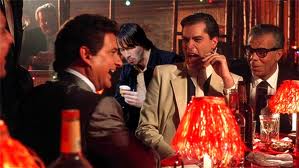
Another really fascinating character to follow is that of Tommy Devito played by Joe Pesci. Tommy is a tough guy born into the life, but the prime example of just never being satisfied. His short fuse temper is responsible for some of the most memorable scenes in the movie.  The “funny like a clown” scene and the fallout from “go home and get your shinebox” are two of the more goodfellas2frightening sequences ever seen on screen, and are perfect examples of what a loose cannon Tommy is. This character is based on the real life Tommy “Two Gun” DeSimone, muscle for the Lucchese crime family.

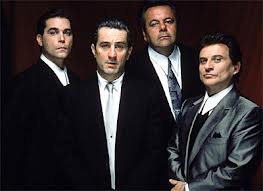
In addition to Karen, Henry and Tommy, the other main character is Jimmy Conway, played by Robert DeNiro. Conway is based on the real life Jimmy “The Gent” Burke, who was supposedly the mastermind behind the infamous Lufthansa heist depicted in the movie.  The Conway character perfectly represents paranoia and greed, while hiding behind the mob loyalty pledge. DeNiro never once overacts here, but his Conway dominates the screen despite the strong presence of Liotta and Pesci … and even Paul Sorvino, who plays mob boss Paulie.  Paulie is based on Paul Vario, the head of the Lucchese crime family. Sorvino plays him as quietly powerful and a guy with a phone phobia (for good reason). Sorvino’s Paulie is the centerpiece of the mob and is totally believable as a guy you better not cross.

goodfellas One of the more memorable scenes features Jimmy, Henry and Tommy stopping off at Tommy’s mother house to pick up a shovel … and a large, useful knife.  While there, Tommy’s mother (played by Catherine Scorcese, Martin’s mother) not only makes them a huge 3 am Italian meal, but also shows off some of her artwork, and even tells a joke!

What’s really fun to watch as the film progresses is the change of pace and camera work. Watching young Henry earn his stripes is treated with a light, almost comical touch.  As he becomes fully entrenched, we see a young man enjoying the power and respect of his position. This is crystallized by Scorcese’s infamous long-tracking shot through the back entrance and kitchen of the Copacabana as Henry and Karen end up front row by the stage. The downward spiral is much more frenetic with fast cuts and a desperate feel. Scorcese helps us feel the drug-induced paranoia that dominates Henry.

David Chase has stated that Goodfellas had quite an impact and inspired him to create “The Sopranos”, and the marks are goodfellas3quite clear. There is even a significant crossover in the cast as both feature Frank Vincent, Tony Sirico, Frank Pellegrino, Michael Imperioli and, of course, Lorraine Bracco (who was Tony Soprano’s psychiatrist).

Goodfellas was nominated for six Academy Awards, and Joe Pesci was the only winner (Best Supporting Actor).  It lost out in the Best Picture category to Dances with Wolves.  Scorcese has since directed two other critically acclaimed gangster films: Casino (1995, from another Nicholas Pileggi book), and The Departed (2006, which won Scorcese his first Oscar and also won Best Picture). You might also like to know that Pileggi is the creator of “Vegas”, the new TV show starring Dennis Quaid and Michael Chiklis.  The show is about the mob’s influence in the early “wild west” days of Las Vegas.

For years, movie lovers have been debating whether The Godfather or Goodfellas is the best gangster film. As much as I love debate, I see no reason to choose … they are both exquisite filmmaking, though quite different in style. Both films have provided us direction in life.  The Godfather informed us that “It’s not personal, Sonny. It’s strictly business”.  Goodfellas counseled us “Never rat on your friends, and always keep your mouth shut.”   Far be it from me to question the source of good advice!

***PROFANITY WARNING***  This is the unedited “funny like a clown scene” and it’s definitely NSFW!!!

http://www.youtube.com/watch?v=E84VqqCPI7w