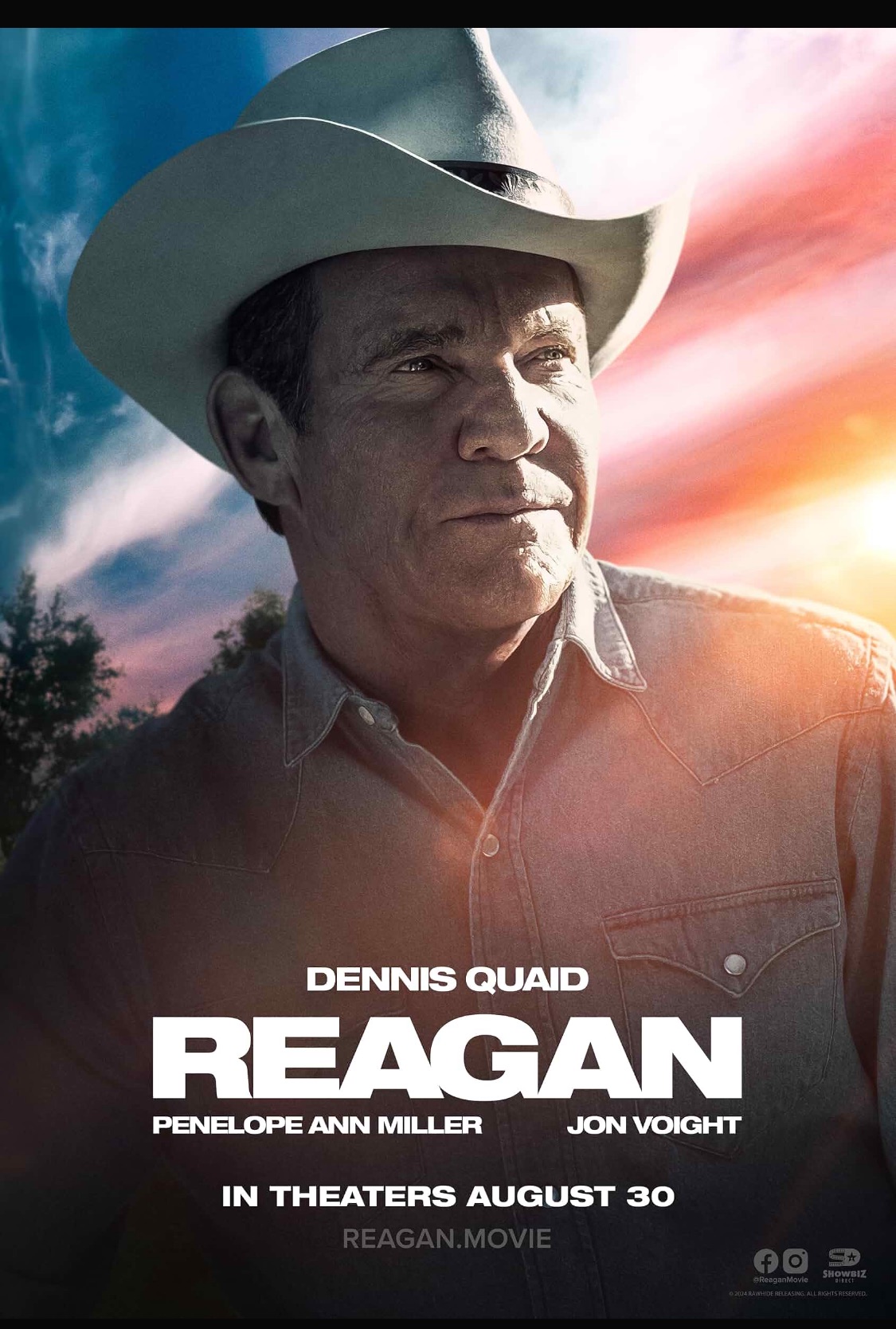
REAGAN (2024)

November 1, 2024

Greetings again from the darkness. The opening credits provide a brief visual reminder of the Cold War, a period mostly forgotten (or never really learned) by those under age 60. Unfortunately, the intro is about as complete as a tweet would be today, so it doesn’t work as a history lesson for those who don’t already know. The same could be said for this biopic from director Sean McNamara (VINDICTA, 2023). For those wondering why so many idolize former President Ronald Reagan and cherish those years under his leadership, McNamara’s film serves up a tribute to the man who was elected as the 40th President of the United States. Think of this as an airbrushed look back, as most of the blemishes have been erased.

Screenwriter Howard Klausner (SPACE COWBOYS, 2000) adapted Paul Kengor’s 2006 book, “The Crusader: Ronald Reagan and the Fall of Communism”. Dennis Quaid stars as Reagan and expertly captures some of the familiar mannerisms of the man who had numerous nicknames throughout his life: “Dutch” (from his mom), “The Gipper” (from his movie, KNUTE ROCKNE, ALL AMERICAN), “Rawhide” (his Secret Service handle), and “The Great Communicator” (for his ability to connect with folks during speeches). 

The film opens on Reagan’s 1981 speech to the AFL-CIO as he’s telling one of his patented jokes. He then proceeds out of the building where the sequence mixes in actual footage of him taking a bullet from close range … a shot that nearly took his life. The shooter (Hinkley) is not mentioned by name here. Not told in complete chronological order, McNamara does outline Reagan’s Midwest upbringing, including his stint as a lifeguard. Handsome and charming, we see how Reagan capitalized on both to become an actor, spokesperson, SAG President, and Governor of California before taking that biggest step to the White House.

Oscar winner Jon Voight plays Viktor Petrovich, a Russian KGB Agent, who provides the structure of the film by progressively debriefing rising Russian politician Andrei Novikov (Alex Sparrow) on the decades of observation and research conducted on Reagan. This runs us through Reagan’s first marriage to actress Jane Wyman (Mena Suvari) and subsequent marriage to his true love, Nancy Davis (Penelope Ann Miller). Ronnie and Nancy were devoted to each other and the movie emphasizes this, while not delving too deeply into Ms. Reagan’s propensity to get involved in many White House meetings.

The arms control negotiations between Reagan and the Russians are fairly interesting. First, it’s Leonid Brezhnev (Robert Davi) followed by a few Russian Premier deaths, until Mikhail Gorbachev (Oleg Krupa) arrives, leading to some colorful discussions culminating with Reagan’s “tear down this wall” speech. It’s through Voight’s character that we learn the Russians had their own nickname for Reagan: “The Crusader”. Many recognizable names of the era are present and played by familiar actors. These include Dan Lauria as Tip O’Neill, an unrecognizable and rarely seen these days Leslie-Anne Down as Margaret Thatcher, an unrecognizable and rarely seen these days Jennifer O’Neill as Nelle Reagan, Xander Berkeley as George Schulz, C Thomas Howell as Caspar Weinberger, and Pat Boone as Rev. George Otis (in a scene with an actor portraying singer Pat Boone).

There is no emphasis on either Bonzo the Chimp or the Iran-Contra affair, but it does touch on Reagan’s primary loss to Gerald Ford, the debates with Carter and Mondale, and we see the ever-present jellybeans. De-aging technology is used, especially obvious on Jon Voight, and the “Evil Empire” and Star Wars defense system have their moments. It’s a very favorable and complimentary look at a man who led a fascinating and interesting life before Alzheimer’s forced him to take a final horseback ride across his beloved ranch, and issue a statement to the public. While it won’t be mistaken as hard-hitting journalism, Ronald Reagan’s life is worthy of celebration and the film does just that.

Beginning November 1, 2024, it’s available Video on Demand, and on Blu-ray beginning November 19, 2024

WATCH THE TRAILER


THE BIRTH OF A NATION (2016)

October 6, 2016

birth-of-a-nation Greetings again from the darkness. Rarely is a director’s feature film debut one that has historical and societal relevance … and certainly few first-timers would dare “borrow” the title of one of the most iconic films in cinematic history (regardless of the irony). But it seems Nate Parker may be no ordinary filmmaker. His 7 year passion project is well made, well acted and worthy of discussion.

Though the films share the title card (right down to the font), there are almost no similarities between Mr. Parker’s film and the 1915 D.W. Griffith movie. Griffith’s movie (set 30-40 years later) is known as the first blockbuster and historical epic, was the first film screened at The White House (by Woodrow Wilson), and has been studied for its advanced filmmaking techniques. It’s also notorious for the despicable portrayal of racism, and has even been credited/blamed for re-energizing the activities of the Ku Klux Klan. Parker’s film is neither a remake nor a historical epic – it’s more of a biographical portrait of the most famous figure in the 1931 Southampton, Virginia uprising … Nat Turner.

This is the story of Nat Turner, but it’s clearly Nate Parker’s film. He is producer, co-writer (with Jean Celestin), director and lead actor (as Turner). Previously recognized for his acting (The Great Debaters, 2007), Parker’s passion for the story is evident. He takes creative license in some key elements (Turner’s marriage, the interracial baptism, the armory battle), but the fundamental truth that Turner was driven by his religious beliefs and visions to fight in order to free slaves is profound and ingrained in each scene.

Supporting work is solid and comes from Armie Hammer as Nat’s plantation owner and master, Penelope Ann Miller (The Shadow, 1994) as the plantation matriarch who teaches young Nat to read the bible (not the white man books), Jackie Earle Haley (The Bad News Bears, 1976) as the villainous slave hunting ranch hand, Mark Boone Junior as the scheming Reverend, Gabrielle Union as a rape victim, and Aja Naomi King (“How to Get Away with Murder”) as Cherry (Turner’s wife).

Nat Turner’s uprising lasted a mere 48 hours, and resulted in the slaughtering of dozens of slave owners and their families. Of course, many slaves were also killed and the fallout was that slave owners became more wary of the possible actions of slaves … while it also provided a glimmer of hope, and generational stories, for those who remained enslaved.

Religion was a driving force in Turner’s actions, and it’s fascinating to see a movie acknowledge conflicting bible verses, and how support can be found for most any action … in this case, slavery AND the battle against it. Turner’s sermons to slaves evolve over time from a message of “obey your master” to the point where he is inspiring the uprising – all with words directly from the scripture.

The end for Nat Turner provides the end of the movie, but of course, it’s not the end of the story. One need only check today’s headlines to know that racial tensions are prevalent and that society still has a ways to go for equality and humanity for all. Nina Simone’s “Strange Fruit” is one of the more haunting songs one will ever hear in a movie (originally recorded in 1939 by Billie Holliday), but it’s spot-on in its inclusion. A detailed song about lynching grabs our attention amongst the whippings, force-feedings, rape and other torturous mistreatments.

Slavery has been portrayed on screen in such films as 12 Years a Slave, “Roots”, Django Unchained, and Amistad. Nate Parker’s film deserves to be mentioned among these projects, and there is little doubt we will hear and see even more from Parker as a filmmaker (and actor). As a final benefit, the film reminds us to never bring a hatchet to a canon fight.

**NOTE: for those who follow the NBA, you’ll notice Michael Finley and Tony Parker are Executive Producers for the film.

**NOTE TO AMC NorthPark: my movie buddy was not pleased with his $7.03 small popcorn. Being one of the few who pays with cash, he questions why you can’t make 3 cents less per bag rather than load down your customers with 97 cents change … to say nothing of the inefficiencies in having your concession workers count out the 3 quarters, 2 dimes, 2 pennies


THE ARTIST

December 27, 2011

 Greetings again from the darkness. Remember the last silent film that received this much adoration, acclaim and publicity? Of course you don’t. It was 1927 and Clara Bow starred in Wings, the most recent silent film to be nominated for Best Picture (it won). My guess is, that streak is about to end thanks to French writer/director Michel Hazanavicius.

No doubt many will avoid this one since it is a Black & White silent film. What a mistake that would be. It offers a wonderfully entertaining and captivating story, and two outstanding and expressive lead performances. Jean Dujardin is remarkable as George Valentin, one of the biggest movie stars in 1927 (when this story begins). It’s around this time when the “talkies” begin taking over. Valentin is a very likable character, but foolishly believes talking movies are a fad and his fans will remain loyal to him and his traditional silent films. Not only do talkies take off, but the Great Depression also hits. Valentin finds himself out of work and broke.

 The most fun in the film occurs when Valentin and Peppy Miller (Berenice Bejo) are on screen together. Their characters have a chance meeting and there is an instant spark. Valentin gets her the first break of her career and before long, she is on the rise as fast as he free falls. Only Valentin’s dog and driver (James Cromwell) remain loyal to him during the tough times, but Peppy works behind the scenes to ensure their bond doesn’t die.

It’s impossible to watch this film and not notice the influence of Singin’ in the Rain and Sunset Blvd. Also, Dujardin’s Valentin looks to be a cross between Douglas Fairbanks and Gene Kelly, replete with the electric matinee idol smile. Both Dujrardin and Ms. Bejo (who is the director’s real life girlfriend) have the elastic face and bright eyes necessary for silent film stardom. They really allow us as viewers to forget the silence and enjoy the characters.

 Unless you are a film historian or a real movie buff, your only exposure to silent films may be from short clips or Mel BrooksSilent Movie. This one will change that and offer you glimpse at just how powerful film images can be.  Another thing that will jump out is how crucial complimentary music is.  It will guide you through the scene.  Ludovic Bource is responsible for the terrific original score, and other pieces of music are also used … particularly Bernard Herrmann‘s piece from Vertigo.

This is a fully realized story with excellent character development. You might wonder how this is possible with no dialogue, but that’s why this is a must see film garnering an abundance of critical acclaim. It’s very easy to access and is purely entertaining … with moments of both happiness and sadness. It has everything a really good movie should have … just with fewer lines of dialogue and a really smart dog!

SEE THIS MOVIE IF: you want to see one of the best movies of the year OR you don’t believe a silent movie can hold your attention (this one will prove you wrong)

SKIP THIS MOVIE IF: you just don’t like movies … sorry, I can’t think of another reason.

watch the trailer: