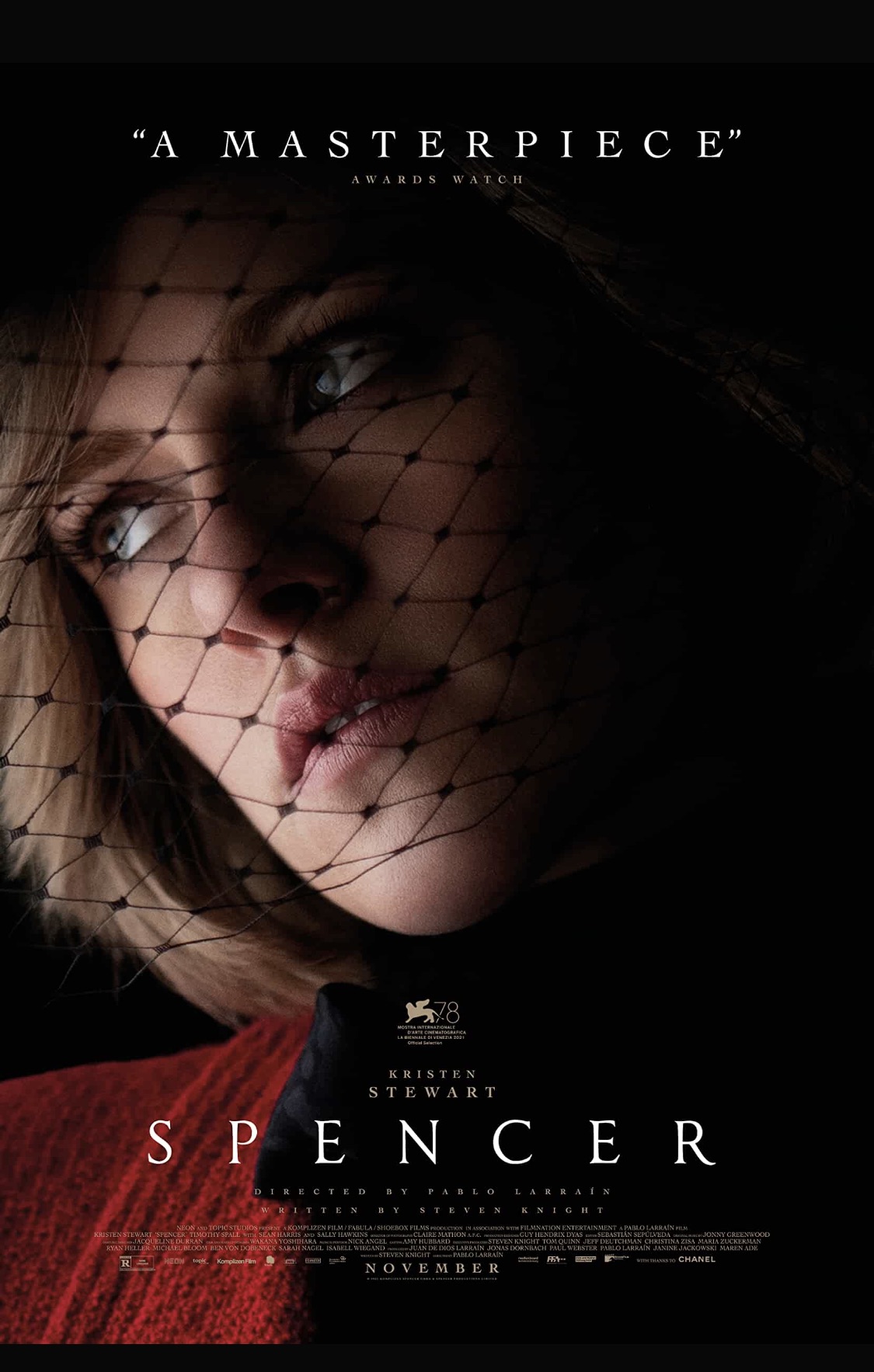
SPENCER (2021)

December 30, 2021

Greetings again from the darkness. “A fable of a true tragedy.” Such is the cautionary sub-heading that director Pablo Larrain begins his latest film. As in his 2016 film, JACKIE, the director turns his lens to an icon of which both too much and too little is known. The screenplay is written by Steven Knight (DIRTY PRETTY THINGS, 2002), and it takes place in the early 1990’s not long before the official marital break of the Prince and Princess of Wales. Much of this movie occurs in the muddled mind of Lady Diana through surreal dream sequences and imagined internal mental imagery.

You may find the holidays to be a stressful time, but what we see in Diana are the results of unrelenting pressures: media, royal family, a husband’s not-so-secret relationship with another woman, and yes, the somewhat absurd Christmas traditions of the institution into which she married. Kristen Stewart plays Diana, and we first see her lost on the back country roads trying to drive herself to Sandringham Estate, the site of the festivities. Arriving late (as she does throughout the 3 days covered here), Diana is confronted by Major Gregory (Timothy Spall), a military man hired by the royal family to keep the media at bay and to ‘spy’ and report on Diana’s every move … including the traditional holiday “weigh-in”, a particularly discomforting event for the Princess with an eating disorder.

It seems the only ones happy to see her are the kids: William (Jack Nielen) and Harry (Freddie Spry). Their relationship is much how we have imagined – lots of mommy time with some royal lessons thrown in for good measure. A book on her life leads to Diana’s encounters with the ghost of Anne Boleyn, the second wife of King Henry VIII, whose path is one Di would prefer to avoid. Her only confidant is her dresser Maggie (Sally Hawkins), the lone adult she can trust with actual thoughts and conversation. We quickly realize that, regardless of the size of the castle, Diana feels very much as if she has been caged by her situation.

Her emotional pain and anguish seems to multiply by the minute, right down to being forced to wear the pearl necklace – identical to the one Charles (Jack Farthing) also gave Camilla. Grasping for freedom, Diana tries to explore her nearby childhood home, now a relic of the past. The coat removed from a dilapidated scarecrow is yet another attempt for Diana to escape back to her simpler and happier life, and of course, we watch this knowing how her story ends.

The head chef, Darren McGrady (a terrific Sean Harris) is one of the few who holds a soft spot of empathy for the Princess, but her paranoia is only enhanced by such things as the sign in the kitchen that states, “They can hear you”, and a reminder from Maggie, “Everyone here hears everything.” Cinematographer Claire Methon complements the surreal feel with matching camera work, and Jonny Greenwood (PHANTOM THREAD, 2017) delivers one of his most unique and distinctive scores – both matching the oddity of the film and the captivating performance of Kristen Stewart. More psychodrama than biopic, director Larrain’s film is both interpretative and a bit sad.

available VOD (Amazon)

WATCH THE TRAILER


NERUDA (Chile, 2016)

January 19, 2017

neruda Greetings again from the darkness. There is little offered by the history of the country of Chile that would lead you to believe that some laughs, giggles and chuckles are in store if you watch director Pablo Larrain’s film about Pablo Neruda. But that’s exactly what happens as we watch a police inspector hunt down the Nobel Prize winning Chilean poet and Senator. While you would probably not describe it as an outright comedy, it’s a serio-comedy that will educate (a little) and entertain (a lot).

The opening scene takes place in the men’s room as a most serious Senate debate has flowed into an inappropriate locale. Apparently there is no relief during this time of relieving. It’s here that Neruda’s spoken words are as important as those he writes, and those spoken words lead directly to his need to go on the run. The poet/senator and his artist wife Delia del Carril become fugitives in their own country, and most of the film has them negotiating the Chilean underground.

Set in 1948, three years after the end of WWII, a fascinating game of cat and mouse between hunter and hunted evolves. Director Larrain and writer Guillermo Calderon employ a generously creative license, and play quite fast and loose with facts resulting in a delightfully complex quasi-detective story.

Luis Gnecco plays Pablo Neruda, and actually looks very much like the Chilean icon who was influential, but also a bit prickly and burdened with his own sense of entitlement. Gael Garcia Bernal plays Inspector Peluchonneau, who is charged by the President to hunt down and capture the now enemy of the state. It’s a wild chase that involves up to 300 policemen in support of the Inspector who romanticizes the chase. The filmmakers have more fun with traditional story structure as the Inspector’s internal dialogue questions whether he is the lead character … an idea that would never be considered by the man he is chasing.

The film has a retro look and feel, and borders on farcical at times – the shots inside a moving car appear right out of the old 1940’s detective movies. But the harsh realities of the times are never far removed. It could be a Picasso speech or a concentration camp director named Pinochet (soon to play a more important role in Chile). Neither the Inspector nor the fugitive make for a trustworthy narrator, but their different perspectives constantly provide us with more bits to consider.

Luis Gnecco, Gael Garcia Bernal and Mercedes Moran (as Delia del Carril) are all excellent in their roles, and the use of music is spot on … especially the score from Federico Justid (whose work I noted in Magallanes and The Secret in Their Eyes). Director Larrain also released the high profile Jackie (with Natalie Portman) over the holidays, and deserves to be discussed as one of the more creative filmmakers working today. It’s pretty tough to name another contemporary film that blends an oddball inspector, a tough woman losing touch, and a narcissistic fugitive – all with bases in reality, while never settling for something as mundane as the truth.

watch the trailer:


JACKIE (2016)

December 10, 2016

jackie Greetings again from the darkness. There will be two distinct groups that erroneously presume this is a traditional biopic of the glamorous former first lady: those who wave it off as Lifetime Channel fare, and those who excitedly walk in thinking they are going to be swept away in the pink Chanel suit from that fateful day in November 1963. Instead, the first English language feature from director Pablo Larrain (No, 2012) offers up a what-might-have-been look behind the scenes and takes a stab at the psychological make-up of the often underestimated and complex woman known even today as simply Jackie.

The opening scene provides the first of countless close-ups of Natalie Portman as Jackie. Different than the usual movie close-ups, these are somehow closer – more intimate and more intrusive. The shots make us uncomfortable, as if we are intruding on her personal space. This is by design, as the film takes us to a surreal place where we see Jackie the person, rather than Jackie the icon. The framing device used is an interview she granted to Life Magazine reporter Thomas H White (Billy Crudup billed only as “the journalist”) at the Kennedy compound in Hyannis Port, merely a week after the assassination.

To grasp the concept here from director Larrain and writer Noah Oppenheim (in a big stretch from The Maze Runner), it’s imperative to understand that, at the time, Jackie was the personification of a nation’s grief and the ultimate example of dignity and grace (yes, Seinfeld fans, she had grace). We quickly witness the power and control she wielded. “Don’t think for a second I’m going to allow you to publish that” … she states after exposing her most vulnerable and personal thoughts. Later, she puffs on a cigarette and tells the reporter, “I don’t smoke”. It’s in these moments that we begin to realize the point – Jackie was a master at generating the “proper” public perception from even the harshest personal realities (many of which the film politely ignores).

Much of the film deals with her dogged pursuit of creating a lasting legacy for her husband. The idea of Camelot was meant to provide hope and idealism to the public who so wanted to idolize and romanticize the first couple. The symmetry with Lincoln – the portrait, the bedroom and the meticulously planned elaborate funeral procession – were meant to establish heft and substance for an all-too-brief administration that even had brother Robert (Peter Sarsgaard) lamenting how little was accomplished. These were the calculated strategies of a woman who was much more than the charming and slightly nervous host who took America on a televised tour of The White House on CBS in 1962.

The film utilizes flashbacks to the Lincoln Continental with the Texas Schoolbook Depository in the background, as well as detailed recreations of The White House, Parkland Hospital, Air Force One, St. Matthew’s Cathedral, and of course, the pink Chanel dress. That said, this is certainly not a movie designed to solve the case or disprove one of the conspiracy theories … it remains steadfast as a close-up of Jackie.

Others in supporting roles include a nearly unrecognizable (and minus her usual ticks) Greta Gerwig as Nancy Tuckerman (Jackie’s social secretary and friend), John Carroll Lynch and Beth Grant as LBJ and Lady Bird, Max Casella as Jack Valenti, stunning lookalike Caspar Phillipson as JFK, and a remarkable John Hurt as the Priest helping Jackie through her spiritual crisis. But of course this is Natalie Portman’s movie. She captures the breathy vocals and the contrasting strong directness when dealing with Bobby and Lyndon. Her movements mirror those from the actual footage of the White House tour … it’s really a performance to behold.

Many original images, videos, and clips are blended/spliced into the re-enactments to add a touch of sentimentality and prove how close to reality the film holds. One thing to brace for is the most unique score you’ll likely hear in a film this year. Mica Levi’s unusual sound brilliantly complements the many moods of Jackie, and even manages to remain strong around Richard Burton’s rousing rendition of “Camelot”. Ms. Portman’s performance and the behind-the-curtain approach work well in reminding us that these were real people … not just Kennedys.

watch the trailer: