Author: Tim Brown
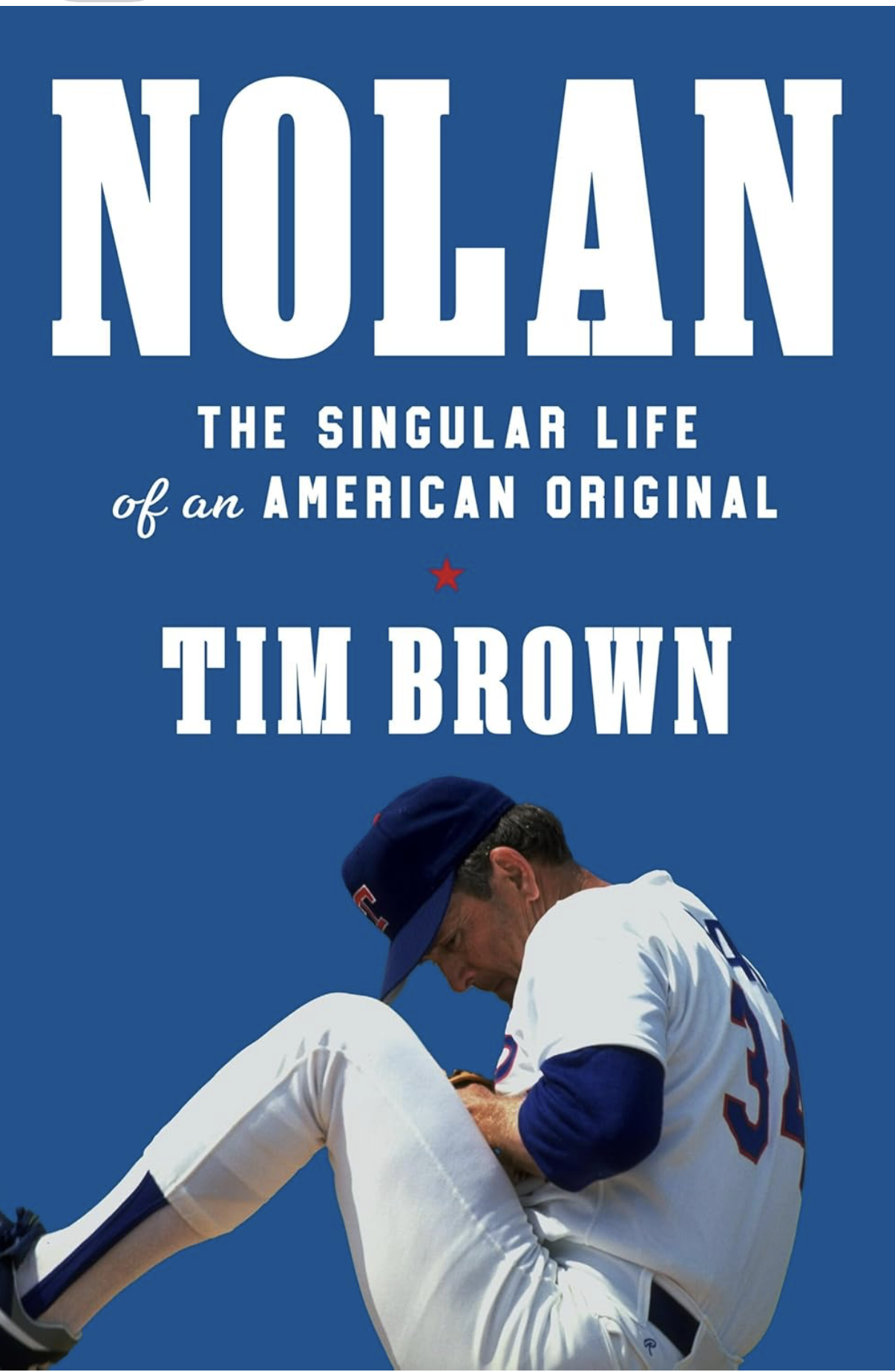 The Ryan Express. Tex. Nolie. However you refer to Lynn Nolan Ryan, he was without question one of the most exciting players and dominating pitchers in Major League Baseball history. Sure, he had some detractors, but few of those are knowledgeable baseball fans or among those who were lucky enough to see him pitch. Renowned sportswriter and author Tim Brown serves up plenty of ‘inside baseball’ here as it relates to Nolan’s career, yet some of the most interesting bits and pieces are in regard to Ryan as a man.
Some standard biographical information is included, with an emphasis on Ryan’s childhood in Alvin, Texas (born in Refugio) and his lifelong connection to the area. He’s been married to local girl Ruth Holdorff since 1967 and if anything, Ruth’s continued support of and importance in Nolan’s career might be slightly underplayed in the book. We are talking about a woman who would gear up and catch Nolan Ryan pitches in the offseason. Still, this is a book about Nolan, and some terrific stories are recollected. This includes that incredible baseball career of 27 seasons, and also the post-playing career, which led to his continuing need to scratch the competitive itch.
We learn the importance of Red Murff (an entire chapter), the baseball scout who discovered Nolan and so believed in his potential, that he persuaded the New York Mets to draft him … leading to his MLB debut at age 19 and his only World Series appearances in 1969 for the legendary “Miracle Mets.” After the 1971 season, the Mets traded the young fireballer to the Angels, where he pitched some of his most dynamic and spectacular games. Eight seasons later, Nolan seized the chance to play near his hometown of Alvin for the Houston Astros. With this move, he became the first major leaguer to earn more than $1 million per season. After nine seasons in Houston, Nolan jumped to the Texas Rangers, where he would end his playing career five years later … at the age of 46.
Those are the numbers and years, yet as Tim Brown’s book stresses, there are more pertinent ways to capture Nolan Ryan, the man. A consistent theme appears at the point of those career moves. Ryan felt disrespected by the owners/management teams of the Angels, Astros, and ultimately the Rangers (after he became a part-owner and Team President). In keeping with the ‘strong, silent type’, Ryan demanded respect and saw no need to put up with anything less. The true way to judge a man’s character is by hearing what others say about him, and Brown’s book excels at telling such stories and laying out the foundation of why Nolan Ryan remains a Texas and baseball legend.
Some numbers are crucial in further understanding Ryan’s legacy. You should know that his 27-year career resulted in 324 wins, seven no-hitters, 12 one-hitters, 18 two-hitters, and 5714 career strikeouts. An obvious Hall of Famer, Ryan refused to rest on his laurels after his playing career ended. Instead, his resume includes rancher (with a beef business), banker, spokesperson, college baseball assistant coach and part owner (with his son) of Ryan Sanders Sports and Entertainment (owner of minor league Round Rock Express). All of this was after his time as President/CEO/part owner of the Texas Rangers and Special Assistant to the Houston Astros.
Brown devotes a full chapter to a breakdown of each of Nolan’s seven no-hitters, including naming the catcher, providing the final score, and the number of strikeouts and walks. Other chapters speak to the important figures in his career: Gene Autry, Bobby Valentine, Tom Grieve, Tom Seaver, Phil Garner, Tom House, Tim Purpura, and (not in a good way) John McMullen. Of course, the Robin Ventura episode is detailed, as is the underreported meeting between the two men a few years later (again, true character shining through). Hardcore baseball traditionalists will find immense pleasure the “The Bow Tie” chapter which speaks directly to Nolan’s use of intimidation while on the mound … or hulking around the mound … or reacting to batter’s bunts or smiles.
As a young kid just getting into baseball, I first saw Nolan pitch in the 1969 World Series for the Mets (on TV). Through the 1970’s, 1980’s, and early 1990’s, I was fortunate enough to see him in person as he pitched for the Angels, Astros, and Rangers. Each outing began with anticipation and excitement over what ‘might’ happen, and the confidence of knowing it would be memorable, regardless of the outcome. Brown’s last few chapters detail how Ryan has spent his time since retiring. There is also a section on how it’s possible the Texas Rangers might have folded and/or relocated if not for the timely addition of Nolan Ryan to the roster, and his subsequent impact in the front office. When the franchise finally secured a World Series win in 2023, those conversations and thoughts resurfaced.
Of course, there have been quite a few previous books written about Nolan Ryan. Even today, young pitchers can learn from “Nolan Ryan’s Pitcher’s Bible” (co-written by Ryan and Tom House). Still, it’s this latest book from Tim Brown that is so thorough and comprehensive. It covers so many aspects of the man. The legacy of Nolan Ryan remains massive from a baseball perspective, yet his lasting impact is that of being a man of principle, a man of honor, a devoted husband and family man, the ultimate competitor … and a final description that seems all too rare these days … a worthy role model.
The book releases on May 19, 2026


 Posted by David Ferguson
  Greetings again from the darkness. Having been a baseball fan for as long as I can remember, I can list the handful of players that I got to see play in person who left me in utter awe of their talent. Lynn Nolan Ryan was definitely one of them, so when I saw Bradley Jackson’s documentary listed on the SXSW schedule, I immediately sent my RSVP.

