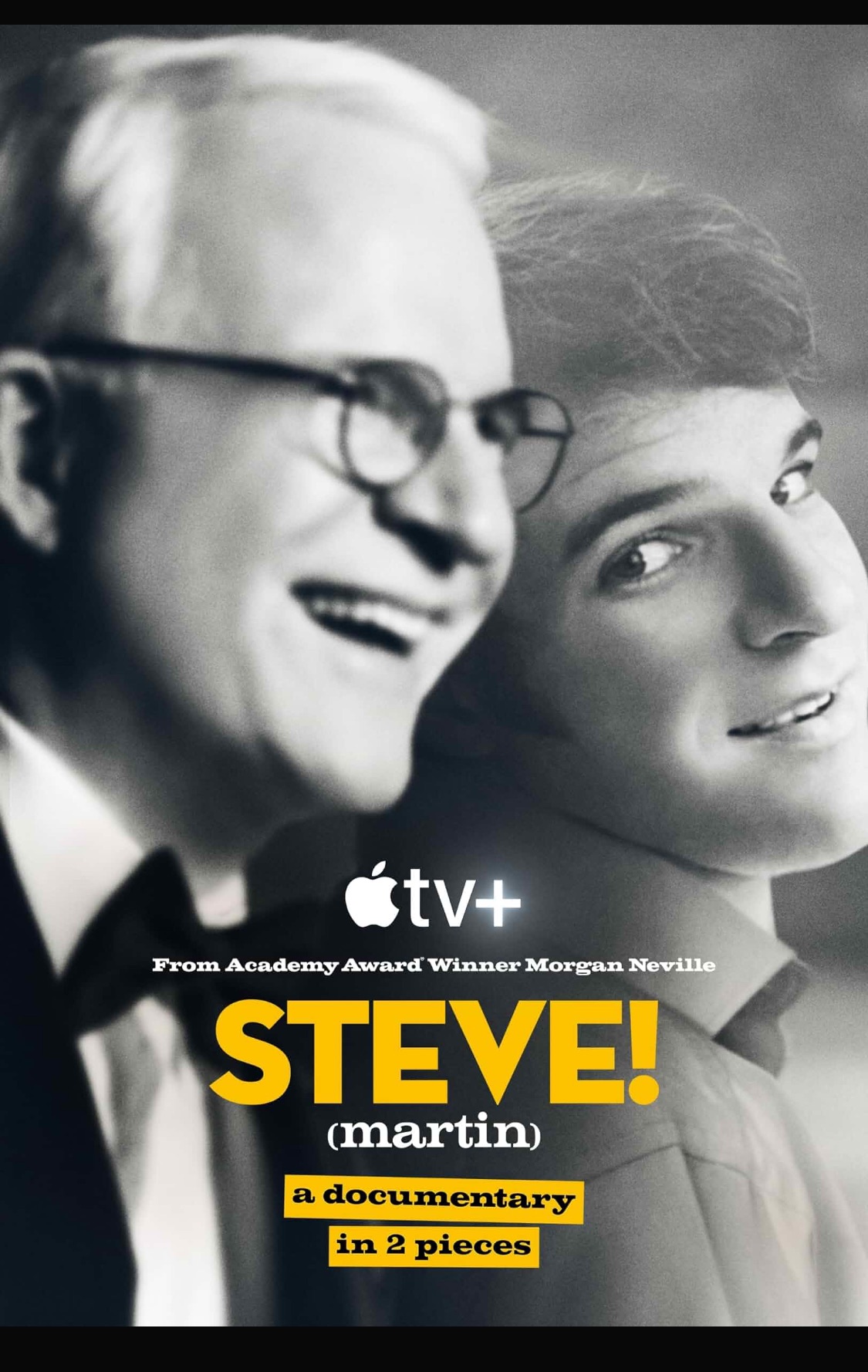
STEVE! (MARTIN): A DOCUMENTARY IN 2 PIECES (2024, doc)

March 28, 2024

Greetings again from the darkness. We are now two full generations past the peak (and end) of Steve Martin’s superstardom as a stand-up comedian. Today, he is mostly known as a banjo player, a writer, or as one of the three co-stars of the hit show, “Only Murders in the Building”. That’s right. At almost 80 years of age, and removed from his two previous fame-inducing careers (comedian and movie star), he “only” has three remaining paths to fame, glory, and gobs of money. Regardless of the Steve Martin era studied, what stands out is his remarkable ability to entertain – something he says captured his fancy the very first time he saw a stage.

Documentarian Morgan Neville won an Oscar for the spectacular 20 FEET FROM STARDOM (2013). He’s also behind WON’T YOU BE MY NEIGHBOR (2018), an excellent profile of Mister Rogers, as well as numerous other documentary projects. With more than a half-century of Martin’s career to somehow cover, Neville takes a “then” and “now” approach with what is effectively two films that split Martin’s fabulous career into the two titular ‘pieces’. “Then” covers the early developmental period, right up until 1980, when Steve Martin shocked the world by walking away from stand-up. “Now” offers a more personal and reflective look at his endeavors since.

For those of us who were around in the 1970’s, “Then” is not just a nostalgic look back at how one man reinvented stand-up comedy (though it is that). It’s also a fascinating look at Martin’s childhood and his early pursuit of finding his place in the entertainment world. We hear Martin state, “I guarantee you I had no talent.” Of course, whether that’s accurate is debatable, but what he certainly had was persistence, ambition, and a desire to make it. As a 15-year-old working at Disneyland (he was born in Waco, Texas but raised in southern California) he learned the basics of magic and balloon animals through observation and relentless practice. He admits his educational background in Philosophy gave him a unique perspective in understanding himself and audiences. He gave himself until age 30 to “make it”, and a fortuitous turn of events, made that birthday a special moment. He worked and massaged and practiced his routine – refining such silliness as an arrow through the head, happy feet, “Excuuuuuse Me!”, King Tut, and “Wild and Crazy Guy” – all while wearing a white suit and sporting premature gray hair. In 1976, Lorne Michaels invited Martin to host a relatively new comedy show called, “Saturday Night Live” (something he has now done 16 times). Soon after, Martin released the first two comedy albums to ever go Platinum. This led to the first of his many movie roles in the classic comedy, THE JERK (1979). Director Neville highlights each step of Martin’s amazing ascension via rare clips and input from Martin himself. And just like that … comedy’s first rock star walked off stage at age 35 and on top of the world.

“Now”, the second entry in Neville’s in-depth documentary, is much less about Steve Martin’s varied career and much more about Steve Martin the person. To emphasize the contrast between ‘Then’ and ‘Now’, this second piece begins in Martin’s kitchen showing him poaching two eggs (heavy on the pepper) for breakfast. Does that sound like showbiz? It’s an entirely different approach as we watch Martin and Jerry Seinfeld have a conversation about comedy, while Tina Fey, his sister, and others give brief insight into their paths crossing with Martin. Even his wife, Anne Stringfield, offers up some personal scoop on the man who has protected his privacy all these years … although it should be noted that their daughter only appears as a cartoon stick figure.

Much of this segment revolves around Steve Martin and his friend and “Only Murders in the Building” co-star, Martin Short, as they collaborate on jokes for their stand-up show … all while jabbing each other with friendly one-liners. Short says the reason Martin hasn’t aged is because he looked 70 when he was 30. It’s that kind of friendly banter between friends. A most poignant moment occurs as Martin is going through his bound copies of movie scripts. PLANES, TRAINS, AND AUTOMOBILES (1987) takes him back to his close friendship with the late, great John Candy, and the memories are almost too painful for Martin to bear.

It’s fascinating to hear Martin talk about his humiliation when PENNIES FROM HEAVEN (1981) failed, and learn more about his devotion to fine art. To emphasize the personal change Martin has gone through, the director shows an interview clip from decades ago where Martin refuses to discuss the first painting he bought, and then juxtaposes it with a contemporary clip where he eagerly expounds on that painting and others. Martin doesn’t appear to carry as much pride in his movie career as he should, and we see him working with illustrator Harry Bliss on a collection of memories and anecdotes from each film.

Morgan Neville likely underestimated the project when it began. He certainly benefitted from Steve Martin’s willingness to open up and share his personal archives. A man of many talents and interests, with multiple careers spanning decades may be a challenge for a biographer, but for viewers, it’s pure joy to stroll through the many reinventions of Steve Martin. His work is worthy of admiration, as is his willingness to open his life and reveal the hard work and dedication that goes on behind the curtain.

The film will be on Apple TV+ on March 29th.

WATCH THE TRAILER


ROADRUNNER: A FILM ABOUT ANTHONY BOURDAIN (2021, doc)

July 15, 2021

Greetings again from the darkness. As the film begins, we understand there will be no happy ending. Anthony Bourdain committed suicide by hanging in 2018 at the age of 61. As it was reported, everyone was shocked. Oscar winning documentarian Morgan Neville (TWENTY FEET FROM STARDOM, 2013) interviews those who knew him best, and by the end of the film, we are left wondering why these folks were shocked at how his demise.

Bourdain … called Tony by those who knew him … spent most of the last 20 years of his life with a camera focused on him, so director Neville allows Bourdain to tell much of his own story. “I got very lucky” is how he explains turning a dishwasher job into the position of Chef at Brasserie Les Halles on Park Avenue in New York, and then evolving into an author, talk show guest, and host of TV travel and culinary shows.

Perhaps you read Bourdain’s first book “Kitchen Confidential: Adventures in the Culinary Underbelly”, or maybe you know him from one of his four TV shows where he traveled around the globe eating strange food and exploring unusual cultures. Then again, to some, he’ll always be known as the guy who was filmed eating a live cobra heart. All of those bits are discussed here, but the real interesting segments occur as others talk about the man they knew/loved/worked with.

Bourdain’s second wife Ottavio, his brother, his friends, his agent, and his production crew are all interviewed here and are surprisingly forthcoming in their recollections and insight into Tony. We even see clips of Bourdain with his daughter, though she is not interviewed. The descriptions add up to a complicated guy. A natural storyteller who was a control freak and hard on those he worked with. Yet he was also charming, immensely intelligent and articulate, and eager to make satisfying TV. He also comes across a bit lost as a person most of the time, never more than when he’s filmed asking Iggy Pop, “What thrills you?” There is even a segment with Tony in a session with his therapist.

The film, and Bourdain himself, don’t shy away from his addictive nature. He admits to a drug problem when he was younger, and for the rest of his life he jumped from one non-drug related addiction to another. His personal life seemed to take a turn when he fell for Italian actress Asia Argento and he became an advocate for the #MeToo movement. His tragic end is discussed, and maybe those closest to him were simply too close to see what seems obvious to us now. Director Neville uses no shortage of archival footage and photos, but it’s the personal interviews that strike the emotional chord here. Two films, APOCALYPSE NOW and VIOLENT CITY apparently had a dramatic impact on Bourdain, and though the end is tragic, his legacy as an adventurous storyteller lives on.

In theaters on July 16, 2021

WATCH THE TRAILER


WON’T YOU BE MY NEIGHBOR? (2018, doc)

June 8, 2018

DALLAS INTERNATIONAL FILM FESTIVAL 2018

 Greetings again from the darkness. Is it too good to be true? We often ask that question in life, but when it comes to Fred Rogers of “Mr. Rogers’ Neighborhood”, director Morgan Neville’s documentary proves the answer is no … he was good and true. Fred Rogers hosted the children’s TV show on PBS for more than 30 years, starting in 1968. The terrific (and surprisingly emotional) film provides the background of the show, and more importantly, profiles a wonderful man.

Director Neville (BEST OF ENEMIES: BUCKLEY VS VIDAL, 2015) has produced numerous biopics on musicians ranging from Keith Richards to Muddy Waters to Johnny Cash to Brian Wilson. His subject this time out was known for his singing the show’s familiar opening number, and his lyrical legacy was his substantial impact on many generations of children. Mr. Rogers was an ordained minister and, in the early days of television, recognized that violent cartoons were not appropriate programming for the formative childhood years. Even in the early years, he was an outlier with sincerity and wholesomeness in entertainment. He never shied away from tough topics – not even death – whether it was the assassination of Robert Kennedy or a dead fish in the aquarium on set. He spoke directly to children in a voice and language they understood.

There are interviews with fellow cast members, long timer crew members, and relatives, including his wife Joanne. We hear Francois Clemmons (Officer Clemmons on the show) discuss how Mr. Rogers addressed Clemmons’ homosexuality and race, adding poignancy to the shared televised foot bath. Archival footage takes us back to the early years, and we see Lady Aberlin and Daniel Tiger in both black and white and color segments. We learn that the puppet Daniel most resembled the personality of the host himself … a quiet, patient, compassionate being who cared about others.

We see footage of Fred Rogers testifying in front of a Senate sub-committee to prevent funding for PBS from being eliminated, and we see numerous cardigan sweaters and tennis shoes. Mostly we see the approach of a man who built a legacy on kindness and human decency … a lifetime pursuit of uniting that led to struggles with depression. His obsession with 143 – both his weight and his code for “I love you” provides some insight into his personality, and mostly we hear others speak of his lasting impact.

Rather than comedy and pranks, Mr. Rogers was intent on making kids feel safe and secure in a scary world. Sure he educated – often subtly – but it was his innate ability to comfort that kept kids coming back. There are naysayers who say he is responsible for generations of entitled kids who grew into entitled adults, but the film addresses this by showing Roger’s commencement address where he clearly explains the “special” label. His final show was in 2000 and he died in 2003. His legacy is simple yet powerful. We can each do better. We can each be better. We can each be better neighbors.

watch the trailer:


20 FEET FROM STARDOM (2013)

July 1, 2013

20 feet1 Greetings again from the darkness. “And the colored girls go do doo doo, do doo …”. The controversial lyrics from Lou Reed’sWalk on the Wild Side” kick off this exceptional documentary about the oft-ignored back-up singers who have played (and continue to play) a huge role in some of the biggest songs of all-time. You may not know their names, but you have undoubtedly sung along with them while driving or taking a shower.

Director Morgan Neville has a credit list filled with music shorts and documentaries. One of my personal favorites of his is “The American Masters” on Muddy Waters. I recalled that while watching this one because Neville does a nice job of connecting the dots from Gospel, Blues and Soul to the roots of Rock and Roll. The main women featured here all admit to being daughters of preachers, and fine-tuning their ability to harmonize during their youth while singing in the church choir.

20 feet5 Most of the interview time and insight comes from Darlene Love, Lisa Fischer, and Merry Clayton. You may not recognize the names or faces, but you will surely recognize the voices. Ms. Love has been elected to the Rock and Roll Hall of Fame, and may be best known thanks to her annual appearance on the David Letterman Show at Christmas. Ms. Fischer is the most frequent worker today of the three as she tours with Chris Botti, Sting and The Rolling Stones. However, the heart-stopping climax of the film belongs to Merry Clayton, as we are treated to her isolated vocals from the master on her infamous performance on the single “Gimme Shelter“. Hearing her raw voice blast out “Rape. Murder. It’s just a shot away” is both exhilarating and gut-wrenching. To hear her tell the story is mesmerizing. One of my favorite movie moments ever.

20 feet2 While we see and hear the personal stories filled with frustration and regrets, we also see an inherent love of music and the appreciation for their particular gift. We also hear from Tata Vega, Dr. Mabel John (a former Raelette for Ray Charles), and Claudia Lennear. With many similar stories of their quest for solo careers, we get the contemporary version with Judith Hill, a twenty-something working back-up today as she strives for a solo career. The parallels are obvious with her older peers.

Another excellent feature of the film comes in the form of interviews from the likes of Bruce Springsteen, Sting, Stevie Wonder, Lou Adler, Chris Botti, and Mick Jagger. We also see some studio shots featuring Phil Spector (once the hottest music producer, now incarcerated), and concert footage of Talking Heads, Ray Charles, The Rolling Stones, and the Concert for 20 feet3Bangladesh. It’s especially fitting to see Luther Vandross as a back-up singer to David Bowie‘s “Young Americans“, and to hear from Sheryl Crow, who worked as Michael Jackson’s back-up/lead female. These are the examples of the back-ups who successfully made the walk.

My only minor quibble with the film is structural, not content. Neville has an over-whelming task of addressing each of the individual stories, while also relating it to the nasty and unfair music business, the Civil Rights movement, the development of Rock and Roll, and the role that “talent” plays in what Springsteen terms the “complicated” walk from back-up to lead singer (the titular 20 feet). The segment focusing on Merry Clayton’s role in Lynyrd Skynyrd’s “Sweet Home Alabama” is especially poignant. Overall this film is fascinating and entertaining, and makes a great companion piece to Standing in the Shadows of Motown (2002) and Muscle Shoals (2013).  Whether or not you are a fan of documentaries, this is a film to be enjoyed by all.

watch the trailer:

http://www.youtube.com/watch?v=tWyUJcA8Zfo