INTO THE WOODS (2014)

December 23, 2014


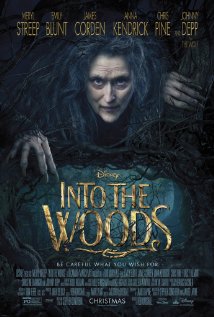
into the woods Greetings again from the darkness. It’s a musical, but not a typical musical. It’s a fairy tale, but not a typical fairy tale. It’s funny, but not a typical comedy. It’s a bit frightening, but not a typical monster film. It’s filled with lessons of morality and responsibility, but certainly not a typical parable. In fact, there is nothing typical about director Rob Marshall’s (Oscar winner for Chicago) screen adaptation of the smash Broadway hit from Stephen Sondheim and James Lupine.

The story revolves around 4 classic Fairy Tales: Little Red Riding Hood, Jack and the Beanstalk, Rapunzel, and Cinderella, in a style much more similar in tone to the edgy Brothers Grimm, than the cuddly Walt Disney traditionals. These four are intertwined with the saga of a baker (James Cordon) and his wife (Emily Blunt) who discover they have been unable to have children due to a long ago spell cast by a wicked witch (Meryl Streep). With a secret agenda, the witch offers the couple a way to break the spell, and that’s what ties-in the four tales and provides a reason for adventure and song.

Filmed seamlessly between an elaborate sound stage and a couple of park locations, the film has a dark and eerie feel to it that’s probably too intense for younger children. And much of the dialogue and lyrics is aimed directly at adults and will be a blur to kids. Additionally, in typical Sondheim fashion, the songs aren’t catchy and melodic in the manner of most movie musicals … instead the lyrics propel the story and help shape the characters. Oh, and by the way, don’t expect any fancy dance sequences – this is pretty serious stuff with plenty of angst amongst the characters.

Ms. Streep is extraordinary as the witch (both nasty and beautiful) and does a terrific job with her three main songs. She is especially fun in her entrances and exits, and while wearing the most impactful of all the costumes. Emily Blunt also handles her vocals very well and offers up some of the film’s most witty dialogue. Chris Pine (as the Prince) is flat out hilarious, and with a twinkle in his eye, spouts lines such as “I was raised to be charming, not sincere”. He also shares the screen with Billy Magnussen (playing the younger brother) in the most audacious of the musical numbers, “Agony”. As Cinderella, Anna Kendrick once again proves she is an exceptionally talented singer, and James Cordon anchors the production as the nice guy village baker we are rooting for.

In supporting roles, we have a devilish Johnny Depp whose screen time as the Big Bad Wolf is quite limited, and a perfectly cast Christine Baranski as the evil step-mother in cahoots with her non-Cinderella daughters played by Lucy Punch and Tammy Blanchard. Lilla Crawford is Little Red Riding Hood, and her young age snuffs out much of the innuendo that the Wolf scenes should have provided, and takes the edge off the song “I Know Things Now”. Daniel Huddlestone is an energetic Jack, and dependable Tracey Ullman plays his frustrated mom. MacKenzie Mauzy captures the awakening of Rapunzel, while Frances de la Tour frightens everyone involved as the agitated (for good reason) Lady Giant.

Unconventional is the best description of this production, and there is a group of viewers who will be totally captivated by it, while a much larger group will probably find it too dark and bleak, and lacking the easy charm we have come to expect from movie musicals. However, for those of us in the first group, we will be totally enchanted by the characters, story lines, wry humor, costumes, sets, and songs.

SEE THIS MOVIE IF: you prefer your fairy tales a bit on the dark side OR you want to see yet another incredible performance from Meryl.

SKIP THIS MOVIE IF: you are looking for a light-hearted holiday matinee for the little kiddies

watch the trailer:


THE HOMESMAN (2014)

December 1, 2014

homesman Greetings again from the darkness. We have come to expect our Westerns to be filled with stoic heroes and nasty villains, but this film delivers a pious, yappy leading lady paired with a selfish, no frills drifter. Based on the 1988 novel from Glendon Swarthout, it’s also the second directorial outing from Tommy Lee Jones (The Three Burials of Melquiades Estrada, 2005).

Hilary Swank plays Mary Bee Cuddy, a name repeated so many times that it will surely stick with you … even if the movie doesn’t. Thirty-one years old and unmarried, Ms. Cuddy is not without talent. She works the plough horses, cooks up fried chicken, and plays a mean fake piano. As is pointed out to her a couple of times, she is also “bossy” and “plain” looking … neither trait especially appealing to men in the wild west.

Ms. Cuddy volunteers to take three local women to Iowa. The three women (Grace Gummer, Miranda Otto, Sonja Richter) have each gone insane, and somehow Iowa is the most civilized place within a wagon ride’s distance. Cuddy teams up with a low-life drifter played by Tommy Lee Jones, after they strike a deal that allows him to escape certain death. The verbal clash of cultures and personality between the two main characters provides most of the action on screen, as the three women being escorted are mostly muted and either locked in the back of the wagon or tied to a wagon wheel during riding breaks.

The film is at its best when focusing on the harsh realities of frontier life. Cinematographer Rodrigo Prieto (Brokeback Mountain) does a nice job of capturing the wide expanse and stark vastness of the landscape, while also tossing in some artsy silhouettes and proof of abruptness of this life. Director Jones utilizes some haphazardly timed flashbacks to help us better understand the plight of the three women, but this could have been done much more effectively. Courage, inner-strength, and morality all play a role here, and the contrast between frontier and civilization was most distinct.

Much of the film plays like an oddball buddy picture – think Nolte and Murphy in 48 Hours, or Bogart and Hepburn in The African Queen. If you find the interaction between Swank and Jones to be realistic, then you will probably buy into the whole film. If not, the lack of flow and choppiness of scenes will jump out. There seems to be a never ending stream of little more than cameos from a tremendous line-up of actors: Barry Corbin, William Fichtner, Jesse Plemons, David Dencik, Evan Jones, John Lithgow, Tim Blake Nelson, James Spader, and Hailee Steinfeld. There are even a couple of scenes near the end featuring Meryl Streep (her daughter Grace Gummer plays one of the 3 insane women). The slew of familiar faces actually detracted from the story for me, because the Swank and Jones characters just couldn’t hold my attention.

The ending seems quite odd and a bit out of place for what we have just watched, and I’m still confused by the line of dialogue addressing the difficult “winter” they must have had on the wagon trip … it’s clearly stated that the trip began in May and would take a few weeks. Even in Nebraska, May and June can’t be considered winter. If you enjoy Hilary Swank on a soapbox or Tommy Lee Jones dancing a jig, then perhaps the pieces will fit better for you than they did for me.

SEE THIS MOVIE IF: you are intrigued by a long, mostly uneventful wagon trip where 3 of the 5 people don’t speak and one rarely shuts up.

SKIP THIS MOVIE IF: Tommy Lee Jones dancing a jig (twice) or Hilary Swank playing air piano just aren’t enough to pull you away from holiday shopping.

watch the trailer:


THE ROOSEVELTS: AN INTIMATE HISTORY (doc, 2014)

September 26, 2014

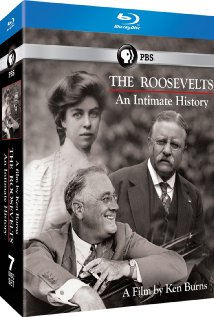
roosevelts Greetings again from the darkness. Ken Burns is renowned for his documentaries – two of my favorites are Baseball (1994) and Jazz (2001). The power he wields is measured by his ability to get 14 hours of documentary not just researched and filmed, but also broadcast via PBS. Think how many Hollywood producers can’t get the green light for a 90 minute pet project. Mr. Burns is a national treasure who creates national treasures, and his latest is some of his finest work yet.

Focusing on one of the most prominent American family – one that dominated politics and history for years – the stories are presented in chronological order, interconnecting the biographies of Theodore, Franklin and Eleanor with the key events in history that they helped shape. But it’s not all politics, as we also learn about the families and the individual make-up (flaws and all) of the 3 principals. We learn of the Republican Roosevelts of Oyster Bay and the Democrats of Hyde Park.

Mr. Burns has set the bar very high for his productions, yet somehow we still managed to be struck by the photographs, archival footage and insights of these people and the times. The sheer number of previously unseen photographs and footage is staggering. Add to that the commentary from writers and historians, and it’s easy to imagine this being the foundation for a high school or college history course … one that students would actually enjoy.

There are seven parts to the whole, each presented in chronological order:

Pt 1 Get Action 1858-1901. This segment focuses on a young, asthmatic Teddy as he overcompensates for his weakness by charging through every obstacle. We see the photo of young Teddy watching Abe Lincolns funeral procession pass 14th and Broadway. Teddy’s perpetual motion takes him to Harvard and the continued formation of his political views. His famous quote is remembered: “Not all Democrats are horse thieves, but all horse thievesn are democrats.” His way with words seemed to have no end. Teddy’s foundation seems a polar opposite to his 5th cousin Franklin, who is quite pampered as a child. The film displays the torturous February 14 when Teddy experienced the death of both his wife and mother. This segment takes us through the Rough Riders, San Juan Hill and the death of President McKinley.

Pt 2 In The Arena 1901-1910. Theodore Roosevelt takes charge as the youngest ever President and immediately begins to battle corporate greed, push for the Panama Canal, and preserve the American wilderness. We watch as FDR courts and then marries cousin Eleanor. This segment shows Teddy inviting Booker T Washington to dinner at the White House, the first African American to do so. We learn that when TR wasn’t speed-talking, he was speed-reading, taking in a book per day. He also became the first President to leave the country while in office, visiting the Panama Canal work site. At FDR’s wedding, Teddy was the one to give away Eleanor. Upon leaving office, TR takes his African trip with son Kermit.

Pt 3 The Fire of Life 1910-1919. The beginning of WWI and how TR campaigned to get the US to enter the war, while FDR was named Asst Secretary of the Navy, and served in the NY State Senate. The chasm between the Roosevelt clans – Oyster Bay vs Hyde Park – widens, as TR joins the Bull Moose Party, and is actually shot in the chest (and somehow continued giving his speech). TR took his Amazon Rainforest trip with Kermit and was stricken with malaria. It’s also in this segment that we begin to understand the most unusual relationship of FDR and Eleanor. She knew of his fondness for certain other women, and it’s in this time when the marriage transitions into a parnership. It’s also during this time that Theodore, age 60, dies in his sleep.

Pt 4 The Storm 1920-1933. The war ended, women could vote, and prohibition arrived. Woodrow Wilson had a stroke while in office, and it’s during this time that FDR is stricken with polio. We see and hear much of FDR’s struggle with the disease and how he worked to hide it, so as not to be seen as weak or limited. 1929 brought the New Deal speech and Eleanor begins her real politicking.

Pt 5 The Rising road 1933-39. The country is battling the Great Depression, and Eleanor’s actions create some controversy. FDR struggles with how best to deal with Hitler, while a quarter to one-third of the nation is unemployed. George Will’s commentary is especially effective here as he points our the two great crisis facing FDR: the depression and Hitler. The fireside chats (30 in 12 years) connect FDR to the citizenry and go far in establishing trust. It’s in this time that Eleanor’s friendship with a couple of other ladies (including Lorena Hickock) begins the questioning of her sexuality. FDR releases two huge pieces of legislation: The Wagner Act (NLRB, organized labor) and the Social Security Act. He delivers his “Ecomonmic Royalist” speech and talks about this generation’s “renedezvous with destiny“.

Pt 6 The Common Cause 1939-44. The preparation for WWII and the bombing of Pearl Harbor are discussed, but the controversy over the strategy is not really examined. FDR continues his close relationship with Missy (his secretary) and Daisy (his cousin). It’s mentioned that the right people are somehow in place during certain moments, and Churchill and FDR fit the description. Eleanor continues her work for the poor, blue collar and African Americans, while the preparation for war effectively ends the depression.

Pt 7 A Strong and Active Faith 1944-62. The plan for post-war peace is complicated by FDR’s cerebral hemorrhage, and during his record fourth term, he dies at age 63. The last hour or so really gives Eleanor her time in the spotlight and she works for Civil Rights, the UN, and against Joseph McCarthy (“our Gestapo”). We see her become the grand lady of the Democratic Party, and even meet with newly elected John Kennedy, though she did not support him. It took death at age 78 to slow her down.

The insight into the obstacles all 3 Roosevelts overcame is fasincating. We hear recordings of each, and the voice acting fills the gaps – Meryl Streep as Eleanor, Edward Herrmann as FDR, and Paul Giamatti as TR. Peter Coyote does a nice job throughout as the narrator, and numerous other actors are utilized through the production, including the final screen appearance of Eli Wallach. This is an incredible documentary covering some giants of US politics and some of the most historical events.

**NOTE: there are also photos and video of FDR’s speech at Ebbets Field, where he cracks about being a Dodgers fan, but never having attended a game there.

watch a PBS promo:


AUGUST: OSAGE COUNTY (2013)

January 12, 2014

august Greetings again from the darkness. Tracy Letts had a very nice year in 2008. He won the Pulitzer Prize and a Tony for writing the play August: Osage County. Since then, he has also written the play and screenplay for Killer Joe, and been seen as an actor in the key role of a Senator in the TV show “Homeland“. This time out, he adapts his own play for director John Wells’ (The Company Men, TV’s “ER“) screen version of August: Osage County.

With an ensemble cast matched by very few movies over the years, the screen version begins with what may be its best scene. Weston family patriarch and published poet Beverly (the always great Sam Shepard) is interviewing Johnna for a position as cook and housekeeper when they are interrupted in stunning fashion by Violet (Meryl Streep), Beverly’s acid-tongued wife who is showing the effects of chemotherapy and her prescription drug addiction. This extraordinary pre-credits scene sets the stage for the entire movie, which unfortunately only approaches this high standard a couple more times.

Despite the film’s flaws, there is no denying the “train-wreck” effect of not being able to look away from this most dysfunctional family. Most of this is due to the screen presence of a steady stream of talented actors: in addition to Streep and Shephard, we get their 3 daughters played by Julia Roberts (Barbara), Julianne Nicholson (Ivy) and Juliette Lewis (Karen); Ewan McGregor and Abigail Breslin as Roberts’ husband and daughter; Margo Martindale (Violet’s sister), her husband Chris Cooper (Charles) and their son Benedict Cumberbatch.

As with most dysfunctional family movies, there is a dinner table scene … this one occurring after a funeral. The resentment and regret and anger on display over casseroles is staggering, especially the incisive and “truth-telling” Violet comments and the defensive replies from Barbara. As time goes on, family secrets and stories unfold culminating in a whopper near the end. This is really the polar opposite of a family support system. Unlike many movies, getting to know these people doesn’t make us like them any more.

Meryl Streep’s performance is one of the most demonstrative of her career. Some may call it over the top, but I believe it’s essential to the tone of the movie and the family interactions. Her exchanges with Julia Roberts define the monster mother and daughter in her image theme. They don’t nitpick each other, it’s more like inflicting gaping wounds. Surprisingly, Roberts mostly holds her own … though that could be that the film borders on campy much of the time. Streep’s scene comes as she recalls the most horrific childhood Christmas story you could ever want to hear.

It must be noted that Margo Martindale is the real highlight here. She has two extraordinary scenes … each very different in style and substance … and she nails them both. Without her character and talent, this film could have spun off into a major mess. The same could be said for Chris Cooper, who is really the moral center of the family. While the others seem intent on hiding from their past, he seems to make the best of his situation.

The film never really captures the conflicting environments of the claustrophobic old Weston homestead and the free wide open plains of Oklahoma. The exception is a pretty cool post-funeral scene in a hayfield where Roberts tells Streep “There’s no place to go“. The main difference between the film version and stage version is the compressed time and the decision to include all explosive scenes. There is just little breathing room here. Still, it’s one of the more entertaining and wildly dysfunctional comedy-dramas that you will see on screen, and it’s quite obvious this group of fine actors thoroughly enjoyed the ensemble experience.

SEE THIS MOVIE IF:  you want to sit back and watch family members go at each other with much more verocity than anything at your own family events OR you just want to see some of the best actors working today (Streep, Martindale, Cooper, Cumberbatch)

SKIP THIS MOVIE IF: you can’t imagine sitting through a dysfunctional family dinner so soon after your own holiday family time.

watch the trailer:

http://www.youtube.com/watch?v=4VBEZrkCT8Q


HOPE SRINGS (2012)

August 17, 2012

 Greetings again from the darkness. I often give extra credit to filmmakers for trying something challenging and different, even if the final product might fall a bit short. What I refuse to do is ignore the opposite … a lazy attempt by a filmmaker who thinks they can skate by simply because they picked a interesting topic. Director David Frankel (The Devil Wears Prada) takes the screenplay from Vanessa Taylor and then seems to sit back and bank on the strength of three lead actors to make a statement.

Meryl Streep is the greatest living actress and maybe the greatest of all-time. She can turn any character into a subject of interest and doesn’t disappoint here as Kay, the disenchanted wife of Arnold, played by Tommy Lee Jones (himself an excellent actor). In an effort to save a marriage gone stale after 31 years, she books a week of intensive marriage counseling with Dr. Bernie Feld (Steve Carell). Grumpy Arnold reluctantly agrees to attend despite his belief that all is “fine” with their marriage for the singular reason that it’s lasted 31 years.  Besides that, he has golf to watch on TV … well, “watch” with his eyes closed.

What follows is not the laugh-fest promised by the trailer, but rather a semi-serious look at marriage for the over-60 generation. I say semi-serious because intense and thoughtful topics are raised, but the film continually makes U-Turns at each fork in the road so as to avoid coming up with any real solution or digging deeper into cause/effect. Instead, some prime opportunity is wasted for this to be either a riotous look at marital frustration or an intriguing dive into what makes men and women of this generation unable to communicate.

My contention is that just because this is a movie about marriage for 60-somethings, we shouldn’t give the filmmakers a gold star for effort. The great John Wooden said, “Never mistake effort for results“. There are some humorous moments … some laugh out-loud moments, but not very many. There are some serious topics broached, but only by skimming the surface. Mostly, the scenes are obvious and predictable and Streep and Jones carry the burden of lifting the material.  As a movie lover, I demand more.

 The three leads are excellent. Mr. Carell does a nice job of playing the understated counselor role. He is smart enough to know that this film belongs to Streep and Jones. There is also minor support work from Ben Rappaport, Marin Ireland, Mimi Rogers and Elisabeth Shue. All of these characters seem tossed in for variety only. None really drive the story. though it seems either one more or one less scene with with Shue in the bar would have made sense. The first 20 minutes of the film has three songs that just overpower the scenes.  I guess this is to ensure that every viewer recognizes the mood of the characters.  It’s as if the director recognized the material was lightweight.

I have labeled this genre Gray Cinema, and have previously stated that I expect we are on the front end of this trend as baby boomers demand more movies about themselves. The trend is commendable, but again I say, we should demand more and better.  Showing up is half the battle … now let’s see the other half.

SEE THIS MOVIE IF: you enjoy watching the great Meryl Streep brilliantly craft another of her cinematic characters

SKIP THIS MOVIE IF: you find the raising of issues to be a starting point, not a finish line for a story

watch the trailer:


TMI (3-1-12)

March 1, 2012

TMI (Today’s Movie Info)

OSCAR TRIVIA

 MERYL STREEP, with her record 17th nomination, earned a third acting Oscar this year.  Only Jack Nicholson, Ingrid Bergman, and Walter Brennan won as many acting Oscars, and only Katharine Hepburn won more, with four. At 62, Streep becomes the fourth oldest person to win in this category, behind only 80-year-old Jessica Tandy (Driving Miss Daisy, 1989), 74-year-old Hepburn (On Golden Pond, 1981), and 63-year-old Marie Dressler (Min and Bill, 1930).

4 – Katharine Hepburn (Morning Glory 1933, Guess Who’s Coming to Dinner 1967, The Lion in Winter 1968, On Golden Pond 1981)

3 – Meryl Streep (Kramer vs Kramer 1979, Sophie’s Choice 1982, The Iron Lady 2011)

3 – Ingrid Bergman (Gaslight 1944, Anastasia 1956, Murder on the Orient Express 1974)

3 – Walter Brennan (Come and Get it 1936, Kentucky 1939, The Westerner 1940)

3 – Jack Nicholson (One Flew Over the Cuckoo’s Nest 1975, Terms of Endearment 1983, As Good as it Gets 1997)


THE IRON LADY

January 15, 2012

 Greetings again from the darkness. So many are up in arms about what this movie isn’t, that they have lost sight of what it is. If you are expecting a political drama and biography detailing the finer points of one of the most impactful and controversial world leaders in history, you will undoubtedly be disappointed. If instead, you accept this as a creative way to tell a story and glimpse at a once powerful person struggling with her place in history, while simultaneously fighting the daily battle against Alzheimer’s, then you too will be satisfied with more than the towering performance of Meryl Streep as Margaret Thatcher.

Lady Thatcher is one of most controversial political figures in modern history. Pundits fall to pro or con in regards to her 3 terms (11 years) as British Prime Minister. Writer Abi Morgan (Shame) and director Phyllida Lloyd (Mamma Mia) don’t take a side in the argument. Instead they offer us the viewpoint of an elderly Lady Thatcher struggling to avoid “going mad”. Her daily battle includes numerous flashbacks to specific moments and events. Through these episodes, we take a quick trip through history … almost a Cliff’s Notes version. Additionally, we witness how she regularly “sees” and speaks with her husband Denis (Jim Broadbent). Yes, he died years ago. It seems she realizes this, but enjoys the comfort of having him nearby.

During the flashbacks, we get a feel for her early onset political ambition, which evidently came from her dad the grocer (and small town politician). He encouraged her to work hard, be different and think for herself, while never backing down from her beliefs. This seems hard-wired into her personality through the years as she fights the male establishment and climbs the “greasy pole” of British parliament.

The brief segments on the Falkland Islands, Parliamentary debates, and tough Labor Union stance will probably leave you wanting more details on how she negotiated her way through some very unpopular decisions. The best suggestion is to read some of the endless stream of documentation in print regarding her time in office. But don’t let that distract you from an unusual and interesting film. Plus, you certainly want to catch another world-class performance from, whom I consider, the greatest actress in film history.

SEE THIS MOVIE IF: you want to see an accurate and insightful personal look at a once powerful world leader who is stuggling with Dementia/Alzheimers and her place in history OR you want to see yet another stunning performance from the great Meryl Streep

SKIP THIS MOVIE IF: you are looking for a documentary style historical biography on Margaret Thatcher

watch the trailer:


TMI (1-13-12)

January 13, 2012

TMI (Today’s Movie Info)

 MERYL STREEP has been nominated for a record 16 Academy  Awards for acting.  She has two wins: Best Supporting Actress for Kramer vs. Kramer (1979) and Best Actress for Sophie’s Choice (1982).  Katherine Hepburn, who was not a fan of Meryl, had 12 nominations (4 wins) and Bette Davis, who was a huge fan of Meryl, had 10 nominations.
 
Ms. Streep graduated from Vassar and studied at Yale School of Drama.  She is now 62 years old and has been married to sculptor Don Gummer for 33 years.  Three of their four kids are actors.
 
Streep’s first feature film role was with Jane Fonda and Vanessa Redgrave in Julia (1977) and her first Oscar nomination came the following year for The Deer Hunter (1978).
 
She often plays real life characters such as: Julia Child, Ethel Rosenberg, Karen Silkwood, Karen Blixen, Roberta Guasppari, Lindy Chamberlain and Susan Orlean.  Once again, she is one of the leading contenders this year for another Oscar nomination for her performance as Margaret Thatcher in The Iron Lady (2011)
 
Streep studied opera as a teenager and is a very talented singer
 
Her next film is Great Hope Springs, a ComDram where she and Tommy Lee Jones co-star as a married couple in counseling.  Their counselor?  Steve Carell.  The expected release date: December 12, 2012
 
And yes, I’m a proud “Streeper”!

IT’S COMPLICATED (2009)

January 3, 2010

 (1-1-10) Greetings again from the darkness. Making Romantic Comedies that women love and men can tolerate is very difficult. Writer/director Nancy Myers has become the most successful female director in Hollywood for this genre. Unfortunately her films’ appeal always lean toward the female perspective and rank high on the cringe factor for men. Examples include Something’s Gotta Give, The Holiday and What Women Want. Compare this work to that of Nora Ephron’s When Harry Met Sally, You’ve Got Mail and, Julie and Julia. Actually there is little comparison. Ephron understands how adults think and Myers is focused on women’s fantasies.

Still, Myers has tapped into the female psyche and delivers what they want. Here the great and beautiful and highly successful Meryl Streep is pursued and coveted by both Alec Baldwin and Steve Martin. Oh yeah, Baldwin is a successful lawyer and Martin a successful architect. Wouldn’t quite fulfill the fantasy if one of the pursuers worked at a bowling alley, eh?

Comedy ensues when adultery, lying and alcohol and drugs become involved. Nothing funnier than the topics that destroy people’s lives. I tend to give viewers a bit more credit. Most already understand that people don’t shrivel up when they get divorced or turn 55. Life goes on and continues to blossom, if you work at it – just like when you are 25.

On the bright side, Streep and Baldwin are very good in their roles. There are some very well written scenes and Streep is such a master that she makes EVERY one of her scenes a bit better than it otherwise would be. Steve Martin is given little to do other than a stupid skit in the car with a self-help disc on getting over a divorce (2 years later) and a failed bit with web cam where Streep helps him clean out his wardrobe.

Supporting work from John Krasinski (The Office), Lake Bell and an over the top Rita Wilson add the elements you would expect. There is even an homage paid to The Graduate – possibly an admission by Ms. Myers that her movie on adultery is far less than the gold standard.