ONE BATTLE AFTER ANOTHER (2025)

September 25, 2025

Greetings again from the darkness. My immediate reaction after viewing this film was that it represented the highest level of filmmaking – including superb acting, a complex story that fits today’s narrative, and the most varied and diverse score I can recall from many years of moviegoing. After a couple of days to mull it over, I believe it’s possible that my initial reaction somehow underrated this instant classic. High praise should be no surprise since the film is the work of writer-director Paul Thomas Anderson – the man behind such cinematic gems as LICORICE PIZZA (2021), PHANTOM THREAD (2017), THE MASTER (2012), THERE WILL BE BLOOD (2007), PUNCH DRUNK LOVE (2002), MAGNOLIA (1999), BOOGIE NIGHTS (1997), and HARD EIGHT (1996).

Anderson has been nominated for eleven Oscars over the years, and here he adapts the 1990 Thomas Pynchon novel “Vineland”. While the novel is set in the 1980’s, Anderson structures his film in such a manner that much post-viewing conversation will focus on its synchronicity to our current political landscape/battlefield. Remarkably, Anderson has delivered a film that features stunning action sequences, cutting political satire, and touching personal drama. It’s almost too much to ask of any one movie, and is very likely a bit too much for some movie goers.

As the film opens, a resistance movement called French 75, led by Perfidia Beverly Hills (powerhouse Teyana Taylor) is doing their thing with help from explosives expert Pat (Leonardo DiCaprio). With the excitement of fulfilling their mission, Perfida and Pat fall for each other – a shared cause can do that. Mucking up the movement and the relationship (unbeknownst to Pat) is a militant with the memorable name of Colonel Steven Lockjaw (Sean Penn). Lockjaw is laser-focused on stopping the resistance – in fact, the only thing that can stop him is a creepy attraction to Perfida, who uses his weakness to her advantage.

A jaw-dropping visual occurs as we see a (very) pregnant Perfida firing an automatic weapon during target practice. Soon after the baby is born, Perfida (not the mothering type) takes off, and Pat, now underground and known as Bob Ferguson, is left to raise the child. Flash forward 16 years, and teenage Willa (the terrific movie debut of Chase Infiniti) and her father are living a quiet life. She’s a tough, but normal high schooler with friends, while he has dulled his mind and outlook with drugs and alcohol … unable to remember the secret password when Colonel Lockjaw tracks him down. French 75 loyalist Deandra (Regina Hall) finds a safe house for Willa, as Bob frantically bounds around town until Willa’s Sensei (Benecio Del Toro) offers to help him. This sensei also hides his own secrets, as Del Toro sprinkles in his patented one-liners.

There is so much going on here, and I’m only now getting to the Christmas Adventurers Club – a clandestine group of white supremacists motivated by racism and lust for power and purity. It’s a club Col Lockjaw desperately wants to be admitted to. In fact, racism hovers over much of the film, with the resistance attempting to defy it through radicalism and extremism … although which side is the most radical or extreme could (and has) carried debates for quite a while.

Three Oscar winning actors are featured here: DiCaprio, Penn, and Del Toro. All three are excellent, but it’s Sean Penn’s Lockjaw that will likely stick with you. Delving into caricature at times, Penn employs many stereotypes, a distinct strut, and a few facial ticks to go with his one weakness in creating a character that we can’t help but laugh at, while also being a bit frightened of his persona. DiCaprio’s Pat/Bob runs the gamut from revolutionary to a Lebowski-type fleeing in his ratty bathrobe. His look varies throughout with varying hairstyles and wardrobes. His father-daughter relationship is truly the heart of the film, and is exceptional drama.

The supporting cast is excellent and includes Alana Haim, Shayna McHayle, Tony Goldwyn, Kevin Tighe, DW Moffett, John Hoogenakker, and Jena Malone … many familiar faces and a great deal of talent. Cinematographer Michael Bauman (back with Anderson after LICORICE PIZZA) delivers the action sequences, the dramatic moments, and a couple of car chases … one which will live on in infamy. Filmed in VistaVision (I saw it in IMAX), there is a mesmerizing car chase through and over and down a hilly desert highway. It’s unlike any car chase I’ve seen, and had me leaning forward in my seat trying to get a look ahead.

This is a story that covers quite a few years and just about as many topics as you’d like to associate with it. There is a nod to THE BATTLE OF ALGIERS (1966), which was another film about the fight for freedom. One note that I’m unsure how to address is the score from frequent Anderson collaborator Jonny Greenwood (Radiohead guitarist). It’s simply fantastic the way Greenwood melds diverse music with the numerous shifts in tone of the characters and story. As for filmmaker Paul Thomas Anderson, it’s subjective as to whether he has outdone his previous stellar work, yet I can confidently label this one as both bleak and funny, while also thrilling, chilling, and timely.

Opens in theaters on September 26, 2025

WATCH THE TRAILER


KILLERS OF THE FLOWER MOON (2023)

October 18, 2023

Greetings again from the darkness. Read the book and see the movie. The order doesn’t much matter, as David Grann’s best-selling non-fiction novel is an incredibly emotional read, while Martin Scorsese’s film is an example of elevated filmmaking. Of course, it’s understandable if a book detailing a repulsive historic travesty is not your cup of tea, or if a three-and-a-half-hour movie on the same subject holds no appeal for you. However, if you are up for the challenge, both are extraordinary works of art, though surprisingly, quite different experiences.

Oscar winner Scorsese worked on the script adapting Grann’s novel with Oscar winning screenwriter Eric Roth (FORREST GUMP, 1994), and Scorsese has stated Leonardo DiCaprio encouraged some changes in perspective. Scorsese also spent a great deal of time with Osage folks making sure to gain insight on how to properly tell their story with all due sensitivity and respect. And what a story it is. While reading Grann’s book, I remained in a state of disbelief that this tragic story from the 1920’s was not common knowledge. In contrast, I felt the telling of this story in the movie, softened the edges just a bit.

Oscar winner DiCaprio stars as Ernest Burkhart, a man returning to town after serving in WWI. Ernest is a simple man, and DiCaprio plays him with a SLING BLADE jaw line and a constant state of being a half-step behind goings on. He’s not a total sap, but close enough that he can be manipulated. This is especially true when it comes to his rancher Uncle William King Hale played by two-time Oscar winner Robert DeNiro. The two men are related but seemingly share no other characteristics. “King” is a master schemer who has spent decades cultivating a relationship and image with the Osage, only to secretly take advantage of their trust at every opportunity. Ernest is a self-described lazy man who ‘loves money’, though he has little interest in earning it the hard way.

There are multiple relationships that are crucial to follow closely. Ernest and his Uncle, Ernest and his Osage wife Mollie (a brilliant Lily Gladstone), Hale and the Osage, Federal investigator Tom White (Jesse Plemons) and everyone to whom he speaks, and then the network of interactions between Ernest and the locals. The long roster of characters jumps in numbers again during the final act, which offers a courtroom drama and interrogations that deliver the conclusion. It’s the first act where Scorsese portrays the dramatic shift from the “old” Osage culture to their staggering newfound wealth. Of course, at the core of all of this is the despicable scheme used by Hale in a heartless strategy to steal the wealth. For those who haven’t yet read the book, it’s best if no more of the story is known prior to seeing the movie. One thing that can be disclosed is that this true story proves the exception to “them with the gold make the rules.” This was also the first case of the newly formed FBI under J Edgar Hoover.

As always, Scorsese has assembled a deep supporting cast to complement the stellar leads. A few of those playing key roles include Tantoo Cardinal, Gene Jones (the coin flip clerk in NO COUNTRY FOR OLD MEN), John Lithgow, Oscar winner Brendan Fraser, Cara Jade Myers, Jason Isbell, Jillian Dion, Scott Shepherd, William Belleau, Sturgill Simpson, Ty Mitchell, Tommy Schultz, (personal favorite) Barry Corbin, Pete Yorn, and Jack White. With apologies to Jesse Plemons who is solid as Tom White, it’s the three leads who captivate us. DiCaprio turns in what is likely his best ever performance, while DeNiro eerily captures the sneaky and devastating evil of Hale (and we get a nod to his Al Capone role from 36 years ago). What can we say about Lily Gladstone? She was a standout in CERTAIN WOMEN (2016), and here she is the heart and soul of the story (though DiCaprio’s Ernest gets much more screen time). Her expressive eyes convey so much, even when she speaks no words.

In addition to the talented cast, Scorsese’s technical group is just as outstanding. Cinematographer Rodrigo Prieto (BROKEBACK MOUNTAIN, 2005) perfectly balances the vastness of the setting with the intimate moments. Production Designer Jack Fisk (THERE WILL BE BLOOD, 2007) delivers the look and feel of the times, while three-time Oscar winner Thelma Schoonmaker works her magic as an Editor to create a manageable flow of this epic. The film’s score, expertly tied to the story’s measured pacing, comes from Robbie Robertson (longtime leader of The Band), who passed away soon after. There is a Scorsese cameo, and I left the theater thinking how usual it is to find a movie so ambitious in scale, yet so intimate and searing in its personal moments. Some may find the larger story a bit difficult to grasp, and that’s likely due to our humanity and desire to believe in the non-existence of this level of evil.

Opens in theaters nationally on October 20, 2023

WATCH THE TRAILER


DON’T LOOK UP (2021)

December 9, 2021

Greetings again from the darkness. What happens if Chicken Little was right, and the sky really is falling? Writer-director, and Oscar winner, Adam McKay proved with THE BIG SHORT (2015) and VICE (2018) what occurs when he turns his unique commentary towards a target. Two questions remain. Is political or social satire just too easy these days? Has insanity permeated our globe to the degree that pointing out the lunacy has become ho-hum? McKay wrote the script from journalist David Sirota’s story, and it’s even more extreme than his previous work, and likely meant as a wake-up call to all of us.
Oscar winner Jennifer Lawrence stars as Kate Dibiasky, a student (with a Carl Sagan figurine on her desk) who discovers a large comet speeding towards earth. Oscar winner Leonardo DiCaprio stars as her professor, Dr. Randall Mindy, and we can see on his face what his calculations mean. The two head to Washington DC to inform the President of their findings. President Orlean (a nod for movie buffs) is played by Oscar winner Meryl Streep, and her Chief of Staff is Jonah Hill, who also happens to be her son. President Orlean is too concerned about her slipping rating in popularity polls to pay much heed to the scientists, opening the way for Jonah Hill to be the most Jonah Hill he’s ever been. It’s an outrageous scene … yet … it feels all too possible.

Dibiasky and Mindy are so shocked and frustrated at the blow-off, they decide to take the story to the media. Appearing on the vacuous and highly-rated morning talk show, “The Rip”, they are guided to “Keep it light. Keep it fun” while on the air with the entirely too-upbeat co-hosts played by Cate Blanchett and Tyler Perry. At this point, Dibiasky is unable to control her frustration. This results in her becoming a social media meme, while Dr. Mindy becomes the “hot” astronomer – labeled an AILF. This is an obvious take on Dr. Fauci’s popularity during the pandemic. Other opportunities for Mindy includes getting closer with Blanchett’s talk show host, despite his wife (Melanie Lynskey) taking care of the home front.

Obviously most of these characters are a bit cartoonish, but that’s the point. Once the media pressures the President into taking action, an ARMAGEDDON type mission is planned, only to be scratched at the last moment and replaced by a more profitable option. Peter Isherwell (Oscar winner Mark Rylance as a blend of Steve Jobs and Elon Musk) is a tech billionaire and President Orlean supporter, and his plan involves mining the meteor for precious metals while also saving the planet.

Although Dibiasky has dropped out of the ‘spread the word’ campaign, she’s still tracking the approaching asteroid via her diet app as she hangs with a philosophical stoner played by Timothy Chalamet. It started as 6 months and 14 days, and we only get periodic updates on how much time remains. Instead, the focus is on the bumbling antics of those involved and the zany reactions of the general public. We even get President Orlean with a speech from the deck of a battleship in yet another dig at past politicians. Pop star Arianna Grande shifts her celebrity support from manatees to a hit duet with Kid Cudi entitled “Just Look Up”, while Himesh Patel plays an opportunistic reporter-boyfriend. Also, Rob Morgan is excellent in his role as supportive scientist Dr. Oglethorpe, and Ron Perelman goes a bit off the rails as the pilot on the first mission.

It’s an incredible cast and what a joy to see DiCaprio in a role so far removed from his usual characters. He even gets a NETWORK scene here, and overall he makes us understand how serious the science is, and how easily someone can go off track. Jennifer Lawrence gets the film’s best recurring gag, while Jonah Hill fits right in as the impetuous benefactor of nepotism. With the abundance of tooth veneers flashed by a multitude of characters, we can assume the film’s dental budget was sky high.

McKay uses the oncoming meteor as a stand-in for the global warming issue, and his tendency to lean heavily left does shine through. However, it’s crucial to note that no one, no thing, no organization, and no affiliation is safe during this one. Whereas ARMAGEDDON took pride and patriotism of blue collar folks and turned them into heroes, McKay examines the other side which is all about feelings, discussions, social media, and popularity. He blends Kubrick’s DR STRANGELOVE with Judge’s IDIOCRACY (which has proven much too accurate), and delivers a disaster movie that uses an asteroid to point out the real danger … which is ourselves. Is it too much? Too silly? Too angry? Too long? Simply playing to the home crowd? It’s likely to be criticized for not being smart enough or clever enough, but seriously, have you looked around at society lately? McKay delivers loads of comedy here, and maybe by laughing at ourselves, we can find a way to improve things. His final scene is more grounded than the rest of the film, and quite touching on its own. Stay tuned for the credit scenes.

Opening in theaters on December 10, 2021 and streaming on Netflix beginning December 24, 2021

WATCH THE TRAILER


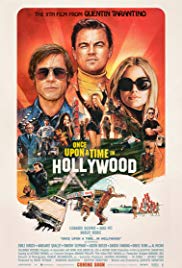
ONCE UPON A TIME … IN HOLLYWOOD (2019)

July 25, 2019

 Greetings again from the darkness. Hippies, westerns, short skirts, pompadours, catchy pop songs … all have (mostly) disappeared from our world. Back to save the day and the memories, and twist a little history, is Quentin Tarantino, the ultimate film geek. His latest reminds us of a bygone era of movie stars and old school filmmaking … a once beloved industry which has been described as being on life support. There have been plenty of big screen love letters to Hollywood, but few if any, were filmed with so many personal touches and call-backs to the director’s own films.

In keeping with the request from Mr. Tarantino, this review will not include any spoilers or details that might negatively impact anyone’s initial viewing of the film. It’s a reasonable request since the film is so unique and literally packed with nostalgia, sight gags, and historical bits and pieces – some accurate, some not so much. There is a lot to take in and process, and the full impact of the initial viewing might result in awe, shock or disgust … and maybe even all of the above. So this will be a pretty simple overview peppered with some insight that should enhance rather than spoil the experience.

The film covers about 6 months in 1969, but in reality, it all takes place (at least what we see on screen) in 3 days. Leonardo DiCaprio (possibly his best ever performance) plays Rick Dalton, an actor who had a hit (fictional) TV western series in the 50’s and 60’s entitled “Bounty Law”. Since the show ended, Rick has been unable to make the successful transition to movies. For comparison, think of Clint Eastwood, Steve McQueen and Burt Reynolds – all actors in TV westerns who found greater career success in movies. Brad Pitt (the epitome of cool) stars as Cliff Booth, Rick’s stunt double, friend, driver, handyman, etc. While Rick is desperate to find the next stage of his career and fend off being forgotten, Cliff, a Vietnam vet, is accepting of his lot in life. Rick lives in a swanky Hollywood Hills home next door to hotshot director Roman Polanski and his starlet wife Sharon Tate; and Cliff lives in a trailer behind the Van Nuys Drive-In with his well-trained Pit Bull Brandy.

There are multiple parallel stories to follow, and a key one involves the aforementioned Sharon Tate. Margot Robbie nails the role and bounces about town with the energy and sweet aura that we imagine she possessed. All 3 of the lead actors – DiCaprio, Pitt, Robbie – have knockout scenes that I’d love to be able to discuss, but I’m not sure how without giving away too much. What I can say is that each of these three talented actors prove that movie stars still exist.

This is Tarantino’s 9th film as a director (he counts the 2-part KILL BILL as one film), and he claims he will stop making films after number 10. There are multiple features we can count on in a QT film, and a ridiculously deep supporting cast is one. Going through each of the characters played by actors you will recognize would take a page and a half, so I’ll cover only a few here. Margaret Qualley is a scene stealer as Pussycat, one of the Manson family girls. You likely remember her from the recent “Fosse/Verdon” or “The Leftovers”, and here she fully embraces the hippie look and spirit. Emile Hirsch plays hairdresser Jay Sebring, one of those in the house with Ms. Tate on that fateful night, and Mike Moh plays Bruce Lee so convincingly that I was momentarily confused when he took off his sunglasses. Also making appearances are some Tarantino regulars: Kurt Russell (as a stunt coordinator and narrator), Michael Madsen (as an actor), and Bruce Dern as George Spahn (a late replacement after Burt Reynolds passed away). Others of note include Maya Hawke (Uma Thurman’s daughter), Austin Butler (recently cast in the title role of Baz Luhrmann’s Elvis biopic) as Tex Watson, Rumer Willis (Bruce’s daughter) as actress Joanna Pettet, Damian Lewis as Steve McQueen, Al Pacino as agent Marvin Schwarzs, Dakota Fanning as Squeaky Fromme, and the late Luke Perry as actor Wayne Maunder (“Lancer”). 90 year old Clu Gulager (“The Virginian”, THE LAST PICTURE SHOW) makes an appearance, and Nicholas Hammond (Friedrich from THE SOUND OF MUSIC) tears into his role with gusto as director Sam Wanamaker. There is even a TV Guide cover featuring the late great character actor Andrew Duggan (“Lancer”). Some of these, and many more, are like cameos, but it’s still fascinating to see the faces.

1969 was 50 years ago, and Tarantino does a remarkable job of recreating the look of Sunset Boulevard, Hollywood Boulevard, Cielo Drive, and studio backlots. Much credit goes to Production Designer Barbara Ling and Set Decorator Nancy Haigh (frequent Coen Brothers collaborator and an Oscar winner for BUGSY). Arianne Phillips does a tremendous job with the costumes that look natural for the time period, and not like something right off the wardrobe racks. Three-time Oscar winning Cinematographer Robert Richardson (HUGO, THE AVIATOR, JFK) is back for his 6th Tarantino film, and he captures the look and feel and vibe of a time that is so personal to the director.

It’s been three and a half years since THE HATEFUL EIGHT, Tarantino’s most recent film, and probably his worst received. This one is clearly personal as it captures the time and place that he fell in love with movies. The dichotomy of rising starlet and fading cowboy as neighbors is a brilliant way to make a point about times changing. This was a time of transition in the United States – a new culture was upon us, and whatever innocence remained, was surely snuffed out on a hot August night in 1969. As usual, his use of music serves a purpose. We are treated to Roy Head, The Royal Guardsmen, and Paul Revere and the Raiders, among others. QT also shows us plenty of bare feet (another trademark). What is unusual is that the film lacks the trademark mass dialogue. This one kind of meanders … right up until it doesn’t.

Quentin Tarantino is a living, breathing film geek (that’s a compliment) who has earned the right to make the movies he wants to make. This one took him a lifetime to live, 5 years to write, and it will take you 161 minutes to watch. It was warmly received at Cannes, but no one can expect to “catch” everything Mr. Tarantino has served up in one viewing. That said, one viewing will likely be one too many for quite a few folks (especially many under 40 who have no recollection of this Hollywood). Some will categorize this as an overindulgent nostalgia trip for movie nerds. And they are likely correct. But for those of us who complain that too many movies are remakes, re-treads and comic books, there is no denying Tarantino delivers a unique and creative viewing experience – and it’s not meant for everyone.

watch the trailer:


BEFORE THE FLOOD (2016, doc)

October 23, 2016

before-the-flood Greetings again from the darkness. Ten years ago Al Gore became a climate-change icon thanks to the Oscar-winning documentary An Convenient Truth (from director Davis Guggenheim). With this updated warning, the climate change crown is passed to Leonardo DiCaprio, and rather than just speak to the topic, he takes us on a worldwide journey to show us the effects.

The film is bookended by DiCaprio’s speech to the UN general assembly after he was named UN Messenger of Peace on Climate Change. It’s a reminder that the mega movie star has long been an environmental activist … and yes, before you scoff, he does acknowledge that his carbon footprint is probably larger than ours (an obvious understatement – unless you also travel by yacht and private jets, and own multiple mansions).

DiCaprio’s personal story about Bosch’s “The Garden of Earthly Delights” hanging above his crib (seriously, how many parents think this is acceptable artwork for a toddler?) acts as a visual to his message that we are on the path of virtual destruction to the earth that we now know.

The power of celebrity in on full display as DiCaprio scores interviews with such luminaries as UN Secretary General Ban Ki-moon, President Obama, Elon Musk, John Kerry, and even Pope Francis. There is also a clip of his long-ago interview with then President Clinton (Bill, not Hillary). However, it’s not the talking heads that have the most impact here. Rather, it’s the first-hand look at the Canadian Arctic, the disappearing glaciers of Greenland, the sunny day street flooding in Miami, the destruction of Indonesian Rain Forest to capitalize on the palm oil market, and the eroding coral reefs. The film plays like a Tim Burton Travel Channel series … each stop more nightmarish than the previous.

His passion is obvious, though his knowledge less so. DiCaprio understands the power his celebrity brings, and he joins with director Fisher Stevens (known mostly for his acting, but also an Oscar winning director for The Cove, 2009) in this attempt to bring the urgent message to the masses. As they state, we are beyond simply changing lightbulbs, and the key is a shift from fossil fuels to renewable energy … a shift that China (not the U.S.) has taken seriously.

With generic solutions like “consume less” and “vote better”, the film mostly avoids controversy … though it does acknowledge the slick and well-funded ‘campaign of denial’ by those who profit mightily from a fossil-fuel dependent world. We see an impressive map/video screen tracking ocean currents, temperatures, etc. and there is a chart comparing electricity usage by U.S. citizens vs other countries (we are energy hogs, in case you weren’t sure). The ending message hasn’t changed much in the past 10 years … “It is all up to us”.

watch the trailer:


THE REVENANT (2015)

December 28, 2015

the revenant Greetings again from the darkness. “Keep breathing.” A flashback in the opening sequence has Hugh Glass whispering the phrase as advice to his young son Hawk, the product of Glass and his beloved Pawnee bride. The phrase has a recurring role throughout the film … possibly serving as a courtesy reminder from director Alejandro Gonzalez Inarritu to the moviegoers mesmerized (and nearly traumatized) by the incredible brutality of what is on screen.

It’s a master class in filmmaking by those at the top of their game. Inarritu is the reigning Oscar winning director for Birdman or (The Unexpected Virtue of Ignorance), and he has re-teamed with the reigning Oscar winning cinematographer from that movie, Emmanuel Lubezki. Two of the finest actors of their generation, Leonardo DiCaprio and Tom Hardy, strip away any semblance of pampered movie stardom to deliver ultra-realistic performances in a story “based in part” on the true to life novel by Michael Punke.

An early action sequence is startling in its ferocity as Arikara surround and attack a group of hunters and trappers, and the whoosh of arrows – many of which find their mark – abruptly drag us into a world that we are unfamiliar with and certainly unprepared for. It’s early 19th century U.S. frontier, and just about everyone and everything can kill you.  Providing just enough time for us to pry our fingers off the armrests, Inarritu stuns us with what is undoubtedly the most fantastic grizzly bear attack on a movie star ever filmed. In what appears to be a single take (which also happens to be the number of breaths I took), Mama Grizzly treats Leonardo the way a young puppy treats its first chew toy.  Scratched, chewed, tossed and stomped.  This scene is savage and brutal, and sets the stage for the true, yet still unbelievable odyssey of survival by frontiersman Hugh Glass.

Tom Hardy excels as the calmly psychotic villain Fitzgerald, though some of his early hillbilly-tinged dialogue is difficult to catch. His hulking presence fits with our imagined look of the frontiersman of the era … tough and unforgiving nearly beyond belief. His bullying of youngster Jim Bridger (played by Will Poulter) and power struggles with Captain Henry (Domhnall Gleeson) are at frightening levels of intensity. Fans of Tarantino’s Inglourious Basterds will smile as they recognize the name of mountain man Jim Bridger … though that’s one of the few smiles offered by this 156 minute gut-wrenching ordeal. It would not be surprising if DiCaprio’s mantel sports an Oscar in a few months. He is that superb in a role that has nothing to do with good looks or charm.

A tale of survival. A quest for revenge.  It’s both of those, as well as a reminder that nature can be both beautiful and brutal. Some of the photography is almost poetic, and often reminds of the work of director Terrence Malick.  And in the blink of an eye, that moment is shattered by the torrential force of river rapids carrying Glass over the waterfall, or his taking a horseback ride off a steep cliff (one of the most dramatic shots of the film). The journey of Glass is unknown in distance or time in the movie, but there is no question as to the numerous struggles with the elements and the raw physicality required to persevere. If you can avoid diverting your eyes, there are visuals here that will be sincerely appreciated – even as you squirm, cringe and moan throughout.

From a technical standpoint, the film was shot on location in Canada and Argentina using only natural lighting, and emphasizing aspects of nature that often are overlooked. The sound of arrows, bears, and even DiCaprio’s breathing are profound and crucial to the overall effect, as are the animal skin garments and other costumes. It’s impossible to tell where CGI meets reality, but the visceral experience will be quite unique for most viewers … and not soon forgotten.

watch the trailer:


THE WOLF OF WALL STREET (2013)

December 28, 2013

wolf Greetings again from the darkness. A brilliant and expertly made film that is excruciatingly painful to watch, yet impossible to look away. That would be my one line review. Of course, that line could be followed by a 10 page essay, to which I won’t subject you. How to do justice to this extraordinary three hours of excess and debauchery? How to give due credit the craftsmanship of director Martin Scorcese? How to acknowledge the pure physicality and kinetic energy of Leonardo DiCaprio’s performance? How to heap praise on a project so lacking in morality and decency? There are no easy answers to these four questions, but there is plenty to discuss.

Let’s be clear. This is a vulgar film telling the disgusting story of a crude and egotistical scam artist who defrauded many innocent people. Jordan Belfort’s autobiography serves as the source material for the screenplay from Terrence Winter (“The Sopranos”, “Boardwalk Empire“). Leonardo DiCaprio (in his fifth collaboration with Martin Scorcese) portrays Belfort as the talented stock broker who soaks up lessons from both his mentor and the real world stock market crash of 1987. That Black Monday led him right into the world of penny stocks and huge commissions. Those commissions and his stunning sales skills take him right into a world that rivals that of Caligula or Fellini’s Satyricon. This is certainly DiCaprio’s most free and limitless performance to date … it’s also his most comedic.

wolf5 Sex. Drugs. Rock and Roll. Sorry, that’s not enough for Belfort. He is also driven by money, greed, power and the need to take advantage of the weak. I lost count, but surely Belfort displays more than seven deadly sins. Everything is extreme. Nothing in moderation. Belfort is both smart and stupid. He is the worst of human nature, and when combined with his charisma, becomes very dangerous. Watching him give his invigorating and over-the-top pep talks to the team recalls the cult evangelists we have seen over the years. His religion is money and winning … never accepting “no”. His followers eat it up.

While most of the movie is pedal to the metal, there are two exceptional scenes that really stood out. When a young, eager, new to Wall Street Belfort has lunch with his mentor (played by Matthew McConaughey), we sense him soaking up the lessons … we see the wheels turning to a new way of thinking. McConaughey is in top form here. The other standout scene takes place aboard Belfort’s yacht as he interacts with the FBI agent played by Kyle Chandler. This agent is the closest thing to a moral barometer the movie allows and their dance of dialogue and acting is pure cinematic magic.

wolf6 Jonah Hill as Belfort’s business partner is his physical opposite, and possibly even less morally-centered than Belfort. He is also extremely funny in a demented way. Three very talented film directors have supporting roles. Rob Reiner (in a rare acting gig) plays Belfort’s bombastic dad and firm accountant. Jon Favreau is the high priced attorney fighting off the SEC and FBI. Spike Jonze plays the boiler room manager who first schools Belfort on penny stocks, and sets the wheels in motion. There is also a very sexy, funny performance from Margot Robbie as Belfort’s second wife.

My words don’t do justice to the manic existence and frenzied scenes of sex, profanity and drug use. The black comedy mixed in prevents this from being the bleak portrayal that it could have been, but don’t underestimate the depths to which the characters will stoop to get what they want. This one makes a similarly themed American Hustle look like a Disney flick. Consider yourself warned … and don’t think you can just turn away from the screen.

**NOTE: the soundtrack is quite diverse and complements the pace of the film.  The musical director is Robbie Robertson, who was part of The Band when Martin Scorcese directed The Last Waltz

watch the trailer:

https://www.youtube.com/watch?v=iszwuX1AK6A


THE GREAT GATSBY (2013)

May 14, 2013

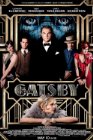
great gatsby1 Greetings again from the darkness. Movie versions of beloved books are always a risky proposition. Devotees of the written word recoil in disgust when a filmmaker dares re-imagine a character or scene, while critics take delight in itemizing each and every stray from the source material. Director Baz Luhrmann is an artist. His canvas is the silver screen, and he thrives in presenting his interpretations and visions. When he agreed to take on F Scott Fitzgerald’s 88 year old masterpiece… one that consistently lands on the lists of top ten novels of all-time … he most assuredly prepared for the onslaught of criticism and outrage that would follow (and has). He must have also known that his work would delight and entertain those open-minded viewers not shackled to thoughts of a single “correct” form (it has).

great gatsby2 If you have seen Luhrmann’s Moulin Rouge! (2001) or Romeo + Juliet (1996), then you are prepared for a Gatsby vision significantly different from director Jack Clayton‘s somber and oft-dreary version starring Robert Redford and Mia Farrow. Taking a different route altogether, Luhrmann worked with Jay-Z on the soundtrack that mixes Roaring 20’s jazz classics with contemporary hip-hop. He worked with award-winning Costume Designer Catherine Martin (his wife) on creating a kaleidoscope of colors for dazzling outfits that range from Gatsby’s pastel suits and shirts to the glitzy and sparkling party dresses at his over-the-top parties. Additionally, Luhrmann invoked the newest 3-D technology to add even more emphasis to the visual spectacle that included free-flowing champagne, high-gloss and high-powered automobiles screaming down narrow roads, sky-filling fireworks, and enough glittery confetti to stop down a parade. Jay Gatsby may know how to throw party, but so does Baz Luhrmann!

great gatsby5 Knowing this movie was coming soon, I re-read Fitzgerald’s novel back in January. While I was once again struck by the depressing feeling it leaves you with (it is after all a tragedy), I was also reminded of what stunning prose the writer lays out. At times I find it borders on poetry. You may agree with many of the 1925 critics who claimed the characters are unlikeable and the plot has little to offer, though you must also acknowledge the work acts as a timeless reminder that the vast majority of us could never come close to writing something as beautiful.  I pity the next high school student who opts to watch Luhrmann’s movie rather than read Fitzgerald’s words.  That essay will likely miss some key themes … but at least the student will be treated to a visual feast!

great gatsby4 The cast members are talented and game for Luhrmann’s world. Leonardo DiCaprio infuses the mysterious Gatsby character with the uncertainty and teetering balance of secrecy, desperation and illusion that Redford never could. His obsession with Daisy (Carey Mulligan) may be difficult to understand, but then why should obsessive love make sense? Joel Edgerton (as Daisy’s husband Tom) is a womanizing brute who sets apart his own inherited wealth and culture from that of Gatsby as East and West Egg. Tobey Maguire‘s Nick Carraway is our lone hope for normalcy. He is thrust into the Gatsby world and never really understands it … but then who could? The Carraway character is my single biggest complaint in regards to the movie. The framing device of Nick writing the story down for his psychiatrist as part of his therapy, means we get entirely too much Tobey Maguire and Nick Carraway for my tastes.

great gatsby7 It’s also a bit disappointing that we get so little of the strong supporting cast: Isla Fisher as Myrtle, Jason Clarke as Myrtle’s husband, and especially Bollywood star Amitabh Bachchan as Meyer Wolfsheim and exciting newcomer Elizabeth Debicki as Jordan Baker, are seen and heard from entirely too few times. In fact, the Nick and Jordan connection from the book is mostly ignored. These are all fabulous actors who did what they could with the characters, but we should remind ourselves that Fitzgerald’s book was always more about the prose than the characters or plot. He told us what he wanted us to know more than have his characters show us. That was his art form. Baz Luhrmann’s art form is showing … and his show is quite a treat!

**NOTE: this is neither a documentary nor exact adaptation … it takes artistic license for automobiles, clothes and music (among other things)!

SEE THIS MOVIE IF: you enjoy varying interpretations of art OR you just can’t decide who makes the dreamiest Gatsby – Leonardo DiCaprio or Robert Redford.

SKIP THIS MOVIE IF: you are a literary traditionalist and believe movie versions of classic books should not vary from the script (this one does).

watch the trailer:

http://www.youtube.com/watch?v=TaBVLhcHcc0


DJANGO UNCHAINED (2012)

January 2, 2013

django Greetings again from the darkness. Well, after two viewings and endless analyzing, it’s time to commit thoughts to the page. Over the years, it has become very clear that a Tarantino movie generates a first reaction, and then proceeds to slither through your mind and morph into something else entirely. It would be very easy to accept this latest as an outrageous peek at slavery disguised as a spaghetti western. For most filmmakers, that would be plenty. The “whole” here is exceedingly impressive, but the real joy for cinephiles is in the bits and pieces.

One need not be a Quentin Tarantino expert to enjoy his movies, but there are a couple of things that help. First, he is at heart, a true lover of cinema and quite the film historian, showing sincere respect to the pioneers of this art form. Second, he loves to bring visibility to issues (large and small) by poking a bit of fun at the evil doers who wield unnecessary influence and control over weaker parties. Morality, vengeance, revenge and come-uppance invariably play a role in django4his story-telling … a bonus this time is the inclusion of the Brunhilde/Siegfried legend from Norse mythology and the Wagner operas.

In his two most recent films, QT has been on a kick for creative revisionist history. Inglourious Basterds made a strong statement against the Nazi’s, while this latest goes hard after slave owners. As you might expect, historical accuracy is less important to him than are the characters involved and the tales they weave. And to that point, it seems quite obvious that where in the past, Tarantino would center his attention on crackling dialogue and searing one-liners, he now offers up much more complete characterizations … these are people we understand, even if we don’t much like them.

The obvious love he has for Sergio Corbucci and Sergio Leone, the driving forces behind spaghetti westerns, is plastered on the screen. We even get the beautiful camera work through the snow as a tribute to Corbucci’s The Great Silence (1968). While this is not a remake or sequel or prequel, Franco Nero’s “I know” response to “The D is silent” generates a laugh and memories django2of a 25 year old Nero in the titular role of Django (1966). The Blaxploitation genre plays a significant role here as well since Jamie Foxx plays Django, a freed slave who buddies up with a German dentist-turned-bounty hunter, so that Django can get revenge on those responsible for the torture and mistreatment of his wife.

The details of the stories will not be exposed here, however, I would encourage you to pay close attention to the moments of film brilliance. There is a running gag with townspeople and slaves alike struggling to accept the sight of Django on a horse. You’ll laugh again when Django is offered the opportunity to pick out his own clothes and we next see Foxx in a velvet Little Lord Fauntleroy outfit straight out of The Blue Boy painting from Gainsborough. There is hilarious banter django5between Big Daddy (Don Johnson) and Betina as he tries to give guidance on how to give Django a tour of the plantation.  The phrenology sequence is not just unusual, but an incredibly tense scene and fun to watch.  Watching the final shootout reminds me of Peckinpah’s The Wild Bunch … only ten times as violent!

Some of the best moments occur when we recognize the actors in the vital foundation scenes. Don’t miss: bad guy Bruce Dern, Don Stroud (the drummer in The Buddy Holly Story) as the ill fated sheriff, Tom Wopat as a patient Marshal (“Dukes of Hazzard”), father and daughter Russ and Amber Tamblyn, Jonah Hill who struggles with the eye holes in his “bag”, the eyes of Zoe Bell, Ted Neeley (Jesus Christ Superstar), “Dexter” dad James Remar in two roles, Walton Goggins as a gunslinger, Michael Parks (multiple roles in Kill Bill and Grindhouse), and of course, Mr Tarantino himself (as an explosive cowpoke from down under).

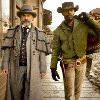
django3 While each of these provide wonderful moments, the real bingo occurs courtesy of the main performances of Jamie Foxx (Django), Christoph Waltz (Dr King Schultz, bounty hunter), Leonardo DiCaprio (Calvin Candie, plantation owner), and Samuel L Jackson (Stephen, Candyland house slave). Any combination of these characters in any scene could be considered a highlight. It’s especially enjoyable to see DiCaprio cut loose after so many uptight characters recently. Samuel L Jackson has long been a Tarantino favorite, and his delivery as the diabolical Uncle Tom house slave who has some secrets of his own, will bring the house down when he first sees Django and, in a much darker way, when his suspicions are confirmed. Power is a big player in the story, and even as a slave, Stephen knows what to do with power when he has it. Mr. Waltz won an Oscar for his Inglourious Basterds performance, and his dialogue here is every bit as rich. It’s obvious how much Tarantino enjoys hearing his words spoken by Waltz. Foxx’ performance could be easily overlooked, but it’s actually the guts of the film. He is quiet when necessary and bold when required.

django - dj We must also discuss the soundtrack. Franco Migiacci‘s original “Django” theme is featured, as are classics and a new song from the great Ennio Morricone. If you doubt the originality of the soundtrack, try naming another western that utilizes a mash-up of James Brown and Tupac Shakur. How about a spot-on use of Jim Croce’s “I’ve Got a Name”? The film is beautifully shot by Robert Richardson, and Fred Riskin takes over for Tarantino’s long-time editor Sally Menke, who sadly passed away in 2010.

It should also be noted that the script puts hip-hop to shame by using the “N-word” more than 100 times. It is a bit disconcerting, and you can google Spike Lee’s comments if you care to read more on the topic. Otherwise, dig in to the latest gem from Tarantino and appreciate his approach and genius … either that, or stay away!

**NOTE: I have purposefully avoided the scandal associated with the film.  If you are interested in reactions from the African-American community, there is no shortage of published reports on those who support the film and those who are outraged.

watch the trailer:

http://www.youtube.com/watch?v=rC8VJ9aeB_g


TITANIC (1997, 3D-2012)

April 8, 2012

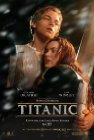
 Greetings again from the darkness. Of course I saw this one a couple of times when it was first released in 1997. Having only watched it once since, I was happy to hear it would get a re-release on its 15th anniversary … even if the marketing hook was the post-production 3D. My thought was with James Cameron working his technical magic, the 3D would be fine, and maybe even add to the spectacle of the sinking ship. After all, he was the mastermind behind Avatar, which with Hugo, are the only two films (in my opinion) that haven’t been weakened with 3D technology.

Unfortunately, I can’t overstate my disappointment in the 3D for Titanic. The colors and lighting are destroyed. When we first see young Rose (Kate Winslet) arrive to board the majestic ocean liner, her lavender hat appears almost gray through the 3D glasses. And later, the stunning crimson Renault, where Rose and Jack (Leonardo DiCaprio) get to “know” each other, appears dull and darkened. Additionally, so many face shots are darkened, rather than illuminated by the beautiful fixtures that adorn Titanic. I was so saddened to see such dullness on top of such greatness. Sure, there were a couple of times where the 3D gave a boost to a special effect, but the film is so beautifully made and such a technical marvel, that the impact is minimal to the positive.

What I will say is that despite my frustration with the technology, I do hope a new generation is introduced to the film. Personally, I am no fan of the love story between Jack and Rose. However, it is such a delight to see the young, eager versions of Little Leo and Kate as they go about their antics. They were 22 and 21 respectively during filming, and we now know them as mature actors and major movie stars. That wasn’t the case when Titanic first premiered.

The real genius of this film is two fold: the story-telling and the technical achievement. Gloria Stuart stars as 101 yr old Rose and she is used to perfection in telling the personal story of Titanic. Her love story with Jack allows director Cameron to show off the amazing ship from all angles … first class, third class, dining rooms and engine rooms. She also allows the viewer to connect with the characters on a personal level. The technical aspect is even more astounding. Sets, models, CGI, and documentary footage are all blended to form a cohesive presentation of one of the most dramatic events of the past 100 years.

Here are a few notes of interest regarding the movie and those involved. The movie was number one at the box office for 15 consecutive weeks and grossed more than $1.8 billion … a record that stood until Cameron’s Avatar eclipsed it. Cameron was already an established sci-fi director with Terminator I & II and Aliens, but he almost had the plug pulled by the production company due to cost overruns. Matthew McConaughey was the producer’s first choice for Jack, but (fortunately) Cameron held firm for DiCaprio. The elderly couple hugging each other in bed as the ship sinks were based on the Strauss’ who owned the Macy’s department store chain. And yes, there were Astor’s and Guggenheim’s onboard when it went down.  Kate Winslet (Best Actress) and Gloria Stuart (Best Supporting Actress) received nominations for playing the same character (Rose). If you have seen the movie before, pay particular attention to the secondary characters … the wardrobes and acting are tremendous: Frances Fisher as Rose’s mother, Kathy Bates as the “Unsinkable” Molly Brown, Billy Zane as the fiancé, David Warner as his henchman, Bernard Hill as the Captain, Victor Garber as the architect, and Jonathan Hyde as the sleazy ship owner. Also catch Suzy Amis in one of her last acting jobs before becoming Mrs. James Cameron … she plays the granddaughter to “old” Rose.

This is an historic film version of an historic event and should be seen by all movie lovers. Some of it is a bit hokey, but if you doubt the technical achievement, compare it to A Night to Remember, the 1958 version of the Titanic story.  And depending on your taste, crank up the closing credits and listen to Celine Dion belt out the Oscar winning Best Song.  She is, after all, “the greatest singer in the world” (an SNL gag).

watch the trailer for “the ship of dreams”: