by Emily St James and Lauren Theisen
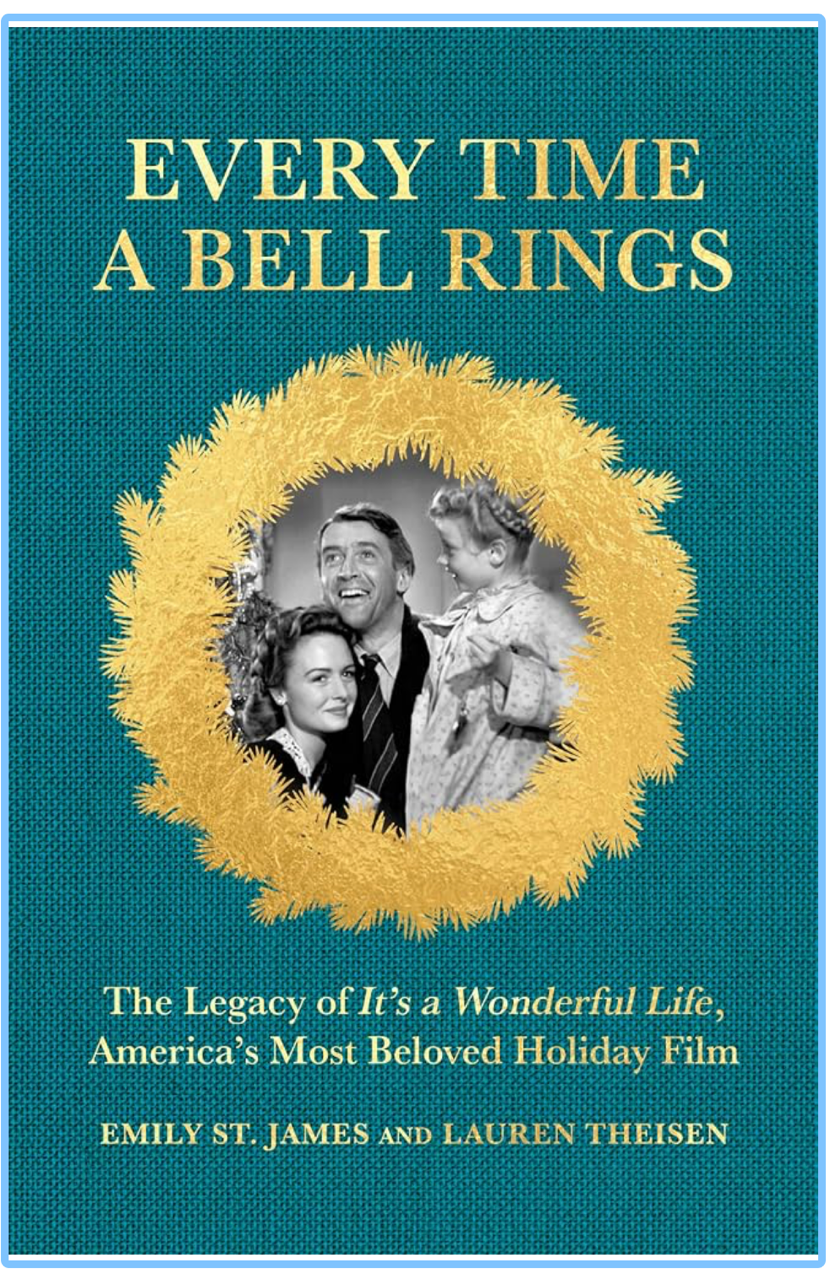 Like many families, our holiday traditions include annual viewings of the 1966 animated “How the Grinch Stole Christmas”, A CHRISTMAS STORY (1983), and, of course, the main event, IT’S A WONDERFUL LIFE (1946). The latter, Frank Capra’s classic, is now 80 years old, and the timing is perfect for a deep dive into why this film has made such an impact on so many viewers over the years. Co-authors Emily St James and Lauren Theisen clearly share a love for the film and fully engage when writing about the individual pieces that make up the whole: the studio, the filmmakers, the cast, and a couple of odd (perhaps lucky) breaks along the way.
When classics collide, the result can be fascinating. The ties to the 1938 short story, “The Greatest Gift” by writer Philip Van Doren Stern is pretty direct, and we can’t help but notice some connection or familiarity to Charles Dickens’ classic 1843 novella “A Christmas Story”, which has spawned many movie versions. And then there is the tale of director Frank Capra’s trip to Seneca Falls, NY, a town that even today, stakes a claim and its identity to being the inspiration for Bedford Falls (understandably, no town attaches its tourism hopes to Pottersville). The book explores all of this, giving Mr. Capra a well-earned extended segment on his life, career, and feelings about the film.
“No man is a failure who has friends.” Perhaps no quote better exemplifies the crux of the film’s message than that one. It certainly applies to George Bailey, played so beautifully by lead actor James Stewart, and couldn’t be further from describing his nemesis Mr. Potter, played with a snarling Ebenezer Scrooge-like persona by Lionel Barrymore. It’s here where the co-authors excel – detailing cultural aspects at the time the film was made, and how that time capsule has so been so readily adopted by contemporary viewing audiences. Well, of course, that’s only after the bookkeeping fluke that lost the copyright and opened the film up to the masses.
Chapters in the book are devoted not just to the main characters of George, Mary, and Potter, but also to Clarence Odbody, Angel 2nd Class; forgetful Uncle Billy; heroic Harry Bailey; Bert the cop; Ernie the cab driver; Nick, Martini, and Annie (lumped in to one chapter); other Bedford Falls ‘weirdos’; and Violet (a terrific Gloria Grahame), a character we wish we knew a bit more about. There are also chapters on Bedford Falls, Seneca Falls, and the copyright mess. Because of these separate segments, and the fact that each chapter is credited to one of the authors, we are asked to think of the book as “a series of essays”, rather than a traditional ‘making of’ book.
Most fans of the film know this was James Stewart’s first film after returning as a war hero from WWII. Another well-known fact is that the film wasn’t a box office smash the year it was released, and despite its five Oscar nominations, there were no wins on a night dominated by THE BEST YEARS OF OUR LIVES. The authors also address why the story is sometimes labeled as promoting socialism, and yet, even with married screenwriters Frances Goodrich and Albert Hackett being close to known communists, neither the film nor the filmmakers were part of the extended Hollywood blacklist of the era.
Contributing to the film’s brilliance is how most who watch describe it as upbeat, joyous, and/or inspirational. This, despite the lead character contemplating suicide and the entire ‘Pottersville’ sequence which can simply be described as bleak and horrific. The authors cover how the film generates a favorable vision of community and country, and how heroism and morality overcome darkness … explaining the film’s place in cinematic history. The book’s Introduction opens with, “Certain movies take on lives of their own.” This movie in particular seems to make the lives of all who watch just a bit more ‘wonderful’, and this book helps us all understand why.
The book is available on Amazon beginning September 29, 2026


 Posted by David Ferguson
