THE ACCOUNTANT 2 (2025)

April 24, 2025

Greetings again from the darkness. As disappointing as most sequels are, there is a glimmer of hope when the original creative team and key cast members return. Such is the case with this sequel to the 2016 film, THE ACCOUNTANT (yes, it’s been nearly a decade). Director Gavin O’Connor and writer Bill Dubuque are back, and both have skins on the wall. O’Connor also directed MIRACLE (2004) and the criminally underrated WARRIOR (2011), while Dubuque was the creator of the hit series “Ozark”.

Two-time Oscar winner Ben Affleck returns as the brilliant and autistic accountant known as Christian Wolff (as well as a few other names). In what may be the least amount of screen time ever afforded a previous Oscar winner, JK Simmons’ Ray King – former director of FinCEN is assassinated, and his former protégé MaryBeth Medina (a returning Cynthia Asdai-Robinson) tracks down Christian to help solve the case. But, of course, things are never that easy, and they also find themselves knee deep in another case – one that hits mighty close to real world headlines with human trafficking and gang activity.

Christian contacts his lethal-weapon brother … yep, for the first time since the end of the first film … and Braxton (Jon Bernthal) reluctantly agrees to join the hunt. The two brothers interact in a manner we’re familiar with from all the ‘mismatched buddy films’ over the years, and Affleck and especially Bernthal excel at this, although it’s impossible not to note Affleck’s too-frequent smirks this time around. An early speed-dating sequence feels totally forced and out-of-place, and one can only assume it’s included for anyone who didn’t watch the first movie (which I highly recommend prior to viewing this one).

As good as the brother banter plays, the mish-mashed stories, lack of central villain, and over abundance of action sequences, turn this into a film trying too hard to please all audiences. Toss in extended segments featuring the autistic techno geniuses at Harbor Neuroscience Academy, and a description of Acquired Savant Syndrome, and the best advice is to just sit back and watch after turning off your own plot-solving brain cells. Christian has developed and funded the group of young geniuses at the Academy, and they are led by non-verbal Justine (played by Allison Robertson, and computer-voiced by Alison Wright of “The Americans”). The missing persons case centers around highly-trained assassin Anais (Daniella Pineda from the Jurassic World franchise), and we can’t help but think she could hold her own as a story and character.

The abundance of comedic elements might surprise fans of the first film, as might the war zone style shootout during the film’s climax and the overly-animated Affleck – all extremes when compared to the original, yet Affleck and Bernthal make the brotherly thing work

Opens in theaters on April 25, 2025

WATCH THE TRAILER


SATURDAY NIGHT (2024)

November 13, 2024

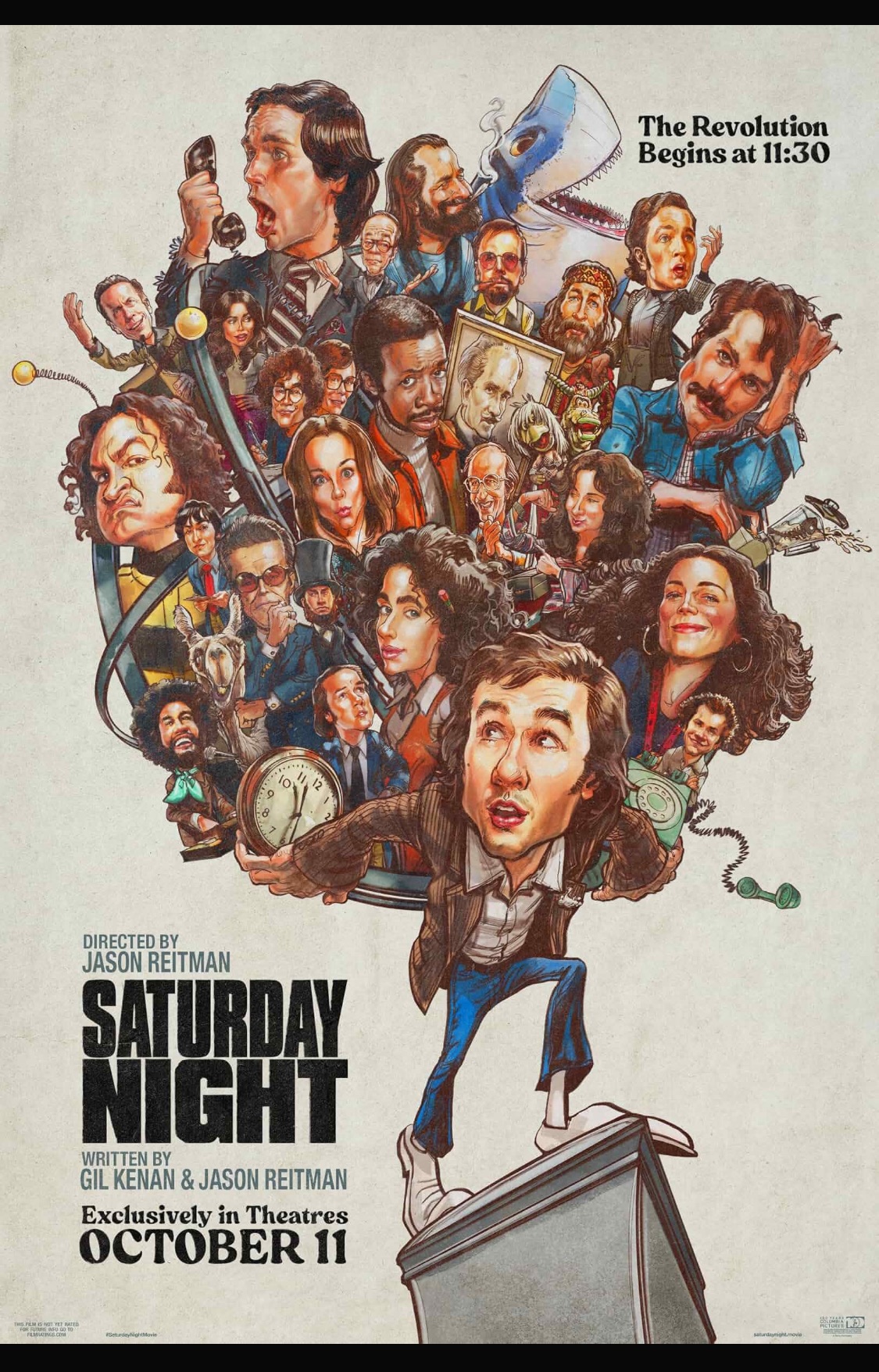
Greetings again from the darkness. For those of a certain age, October 11, 1975, changed television forever. Now celebrating it’s 50th anniversary season, “Saturday Night Live” (SNL was originally just ‘Saturday Night’) has been maligned and criticized so many times over the years, yet it persists in providing commentary and comedy when so many other shows have failed. No better choice exists to present the show’s origin story than writer-director Jason Reitman w-d (JUNO, UP IN THE AIR, THANK YOU FOR SMOKING, TULLY), who along with co-writer Gil Kenan, go extreme with the ‘origin’ by tracking the 90 minutes prior to the first show’s airing.

Thanks to a clock counting down to the 11:30pm showtime and a few periodic reminders, we are always aware of just how few minutes remain for showrunner Lorne Michaels (a terrific Gabriel LaBelle) to pull off this minor miracle. Backstage chaos barely scratches the surface of what Michaels is dealing with (in addition to his own anxiety). Network executives and censors, an out-of-control cast of truly ‘Not Ready for Prime Time Players’, a writer’s room in disarray, incomplete set assemblage, and more than double the material necessary to fill the allotted time are just some of the hurdles facing Michaels.

What we immediately notice is the fine job done in casting the cast: Cory Michael Smith captures Chevy Chase’s looks, ambition, ego, and talent; Dylan O’Brien nails Dan Aykroyd’s physicality and rapid-fire speech; Ella Hunt is underutilized as ultra-talented Gilda Radner; Emily Fairn is insecure Laraine Newman; Kim Matula shows Jane Curtin’s coolness; and Lamorne Morris plays up Garrett Morris’ realization of stereotyped characters. Perhaps the key to the show and this movie is Matt Wood’s portrayal of John Belushi, who initially rebels against the bee costume, refuses to sign his contract, and clearly is the most explosive and vital member of the cast.

 “What is the show?” Lorne Michaels fields that question a few times and fails to give a satisfactory answer … until just before showtime when he eloquently explains it and wins over NBC’s Dave Tebet (Willem Dafoe), the key network executive who was fully prepared to show a Johnny Carson rerun rather than risk embarrassment with the newbies. The frantic pace is unrelenting as a nervous Director of Programming Dick Ebersol (Cooper Hoffman, son of Phillip Seymour Hoffman) tags along wondering if his own career is going to crash and burn right along with Michael’s. Acting as a calming influence is Lorne’s (first) wife Rosie Shuster (Rachel Sennott), who brings serenity to those on the edge.

Revolution is difficult – especially with a bunch of twenty-something no-name actors. Bringing in ‘Mr. Television’ Milton Berle (Oscar winner JK Simmons) allows for further contrast with old comedy versus new, not to mention Berle’s most infamous appendage, which he doesn’t hesitate to flaunt. Others of note include Finn Wolfhard as an NBC page charged with filling the studio audience, a too-tall Nicholas Braun who plays both an out-of-place Jim Hensen and Andy Kaufman (complete with “Mighty Mouse” segment). Matthew Rhys plays coked-out host, George Carlin, and Nicholas Podany is a desperate for stage time upstart named Billy Crystal. Tommy Dewey plays head writer Michael O’Donaghue, and Jon Batiste performs as Billy Preston (while also writing the film’s score).

A couple of highlights include a sound check with Garrett Morris singing about what he’s going to do with his shotgun, Aykroyd as Fred Garver, and of course, Belushi whenever he’s on screen. Director Reitman includes numerous callbacks to sketches and characters … some of which require a sharp eye by viewers. Kudos to Jess Goncher for Production Design that recalls this hectic time, and to cinematographer and frequent Reitman collaborator, Eric Steelberg, for using the camera in sync with a time that was totally out of sync. Capturing an event of anti-establishment or counterculture rebellion is almost as impressive as what Lorne Michaels and the cast and crew pulled off that night (drugs and all).

On Digital November 12, 2024 and on Blu-ray January 7, 2025

WATCH THE TRAILER


BEING THE RICARDOS (2021)

December 9, 2021

Greetings again from the darkness. You don’t have to be one of the 60 million who, between 1951 and 1957, tuned in each week to watch the latest episode of “I Love Lucy” to feel like you know Lucy, Desi, Ethel, and Fred. Most of us have watched the syndicate re-runs over the past 70 years, and that fact added challenges to this project for writer-director Aaron Sorkin – not the least of which was casting the role of Lucille Ball. Everyone had an opinion, and when you go to cast a true icon, it’s a slippery slope.

I’m happy to report (even though it’s not surprising) that Oscar winner Nicole Kidman is truly exceptional as Lucy. Perhaps a better choice could be made if this were a remake of the “I Love Lucy” sitcom, but although the film dips in and out of that show’s production, this is an Aaron Sorkin movie; so the focus is less on comedy and more on the intricacies of social and political issues. Now you might ask, what issues could a beloved star like Lucy have?  How about these: the media is reporting her husband is cheating on her, the sponsors don’t want her appearing on air while pregnant, internal battles over a particular scene with the director and writers, and she’s just been publicly called out for being a communist.

You’ve surely detected by now that this is no comedy about Lucy. Instead, it’s a pretty heavy drama about pressures at the top of a profession, and the eternal difficulties in cultivating a successful marriage. Adding heft is the era in which this occurs. It was rare for a woman to wield Lucy’s power, and the social mores of the time forced big time debate over showing a woman during pregnancy – even if that woman was married! Filmmaker Sorkin utilizes an odd structure for the film. It appears to be happening during the show’s second season, but we are actually looking back years later through the eyes of the show’s writers and producer. And then beyond that, we get flashbacks from the flashbacks to Lucy’s time at RKO, and the early flirtations that led to Lucy and Desi.

Oscar winner Javier Bardem plays Desi Arnaz. Although he bears little physical resemblance to the Cuban bandleader, Bardem expertly captures the essence of Desi as a businessman, actor, musician, lover of Lucy, and lover of life. For me, it was as thrilling to watch Desi’s shrewd negotiations with the network and Philip Morris executives as his energized bongos while performing “Babalu” at Ciro’s. Sorkin makes it clear that both Lucy and Desi were brilliant at what they did. Together they formed Desilu Productions, and he handled much of the business side, while her perfectionism and comedy instincts pushed the show to limits never before reached.

But what would the Ricardos be without their neighbors, landlords, and friends, Fred and Ethel Mertz? Nina Arianda (a Tony winner) plays Ethel/Vivian Vance, while Oscar winner JK Simmons plays Fred/William Frawley. The set is not the warm and fuzzy cocoon one might imagine. Vivian’s well known frustration was with Lucy mandating Ethel’s frumpy and dowdy look, while it’s clear Vivian and Frawley’s bickering carried on after the lights dimmed … due in no small part to Frawley’s alcoholic ways. That said, Ms. Arianda is terrific in the role, and Mr. Simmons epitomizes the grumpy old man we know as Fred.

Due to the flash-forward recollections, we get Tony Hale and John Rubinstein as the younger and older producer Jess Oppenheimer, Jake Lacy and Ronny Cox as the younger and older writer Bob Carroll, while Alia Shawkat and Linda Lavin play the two versions of writer Madelyn Pugh. It’s Ms. Lavin who describes Lucy and Desi’s relationship as, they were either “tearing each other’s heads off, or tearing each other’s clothes off.” It’s debatable whether Sorkin’s choice to structure the multiple time lines adds to the film’s depth, but it does allow for more talking … something Sorkin never shies away from. This is his third directorial effort after MOLLY’S GAME (2017) and THE TRIAL OF THE CHICAGO 7 (2020), and he won his Oscar for the adapted screenplay of THE SOCIAL NETWORK (2010).

Despite all the other aspects, this is the story of Lucy in crisis mode. She is pregnant with the child of a husband who is likely cheating on her. Her show and company are in jeopardy, and because of something she did many years ago, her status as a beloved American icon could be lost. Her show transcended all other forms of entertainment at the time and was must-watch TV when not every home had a TV (much less 3 or 4). The film mostly covers one week in time, though Sorkin does give us a look back at a time when the industry simply didn’t know what to do with her talent. For the fans, we do get a mention of Vitameatavegin, and a wonderful recreation of the infamous stomping of grapes. It’s a delight to see such fine actors fully engaged in roles they know will be picked apart by many. This is not the Lucy movie we would typically expect, but it’s one that pays tribute to the real person and real people and what they accomplished.

In theaters on December 10, 2021 and streaming on Amazon Prime beginning December 21, 2021

WATCH THE TRAILER


GHOSTBUSTERS: AFTERLIFE (2021)

November 18, 2021

Greetings again from the darkness. There is a reason musical acts like The Eagles, Jimmy Buffet, and The Rolling Stones continue to pack arenas. We love our nostalgia and prefer it familiar and easily recognizable. The fans don’t show up to hear the new songs, but rather those ‘oldies-but-goodies’ that bring back pleasant memories. Writer-director Jason Reitman and co-writer Gil Kenan fully understand this psychology as they deliver what amounts to a sequel of the original GHOSTBUSTERS movie released 37 years ago (and directed by Reitman’s father Ivan).

The hook in this updated version is that Callie (Carrie Coon), the adult daughter of original Ghostbuster Egon Spengler (originally portrayed by the late Harold Ramis), has been evicted from her apartment. She packs up the car and her two kids, and heads to the dilapidated farm house she inherited from the father she never knew. Callie has lived her life bitter and hurt that her father never reached out, choosing instead to isolate himself in Summerville in the “middle of nowhere”. Her kids are Trevor (Finn Wolfhard), an awkward teenager, and Phoebe (a stellar McKenna Grace), a science whiz who seems to be a near-clone of the grandfather she never met.

As they adjust to a new life, Trevor swoons over local girl Lucky (Celeste O’Connor), while Phoebe befriends another outcast self-named Podcast (Logan Kim), and Callie gets closer to Gary Grooberson (Paul Rudd), a Seismologist “teaching” summer school with help from some age-inappropriate movies on VHS. As great as Coon and Rudd are (and both are great), the real fun comes from the youngsters exploring grandfather’s workshop and the mysterious mountain at the edge of town, which is actually a long ago abandoned mine run by the town’s founder.

Supporting actors include Bokeem Woodbine, JK Simmons, and Tracy Letts. Many of the elements will seem familiar as the kids begin to uncover the ghostly creatures unlocked thanks to Grandpa Egon’s research and tools. As with the original, busting the ghosts is fun, but it’s the one-liners and crackling dialogue that make this a joyous ride from beginning to end. A battered Ectomobile (Ecto-1) plays a key role, as do ghost traps, crossing streams, and a new generation of Stay-Puft Marshmallows.

Jason Reitman is a two-time Oscar nominee for UP IN THE AIR (2009) and JUNO (2007), but it seems clear his mission here was to provide a fitting tribute to the original film, his father, and the late Harold Ramis. He’s assisted along the way with some special effects and even more special appearances, though the missing Rick Moranis is notable (and expected). The original blockbuster spawned sequels, re-boots, toys, an animated series, video games, documentaries, and now … another sequel (one that mostly disregards everything but the original). There is a Spielberg feel as the scene is small town instead of NYC, and perhaps with this family-friendly focus on the kids, the best comparison might be THE GOONIES. It’s nostalgic, yet new and fresh, and we do get a look at Hook and Ladder #8, and the familiar tune of Ray Parker Jr’s iconic theme song. Hang on for the mid-credit and post-credit scenes, and just remember to take this for what it is … a rollicking good time.

Opening in theaters on November 19, 2021

WATCH THE TRAILER


I’M NOT HERE (2019)

March 7, 2019

 Greetings again from the darkness. So many are haunted by the past – unable to move beyond either having been dealt a bad hand or having created one through their own actions. The film opens on a gaunt Steve (JK Simmons), alone in his apartment, and seemingly barely functioning. He is contemplating suicide with a shiny gun he keeps on a coffee table in a home as unkempt as himself. His only breaks are to frantically search the house for another bottle of vodka, or to listen to a phone message that kicks off yet another painful memory.

The film features three timelines for Steve: the despondent, suicidal elder; the twenties and thirties version (Sebastian Stan); and the 1960’s childhood Stevie (Iain Armitage, “Young Sheldon”). Those young years for Stevie recall his always-annoyed mom (Mandy Moore) and his fun-loving dad (Max Greenfield), while the young adult years show us his romance and marriage with Karen (Maika Monroe). It’s not long before we recognize the common thread that binds the timelines: alcoholism. First his dad’s, then his own.

Our memories tend to return in moments and flashes of events. This becomes more evident and the memories less reliable when years of alcohol abuse are in play. The flashes include the courtroom and judge of his parents’ divorce, his dad drinking, his own courting of Karen and the booze that accompanied it, the dissolution of his own marriage, and an unspeakable tragedy that ruined his life without taking it … something he is looking to remedy with that gun.

JK Simmons is remarkable here. His Steve is mired in loneliness, depression, guilt, and regrets – each amplified through booze. Simmons’ performance offers up not a single line of dialogue. He never leaves the apartment. He never has human interaction. Yet despite all of this, he never leaves our thoughts as he pinballs through his memories. Mr. Stan and Ms. Monroe provide the most telling scene outside of Simmons’ segments. Notice the difference in demeanor as he tells her he heard the shot when his dad killed himself vs how she states her mother died from cancer. This is the contrast of moving on no matter what life serves up, or being burdened with that weight forever.

The film was directed by Mr. Simmons’ wife Michelle Schumacher, and she co-wrote the screenplay with Tony Cummings (son of Emmy winning actor Robert Cummings). Mr. Cummings also appears as the judge in the divorce hearing. The film was originally shown in 2017, but is only now getting released. For fans of JK Simmons, it’s a must see.

watch the trailer:

https://www.youtube.com/watch?v=sYDwdCdXCOM


THE FRONT RUNNER (2018)

November 16, 2018

 Greetings again from the darkness. Jason Reitman has proven himself to be an outstanding filmmaker who delivers entertaining stories with insightful commentary often accompanied by biting humor. His excellent films include: THANK YOU FOR SMOKING, JUNO, UP IN THE AIR, and one of this year’s most underappreciated films, TULLY. His latest is based on the book “All the Truth is Out” by Matt Bai (who also co-wrote the screenplay with Reitman and “House of Cards” Producer Jay Carson), and it tells the story of Colorado Senator Gary Hart and his derailed 1988 campaign for President.

The film begins in 1984 when an idealistic Hart loses the Democrat party nomination to Walter Mondale, who of course, went on to lose the national election to Ronald Reagan. It then picks up as the 1988 campaign is underway and Hart is the party frontrunner, and some say the candidate most likely to win the Presidency. Hugh Jackson plays Hart and is unfortunately burdened with an ill-fitting and distracting wig meant to emulate the lush locks sported by the youthful looking Senator. Vera Famiga plays his wife Lee, and Kaitlyn Dever plays their daughter Andrea. Casting two such fine actresses matters because of what happened during the campaign.

Senator Hart was the favored candidate of the young and the idealistic forces, though the details of his platform were never communicated clearly. Mostly, he was presented as the energetic candidate of hope versus the stodgy Republican Party that had delivered Ronald Reagan for 8 years and was now looking to George Herbert Walker Bush. Everything changed for Hart when rumors of marital infidelity, and possibly even an open marriage, began to circulate. When the media asked him, he was defiant … at times snapping in anger that his personal life was no one’s business.

We are taken inside the campaign via many familiar faces, including campaign manager Bill Dixon played by JK Simmons, and a terrific turn by Molly Ephraim as staffer Irene Kelly. We are invited on board the aptly named party yacht “Monkey Business” when Hart first meets Donna Rice (Sara Paxton), setting off what could considered be the birth of political gossip-columns. The Herald and Washington Post are key players here, as are editor Ben Bradlee (Alfred Molina) and iconic journalist Bob Woodward. Apparently this is supposed to show us how politics and the media coverage of politics changed with Gary Hart.

Where the movie lets us down is in not providing any explanation to why Hart was the front runner, whether the U.S. or even the democratic party missed out on a great (or even competent) President, and how in the world Hart was so clueless as to why citizens might have an interest in his personal life activities that included sleeping with a woman (or women) that weren’t his wife. By the way, the reason for the last one is character … and we’ve since learned it’s not as important as what we might have once thought. These are all key issues as to why this is even a story, and whether or not it’s interesting enough to re-tell.

Instead of details, we are bombarded with overlapping dialogue and frenetic editing designed to generate some buzz and energy. The reality is that Gary Hart was really not that interesting, and in fact, by denying the importance of character, he thumbed his nose at his supporters. This blip on American history is simply not enough to justify a 2 hour a movie, and Mr. Jackman never seems able to capture the essence of Hart (whatever that essence might have been). There is obvious relevance to how today’s press treats personal stories, but a bland candidate makes for a bland movie.

watch the trailer:


PATRIOTS DAY (2016)

January 12, 2017

patriots-day Greetings again from the darkness. Is it too soon? If not, is it too painful to revisit? Even if the time is right, is injecting a fictitious supercop into the horrific events an acceptable approach? Every viewer of the film will have their own answers to these questions, but clearly writer/director Peter Berg (Deepwater Horizon, Lone Survivor) and Boston area native Mark Wahlberg believed now is the time and that this is the best way to re-create this catastrophe and its fallout.

Wahlberg plays Tommy Saunders, a Boston detective kicked back to uniform duty as penance for a run-in with another cop. His character is evidently a composite of multiple cops and first responders, and though he is the center of the film, the character is the weak link. He’s some type of supercop who never sleeps and manages to be literally everywhere something is happening … either the Boston Marathon finish line, FBI control center, the hospital interviewing survivors, or cruising the streets with his spotlight tracking down the bad guys.

Beyond Wahlberg’s character, the film does a remarkable job at re-creating the tragic events, the emotional and physical fallout, and the urgent law enforcement manhunt. Since it’s been less than 4 years, most every piece of this is fresh in our minds. We follow along from when the street cameras are used to identify the suspects all the way through the final capture from the backyard boat.

Another thing the film does well is tell the stories of certain individuals who were impacted. We experience the emotions of Boston Police Commissioner Ed Davis (John Goodman), the preparedness and cool of Watertown Police Chief Jeffrey Pugliese (JK Simmons), the highs and lows of MIT Officer Sean Collier (Jake Picking), the terror and courage of captive Dun Meng (Jimmy O Yang), and the focus and conflicts of Governor Deval Patrick (Michael Beach) and FBI Special Agent Richard DesLauriers (Kevin Bacon). There is also the story of survivors Jessica Kensky (Rachel Brosnahan) and Christopher O’Shea (Patrick Downes), and a few others who we get to know a little bit.

The bombers/terrorists/brothers are played by Alex Wolff and Themo Melikidze, and no effort is made to sympathize or explain their actions. The closest we get is an argument in the apartment with the wife (played by Melissa Benoist) over the wrong type of milk. I will not use the real names here as I don’t believe in providing any publicity for such creators of evil.

The film successfully establishes the “normal” start to what seemed to be a “normal” day. Of course, April 13 2013 turned out to be anything but. We hear the Newtown tribute at the opening of the race, and we see David Ortiz with his color proclamation at Fenway Park. The music by Trent Reznor and Atticus Ross is always spot on with the mood, and the last 10 minutes are by far the most emotional … we hear from the real life survivors, first responders and others so crucial to that time. I may believe that this story would best be told in documentary form, but there is no denying that it’s a reminder of the power of love, and the spirit of Boston and America.

NOTE: why does it seem Michelle Monaghan is underutilized in almost every movie she appears? She is such a fine actress, but she rarely seems to get the screen time she should

watch the trailer:


LA LA LAND (2016)

December 10, 2016

la-la-land Greetings again from the darkness. Is this a nostalgic throwback to the movie musicals of Stanley Donen and Fred Astaire, or is it a contemporary film designed to revitalize the movie musical genre in an era dominated by superheroes and sci-fi? However you might choose to label writer/director Damien Chazelle’s follow-up to Whiplash (2014), it’s clearly one of the best and most entertaining movies of the year.

While the opening credits are still rolling (“Presented in CinemaScope” being the first gag), the film kicks off with its only large scale (think Busby Berkeley on a L.A. freeway rather than in a swimming pool) musical production, “Another Day of Sun”. It’s also the first of 3 less-than-warm-and-fuzzy “meetings” between the two lead characters before they finally click.

Emma Stone and Ryan Gosling light up the screen with the same incredible chemistry they displayed in Crazy, Stupid, Love (2011). Mia (Ms. Stone) is a struggling actress-wannabe working behind the counter at the Warner Brothers studio coffee shop. Sebastian (Mr. Gosling) is a pianist committed to the traditions of jazz music … even as he toils in a club playing mainstream tunes for folks who aren’t even listening.

As their relationship develops, we are treated to a tap dance number in the Mulholland Drive moonlight. Soon, Sebastian (either a brooding Gene Kelly or a dancing James Dean) is forced to make a choice between finding a way to open his own jazz club or compromising his integrity by making lots of money joining a “hot” band (led by John Legend), while Mia is focusing on auditions and her writing (which leads to a disastrous one-woman show).

Director Chazelle and cinematographer Linus Sandgren create a look in line with Singin’ in the Rain, but a tone more suited to A Star is Born. There is no shortage of romance and music, but it’s equally balanced with melancholy, foolish dreams, and shattered hopes. While it’s an homage to old Hollywood, Los Angeles and movie musicals, it seems to gracefully swing between past and present – and reality and fantasy.

Mia has a bedroom wall mural of Ingrid Bergman, while Sebastian treasures his piano stool that once belonged to Hoagy Carmichael … two more examples of past and present intertwined. Ms. Stone and Mr. Gosling possess solid (not exceptional) singing voices, which aids in having the songs tell their story. Ms. Stone is quite a talent, and especially stands out in her audition scenes … we feel her pouring her heart out to casting agents who may or may not even be paying attention. It’s remarkable work from her.

Supporting work is provided by Rosemarie DeWitt (as Sebastian’s sister), JK Simmons (as a club owner and Sebastian’s boss), Finn Wittrock (as Mia’s boyfriend) and Damon Gupton. Also in supporting roles would be the Griffith Observatory (after a Rebel Without a Cause viewing), the Los Angeles scene, and the Warner Brothers lot.

The “What Could Have Been” ending sequence is top notch filmmaking in all aspects, and perfectly caps a movie that drips with nostalgia … while also being touching, funny, and downright fun. Watching this film is much like going through the ups and downs of a relationship, and rather than a fairy tale, it’s a painful jab at “the one who got away”. It deserves to be seen on the big screen – enjoy the full palette of colors and the full spectrum of emotions (love and heartbreak, frustration, anger, and utter joy). This is one to tell your friends about … don’t wait for them to tell you.

watch the trailer:


OSCARS recap (2015)

February 23, 2015

oscars6 Greetings again from the darkness. “Stay weird and stay different” is the main takeaway from this year’s Oscars presentation. Not only was that the heartfelt and emotional plea to kids made by Adapted Screenplay winner Graham Moore (The Imitation Game), but it also describes Best Picture winner Birdman Or (The Unexpected Virtue of Ignorance).

The Academy seems to suffer from a multiple personality disorder in trying to decide what to do with the ceremony. Is it a formal and dignified event to honor the nominees? Is it a celebration of the artistic and historic sides of cinema? Is it an opportunity to entertain the tens of millions of TV viewers who tune in each year? Not knowing the objective makes it very difficult to be successful, which leads to a too-long mish-mash of all three approaches further muddled by the 30-second political statements offered up by millionaires whose words probably carry less weight than they believe, but more than they should.

As a movie lover, what draws me to the telecast is the celebration of cinema, so my favorite segments included: the brilliant opening number entitled “Moving Pictures” as performed by emcee Neil Patrick Harris, with an assist from Anna Kendrick, Jack Black, numerous costumed dancers, some terrific special effects, and clips from many iconic movies; the beautifully sung melody by Lady Gaga as a tribute to the 50th anniversary of The Sound of Music – with an appearance from Julie Andrews; and the first time ever that each movie nominated for Best Picture (all 8 of them) went home with at least one Oscar.

Of course there were also segments which I did not enjoy so much: an ultra-creepy John Travolta pawing at Idina Menzel’s face a year after butchering her name on stage; a lackluster Birdman parody by Neil Patrick Harris that paled in comparison to the recent work of Fred Armisen (Indie Spirit Awards) and Sesame Street (with Big Bird); the cut away shots to Michael Keaton chomping his chewing gum like a junior high kid; and the multitude of lame jokes (and absurd pre-show predictions) by Mr Harris that could have been excused if not for the poorly timed zinger directed at the dress choice of an award winner who had just moments before disclosed the suicide of her child.

Emotions always run high in a room full of artists, and the live performance of “Glory” from Best Picture nominee Selma was quite impressive … from the infamous bridge setting, to the vocals of Common and John Legend, to the dozens of folks who joined them onstage (Note: they were given much more time than the other live performances of nominated songs). Also registering high on the emotional meter were: Patricia Arquette’s call for pay equality, Eddie Redmayne’s pure joy at winning Best Actor, and the excitement, pride and perspective shown by Ida director Pawel Pawlikowski  towards his home country of Poland.  On the other end of the emotional spectrum, how does it make sense that sourpuss Sean Penn tries to crack wise with an ill-timed joke, while “comedian” Eddie Murphy reads the list of nominees like he is checking inventory at Home Depot?

On a personal note, my favorite film of the year was Boyhood, and while I am not upset that my second favorite film of the year won Best Picture, I do wish director Richard Linklater had received more accolades for his unique and extraordinary project. It was nice to see two screen veterans and professionals like Julianne Moore and JK Simmons take home their first Oscars, and I was ecstatic to see so many awards go to Wes Anderson’s beautiful The Grand Budapest Hotel and the frenetic Whiplash. We should all welcome the notice given to international talents like Emmanuel Lubezki, Alexandre Desplat and the previously mentioned Eddie Redmayne.

Alejandro Inarritu was the big winner of the night for his ground-breaking work on Best Picture winner Birdman Or (The Unexpected Virtue of Ignorance) and on one of his trips to the stage he articulated a point of which I fully agree. He talked about how in the world of art, “works can’t be compared”, and when he has completed a project, it is that moment when he feels like he has succeeded. That is the heart of why the Academy remains confused about how to treat this event. The work of one actor cannot be objectively compared to that of another. No movie can fairly be determined superior to another. By their nature, works of creativity and art impact each of us differently, and the real test is … were we moved? Were we touched? Did the work cause us to think? Each of these things is more important than a shiny statuette … unless it’s one of those Lego Oscars, which, regardless what was contained in the $160,000 swag bags, were the absolute coolest item given away at the Dolby Theatre!

oscars7


WHIPLASH (2014)

October 26, 2014

whiplash Greetings again from the darkness. The pursuit of greatness is not always pretty. No matter if your dream is athletics, dancing, music or some other; you can be sure hard work and sacrifice will be part of your routine. You will likely have a mentor, teacher or coach whose job is to cultivate your skills while pushing you to new limits. This film questions whether the best approach is intimidation or society’s current preferred method of nurturing.

Miles Teller plays Andrew, a first year student at an elite Manhattan music conservatory. Andrew dreams of being a great jazz drummer in the vein of Buddy Rich. When offered a rare shot at the top jazz orchestra, Andrew quickly discovers the conductor is a breed unlike anything he has ever encountered. The best movie comparison I can offer for JK Simmons’ portrayal of Terence Fletcher is R Lee Ermey’s Drill Instructor in Full Metal Jacket. This is no warm-hearted Mr Holland’s Opus. Fletcher bullies, intimidates, humiliates and uses every imaginable form of verbal abuse to push his musicians, and especially young Andrew, to reach for greater heights.

Andrew and Fletcher go head to head through the entire movie, with Fletcher’s mental torment turning this into a psychological thriller … albeit with tremendous music. We witness Andrew shut out all pieces of a personal life, and even take on some of Fletcher’s less desirable traits. Andrew’s diner break-up with his girlfriend (Melissa Benoist) is much shorter, but just as cold as the infamous opening scene in The Social Network. At a small dinner party, Andrew loses some of the sweetness he inherited from his dad (Paul Reiser), and unloads some Fletcherisms on some unsuspecting family friends.

Writer/Director Damien Chazelle has turned his Sundance award-winning short film into a fascinatingly brutal message movie that begs for discussion and debate. The open-ended approach is brilliant, though I found myself initially upset at the missing clean wrap that Hollywood so often provides. What price greatness? Is comeuppance a reward? Are mentors cruel to be kind? For the past few years, I have been proclaiming that Miles Teller (The Spectacular Now) is the next John Cusack. Perhaps that bar is too low. Teller just gets better with each film. His relentless energy draws us in, and we find ourselves in his corner … even though this time, he’s not the greatest guy himself. Still, as strong as Teller is, the film is owned by JK Simmons. Most think of him as the dad in Juno, or the ever-present insurance spokesman on TV, but he previously flashed his bad side as the white supremacist in “Oz“. Even that, doesn’t prepare us for Simmons’ powerhouse performance … just enough humanity to heighten his psychological torturing of musicians.

You should see this one for Simmons’ performance. Or see it for the up-and-coming Teller. Enjoy the terrific music, especially Duke Ellington’s “Caravan”. See it for the talking points about teachers, society and personal greatness. See it for any or all these reasons – just don’t tell director Damien Chazelle “good job“.

SEE THIS MOVIE IF: you want to see JK Simmons in a likely contender for the Best Supporting Actor Oscar OR you have been waiting for someone to prove a drum solo can actually be worthy of your attention

SKIP THIS MOVIE IF: you have no interest in exploring what is involved in attaining greatness, regardless of the talent or skill

watch the trailer: