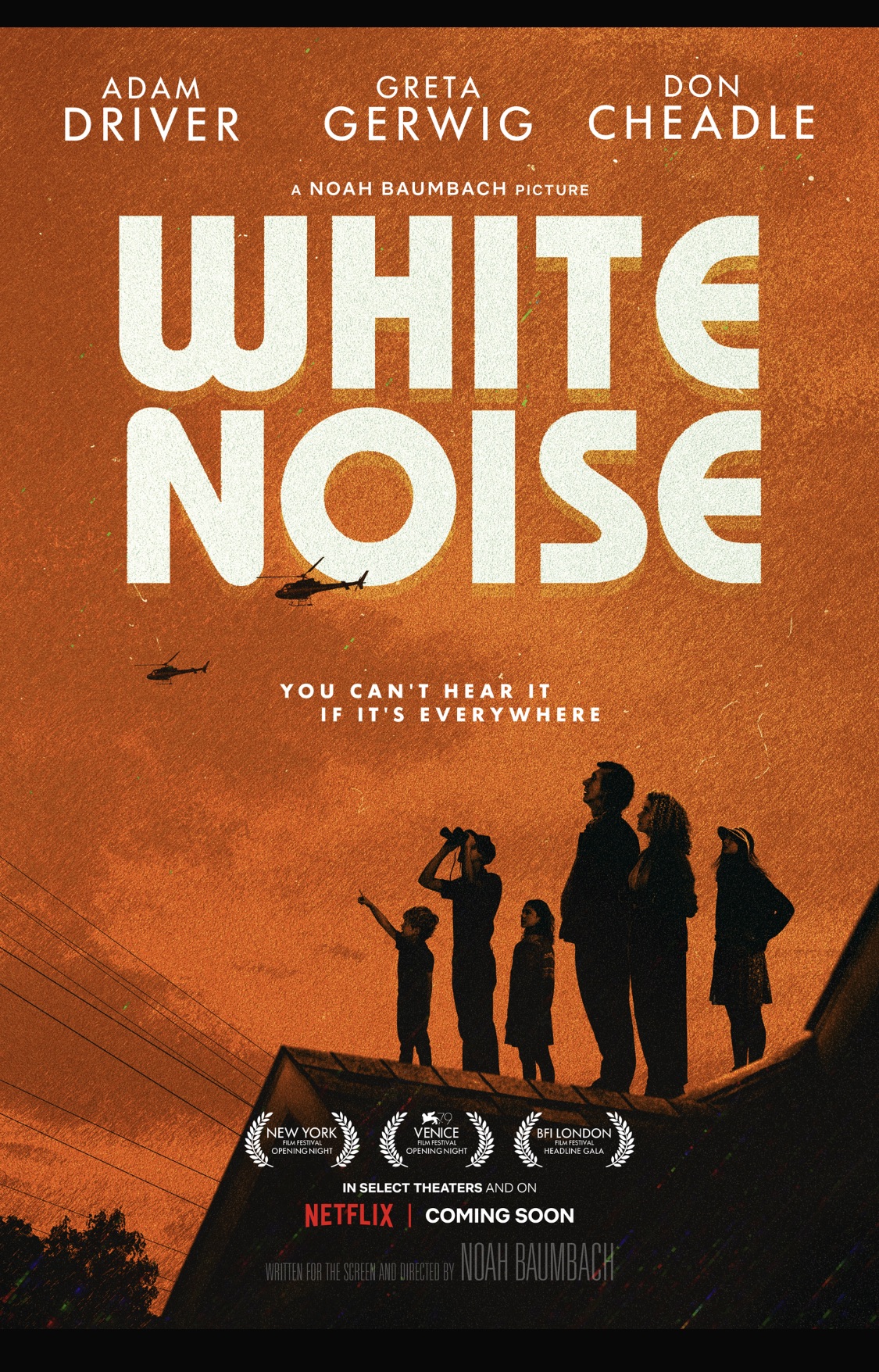
 Greetings again from the darkness. Writer-director Noah Baumbach’s latest film is one of those that causes us to feel a bit guilty at not finding it as important or noble as it finds itself. That’s not meant to be as critical as it sounds. Afterall, Baumbach is the one who has managed to bring the “unfilmable” … Don DeLillo’s 1985 novel (National Book Award for fiction) … to the big screen. Baumbach’s last film was MARRIAGE STORY (2019), a masterpiece on relationships, and while this current film is a more ambitious undertaking, it likely will prove less accessible to many viewers.
Adam Driver stars as Jack Gladney, a professor at a (fictitious) midwestern college, who has reached celebrity status through his Hitler studies curriculum – although he remains uneasy at his own inability to speak German. Jack’s own home life teeters on bedlam most every day. He and his wife Babbette (Greta Gerwig, director Baumbach’s real life spouse) are both on their fourth marriage, and their blended family of kids results in tension and more overlapping dialogue than one would find in a filled sports arena. Babbette is showing signs of early onset dementia, and is regularly and secretly taking a drug called Dylar. Of course, it’s the 1980’s and Google hasn’t been born, so Jack and Babbette’s daughter Denise (Raffey Cassidy) find themselves scouring books and asking doctors about the mysterious drug.
There are some amazing lines (most taken straight from DeLillo’s novel) throughout the film, and Act 1 features a stunning rap-battle type lecture with Jack and his colleague Murray Suskind (Don Cheadle) taking on Elvis versus Hitler and their relationships with their respective mothers. It’s filmed like a boxing match and most of the students seem oblivious to this treat. Act 2 is labeled “The Airborne Toxic Event” and it’s a fiery tanker car (filled with toxic waste) explosion that marks the transition. A mass evacuation takes the family to Camp Daffodil for 9 days, and Jack’s limited exposure to the toxic air places him in peril and leads to Act 3 where the fear of death merges with the discovery of Babbette’s Dylar source. The question then becomes, will Jack first die or commit murder … because, as we are told, men are killers.
Jack’s son is aptly named Heinrich and is played by Sam Nivola (the son of Alessandro Nivola and Emily Mortimer). Baumbach is an intellect obsessed with neurotic intellectual characters, and he thrives at blurring the line between satire and societal commentary … which is obviously why he was drawn to DeLillo’s novel. The film is often chaotic, and is an odd blend of science fiction, the ugliness of consumerism, and teasing the end of our world and existential contemplation reflecting our fear of death. Especially effective are the Production Design of Jess Gonchor and the work of composer Danny Elfman. Perhaps there could be no better ending than the dance number in the vitally important local grocery store that continues through the closing credits. The film is funny, frightening, and a bit of a downer that offers more questions than answers – an adaptation that serves the novel.
Opening in theaters on December 2, 2022


 Posted by David Ferguson
 Movie Reviews from the Dark