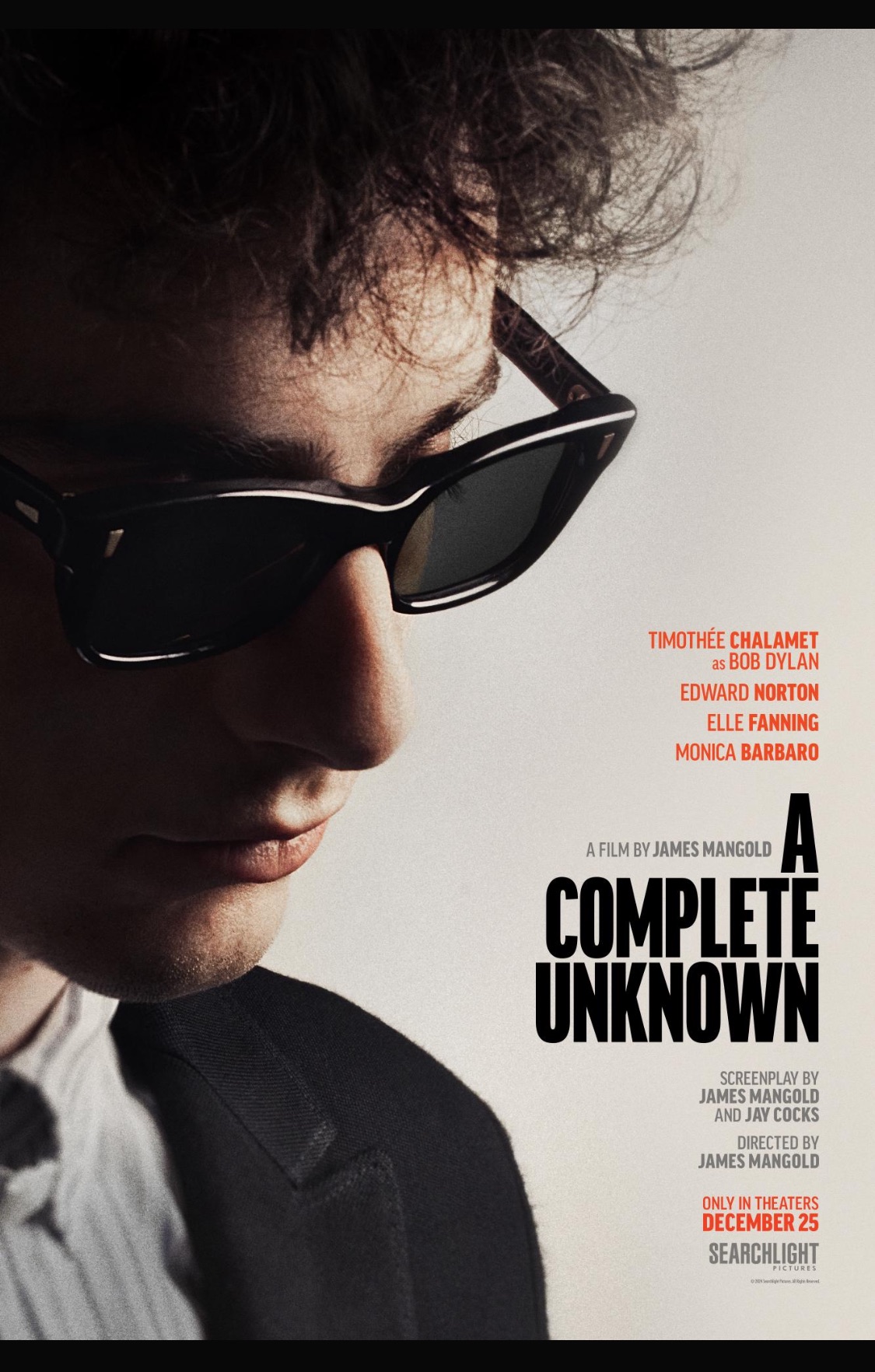
 Greetings again from the darkness. As a nineteen-year-old college dropout, Robert Zimmerman traveled from his hometown of Hibbing, Minnesota to New York City so that he could play music and visit his folk hero, Woody Guthrie, who was hospitalized with Huntington’s Disease. Of course, Zimmerman became known as Bob Dylan, and his musical genius continues to this day – more than 60 years and counting. Those early formative years are recounted here by writer-director James Mangold (WALK THE LINE, 2005; 3:10 TO YUMA, 2007; FORD V FERRARI, 2019) and co-writer Jay Cocks (GANGS OF NEW YORK, 2002), who used Elijah Wald’s 2015 book, “Dylan Goes Electric! Newport, Seeger, Dylan and the Night that Split the Sixties” as inspiration.
Timothee Chalamet perfectly captures the essence of young Bob Dylan – one who was driven to write songs, and one destined to change the music scene. Was he focused? Absolutely. Was he arrogant? Without a doubt. Was he talented? So much so that for decades he has inspired other musicians and songwriters. Edward Norton is uncanny as folk icon and activist Pete Seeger, even nailing the distinctive accent and mannerisms, while Scoot McNairy plays legendary Woody Guthrie (“This Land is Your Land”), already robbed of voice by disease. The two men are taken aback by the first song Dylan plays for them – providing just the boost of confidence the young man needed to take to the streets and clubs, honing the sound that would bring joy to so many.
We get a sense of Dylan’s journey and rise to fame, as well as a couple of his romantic dalliances – specifically, artist Sylvie Russo (an odd name change for a character clearly based on Suze Rotolo) and activist and fellow folk singer Joan Baez. Elle Fanning plays Russo/Rotolo, who appeared with Dylan on the cover of his “The Freewheelin’s Bob Dylan” album, and Monica Barbaro plays Baez and gets to showcase her own lovely voice on stage a few times (as well as Baez’s frequent frustration with Dylan). Other supporting roles include Boyd Holbrook as Johnny Cash, Charlie Tahan as Al Kooper, Dan Fogler as Albert Grossman, and Norbert Leo Butz as Alan Lomax. All of these were key players in the development of Dylan.
Dylan’s obsession with writing is established – at the expense of most personal relationships. However, the crux of this story is the moment that transformed Bob Dylan from a folk music favorite to a musical icon. A good deal of time is spent showing the number of people who assertively fought against Dylan turning electric for the 1965 Newport Folk Festival. It’s such a classic example of an institution trying to protect its territory from change … as if the plugging of a guitar into an amp could ruin music that has constantly evolved over many centuries. Contradictory reports claim Dylan was booed mercilessly while he played that day, while other reports claim there were a few in the audience upset, but most reacted warmly to the new style. I don’t believe the film mentions that Dylan was backed that day by a good chunk of The Paul Butterfield Blues Band, but we do get to experience the new sensation, “Like a Roling Stone”.
Chalamet surprises here with his depth of performance, as well as his musical ability – singing and guitar playing. Rabid Dylan fans will surely find fault with some details, but most music fans will embrace the look at Dylan’s musical roots and the development of his genius and songwriting prowess.
Opens in theaters on December 25, 2024


 Posted by David Ferguson
 Movie Reviews from the Dark