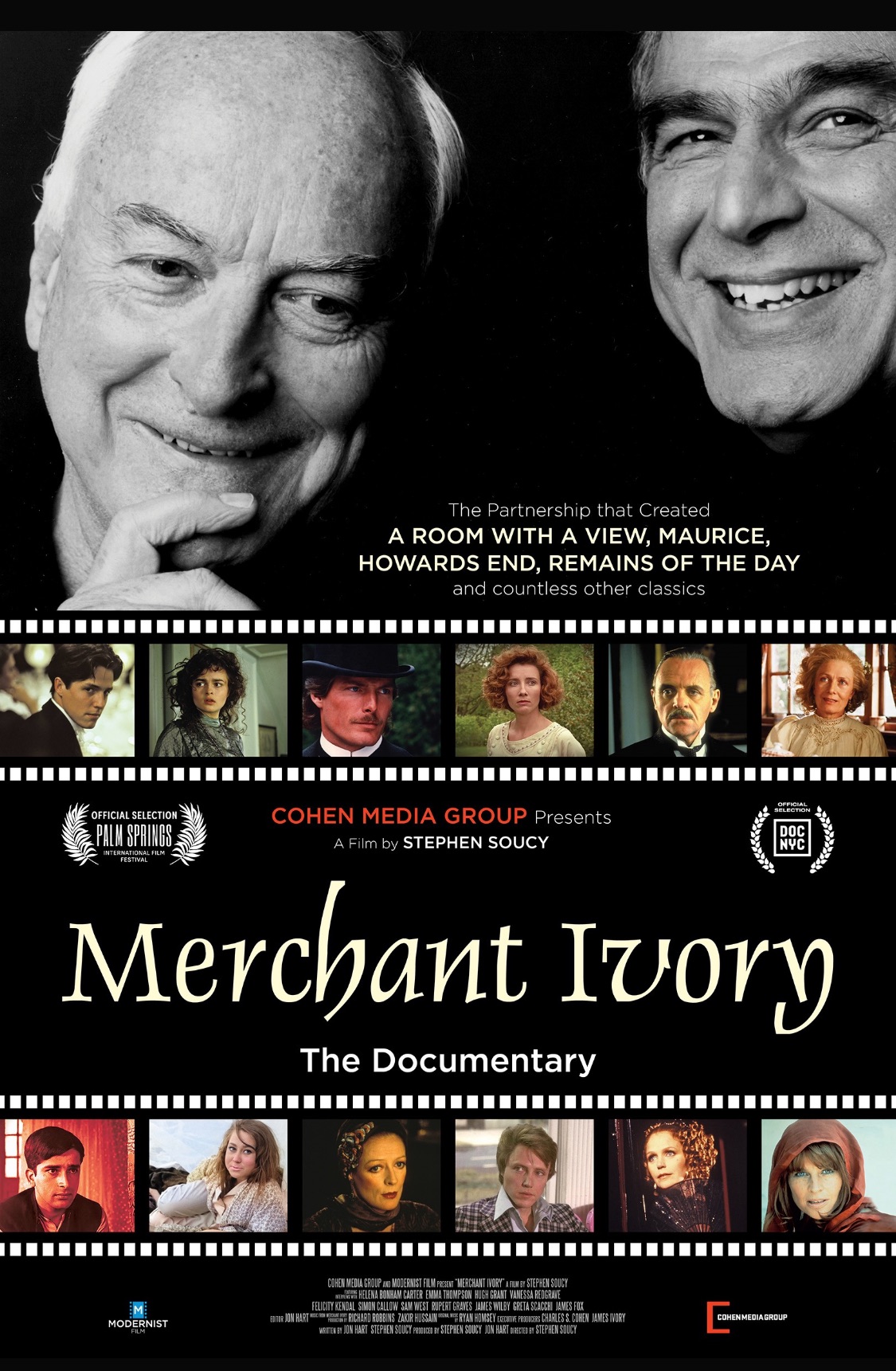
MERCHANT IVORY (2024, doc)

August 29, 2024

Greetings again from the darkness. “A Merchant Ivory film” became a colloquialism when discussing certain films from the mid-1980’s and continuing for about twenty years. Of course, they weren’t all actual Merchant Ivory films … though many tried to be. Documentarian Stephen Soucy has delivered quite a tribute to the filmmakers and the two men. Although from the beginning, Soucy posits this as a four-headed troupe, not two-headed.

The opening statistics show, between 1961 and 2007, Ismail Merchant produced 42 films, James Ivory directed 30 films, Ruth Prawer Jhabvala wrote 23 films, and composer Richard Robbins scored 21 films. With so many Oscar nominations for his films, it’s interesting to note that producer Merchant never took the gold statue. It should also be noted that Ivory is the only surviving member of the foursome. Merchant died in 2005. Robbins died in 2012. Ruth died in 2013. It’s 96-year-old James Ivory who is still active today, and even sits for an interview for the film.

Soucy divides the film into six chapters, but the film is so well structured, the chapter headings aren’t even needed to help us stay on track. We hear how Merchant and Ivory first met, and early on Soucy includes interviews from actors such as Helena Bonham Carter, Hugh Grant, Emma Thompson, a prickly Vanessa Redgrave, Rupert Graves, Sam Waterston, and Simon Callow to offer insight into the challenging projects. Actors rave about the script while relaying the difficulties in working with such low and tight budgets. Merchant was constantly cutting costs while simultaneously working to raise money during productions.

Much of the insight revolves around the divergent personalities of Merchant and Ivory. Their relationship was volatile both on set and off, professionally and personally. Being “secretly” gay in New York during the 1960’s would be challenging enough, and we then learn that Merchant was a charming rascal (sometimes con man), while Ivory was a meticulous craftsman. If not for Ivory’s professionalism and Merchant’s cooking, the sets may have been even more explosive.

As movie goers, we aren’t privy to that extraneous stuff. Instead, we see the scrumptious sets and stunning costumes complementing rich stories and superb acting. So much of what Soucy presents here is new to us as film lovers. Additionally, it’s wonderful to learn more about Oscar winning writer Ruth Prawer Jhabvala, who excelled at adapting the works of EM Forster for the big screen: A ROOM WITH A VIEW (1985), MAURICE (1987), and HOWARD’s END (1992). And yes, she wrote the screenplay for THE REMAINS OF THE DAY (1993), which won no Oscars going up against the magnificent SCHINDLER’S LIST. Her daughter Ava is a contributor here.

Soucy tells us there were 15 films before A ROOM WITH A VIEW, which changed everything for the filmmakers and partners. It’s truly fascinating to see clips from their early films and hear the stories about how those projects came together. There was, of course, criticism to go with the accolades, as their movies were referred to as the “Laura Ashley” school of filmmaking. And frequent costume designers (and multi-Oscar winners) Jenny Beavan and John Bright add that in addition to the budgetary concerns, the expedited timeframes and staff shortages brought more strain. Personal drama is brought to light, especially as it pertains to composer Richard Robbins, and his relationships with both Merchant and Helena Bonham Carter. The walls of that country estate could surely tell some tales.

After Merchant’s death, it appeared that THE CITY OF YOUR FINAL DESTINATION (2009) would likely be Ivory’s final film project. Instead, he won an Oscar for adapting the screenplay (from Andre Aciman’s novel) for CALL ME BY YOUR NAME (2017), and has continued to write and direct. Ivory’s memoir is quoted here. The chronological look at their films is interesting enough, yet it’s the behind-the-scenes insight and personal details that set this apart from many documentary tributes. Even as it concludes, in our minds we hear the voice of Merchant, “Shoot, Jim! Shoot! Shoot!

Opens in select theaters August 30, and expanding on September 6, 2024

WATCH THE TRAILER


CALL ME BY YOUR NAME (2017)

December 21, 2017

 Greetings again from the darkness. Although confusing the two is understandable, there is a difference between a story of romance and a story of love. That’s not to say that the two can’t overlap; in fact, they often do. In movies, romance is the dish most often served because it’s usually more interesting. Watching the flirtatious dance and often awkward exploratory stage of what was once called the rituals of courting offers a writer, actor and director infinitely more possibilities than what we associate with the years of deep connection labeled as love. Andre Aciman’s novel is adapted by James Ivory (of Merchant-Ivory fame, and 3 times Oscar nominated for Best Director) and the script leans heavily on romance … lustful romance, to be specific.

Director Luca Guadagnino (A BIGGER SPLASH, I AM LOVE) is an expert at making movies that engage our senses. His movies delicately tease us – they slowly absorb us into the emotions and feelings of the characters. Very few filmmakers have the skill to subtly seduce the viewer, and draw us into the story so that we are no longer merely observing. It’s nuanced story-telling at the highest level.

Elio’s (Timothee Chalamet) family spends the summer at their estate in northern Italy. You’ve likely never met a more cultured family. His father (Michael Stuhlbarg) is a renowned professor, his mother (Amira Casar) a recognized translator, and Elio himself is a musical prodigy who whiles away the days by transcribing classical music and reading every book he can get his hands on. Oh, he also flirts with the local girls because he is, after all, a 17 year old boy. His intelligence and corresponding wit is of a much older person, standing in stark contrast to his innocence and childlike maturity level with all other pieces of life’s puzzle.

Elio’s world is rocked when his father’s newest research assistant, Oliver (Armie Hammer), shows up. An “Americano” who offsets his extreme politeness with an unrefined “Later” when departing any encounter, Oliver explodes on the scene like a Greek God. He and Elio have an initial passive-aggressiveness towards each other as they test the boundaries for weakness, and more importantly, interest. Things move very slowly as the passion and curiosity brews during their bike rides, walks through the apricot orchards (forbidden fruit), swimming in every watering hole, and competitive banters on intellectual topics. There is a sensuality to most every scene, though those same scenes are filled with unspoken tension.

The sunlit beauty as each summer day passes initially masks the emotions, and the stunning setting, people, colors, and music is accentuated by the camera work of cinematographer Sayombhu Mukdeeprom. Nature is on display in its full glory; not just through trees, sunlight, and water, but in that elusive and unexplained connection between two people so strongly drawn to one another.

Director Guadagnino’s film easily slides into the romantic sub-genre of such films as BLUE IS THE WARMEST COLOR, BROKEBACK MOUNTAIN, and CAROL, and the artistic approach provides a gentleness that even the peach scene can’t undo. Michael Stuhlbarg (who seems to be everywhere these days) has an extraordinary father/son scene near the end which reminds us that each one of us has a story on how life may or may not have turned out as planned. The gut-wrenching pain with sharing that story usually means it remains untold; however, the invaluable lesson is not lost on Elio. First love and first heartbreak bring both emotional ecstasy and emotional devastation, and whether you believe the film’s statement “We have less to give each new person”, you’ll likely agree that the use of Psychedelic Furs “Love My Way” is spot on.

watch the trailer:


THE CITY OF YOUR FINAL DESTINATION (2009)

July 4, 2010

 Greetings again from the darkness. Most everyone is familiar with the peak of Merchant-Ivory film collaboration which included: A Room With a View, Remains of the Day, and Howard’s End to name a few. Ismail Merchant died a few years ago, but director James Ivory returns with a powerful, yet odd film based on Peter Cameron’s novel.

The film boasts a very nice cast: Anthony Hopkins as the aging, gay man who is the brother of a famous (now dead) novelist; Laura Linney as the widow of the writer; and Charlotte Gainsbourg as the writer’s former mistress. Oh yeah, these three all live together (plus Hopkins’ younger Japanese partner) in a compound in Uruguay on land the writer left behind after his suicide.

The story gets interesting when Omar (played by Omar Metwally) shows up unannounced after receiving a declination of his request to write a biography on the novelist. Hopkins supports the idea as he expects it will generate book sales and revenue for the group. Linney is flat against it thinking it will spill too many secrets. Gainsbourg initially sides with Linney, but changes her vote when she falls for Omar.

On the surface, the story is about Omar’s attempt to win over Linney’s bitter character and change her mind. The much more appealing story is Omar’s awakening to life in this oddball community, now that he is out of the clutches of his domineering type-A girlfriend and co-worker played superbly by Alexandra Maria Lara. Talk about a personality that makes you want to run away to Uruguay! She almost makes Linney’s character seem charming.  Almost.

Mr. Ivory excels in subtlety and he is in fine form here. So many “little” moments make this story really click. It is also beautifully photographed. This is a really good film with interesting characters and a theme of finding one’s self that will probably get lost in the mass confusion of summer giants like Twilight and Toy Story 3. If you get the chance, make the time to see this one.