“Adventure-a-thon” THE LOST CITY OF Z

May 3, 2025

Blogathon “Adventure-a-thon”

The blogathons administered by Cinematic Catharsis and RealWeegieMidget Reviews are always fun to participate in … and the entries from talented writers make for interesting and enlightening reading. Unfortunately, my movie review schedule often prevents me from dedicating the necessary time, so I’m always excited when my lull corresponds to their next collaborative blogathon.

This time the topic is “Adventure”, and since so many movies and TV shows fall into that category, the challenge was in selecting one that I not only left me in awe, but also hasn’t received the recognition it deserves (in my opinion). On this basis, my choice became:

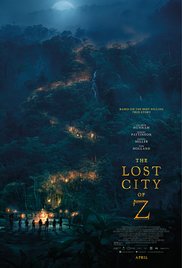
 THE LOST CITY OF Z (2016)

It’s been almost ten years since this film from director James Gray was released, and I’ve recommended it many times to folks who were unfamiliar or unaware. The film is expertly photographed by cinematographer Darius Khandji (a two-time Oscar nominee) and is based on the book by the absurdly talented David Grann, whose books also include one of my personal favorites, “Killers of the Flower Moon”. The screen is filled with green and golden hues (similar to OUT OF AFRICA), providing a sense of realism and a touch of romanticism to the true adventures of the bold explorer, Percy Fawcett.

Charlie Hunnam (fresh off his “Sons of Anarchy” run) portrays military man and explorer Fawcett (often) through quiet strength and a doggedness to discover what is ahead. Helping us to understand this man’s heroic actions, director Gray divides the presentation into three areas: the stuffy, poorly lit backroom of London’s power brokers; the 1916 WWI front line where Fawcett’s courage is on full display; and the Amazon jungles where Fawcett strives for glory and redemption. No matter that we viewers would be satisfied with a film focusing only on those last two circumstances of action, Gray wisely recognizes that it’s the debates and conversations within the backrooms that motivate Fawcett to never give up the fight.

With a run time of 2 hours and 21 minutes, the film is quite long, yet it never seems so thanks to the three main Fawcett expeditions of focus. In 1906 the Royal Geographic Society enlisted Fawcett for a “mapping” journey to distinguish boundaries around Bolivia in what had become a commercially important area to the abundance of rubber. It’s on this adventure where Fawcett cracks wise about overcoming his “poor choice in ancestors”. He’s joined on this expedition by the great Franco Nero, and it’s also the one that lights Fawcett’s lifelong obsession with proving the existence of Z (Zed), an earlier advanced society.

1912 brings the second Amazonia expedition – the one in which renowned Antarctic explorer James Murray (played her by a snarling Angus Macfayden) joins Fawcett and his loyal and expert travel companion, Henry Costin (a terrific Robert Pattinson). The trip proceeds as one might expect when an ego-driven, unqualified yet wealthy passenger hitches a ride for glory alone. Murray’s history is well documented, and the film treats him just as we’d expect.

It’s the third trip (1925) that Fawcett makes with his son that will not only prove to be his last, it’s also the one that left unanswered questions which writer Grann felt compelled to research for his book. What possesses a man to hop into a wooden canoe on unchartered waters and trek through lands and jungles with no known back story? The spirit and mettle of such a man defines the legacy of Percy Fawcett. The film also offers us glimpses of life at home for Fawcett with his wife Nina (Sienna Miller), who flashes signs of early feminism. One of their kids is played by Tom Holland (giving us a future Spider-Man and future Batman – Pattinson in the same movie).

The film leaves an impact for many reasons: it looks stunning, Fawcett’s life was fascinating, the adventures are dangerous and breathtaking, we gain a sense of the courage required for such explorers. This was also the year of LA LA LAND – and the MOONLIGHT mess on stage – and James Gray’s film was overlooked for awards, but even all these years later, it still offers an movie-watching experience like few others.

Trailer: THE LOST CITY OF Z


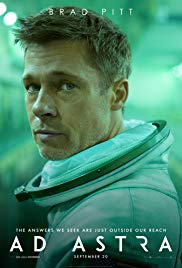
AD ASTRA (2019)

September 19, 2019

 Greetings again from the darkness. Astronaut Roy McBride’s pulse rate may never go above 80 bpm, but mine certainly did during the opening sequence which features a stunning and spectacular space fall. It’s unlike anything we’ve seen before. Roy has trained his entire life for this work; however his true mental state is only revealed slowly throughout the film’s run. After witnessing his actions and hearing (through narration) his thoughts, we are left to decide what we think of Roy … stoic hero or simmering psychopath? Either way, he’s haunted by a past that has rendered him mission-focused and the world’s worst party guest. The film takes place in the not-too-distant future.

Brad Pitt stars as Roy McBride, in what may be his career best (and most inward-looking) performance. Roy is the son of NASA hero Clifford McBride (Tommy Lee Jones), the leader of The Lima Project – a decades old mission to Neptune tasked with searching for extraterrestrial life. The elder McBride has long been assumed dead with no signals or response signs in many years. A recent power surge that threatens humanity has been traced to Neptune, and now Roy is being used as bait to track down his rogue astronaut father and prevent him from causing further damage.

Roy’s assignment requires him to journey from Earth to the Moon to Mars and, ultimately, on to Neptune. Along the way, he travels with Colonel Pruitt (Donald Sutherland), an old friend of Clifford’s, who is sent along to make sure the son doesn’t acquiesce to the father. Of course, it’s a nice touch to have Tommy Lee Jones and Donald Sutherland together again in a space movie 20 years after SPACE COWBOYS, a more upbeat adventure. Here we see a populated moon – yet another place we humans have messed up – replete with turf wars. There is also a shootout in a space capsule, and an unscheduled stop that provides shocking visuals and causes a shift in the crew.

James Gray, who directed the vastly underrated THE LOST CITY OF Z (2016) delivers a space film with terrific visuals and a script he co-wrote with Ethan Gross, that examines how a father can affect the life of his son even when he’s not present. The film has an unusual pace to it. There are a few action sequences, but the core of the film is the psychological state of son versus absent father. Roy’s inability to connect with loved ones is displayed through flashbacks involving Liv Tyler, and it’s his own narration that provides us much more insight than his regularly scheduled psychological tests.

Ruth Negga (LOVING) has a nice turn as Helen Lantos, one of the key officials at the Mars space station, and her encounter with Roy provides him with yet more background on his father. It’s easy to recall both APOCALYPSE NOW (only with Tommy Lee Jones as Colonel Kurtz) and 2001: A SPACE ODYSSEY given the isolation, questionable mental state, and mission-gone-wrong. The cinematography Hoyte Van Hoytema (DUNKIRK) is outstanding, and never allows us to forget Roy is in space … with danger present in every moment. The title translates “to the stars”, and it’s true in every sense.

Mr. Gray has delivered a thought-provoking big budget science fiction film. It has incredible special effects, but the personal story packs even more punch than the galactic adventure. Many will compare this to other space films like CONTACT, GRAVITY, and FIRST MAN, but this one requires more investment from the viewer, as it’s the character study that resonates. This is Brad Pitt’s movie (he’s in most every scene), and the ties to his father are never more evident than when he (and we) see The Nicholas Brothers performing in black and white on that monitor. If a daily psychological profile was required for each of us, it would be interesting to see how much work would actually be accomplished. Now, imagine yourself stationed in space and just try to keep your heartrate below 80!

watch the trailer:


THE LOST CITY OF Z (2017)

April 20, 2017

DALLAS INTERNATIONAL FILM FESTIVAL 2017

 Greetings again from the darkness. We aren’t likely to watch a more beautiful or expertly photographed film this year. Director James Gray’s (The Immigrant, We Own the Night) project looks and feels like a throwback to days of epic filmmaking, and cinematographer Darius Khandji (Se7en, Evita, The Immigrant) fills the screen with green and gold hues (similar to Out of Africa) that deliver both a sense of realism and a touch of romanticism. The minor quibble here is with the emphasis on the biographical rather than the more interesting and compelling and adventuresome expeditions to the “new” world.

Our true to life hero (and the film’s portrayal provides no other description) is military man and explorer Percy Fawcett played by Charlie Hunnam. Based on the book by David Grann, the film divides focus into three areas: the stuffy, poorly lit backrooms of London power moguls; the 1916 WWI front line where Fawcett proves his mettle; the jungles of Amazonia wherein lies Fawcett’s hope for glory and redemption. It’s the latter of these that are by far the most engaging, and also the segments that leave us pining for more detail.

The three Fawcett expeditions form the structure for the quite long run time (2 hours, 21 minutes). In 1906 the Royal Geographic Society enlisted Fawcett for a “mapping” journey to distinguish boundaries around Bolivia in what had become a commercially important area due to the black gold known as rubber. Fawcett was not just a manly-man, he was also obsessed with overcoming his “poor choice in ancestors” and gaining a position of status within society. Using his military training and personal mission, that first expedition (with help from a powerful character played by the great Franco Nero) was enough to light Fawcett’s lifelong fixation on proving the existence of Z (Zed) and the earlier advanced society.

Back home, Fawcett’s wife Nina (Sienna Miller) shows flashes of turn-of-the-century feminism, though lacking in judgment when she suggests a ridealong with her husband on his next expedition. Although the couple spends little time together, given the years-long trips, they do manage to produce a hefty brood of kids, the eldest played by Tom Holland (the new Spider-Man).

1912 brings the second Amazonia expedition, the one in which renowned Antarctic explorer James Murray (a snarly Angus Macfayden) joins Fawcett and his by now loyal and expert travel companion Henry Costin (a terrific Robert Pattison). The trip proceeds as one might expect when an ego-driven, unqualified yet wealthy passenger is along for only the glory. Murray’s history is well documented and here receives the treatment he earned.

It’s the third trip in 1925 that Fawcett makes with his son that will be his last, and the one that dealt the unanswered questions inspiring Mr. Grann to research and write his book. It’s also the segment of the film that leaves us wanting more details … more time in the jungle. With the overabundance of information and data available to us these days, the staggering courage and spirit of those willing to jump in a wooden canoe on unchartered waters and trek through lands with no known back story, offer more than enough foundation for compelling filmmaking. It’s this possibility of historical discovery that is the real story, not one man’s lust for medals and confirmation. More jungle could have elevated this from very good to monumental filmmaking.

watch the trailer:


DIFF 2017: Day Eight

April 9, 2017

The Dallas International Film Festival runs March 31 – April 9, 2017

 It’s the second Friday of DIFF which means a high profile new release in the prime time slot. This year it’s The Lost City of Z. The epic and historical tale hit theatres nationally next week, so it’s nice to get an early peek. Below is a recap of the 2-and-a-half films I watched on Friday April 7:


THE LOST CITY OF Z

We aren’t likely to watch a more beautiful or expertly photographed film this year. Director James Gray’s project looks and feels like a throwback to days of epic filmmaking, and cinematographer Darius Khandji’s (Se7en, Evita, The Immigrant) fills the screen with green and gold hues that deliver both a sense of realism and a touch of romanticism. The quibble here is with the emphasis on the biographical rather than the more interesting and compelling and adventuresome expeditions to the “new” world.

Our hero (and the film’s portrayal provides no other description) is military man and explorer Percy Fawcett played by Charlie Hunnam. Based on the book by David Grann, the film divides focus into three areas: the stuffy, poorly lit backrooms of London power moguls; the 1916 WWI front line where Fawcett proves his mettle; the jungles of Amazonia wherein lies Fawcett’s hope for glory and redemption. It’s the latter of these that are by far the most engaging, and also the segments that leave us wishing for more detail.

The three Fawcett expeditions form the structure for the quite long run time (2 hours, 21 minutes). In 1906 the Royal Geographic Society enlisted Fawcett for a “mapping” journey to distinguish boundaries around Bolivia in what had become a commercially important area due to the black gold known as rubber. Fawcett was not just a manly-man, he was also obsessed with overcoming his “poor choice in ancestors” and gaining a position of status within society. Using his military training and personal mission, that first expedition (with help from a powerful character played by the great Franco Nero) was enough to light Fawcett’s lifelong fixation on proving the existence of Z (Zed) and the earlier advanced society.

Back home, Fawcett’s wife Nina (Sienna Miller) shows flashes of turn-of-the-century feminism, though lacking in judgment when she suggests a ridealong with her husband on his next expedition. Though the couple spends little time together, given the years-long trips, they do manage to produce a hefty brood of kids, the eldest played by Tom Holland (the new Spider-Man).

1912 brings the second Amazonia expedition, the one in which renowned Antarctic explorer James Murray (a snarly Angus Macfayden) joins Fawcett and his by now loyal and expert travel companion Henry Costin (a terrific Robert Pattison). The trip proceeds as one might expect when an ego-driven, unqualified yet wealthy passenger is along for only the glory. Murray’s history is well documented and here receives the treatment he earned.

It’s the third trip in 1925 that Fawcett makes with his son that will be his last, and the one that dealt the unanswered questions inspiring Mr. Grann to research and write his book. It’s also the segment of the film that leaves us wanting more details … more time in the jungle. With the overabundance of information and data available to us these days, the staggering courage and spirit of those willing to jump in a wooden canoe on unchartered waters and trek through lands with no known back story, offer more than enough foundation for compelling filmmaking. It’s this possibility of historical discovery that is the real story, not one man’s lust for medals and confirmation. More jungle could have elevated this from very good to monumental filmmaking.


CHEER UP (documentary)

Well I was due for my first major disappointment, and it came courtesy of a documentary with an interesting synopsis. The leader of Finland’s “worst” cheerleading squad travels to Texas to gain tips and training ideas to improve her squad’s performance. I only lasted 40 minutes of the listed 86 minute run time, and I’m still not sure if this is director Christy Garland’s final version of the film, or if this was simply a rough cut rushed for a festival screening. And that’s where I will leave my comments


SKY ON FIRE (Chongtiang Huo)

A late night screening of an action movie from China/Hong Kong has a responsibility to the genre to check certain boxes, none of which included thought-provoking or socially conscious issues. Instead, success depends on a visual onslaught of explosions, car chases, helicopter flights, sleek and modern tall building sets, loud and massive gun battles, and confined area martial arts duels.

Writer/director Ringo Lam and his cast (Daniel Wu, Hsiao-chuan Chang, Amber Kuo) subject themselves to all of the violent perils listed above, and even toss in cancer and the battle for revolutionary healing drugs to ensure there is never a moment of peace and quiet during the film.

The “ex-stem cells” are the McGuffin that creates the good guys vs bad guys scen ario. Will this medical breakthrough be used to cure cancer and other diseases, or will they be weaponized for power? So while that’s the question asked in the film, my movie-buddy JJ asked the real question … has Michael Bay already begun work on an Americanized version? Surely that mammoth skyscraper explosion is already on his Bay-splosion radar.