 “As far back as I can remember, I always wanted to be a gangster.” That’s how Henry Hill introduces himself. He is the narrator and key figure in director Martin Scorcese’s 1990 masterpiece. What follows Mr. Hill’s intro is the film version of Nicholas Pileggi’s non-fiction book, Wiseguy: Life in the Mafia Family (published 1986). Every so often the perfect match of writer, director and cast occurs, and Goodfellas is one of those rare treats.
Viewing a 35mm print at the historic Texas Theatre just seemed apropo. Knowing that this is the realized vision of Mr. Scorcese and his long time editor, Thelma Schoonmaker, caused the numerous VHS and DVD viewings over the years to simply fade away. The silver screen works wonders for a film with such “big” characters, such startling violence, and such a perfectly inter-woven soundtrack.
Ray Liotta plays Henry Hill, the real life gangster who ended up snitching on the mob and entering the Federal Witness Protection program. This should not be considered a spoiler because Hill’s story is known worldwide and, well, the movie is 23 years old! Liotta was a relative newcomer when he exploded onto the screen in Jonathan Demme’s Something Wild in 1986. His manic performance in that movie led Scorcese to cast him as Henry Hill. The real life Hill spoke at length with Pileggi for the novel, and the result is a very detailed and nuanced look into the life inside a New York crime family.
 The fascinating aspects are too numerous to touch on them all, but there are some that really stood out in this latest viewing. First, Lorraine Bracco plays Hill’s wife Karen. Watching the development of her character is pure gold on screen. She starts out as a fresh-faced blind date, who pulls no punches in putting Hill in his place after he stands her up … and right in front of his fellow gangsters, no less. Watching her fall for “the life” is like watching someone get gradually intoxicated. She seems aware but numb to the rational side of her brain. As Karen develops, she battles through some really tough situations, continues to be Hill’s biggest supporter, and finally his cohort in crime near the end. She is one of the most interesting and best developed female characters from any gangster movie.
Another really fascinating character to follow is that of Tommy Devito played by Joe Pesci. Tommy is a tough guy born into the life, but the prime example of just never being satisfied. His short fuse temper is responsible for some of the most memorable scenes in the movie. The “funny like a clown” scene and the fallout from “go home and get your shinebox” are two of the more 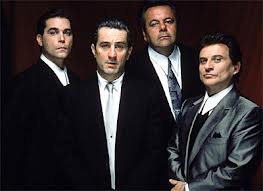 frightening sequences ever seen on screen, and are perfect examples of what a loose cannon Tommy is. This character is based on the real life Tommy “Two Gun” DeSimone, muscle for the Lucchese crime family.
In addition to Karen, Henry and Tommy, the other main character is Jimmy Conway, played by Robert DeNiro. Conway is based on the real life Jimmy “The Gent” Burke, who was supposedly the mastermind behind the infamous Lufthansa heist depicted in the movie. The Conway character perfectly represents paranoia and greed, while hiding behind the mob loyalty pledge. DeNiro never once overacts here, but his Conway dominates the screen despite the strong presence of Liotta and Pesci … and even Paul Sorvino, who plays mob boss Paulie. Paulie is based on Paul Vario, the head of the Lucchese crime family. Sorvino plays him as quietly powerful and a guy with a phone phobia (for good reason). Sorvino’s Paulie is the centerpiece of the mob and is totally believable as a guy you better not cross.
 One of the more memorable scenes features Jimmy, Henry and Tommy stopping off at Tommy’s mother house to pick up a shovel … and a large, useful knife. While there, Tommy’s mother (played by Catherine Scorcese, Martin’s mother) not only makes them a huge 3 am Italian meal, but also shows off some of her artwork, and even tells a joke!
What’s really fun to watch as the film progresses is the change of pace and camera work. Watching young Henry earn his stripes is treated with a light, almost comical touch. As he becomes fully entrenched, we see a young man enjoying the power and respect of his position. This is crystallized by Scorcese’s infamous long-tracking shot through the back entrance and kitchen of the Copacabana as Henry and Karen end up front row by the stage. The downward spiral is much more frenetic with fast cuts and a desperate feel. Scorcese helps us feel the drug-induced paranoia that dominates Henry.
David Chase has stated that Goodfellas had quite an impact and inspired him to create “The Sopranos”, and the marks are 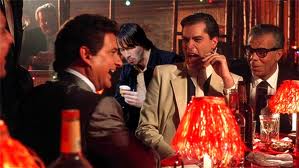 quite clear. There is even a significant crossover in the cast as both feature Frank Vincent, Tony Sirico, Frank Pellegrino, Michael Imperioli and, of course, Lorraine Bracco (who was Tony Soprano’s psychiatrist).
Goodfellas was nominated for six Academy Awards, and Joe Pesci was the only winner (Best Supporting Actor). It lost out in the Best Picture category to Dances with Wolves. Scorcese has since directed two other critically acclaimed gangster films: Casino (1995, from another Nicholas Pileggi book), and The Departed (2006, which won Scorcese his first Oscar and also won Best Picture). You might also like to know that Pileggi is the creator of “Vegas”, the new TV show starring Dennis Quaid and Michael Chiklis. The show is about the mob’s influence in the early “wild west” days of Las Vegas.
For years, movie lovers have been debating whether The Godfather or Goodfellas is the best gangster film. As much as I love debate, I see no reason to choose … they are both exquisite filmmaking, though quite different in style. Both films have provided us direction in life. The Godfather informed us that “It’s not personal, Sonny. It’s strictly business”. Goodfellas counseled us “Never rat on your friends, and always keep your mouth shut.” Far be it from me to question the source of good advice!
***PROFANITY WARNING*** This is the unedited “funny like a clown scene” and it’s definitely NSFW!!!


 Posted by David Ferguson

 Movie Reviews from the Dark