THE GOOD HALF (2024)

August 15, 2024

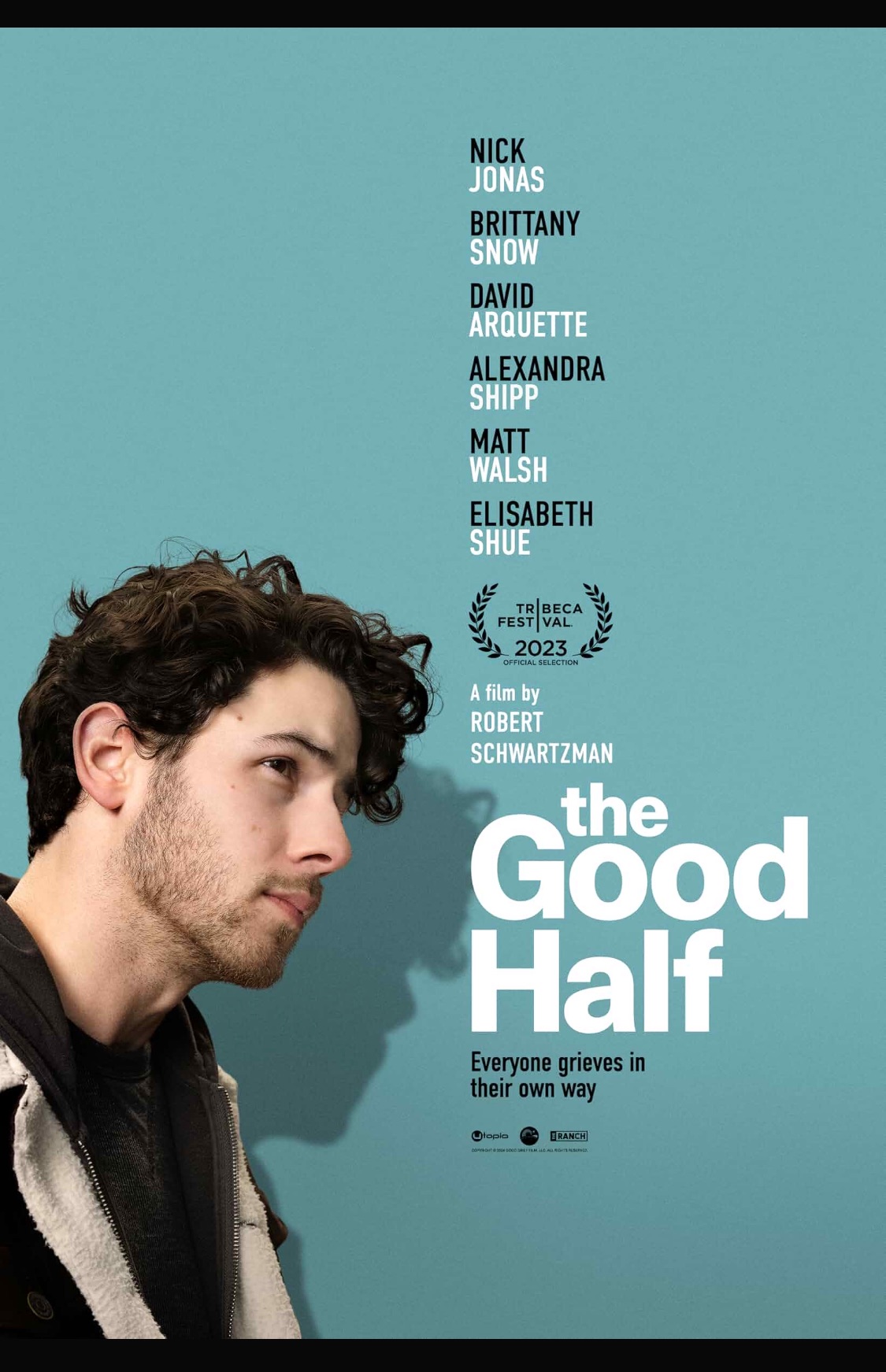
Greetings again from the darkness. Losing a parent is a difficult time that most of us will deal with at some point. Sorrow and guilt and anger are typically part of the grieving process, and that’s precisely what writer Brett Ryland and director Robert Schwartzmann (THE ARGUMENT, 2020) show us. For those who have been through it already, it’s likely to bring back emotions that will always be there, and for those who haven’t experienced this yet, it serves as a cautionary tale.

The film opens with a mother (Elisabeth Shue) trying to make peace with her angry young son (Mason Cufari). It turns out mom absent-mindedly left the boy at the store, and it takes a ‘pinky promise’ that “I’ll never leave you again” from mom to win the boy back. Of course, as avid movie lovers, we know this means mom will in fact leave the boy again at some point.

The film then jumps ahead 15 plus years, as that young boy Renn has grown up (now played by Nick Jonas) and is on a flight from Los Angeles back home to Cleveland for his mother’s funeral. While flirting over the sleeping dude in the middle seat, Renn and Zoey (Alexandra Shipp, BARBIE, 2023) bond a bit, and even exchange numbers. She’s therapist in town for a conference, and he coyly avoids telling her the real reason he’s home.

Once home, it’s clear an agitated and barely-speaking Renn is holding back emotions, and so is his sister Leigh (Brittany Snow, PITCH PERFECT franchise). Their kinda goofy dad (Matt Walsh, “Veep”) awkwardly tries to make the best of things, despite the strain between his son and daughter. Leigh is a bit miffed at Renn for leaving her alone to take care of their cancer-stricken mom, and Renn is carrying the guilt and shame of not being there, as well as the anger of having mom leave him. However, the two can share their similar feelings of disgust towards stepdad Rick (perfect villain, David Arquette), whom we also find very easy to dislike. Their casket shopping experience is a terrific scene and gives Renn a chance to open up a bit with sarcasm.

Renn escapes the pressure a couple of times by meeting Zoey for drinks … even karaoke, where Jonas sings the Modern English classic, “I Melt with You”. Jonas and Ms. Shipp have good chemistry, and that goes for Jonas and Ms. Snow, as well. In fact, Jonas delivers a strong enough performance that we feel tense when he finally unloads his pent-up emotions, and he’s able to juggle the mixture of comedy and grief and family drama. Everyone grieves in their own way, and it’s always painful. The film’s best line, “happy or not, it’s family”, is one many can relate to, and there is also a bit of advice: sometimes … take the long way.

In theaters August 16, 2024

WATCH THE TRAILER


BATTLE OF THE SEXES (2017)

September 29, 2017

 Greetings again from the darkness. At least two generations are too young to have experienced the 1973 media circus that was the tennis match between Billie Jean King and Bobby Riggs. However, what matters is that the impact and social changes that began in earnest that night at the Astrodome are still being felt and evolving today. It might seem incredulous that the 29 year old top-ranked women’s player emerging victorious against a 55 year old who played his last professional match 14 years prior would have an impact on anything other than TV rankings, but in fact, it caused a significant societal shift.

Real life married couple and co-directors Jonathan Dayton and Valerie Faris are well known for their collaborations on iconic music videos and TV commercials, and since joining the movie world have brought us LITTLE MISS SUNSHINE and RUBY SPARKS. Their talent for visual presentation is on display here in both the tennis scenes and the more intimate character moments. And, oh my, there are some intimate moments thanks to the script from Oscar winning screenwriter Simon Beaufoy (SLUMDOG MILLIONAIRE). There is no shying away from Ms. King’s sexual confusion/awareness/preferences.

Emma Stone (Oscar winner for LA LA LAND) stars as tennis legend Billie Jean King and manages to convey three different sides: the ultra-competitor, the champion for equal rights, and the married woman coming to grips with her sexual identity. Steve Carell captures the essence and mannerisms of Bobby Riggs, the former tennis champ, floundering in middle-age and always on the lookout for his next hustle or gambling opportunity. Surprisingly, only a minor portion of the film deals with the actual tennis match. Instead, the film dives into the personal lives of these two polar opposite personalities, each with their own challenges and issues.

Despite the fun and outrageousness that the Riggs character delivers, the film might have been better served focusing even more on Ms. King. While she needed the “villain”, it was really her dedication to the cause and strength amidst the backlash that made the difference … along with her court skills. Watching her stand tall in confrontations with the chauvinistic and powerful Jack Kramer (Bill Pullman) is something to behold. Again, those that weren’t around might not believe some of the outrageous claims by the men of the times.

Supporting work comes from Andrea Riseborough as the all-important Marilyn, who turns Billie Jean away from her husband Larry (Austin Stowell), Sarah Silverman as promoter Gladys Heldman, Natalie Morales as Rosie Casales, Alan Cumming as the colorful clothes designer, an underutilized Elisabeth Shue as Riggs’ wife, Fred Armisen as Rheo Blair – Riggs’ partner in the herbs and vitamins game, and Lewis Pullman (Bill’s real life son) as Riggs’ son, Larry. We are even treated to a Bob Stephenson sighting as the Sugar Daddy PR guy at the match.

This was the era when the Vietnam War was winding down, the Watergate scandal was raging, outside “the norm” sexual preferences were kept in the closet, prize money for men’s tennis was 8-10 times that of women, and the overall respect for women and their sports was excruciatingly misguided. Listening to Howard Cosell speak so condescendingly during the national broadcast merely confirms the inequity. Of course, these same issues are discussed and debated even today, as society evolution is often slow, even when moving in the right direction. The film might not add much to today’s cause, but it reinforces the early legacy of Billie Jean King as a difference-maker.

watch the trailer:


HOPE SRINGS (2012)

August 17, 2012

 Greetings again from the darkness. I often give extra credit to filmmakers for trying something challenging and different, even if the final product might fall a bit short. What I refuse to do is ignore the opposite … a lazy attempt by a filmmaker who thinks they can skate by simply because they picked a interesting topic. Director David Frankel (The Devil Wears Prada) takes the screenplay from Vanessa Taylor and then seems to sit back and bank on the strength of three lead actors to make a statement.

Meryl Streep is the greatest living actress and maybe the greatest of all-time. She can turn any character into a subject of interest and doesn’t disappoint here as Kay, the disenchanted wife of Arnold, played by Tommy Lee Jones (himself an excellent actor). In an effort to save a marriage gone stale after 31 years, she books a week of intensive marriage counseling with Dr. Bernie Feld (Steve Carell). Grumpy Arnold reluctantly agrees to attend despite his belief that all is “fine” with their marriage for the singular reason that it’s lasted 31 years.  Besides that, he has golf to watch on TV … well, “watch” with his eyes closed.

What follows is not the laugh-fest promised by the trailer, but rather a semi-serious look at marriage for the over-60 generation. I say semi-serious because intense and thoughtful topics are raised, but the film continually makes U-Turns at each fork in the road so as to avoid coming up with any real solution or digging deeper into cause/effect. Instead, some prime opportunity is wasted for this to be either a riotous look at marital frustration or an intriguing dive into what makes men and women of this generation unable to communicate.

My contention is that just because this is a movie about marriage for 60-somethings, we shouldn’t give the filmmakers a gold star for effort. The great John Wooden said, “Never mistake effort for results“. There are some humorous moments … some laugh out-loud moments, but not very many. There are some serious topics broached, but only by skimming the surface. Mostly, the scenes are obvious and predictable and Streep and Jones carry the burden of lifting the material.  As a movie lover, I demand more.

 The three leads are excellent. Mr. Carell does a nice job of playing the understated counselor role. He is smart enough to know that this film belongs to Streep and Jones. There is also minor support work from Ben Rappaport, Marin Ireland, Mimi Rogers and Elisabeth Shue. All of these characters seem tossed in for variety only. None really drive the story. though it seems either one more or one less scene with with Shue in the bar would have made sense. The first 20 minutes of the film has three songs that just overpower the scenes.  I guess this is to ensure that every viewer recognizes the mood of the characters.  It’s as if the director recognized the material was lightweight.

I have labeled this genre Gray Cinema, and have previously stated that I expect we are on the front end of this trend as baby boomers demand more movies about themselves. The trend is commendable, but again I say, we should demand more and better.  Showing up is half the battle … now let’s see the other half.

SEE THIS MOVIE IF: you enjoy watching the great Meryl Streep brilliantly craft another of her cinematic characters

SKIP THIS MOVIE IF: you find the raising of issues to be a starting point, not a finish line for a story

watch the trailer: