“Adventure-a-thon” THE LOST CITY OF Z

May 3, 2025

Blogathon “Adventure-a-thon”

The blogathons administered by Cinematic Catharsis and RealWeegieMidget Reviews are always fun to participate in … and the entries from talented writers make for interesting and enlightening reading. Unfortunately, my movie review schedule often prevents me from dedicating the necessary time, so I’m always excited when my lull corresponds to their next collaborative blogathon.

This time the topic is “Adventure”, and since so many movies and TV shows fall into that category, the challenge was in selecting one that I not only left me in awe, but also hasn’t received the recognition it deserves (in my opinion). On this basis, my choice became:

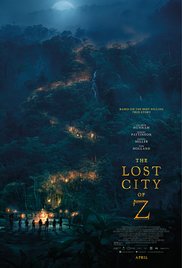
 THE LOST CITY OF Z (2016)

It’s been almost ten years since this film from director James Gray was released, and I’ve recommended it many times to folks who were unfamiliar or unaware. The film is expertly photographed by cinematographer Darius Khandji (a two-time Oscar nominee) and is based on the book by the absurdly talented David Grann, whose books also include one of my personal favorites, “Killers of the Flower Moon”. The screen is filled with green and golden hues (similar to OUT OF AFRICA), providing a sense of realism and a touch of romanticism to the true adventures of the bold explorer, Percy Fawcett.

Charlie Hunnam (fresh off his “Sons of Anarchy” run) portrays military man and explorer Fawcett (often) through quiet strength and a doggedness to discover what is ahead. Helping us to understand this man’s heroic actions, director Gray divides the presentation into three areas: the stuffy, poorly lit backroom of London’s power brokers; the 1916 WWI front line where Fawcett’s courage is on full display; and the Amazon jungles where Fawcett strives for glory and redemption. No matter that we viewers would be satisfied with a film focusing only on those last two circumstances of action, Gray wisely recognizes that it’s the debates and conversations within the backrooms that motivate Fawcett to never give up the fight.

With a run time of 2 hours and 21 minutes, the film is quite long, yet it never seems so thanks to the three main Fawcett expeditions of focus. In 1906 the Royal Geographic Society enlisted Fawcett for a “mapping” journey to distinguish boundaries around Bolivia in what had become a commercially important area to the abundance of rubber. It’s on this adventure where Fawcett cracks wise about overcoming his “poor choice in ancestors”. He’s joined on this expedition by the great Franco Nero, and it’s also the one that lights Fawcett’s lifelong obsession with proving the existence of Z (Zed), an earlier advanced society.

1912 brings the second Amazonia expedition – the one in which renowned Antarctic explorer James Murray (played her by a snarling Angus Macfayden) joins Fawcett and his loyal and expert travel companion, Henry Costin (a terrific Robert Pattinson). The trip proceeds as one might expect when an ego-driven, unqualified yet wealthy passenger hitches a ride for glory alone. Murray’s history is well documented, and the film treats him just as we’d expect.

It’s the third trip (1925) that Fawcett makes with his son that will not only prove to be his last, it’s also the one that left unanswered questions which writer Grann felt compelled to research for his book. What possesses a man to hop into a wooden canoe on unchartered waters and trek through lands and jungles with no known back story? The spirit and mettle of such a man defines the legacy of Percy Fawcett. The film also offers us glimpses of life at home for Fawcett with his wife Nina (Sienna Miller), who flashes signs of early feminism. One of their kids is played by Tom Holland (giving us a future Spider-Man and future Batman – Pattinson in the same movie).

The film leaves an impact for many reasons: it looks stunning, Fawcett’s life was fascinating, the adventures are dangerous and breathtaking, we gain a sense of the courage required for such explorers. This was also the year of LA LA LAND – and the MOONLIGHT mess on stage – and James Gray’s film was overlooked for awards, but even all these years later, it still offers an movie-watching experience like few others.

Trailer: THE LOST CITY OF Z


KILLERS OF THE FLOWER MOON (2023)

October 18, 2023

Greetings again from the darkness. Read the book and see the movie. The order doesn’t much matter, as David Grann’s best-selling non-fiction novel is an incredibly emotional read, while Martin Scorsese’s film is an example of elevated filmmaking. Of course, it’s understandable if a book detailing a repulsive historic travesty is not your cup of tea, or if a three-and-a-half-hour movie on the same subject holds no appeal for you. However, if you are up for the challenge, both are extraordinary works of art, though surprisingly, quite different experiences.
Oscar winner Scorsese worked on the script adapting Grann’s novel with Oscar winning screenwriter Eric Roth (FORREST GUMP, 1994), and Scorsese has stated Leonardo DiCaprio encouraged some changes in perspective. Scorsese also spent a great deal of time with Osage folks making sure to gain insight on how to properly tell their story with all due sensitivity and respect. And what a story it is. While reading Grann’s book, I remained in a state of disbelief that this tragic story from the 1920’s was not common knowledge. In contrast, I felt the telling of this story in the movie, softened the edges just a bit.

Oscar winner DiCaprio stars as Ernest Burkhart, a man returning to town after serving in WWI. Ernest is a simple man, and DiCaprio plays him with a SLING BLADE jaw line and a constant state of being a half-step behind goings on. He’s not a total sap, but close enough that he can be manipulated. This is especially true when it comes to his rancher Uncle William King Hale played by two-time Oscar winner Robert DeNiro. The two men are related but seemingly share no other characteristics. “King” is a master schemer who has spent decades cultivating a relationship and image with the Osage, only to secretly take advantage of their trust at every opportunity. Ernest is a self-described lazy man who ‘loves money’, though he has little interest in earning it the hard way.

There are multiple relationships that are crucial to follow closely. Ernest and his Uncle, Ernest and his Osage wife Mollie (a brilliant Lily Gladstone), Hale and the Osage, Federal investigator Tom White (Jesse Plemons) and everyone to whom he speaks, and then the network of interactions between Ernest and the locals. The long roster of characters jumps in numbers again during the final act, which offers a courtroom drama and interrogations that deliver the conclusion. It’s the first act where Scorsese portrays the dramatic shift from the “old” Osage culture to their staggering newfound wealth. Of course, at the core of all of this is the despicable scheme used by Hale in a heartless strategy to steal the wealth. For those who haven’t yet read the book, it’s best if no more of the story is known prior to seeing the movie. One thing that can be disclosed is that this true story proves the exception to “them with the gold make the rules.” This was also the first case of the newly formed FBI under J Edgar Hoover.

As always, Scorsese has assembled a deep supporting cast to complement the stellar leads. A few of those playing key roles include Tantoo Cardinal, Gene Jones (the coin flip clerk in NO COUNTRY FOR OLD MEN), John Lithgow, Oscar winner Brendan Fraser, Cara Jade Myers, Jason Isbell, Jillian Dion, Scott Shepherd, William Belleau, Sturgill Simpson, Ty Mitchell, Tommy Schultz, (personal favorite) Barry Corbin, Pete Yorn, and Jack White. With apologies to Jesse Plemons who is solid as Tom White, it’s the three leads who captivate us. DiCaprio turns in what is likely his best ever performance, while DeNiro eerily captures the sneaky and devastating evil of Hale (and we get a nod to his Al Capone role from 36 years ago). What can we say about Lily Gladstone? She was a standout in CERTAIN WOMEN (2016), and here she is the heart and soul of the story (though DiCaprio’s Ernest gets much more screen time). Her expressive eyes convey so much, even when she speaks no words.

In addition to the talented cast, Scorsese’s technical group is just as outstanding. Cinematographer Rodrigo Prieto (BROKEBACK MOUNTAIN, 2005) perfectly balances the vastness of the setting with the intimate moments. Production Designer Jack Fisk (THERE WILL BE BLOOD, 2007) delivers the look and feel of the times, while three-time Oscar winner Thelma Schoonmaker works her magic as an Editor to create a manageable flow of this epic. The film’s score, expertly tied to the story’s measured pacing, comes from Robbie Robertson (longtime leader of The Band), who passed away soon after. There is a Scorsese cameo, and I left the theater thinking how usual it is to find a movie so ambitious in scale, yet so intimate and searing in its personal moments. Some may find the larger story a bit difficult to grasp, and that’s likely due to our humanity and desire to believe in the non-existence of this level of evil.

Opens in theaters nationally on October 20, 2023

WATCH THE TRAILER


DARK CRIMES (2018)

May 30, 2018

 Greetings again from the darkness. A neo-noir “inspired by actual events” and based on a compelling 2008 “New Yorker” article by the great David Grann (THE LOST CITY OF Z) seems to have the necessary components for a satisfying thriller. So what went wrong? Unfortunately, a messy script from Jeremy Brock (THE LAST KING OF SCOTLAND) prevents this one from ever having a chance at grabbing our attention, much less holding it.

This is the first English language film from director Alexandros Avranas (MISS VIOLENCE, 2013) and his cast is led by Jim Carrey as police inspector Tadek, a disgraced cop who takes care of his elderly mother while also obsessing over the now coldcase that ruined his career. Carrey sports a Polish accent through “most” of his performance … a performance that is mostly subdued, especially given his career. Joining him as co-leads in the cast are two other excellent actors: Martin Csokas and Charlotte Gainsbourg. Csokas plays Kozlow, the main antagonist and suspect – an author with clues to the key murder highlighted in his novel. Ms. Gainsbourg is underutilized as Kasia, the former sex worker, now intimate acquaintance of Kozlow. She is the key to solving the case.

Grann’s article entitled “True Crimes: A Postmodern Murder Mystery” told the story of novelist/convicted murderer Krystian Bala. It’s an article worth reading and one that bears only passing resemblance to this screen adaptation. The film is purposefully drab, bleak, dark, grey and dour, with a stark, cold look to the characters and most every scene. Tadek is a man on a mission to save his reputation, even at the expense of his family life, or really any life at all. The game of cat and mouse between Tadek and Kozlow never reaches the level of tension that the film seems to think it does … even in the one-on-one interrogation scene or the seemingly endless blabbering of the recordings Tadek listens to.

There is a terrific international cast of supporting actors including iVlad Ivanov, Robert Wieckiewicz, Piotr Glowacki and Agata Kulesza, but the cast is only able to do so much with the material. Perhaps the draw is supposed to be Jim Carrey is the darkest role of his career. On the bright side, the story is neatly wrapped up at the end thanks to one character who deserves a “win”.

watch the trailer:


THE LOST CITY OF Z (2017)

April 20, 2017

DALLAS INTERNATIONAL FILM FESTIVAL 2017

 Greetings again from the darkness. We aren’t likely to watch a more beautiful or expertly photographed film this year. Director James Gray’s (The Immigrant, We Own the Night) project looks and feels like a throwback to days of epic filmmaking, and cinematographer Darius Khandji (Se7en, Evita, The Immigrant) fills the screen with green and gold hues (similar to Out of Africa) that deliver both a sense of realism and a touch of romanticism. The minor quibble here is with the emphasis on the biographical rather than the more interesting and compelling and adventuresome expeditions to the “new” world.

Our true to life hero (and the film’s portrayal provides no other description) is military man and explorer Percy Fawcett played by Charlie Hunnam. Based on the book by David Grann, the film divides focus into three areas: the stuffy, poorly lit backrooms of London power moguls; the 1916 WWI front line where Fawcett proves his mettle; the jungles of Amazonia wherein lies Fawcett’s hope for glory and redemption. It’s the latter of these that are by far the most engaging, and also the segments that leave us pining for more detail.

The three Fawcett expeditions form the structure for the quite long run time (2 hours, 21 minutes). In 1906 the Royal Geographic Society enlisted Fawcett for a “mapping” journey to distinguish boundaries around Bolivia in what had become a commercially important area due to the black gold known as rubber. Fawcett was not just a manly-man, he was also obsessed with overcoming his “poor choice in ancestors” and gaining a position of status within society. Using his military training and personal mission, that first expedition (with help from a powerful character played by the great Franco Nero) was enough to light Fawcett’s lifelong fixation on proving the existence of Z (Zed) and the earlier advanced society.

Back home, Fawcett’s wife Nina (Sienna Miller) shows flashes of turn-of-the-century feminism, though lacking in judgment when she suggests a ridealong with her husband on his next expedition. Although the couple spends little time together, given the years-long trips, they do manage to produce a hefty brood of kids, the eldest played by Tom Holland (the new Spider-Man).

1912 brings the second Amazonia expedition, the one in which renowned Antarctic explorer James Murray (a snarly Angus Macfayden) joins Fawcett and his by now loyal and expert travel companion Henry Costin (a terrific Robert Pattison). The trip proceeds as one might expect when an ego-driven, unqualified yet wealthy passenger is along for only the glory. Murray’s history is well documented and here receives the treatment he earned.

It’s the third trip in 1925 that Fawcett makes with his son that will be his last, and the one that dealt the unanswered questions inspiring Mr. Grann to research and write his book. It’s also the segment of the film that leaves us wanting more details … more time in the jungle. With the overabundance of information and data available to us these days, the staggering courage and spirit of those willing to jump in a wooden canoe on unchartered waters and trek through lands with no known back story, offer more than enough foundation for compelling filmmaking. It’s this possibility of historical discovery that is the real story, not one man’s lust for medals and confirmation. More jungle could have elevated this from very good to monumental filmmaking.

watch the trailer: