MOUNTAINHEAD (2025)

May 30, 2025

Greetings again from the darkness. Artificial Intelligence and the uncertainty of its uses and power are real world concerns. On the heels of MISSION: IMPOSSIBLE – THE FINAL RECKONING, which dealt with AI as an omnipotent force, comes an HBO film that focuses more on the human beings driving the technology. Jesse Armstrong, the creator of “Succession”, delivers his feature film directorial debut as a combination of satire and caution.

Four ‘Tech Bros’ meet for poker weekend at a stunning mountainside home (an actual ski resort in Park City, Utah). Randall (Steve Carell, “The Office”) is the elder of the group, and is referred to as “Papa Bear”. He’s also convinced he can overcome his terminal cancer (these guys aren’t accustomed to taking no for an answer). Venis (Cory Michael Smith, Chevy Chase in SATURDAY NIGHT, 2024) is the world’s richest man, and behind the deep-fake tool causing so much of the global turmoil. Jeff (Ramy Yousef, POOR THINGS, 2023) is the renowned developer of an AI platform that Venis desperately needs to acquire for guardrails on his own system. Lastly, there is Hugo (Jason Schwartzman, MOONRISE KINGDOM, 2012), nicknamed “Souper” – as in Soup Kitchen – since he is the least filthy rich of the foursome, having not yet attained “B” status. It’s his house, nicknamed Mountainhead (a play on Ayn Rand’s “Fountainhead”), where the group has gathered.

Obvious from the beginning is the tension between hyper and cocky Venis and self-righteous Jeff, since the latter won’t sell to the former despite knowing full well how vital the transaction could be. In fact, it takes little time to note the massive egos on full display are used to mask each man’s insecurities. The rapid-fire sharp dialogue with cutting quips is normal to these guys, although at times Souper comes across as a bit desperate to impress the others. Does Jeff actually have morals, or is he simply enjoying his own power trip over Venis? Although that’s the biggie, there are numerous other minor moments of one-upmanship. Along the way, we get a couple of twists.

From their phones and TV, the four keep a constant watch on world events which seem to get darker and more dangerous by the minute … all the while these rich clowns battle over their personal minutiae. These are the kind of guys who may get a call from the President at any time. By the end, we are convinced of a few things. Rich people have their own personal agendas, often turning their money into toxic wealth. It seems likely that there are no limits to how far they would go to achieve their desired results. Also, any affiliation is possible, and all past misdeeds can be forgotten for the right gain. Lastly, despite the satire, AI is a danger if for no other reason than the humans driving it.

Debuts on HBO/Max on May 31, 2025

WATCH THE TRAILER


SATURDAY NIGHT (2024)

November 13, 2024

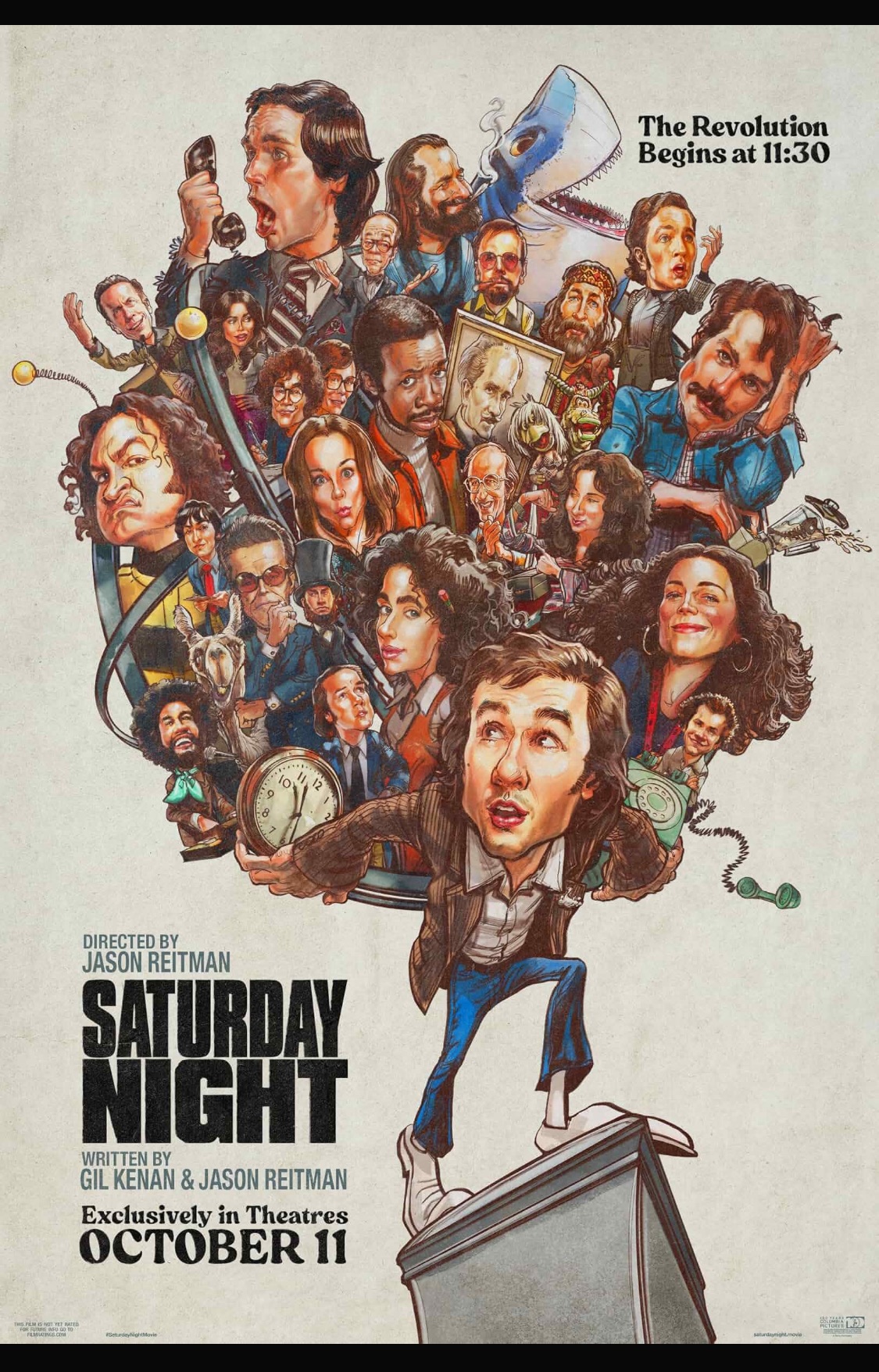
Greetings again from the darkness. For those of a certain age, October 11, 1975, changed television forever. Now celebrating it’s 50th anniversary season, “Saturday Night Live” (SNL was originally just ‘Saturday Night’) has been maligned and criticized so many times over the years, yet it persists in providing commentary and comedy when so many other shows have failed. No better choice exists to present the show’s origin story than writer-director Jason Reitman w-d (JUNO, UP IN THE AIR, THANK YOU FOR SMOKING, TULLY), who along with co-writer Gil Kenan, go extreme with the ‘origin’ by tracking the 90 minutes prior to the first show’s airing.

Thanks to a clock counting down to the 11:30pm showtime and a few periodic reminders, we are always aware of just how few minutes remain for showrunner Lorne Michaels (a terrific Gabriel LaBelle) to pull off this minor miracle. Backstage chaos barely scratches the surface of what Michaels is dealing with (in addition to his own anxiety). Network executives and censors, an out-of-control cast of truly ‘Not Ready for Prime Time Players’, a writer’s room in disarray, incomplete set assemblage, and more than double the material necessary to fill the allotted time are just some of the hurdles facing Michaels.

What we immediately notice is the fine job done in casting the cast: Cory Michael Smith captures Chevy Chase’s looks, ambition, ego, and talent; Dylan O’Brien nails Dan Aykroyd’s physicality and rapid-fire speech; Ella Hunt is underutilized as ultra-talented Gilda Radner; Emily Fairn is insecure Laraine Newman; Kim Matula shows Jane Curtin’s coolness; and Lamorne Morris plays up Garrett Morris’ realization of stereotyped characters. Perhaps the key to the show and this movie is Matt Wood’s portrayal of John Belushi, who initially rebels against the bee costume, refuses to sign his contract, and clearly is the most explosive and vital member of the cast.

 “What is the show?” Lorne Michaels fields that question a few times and fails to give a satisfactory answer … until just before showtime when he eloquently explains it and wins over NBC’s Dave Tebet (Willem Dafoe), the key network executive who was fully prepared to show a Johnny Carson rerun rather than risk embarrassment with the newbies. The frantic pace is unrelenting as a nervous Director of Programming Dick Ebersol (Cooper Hoffman, son of Phillip Seymour Hoffman) tags along wondering if his own career is going to crash and burn right along with Michael’s. Acting as a calming influence is Lorne’s (first) wife Rosie Shuster (Rachel Sennott), who brings serenity to those on the edge.

Revolution is difficult – especially with a bunch of twenty-something no-name actors. Bringing in ‘Mr. Television’ Milton Berle (Oscar winner JK Simmons) allows for further contrast with old comedy versus new, not to mention Berle’s most infamous appendage, which he doesn’t hesitate to flaunt. Others of note include Finn Wolfhard as an NBC page charged with filling the studio audience, a too-tall Nicholas Braun who plays both an out-of-place Jim Hensen and Andy Kaufman (complete with “Mighty Mouse” segment). Matthew Rhys plays coked-out host, George Carlin, and Nicholas Podany is a desperate for stage time upstart named Billy Crystal. Tommy Dewey plays head writer Michael O’Donaghue, and Jon Batiste performs as Billy Preston (while also writing the film’s score).

A couple of highlights include a sound check with Garrett Morris singing about what he’s going to do with his shotgun, Aykroyd as Fred Garver, and of course, Belushi whenever he’s on screen. Director Reitman includes numerous callbacks to sketches and characters … some of which require a sharp eye by viewers. Kudos to Jess Goncher for Production Design that recalls this hectic time, and to cinematographer and frequent Reitman collaborator, Eric Steelberg, for using the camera in sync with a time that was totally out of sync. Capturing an event of anti-establishment or counterculture rebellion is almost as impressive as what Lorne Michaels and the cast and crew pulled off that night (drugs and all).

On Digital November 12, 2024 and on Blu-ray January 7, 2025

WATCH THE TRAILER


FIRST MAN (2018)

October 11, 2018

 Greetings again from the darkness. “That’s one small step for [a] man, one giant leap for mankind.” Every junior high student learns that Neil Armstrong spoke those words when he became the first person to walk on the moon’s surface in 1969. So while his words are etched into our minds and the televised visuals of the historic event are seared into our corneas, most of us know little of the man who is renowned as an American hero. Director Damien Chazelle (LA LA LAND, WHIPLASH) finds a way to personalize a man’s story without sacrificing the corresponding grandiose theatre and immense danger.

Kicking off with one of the most intense cinematic sequences ever, the film puts us inside the cockpit of a test flight with Armstrong in 1961 as he bounces off the atmosphere and rockets towards near certain death. This opening makes the statement that this is no ordinary man, and this is no ordinary movie … and we are now prepared to hold on tight! Based on James R Hansen’s book, the only biography Armstrong authorized, the script from Oscar winner Josh Singer (SPOTLIGHT) expertly balances the test pilot/astronaut portion with the character study/personality of the man. Intensity is on display throughout – whether in a capsule or during family time.

Ryan Gosling stars as Neil Armstrong, and the story tracks him from 1961 through that famous moment in 1969. What we see is a man who was first an engineer, and then a pilot. A man whose intellect and nerve allowed him to be part of the second group of pilots selected for NASA’s astronaut program in 1962. The first group was the Mercury Seven. He was also a man emotionally devastated by the death of his young daughter Karen (from a brain tumor) and the numerous deaths of friends and associates in the space program. The film clearly shows how he was impacted.

Proving true JFK’s proclamation that the driving force wasn’t that it was easy, but rather that it was quite hard (and dangerous), we glimpse some of the inner workings of NASA, and what becomes clear that the space program was high stakes gambling filled with huge risks – all for a space race against the Russians that was motivated by ego and national pride. Daily danger was part of the job, as was the claustrophobia that comes with sitting in tin can space capsules being monitored by computers far less powerful than the cell phone you are likely using to read this.  Armstrong’s claustrophobia somehow seemed less apparent during his flights than during press conferences or sitting at the kitchen table with his family – providing even more insight into the man.

Claire Foy (“The Crown”) plays Janet Armstrong, the strong-for-the-kids while suffering-in- (mostly) silence homemaker wife. Ms. Foy does a nice job of conveying the emotional turmoil that goes with being an astronaut’s wife, and having no one to share the uncertainty and worry with. Jason Clarke plays Ed White, the first American to walk in space (Gemini 4) and Armstrong’s neighbor and close friend. Olivia Hamilton plays his wife Pat, while Kyle Chandler plays Deke Slayton, and Corey Stoll offers up a not so complimentary portrayal of Buzz Aldrin. Other familiar faces in the cast include Shea Whigham as Gus Grissom, Christopher Abbott as Dave Scott, Pablo Schreiber as Jim Lovell (played by Tom Hanks in APOLLO 13), Ethan Embry, Ciaran Hinds, Patrick Fugit, Lukas Haas, Cory Michael Smith, Brian D’Arcy James, and Leon Bridges.

Meticulous attention to details of the era include kids that actually ask to go play outdoors (and aren’t overly impressed with astronaut dads). The sound design and set designs are phenomenal and complement the outstanding cinematography of Linus Sandgren (Oscar winner for LA LA LAND). The abundance of close-ups allow for an intimacy that makes the awe-inspiring space sequences even more breath-taking. Actual historic space audio is used whenever possible, and director Chazelle doesn’t shy away from showing us the “other side” of the space program: Gil Scott-Heron’s “Whitey’s on the Moon”, writer Kurt Vonnegut publically questioning the program, and many citizens wondering why so much money is being spent on rockets while there were so many other areas (including Vietnam) in need of attention.

The humor is often quite sly, including a scene where his competitive applicants shrug off Armstrong as only a “Civilian”, unaware of his remarkable service and record in the Korean War as a Navy Fighter Pilot. Gosling’s quietly intense portrayal of Armstrong could be termed constrained, but it’s quite fitting given his subject. Composer Justin Hurwitz (Oscar winner for LA LA LAND) delivers and unusual but fitting score, and we can’t help but realize this would make a terrific trilogy bookended by THE RIGHT STUFF (1983) and APOLLO 13 (1995). Chazelle presents a fitting bio of a true American hero (and yes, we can see the flag on the moon), while also giving us a look at the harrowing process of putting folks into space. It’s on us to decide if it’s worth it, but leaves no doubt that President Kennedy was right … it is hard.

***On a personal note, I attended the first year of Edward H White Middle School in San Antonio, and his widow Pat White came to the Grand Opening. I vividly remember what a classy lady she was and how proud she was of her husband.

watch the trailer:


WONDERSTRUCK (2017)

October 26, 2017

 Greetings again from the darkness. If you know an adolescent who is ready to step up from comic book movies, this would be a terrific introduction to more emotionally dramatic and narrative-driven cinema. That’s certainly not meant to imply that director Todd Haynes’ latest is only for kids, or even that it’s aimed at that demographic. Instead, it’s the rare opportunity to follow two intersecting story lines over two different time periods with kids as the main focus, and have some very interesting post-movie discussions related to characters, eras, and filmmaking techniques.

We follow the stories of two kids who are separated by 50 years. Although the time boundary exists, the similarities between their journeys are many. Each is running away from home in search of their roots and identity. They are both hearing-impaired and living in less than ideal family environments. Additionally, their footsteps cross many of the same places in New York City as two museums play key roles.

Ben (Oakes Fegley, PETE’S DRAGON) is a 12 year old living in Gunflint, Minnesota. It’s 1977 when his mother (Michelle Williams) dies unexpectedly and a freak accident takes his hearing. Convinced an odd bookmark is a clue to finding the father he’s never met, Ben sets off for New York City. Rose (remarkable first time actress Millicent Simmonds) lives in 1927 Hoboken, New Jersey and is obsessed with silent screen star Lillian Mayhew (Julianne Moore in a dual role). Rose is an artistic child whose domineering dad has little time for her, so she hops aboard the ferry and heads to the big city to track down an idol – who may be more closely tied than we first imagine.

Brian Selznick adapted the screenplay from his own novel (he also wrote “The Invention of Hugo Cabret”, which was the basis for Scorcese’s HUGO), and some may find the two story lines muddled or difficult to follow. However, for those who connect with the characters and their adventures, it’s a fascinating and entertaining ride. Director Todd Haynes (FAR FROM HEAVEN, CAROL) has established his expertise in visual stylings, and here he gets to present two distinct looks for the separate eras. Ben’s 1977 world is filled with the polyester and neon colors of that era and it’s even given the washed-out look of 1970’s cinema. On the opposite end of the spectrum, Rose’s 1927 world is presented in black and white as a silent movie. The lack of dialogue allows us to focus on her facial expressions and body language, which tell us what we need to know.

The American Museum of Natural History plays a significant role in both stories, and the Queens Museum is central to the finale which ties up the two pieces for us. The contrasts of the two eras are as vital as the similarities. Along the way, each of the kids gets a bit of help. Ben befriends Jamie (Jaden Michael) whose connection to the museum and the city provides Ben a boost, while Rose’s much older brother Walter (Cory Michael Smith) also has a connection to the museum and helps put Rose on the right track. The distinct photographic styles help us easily switch between eras, and much credit goes to cinematographer (and frequent Haynes collaborator) Edward Lachman and editor Affonso Goncalves.

Oscar Wilde’s quote, “We are all in the gutter but some of us are looking at the stars”, takes its shot as the theme for the two stories, and really it’s a heartfelt film with interesting storytelling and unusual cinematic effects. The set design is terrific throughout, and especially vital during the silent movie segments of Rose’s story. Carter Burwell’s prominent score also effectively shifts styles between stories and eras. The ties that bind us – a core need to understand our roots – do so regardless of age and time period. This is a nifty little film that provides much to discuss and consider.

watch the trailer:


CAROL (2015)

December 26, 2015

carol Greetings again from the darkness. When Patricia Highsmith first wrote her novel “The Price of Salt”, she had it published in 1952 under a pseudonym (Claire Morgan). This was a sign of the unforgiving social conventions of the era, which also play a key role in the story. At the time, no author would publically admit to writing a book about lesbian lovers, much less admit their participation in such an affair. Highsmith’s novel is the source material for director Todd Haynes’ bookend to his stellar 2002 film Far From Heaven. In that film, Dennis Quaid’s character struggles with his secret life as a gay man while married to Julianne Moore. In this new movie, Cate Blanchett is a married upper class socialite trying to deal with her true feelings for the opposite sex, while fighting to not lose custody of her young daughter.

Haynes has a real feel for attraction … what causes two people to be attracted to each other, and how do they handle it? He re-teams with cinematographer Ed Lachman to create yet another beautiful film with camera work, sets, costumes and a score (Carter Burwell) that complement the romance depicted by the two outstanding lead actresses: Cate Blanchett (Carol) and Rooney Mara (Therese). Ms. Blanchett is a 2-time Oscar winner (5 time nominee), and has become one of the few actors who make each of their films a must-see. She is a true force here as she sweeps into the captivating first sequence (a wonderful long take) and has her first interaction with wide-eyed shopgirl Therese as the two dance together through words and innuendo. It may be the best scene of the movie … at least up to the stunning final shot.

At its core, this is a pretty simple romance of two opposite worlds colliding at a time when their attraction was just not tolerated. 1950’s social conventions, being what they were, meant Carol’s husband (Kyle Chandler) could use her sexual preferences as evidence of immorality in his fight to gain sole custody of their daughter. Cinematically, it’s much more about style. Carol is a beautiful mink-wearing work of art, while Therese is seeking her place in the world, while trying to make sense of her feelings. Every scene drips with style … the cars, the clothes, the restaurants; even cigarettes become a fashion accessory between the fingers of Carol.

Carol and Therese take a road trip, and it’s not until Iowa that the relationship is consummated – a scene that finds neither actress shying away from the moment. Fittingly, this occurs in a motel located in Waterloo … leaving little doubt the turn this story will take.

Supporting work is provided by Sarah Paulson (“American Horror Story”) as Carol’s friend and ex-lover, Jake Lacey (“The Office”) as Therese’s would-be suitor, John Magaro (The Big Short) as her friend and supporter, and Cory Michael Smith (“Gotham”) as a double-life salesman. But this show belongs to Blanchett and Mara. They are terrific together – capturing the unspoken, subtle gestures required by the repressive era they find themselves.  Mara’s character is difficult to describe, but most intriguing to watch and absolutely vital to the message.

Phyllis Nagy adapted Ms. Highsmith’s novel (which was re-published in 1990 under her own name), and her care for the material is clear. Todd Haynes then worked his magic with the look of the film, and the two lead actresses deliver a clinic in nuance and dealing with oppression. As it plays, the strength of the film is with the internal struggles faced by the two lead characters. It leaves us to wonder if the film might have been more powerful had it delved a bit deeper into what the characters would have faced from the outside world.

watch the trailer:

https://www.youtube.com/watch?v=l265M1g5zw0