EMPIRE OF LIGHT (2022)

December 9, 2022

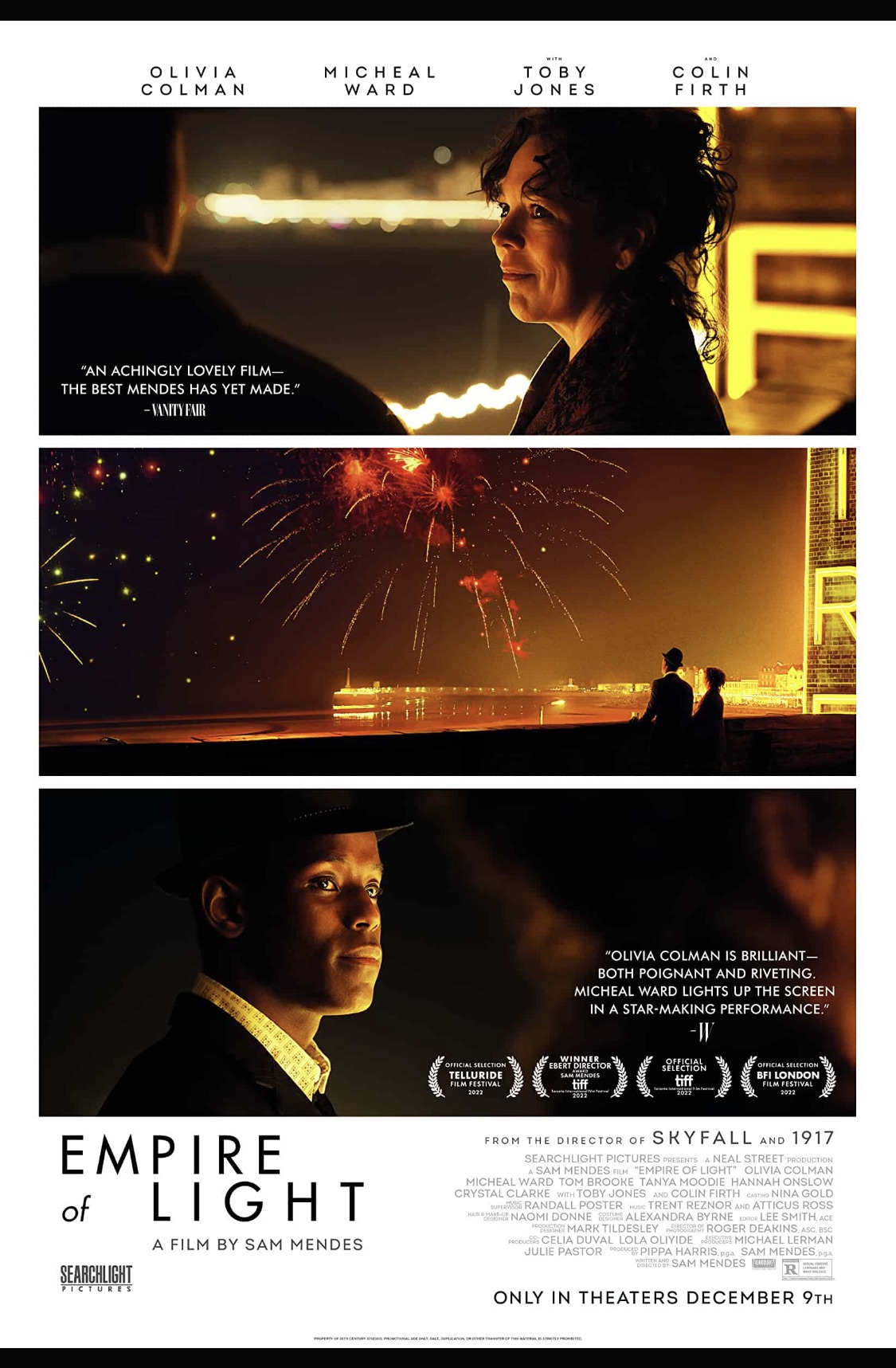
Greetings again from the darkness. Writer-director Sam Mendes won an Oscar for AMERICAN BEAUTY (1999), and has directed other popular movies, including ROAD TO PERDITION (2002) and a couple of James Bond films: SPECTRE (2015) and SKYFALL (2012). This is his first movie since the 3-Oscar winning war film 1917 (2019), and it’s a project that seems designed for Mendes to proclaim his love of movies and belief in movie magic. However, a funny thing happened on the way to movie magic … a movie about mental health, racism, and the Margaret Thatcher era broke out.

By now we’ve all realized that a movie starring Olivia Colman (Oscar winner for THE FAVOURITE, 2018) features at least one outstanding performance. Here, she delivers as Hilary, a theater manager who doesn’t watch movies, and is in therapy for some type of breakdown that occurred over the past year. Her smile for the customers isn’t always able to hide her depression and mood swings – and neither are the ‘quickie’ meetings the married theater owner, Mr. Ellis (Oscar winner Colin Firth, THE KING’S SPEECH, 2010), calls when the urge strikes. Her vulnerability and solitude are on full display.

The closeness of the theater staff is evident by the time new employee, Stephen (Michael Ward), shows up. He brings a spark, along with an ambition for advanced education, and he and Hilary hit it off immediately. Romance blossoms between the odd couple, and we soon learn Stephen has grown accustomed to facing racism, while Hilary seems oblivious to such things happening in the world. Empire Cinema is located on the seaside boardwalk, and the plush lobby is coated in heavy red velvet and adorned with sparkling brass fixtures. The timeframe is evident from the theater’s movie posters: BLUES BROTHERS, ALL THAT JAZZ, STIR CRAZY, etc.

The closed off screens 3 and 4 and the upper-level abandoned ballroom act as the rendezvous spot for Hilary and Stephen, while fireworks and a New Year’s rooftop kiss bring joy and excitement into Hilary’s life. The always interesting Toby Jones plays old school projectionist Norman, and he helps explain the second meaning of the film’s title when he describes the beam of light that flashes through the 24 frames/second of film. He terms that beam of light an “escape”, which is how so many view the movies.

Hilary’s history of schizophrenia and depression and lithium treatment mean that smooth sailing will not last for her. A street riot spills over into the theater and the scene shifts to the local hospital, where another character is introduced – one that might have added quite a bit to the story if expanded. Mendes chooses an odd approach to paying tribute to cinema, even when Hilary does finally realize the magic in a scene that recalls CINEMA PARADISO (although Hal Ashby’s gem BEING THERE is what she watches). Cinematographer extraordinaire and two-time Oscar winner Roger Deakins proves yet again how his work can elevate a film, as does the score from Trent Reznor and Atticus Ross (the Oscar winning composers).

Mendes chooses a restrained presentation, and though many of us believe in that feeling of elation associated with movies, no one believes movie magic is a cure for anything as serious as mental illness or racism. There are some terrific individual scenes that work better than the movie as a whole, but it’s unclear whether the film needed to be shorter, longer, or just better constructed.

Opens in theaters on December 9, 2022

WATCH THE TRAILER


MOTHERING SUNDAY (2022)

April 8, 2022

Greetings again from the darkness. Every writer has a story about what inspired them to put words on the page. What we have here is Eva Husson directing a script from Alice Birch (LADY MACBETH, 2016) who has adapted the 2016 novella from British author Graham Swift. We follow Jane Fairchild through three stages, as her work as a maidservant allows her to become “an occupational observer of life.”

It’s Mothers’ Day 1924 and Jane (Odessa Young, SHIRLEY, 2020) is anticipating her latest romantic tryst with Paul Sheringham (Josh O’Connor, EMMA., 2020). Both know this is their final time together, and they take full advantage. Jane’s employers, Godfrey and Clarrie Niven, are meeting Paul’s parents for a celebratory luncheon with Emma (Emma D’Arcy), the ‘proper’ woman Paul is to marry. Oscar winner Colin Firth (THE KING’S SPEECH, 2010) and Oscar winner Oliva Colman (THE FAVOURITE, 2018) play the Nivens, and deaths from WWI hang over all of these families like the darkest of clouds.

The story is told in non-linear fashion, with Jane and Paul’s final lovemaking session being that which all other events seem to revolve. We also spend some time with Jane in her 40’s as she is living with her philosopher husband Donald (Sope Dirisu), and then in her 80’s as she is celebrated as a renowned and prize-winning author. In this last stage, Jane is surprisingly played by the great Glenda Jackson, a two-time Oscar winner (A TOUCH OF CLASS, 1973, and WOMEN IN LOVE, 1969), who has only appeared in a handful of TV movies these past thirty years. Ms. Jackson turns 86 next month, and spent time as an elected member of Parliament. She’s always been an interesting person, and it’s terrific to see her back on the big screen – even if she only gets a couple of brief scenes followed by one substantial one near the end.

It’s a beautiful film and it’s sensuously photographed, though maybe a bit odd in that it focuses so diligently on the visuals (thanks to cinematographer Jamie D Ramsay), while actually following a woman’s journey into writing. Love (or lack of it) and grief and life’s transitions are all on display, as are the harsh realities of class differences. Ms. Young and Mr. O’Connor are both terrific, and though she has minimal screen time, we are stunned again at just how much emotion Ms. Colman can convey with her face.

Memories and recollections of “that day” play a crucial role as the mature Jane wrestles with writing her novel … one that her publisher expects to be a thriller. Of course, we watch as Jane’s story plays out, so we know where her writing is headed. The film has a vagueness to its storytelling that prevents us from ever fully engaging with Jane or any of the rich, sad people, yet it’s such a beautiful film to look at that we never seem to mind.

In theaters on April 8, 2022

WATCH THE TRAILER


SUPERNOVA (2021)

January 28, 2021

 Greetings again from the darkness. Relationships end. Sometimes that brings relief, other times pain. For long time couple Sam and Tusker, the end is speeding towards them and they are each taking approaches on how best to handle. Writer-director Harry Macqueen delivers a tender story that is elevated by two extraordinary lead performances.

Colin Firth (Oscar winner, THE KING’S SPEECH, 2010) stars as Sam, a concert pianist, and Stanley Tucci (Oscar nominated, THE LOVELY BONES, 2009) co-stars as Tusker, a published novelist. These are arguably career best performances from both, and they complement each other so well on screen that we simply forget we are watching actors and accept the plight of this couple – of these two men. Driving along in their RV from a bygone era, they have the familiar exchanges that come from spending a lifetime together. We enjoy their banter, but it’s Sam’s opening line that sets the tone when he says, “We’re not going back, you know”. He’s referring to a suitcase that Tusker didn’t allow him to help pack, though soon enough we realize that line is even more to the point when it comes to their life journey.

As the bucolic northern England countryside passes by, it becomes evident that Tusker has early onset dementia. Though more present than not, he sometimes forgets a word, while in his worst moments doesn’t know where he is or how he arrived. The purpose of the trip is two-fold: Sam is giving a ‘comeback’ concert after many years away from the circuit, and this is Tusker’s farewell visit to family and friends. Of course, we (and Tusker) also recognize that this is likely the final fond memory this couple will make. While Sam is insistent that he can help Tusker remain productive, Tusker is well aware that he will quickly become a burden to the man he loves – and that’s not something he wants to see happen.

Dementia is a slow fade, often over many years. Recognizing that it’s happening to you is as painful as watching a loved one decline. People deal with this in their own way, and Macqueen’s film handles it gently, while the actors exhibit much grace in their portrayals. The line, “It’s not about fair. It’s about love” really struck a nerve, and made it clear that these are two characters we like and believe in – inside a story that’s heart-wrenching. Star-gazing plays a role here, and there’s only a mild poke at Margaret Thatcher’s policy towards gays. This isn’t a movie of politics, but rather one of emotions and humanity. Not much happens here … only everything. Best to reach for the stars, as “we’re not going back.”

*side note: I did have to look up “frog-marching” since it’s used in conversation, and I had not previously heard the phrase.

The film hits theaters on January 29, 2021 and Digital on February 16, 2021

WATCH THE TRAILER


THE SECRET GARDEN (2020)

August 6, 2020

 Greetings again from the darkness. In the years since Frances Hodgson Burnett’s novel was first published in 1911, “The Secret Garden” has become one of the most popular and oft-read children’s books. Previous film adaptations include the 1949 version with Margaret O’Brien and Dean Stockwell, and the 1993 version with Kate Maberly and Maggie Smith. Additionally, the novel has been adapted numerous times for the stage and television. Director Marc Munden is working with the screenplay adapted by Jack Thorne (WONDER, 2017), and the two had previously collaborated on the BBC series “National Treasure”. Readers of the beloved novel will certainly recognize the changes and differences within this version, both in characters and theme.

As the film begins, we are told it’s “the eve of Partition”, which was the 1947 division of British India into two separate states: India and Pakistan. This timing is, of course, quite a bit later than Ms. Burnett’s setting, but the effect is the same – young Mary Lennox (Dixie Egerickx) is orphaned when her parents die, and left alone when the servants desert her. She is shipped off to live with an uncle (Oscar winner Colin Firth) she doesn’t know. Accompanied to massive Misselthwaite Manor by the housekeeper, Mrs. Medlock (Julie Walters), Mary quickly understands that Uncle Archibald Craven is a grieving widow (his wife was Mary’s mother’s sister) who is not to be disturbed, and his hunchback is not to be stared upon. Mary soon learns that her spoiled brat manner will not be tolerated, though her natural spunk will prove advantageous. The young girl is one who is accustomed to be waited on, while also wanting to prove her independence.

Mary’s imagination is extraordinary and she often asks, “Do you want to hear a story?” CGI effects allow us to see what she has envisioned, whether it’s the wallpaper coming to life, or her mother and aunt frolicking through the halls or swinging in the garden. Mary soon befriends Martha the maid (Isis Davis), and then happens upon “Jemima” the dog while wandering the estate grounds. It’s here where the fantastical and supernatural meet reality, and a helpful Robin leads Mary to the key that unlocks the gates of the gardens that have been locked away since Uncle’s wife died. Mary and her new friend Dickon (Amir Wilson) go on adventures through the garden – a garden which has mystical powers.

One evening Mary hears cries echoing in the halls of Misselthwaite. Despite being forbidden from exploring, she discovers her cousin Colin (Edan Hayhurst) locked away in a far off bedroom. Colin is a sickly child, supposedly stricken with a spinal problem that keeps him from going outside. Mary continues to visit Colin, and soon she and Dickon are sneaking Colin into the secret garden, where the magical healing powers begin to take hold. The titular garden doesn’t make an appearance until about one hour in, but its beauty and wonder are on full display.

This is a story about the power of loss and grief and depression, and it offers the life lesson that the things we care for blossom and grow and thrive. This version has some elements of such classics as “Peter Pan” and “The Chronicles of Narnia” in that fantasy and magic play a much larger role than in the novel. Director Munden employs a darker approach and seems to emphasize self-discovery. Young actress Dixie Egerickx was a standout in the recently watched SUMMERLAND, and she is terrific here – despite the changes to the story that some fans might not embrace. The film seems a bit disjointed at times, but it’s always a feast for the eyes, and offers up one of the year’s best scores, courtesy of Oscar winner Dario Marianelli (ATONEMENT, 2007).

Available Video on Demand August 7, 2020

watch the trailer:


1917 (2019)

December 23, 2019

 Greetings again from the darkness. It’s now been over 100 years since World War I ended. The Great War garners barely a mention in high school history books these days, and Hollywood has devoted much more time and energy to WWII. Filmmaker Peter Jackson did his part with last year’s stunning documentary THEY SHALL NOT GROW OLD, a video and photographic look at the actual people involved in the First World War. And now, Oscar winning director Sam Mendes (AMERICAN BEAUTY) delivers another glimpse … and another technical marvel.

Mr. Mendes, working with Oscar winning Cinematographer Roger Deakins (BLADE RUNNER 2049) and Oscar winning Film Editor Lee Smith (DUNKIRK), has shot and edited the film to give the look of one continuous take in real time. Although used previously in such films as Hitchcock’s ROPE and Inarritu’s BIRDMAN, the single take approach is certainly no gimmick here. We open on two young British soldiers lounging in a prairie as they are summoned to report to the commander. Their mission is described as critical, as a British battalion is preparing to walk into a deadly trap set by the Germans. More than 1600 lives are at stake and the phone lines are down. It’s up to Lance Corporal Blake and Lance Corporal Schofield to work their way across No Man’s Land to the front line and hand-deliver an order stopping the attack. Oh, and one more detail: Blake’s older brother is in the battalion he is tasked with warning.

The real time approach serves the purpose of allowing viewers to take on the urgency of Blake and Schofield. We experience the tension and horrors of war. Barbed wire, booby traps, slushy trenches, snipers, rats, dead bodies, dogfights (the aerial type) and towns under siege all play a part here as the men rush towards their goal of saving fellow soldiers lives, including a beloved family member. Dean-Charles Chapman (“Game of Thrones”) plays Blake, and George MacKay (CAPTAIN FANTASTIC) plays Schofield. We spot the personality differences between them. Blake is super focused and determined to save his brother, while Schofield doesn’t welcome the assignment, but is a dutiful soldier and loyal friend.

It’s really the Schofield character with whom the viewer mostly relates. He’s no super soldier or Jason Bourne-type, but rather a young man trying to stay alive and fulfill his orders. With the relentless pacing of the film, we feel the fear and admire the courage. There is an especially touching scene in a bombed-out town where paths are crossed with a French woman (Claire Duburcq) caring for an orphaned infant. It’s a reminder that humanity still exists, even within the bounds of war.

There is no clock ticking in the corner of the screen, but we know time is of the essence, and quite limited. The camera seems to be always moving forward, rarely allowing for us or the characters to exhale. As you might expect, running is done frequently – sometimes towards something, sometimes from it. Roger Deakins is in prime form here with his camera, and there are too many remarkable moments to mention them all; however, the river rapids and waterfall, and the town under siege at night, are two of the most incredible sequences I’ve seen on screen.

Along the journey, some familiar faces pop up as military men: Andrew Scott, Benedict Cumberbatch, Richard Madden, Mark Strong, and Colin Firth. Although each appears only briefly, it’s a testament to their acting prowess that each is memorable. The chaos and relentless terror of war is on display, more often than not. But this isn’t a film designed to create deep thoughts or serious debates on the merits of war. Instead, it’s meant to focus on one of the countless personal stories that occur during war. War is fought by people, not faceless countries, and each person has their own story.

Non-linear story telling has been a movie-thing since even before MEMENTO, but director Mendes (and co-writer Kristy Wilson-Cairns, “Penny Dreadful”) show us the true presentation of linear … in the moment and by the moment. GALLIPOLI and PATHS OF GLORY are about the closest comparisons I can come up with, and the weight of the film is felt physically and emotionally as we are drawn in. The exceptional score from Thomas Newman (14 time Oscar nominee) serves to accentuate the chaos and relentless terror. It’s a work of art and a unique viewing experience.

watch the trailer:


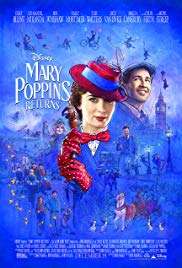
MARY POPPINS RETURNS (2018)

December 17, 2018

 Greetings again from the darkness. The 1964 classic Disney film MARY POPPINS is much beloved and has been shared across generations for more than 50 years. It won 5 Oscars on 13 nominations, and shifted Julie Andrews from a Broadway star to an international movie star, as she won the Oscar for Best Actress while becoming the ideal nanny for most every boy and girl. Rarely do reboots, remakes, or sequels to the classics make much of a dent with the movie-going public, but it’s likely director Rob Marshall’s (CHICAGO, INTO THE WOODS) film will be an exception. Marshall balances nostalgia with contemporary, and benefits from a marvelous successor to the Mary Poppins role … Emily Blunt.

The film opens in low-key fashion as we follow Jack (Lin-Manuel Miranda) through town as he performs his lamplighting duties singing the melancholic “Underneath the Lovely London Sky”. It’s actually a bit of a dry opening that may have some impatient kids wondering why their parents dragged them to see this. Soon after, we are at the familiar 17 Cherry Tree Lane – the Banks’ home – easily recognizable from the original film. We meet grown up siblings Michael (Ben Whishaw) and Jane (Emily Mortimer). Jane is a labor organizer following in her mom’s footsteps, and Michael is a struggling artist and widower raising 3 kids. He has taken a teller job at the Fidelity Fiduciary Bank where his dad (now deceased) worked, but mostly he’s an emotional wreck. In fact, the only way to save the family home from foreclosure is with proof of his father’s bank shares … something the evil new Bank President, William Weatherall Wilkins (Colin Firth), conspires to prevent.

It’s at this point that the kids’ popcorn should just about be gone, so it’s fortunate that our beloved nanny makes her timely appearance … literally floating (with practically perfect posture) into the park where Georgie (an adorable Joel Dawson) and lamplighter Jack are flying a very recognizable kite. Jack, having been an apprentice under Bert the Chimney Sweep, is quite familiar with the significance of Mary Poppins’ arrival. Back on Cherry Tree Lane, Michael and Jane are shocked to see their childhood nanny back in the house, and Michael’s two spunky twins Anabel (Pixie Davies) and John (Nathanael Saleh) aren’t sure what to make of this mysterious visitor.

Director Marshall wisely utilizes the template from the original film, so many of the subsequent sequences have a familiar and cozy feel to them. Mary Poppins’ “Off we go” kicks off a fantastical bathtub adventure and leads to the first of many smile-inducing, visually spectacular moments. A broken porcelain bowl guides us to a beautiful hand-drawn animation (from Walt Disney Studios) sequence with horse-drawn carriage, penguins, and more. Meryl Streep performs “Turning Turtle” in her topsy-turvy studio, and there is an extended (perhaps a bit too long) dance sequence featuring Jack and the other lamplighters singing “Trip a Little Light Fantastic”.

Julie Walters appears as the Banks’ housekeeper and David Warner is Admiral Boom, the Banks’ canon-firing neighbor; however it’s two cameos that will really hit home with the older viewers: Angela Landsbury (not in the original) is the balloon lady singing “Nowhere to Go but Up”, and the remarkable Dick Van Dyke (a huge part of the original) plays an elderly Mr. Dawes Jr from the bank – and even performs a dance routine atop a desk. All of the actors perform admirably, yet this is clearly Emily Blunt’s movie. She shines as the practically perfect nanny, whether debating with her umbrella, digging in her mystical baggage, filling heads with ‘stuff and nonsense’, teaching life lessons to those in need, or singing solo and with others. It’s a wonderful performance and she becomes Mary Poppins for a new generation.

Director Marshall co-wrote the story and screenplay with David Magee and John DeLuca, and they have created a worthy sequel (a quite high standard) from P.L. Travers’ original books that is delightful and a joy to watch. The group of original songs by Marc Shaiman and Scott Wittman serve the story fine, but the one downside to the film is that none of the new songs are as catchy or memorable as those of the Sherman Brothers (Richard and Robert) from 54 years ago. They won Oscars for Best Score and Song (“Chim Chim Che-ree”), and left us singing others such as “Spoon Full of Sugar”, “Let’s Go Fly a Kite” and of course, “Supercalifragilistic”. These new songs including “Can You Imagine That”, “The Place Where Lost Things Go”, “A Cover is not the Book”, “Nowhere to Go but Up” all contribute to the story and to the viewer’s enjoyment, but none leave us singing or humming as we depart the theatre.

This is film where those behind-the-scenes are crucial to its success. Oscar winning cinematographer Dion Beebe (MEMOIRS OF A GEISHA) and Editor Wyatt Smith both are at the top of their game, and Costume Designer Sandy Powell delivers stunners, not just for the singing nanny, but for all characters. The core of the story remains rediscovering the magic in life, and finding joy in each other – and this sequel also provides the adventures to match the original. It’s simultaneously familiar and fresh, which is key to a successful follow up to a beloved classic. Director Marshall has signed on to Disney’s live action THE LITTLE MERMAID, but it’s with MARY POPPINS RETURNS where he has delivered a film that is practically perfect in every way.

watch the trailer:


MAMMA MIA! HERE WE GO AGAIN (2018)

July 19, 2018

 Greetings again from the darkness. It’s been 10 years since director Phyllida Lloyd presented the crowd-pleasing MAMMA MIA! movie. It was a box office hit (over $600 million worldwide) and was, for a few years, the highest grossing musical of all-time. Most importantly, it was extremely entertaining and a joyous cinematic romp for viewers. This year’s sequel is directed by Ol Parker (THE BEST EXOTIC MARIGOLD HOTEL and husband to actress Thandie Newton), and though the melancholy is slathered on a bit too thick, it also fulfills its number one priority – entertaining the fans.

The story begins with Sophie (Amanda Seyfried) putting the final touches on the house-turned-hotel in preparation for the upcoming Grand Opening. It’s named Hotel Bella Donna in honor of Sophie’s mother (Meryl Streep). What looks to be a straight-forward story surprises us with a flashback to Donna’s 1979 graduation, which features not only the first song-and-dance number “When I Kissed the Teacher”, but also the first of two ABBA cameos … Bjorn Ulvaeus as a professor. The young Donna is played brilliantly by Lily James, and she effortlessly captures the free-spiritedness that led to the conundrum of the first movie – 3 possible dads for Sophie.

Those 3 dads return not only as Pierce Brosnan (Sam), Stellan Skarsgard (Bill), and Colin Firth (Harry), but also as Jeremy Irvine (young Sam), Josh Dylan (young Bill), and Hugh Skinner (young Harry). In fact, most of the run time is dedicated to the backstory of these characters and how they first met as youngsters. Each has a segment (and song) with young Harry featured in “Waterloo” accompanied by Benny Andersson (ABBA cameo #2) on piano. Young Bill is the charming sailor who saves the day for Donna, while young Sam assists her with saving a storm-shaken horse (kind of humorous since Mr. Irvine starred in WAR HORSE).

Also back are Dominic Cooper as Sky, Sophie’s true love, who can’t decide between romance and career, and Donna’s life-long friends Tanya (Christine Baranski) and Rosie (Julie Walters), who are also part of the flashback as Jessica Keenan Wynn (excellent as young Tanya) and Alexa Davies (as young Rosie). New to the cast are Celia Imrie in the graduation number, Andy Garcia as the hotel manager, and drawing the biggest applause of all … Cher as Sophie’s grandmother (and as my viewing partner commented, an early peek at what Lady Gaga will look like as a grandma)! It’s best if you experience Cher for yourself, and it should be noted that this is her first big screen appearance since BURLESQUE in 2010.

Of course, the songs are key and many of the ABBA numbers from the first movie are featured again this time. In particular, “Dancing Queen” is a nautical standout, and “Fernando” is a show-stopper. While it may not be quite as raucous as the first, it’s a treat watching Lily James, and there is a wonderful blending of “old” and “new” in the finale. The only real question remaining is, did the casting director do the math before casting Cher (age 72) as Meryl Streep’s (age 69) mother?

*As a special treat, there is a “most interesting” cameo near the end of the film

watch the trailer:


GENIUS (2016)

June 17, 2016

genius Greetings again from the darkness. Most biopics provide a look into the life of someone who had an impact. If after watching this film, you are confused about just who the main subject is, that’s understandable. It’s rare to find a biopic about two people … a duo biopic … but that’s what the film directorial debut of noted British theatre director Michael Grandage presents. Novelist Thomas Wolfe and editor Max Perkins are forever linked in history, and the screenplay by John Logan (Oscar nominated for Gladiator, The Aviator, Hugo) shows us just how intertwined these two lives became. It’s based on A Scott Berg’s 1978 book “Max Perkins: Editor of Genius”.

It’s 1929 and writer Thomas Wolfe (Jude Law) is tapping his foot as he smokes a cigarette while standing on the sidewalk staring at Scribner’s Sons Publishing building in New York City. A moment later he is bursting into an office whilst unleashing a rapid-fire blast of words to which our ears can barely keep pace. Taking in the verbal fireworks is an elegantly quiet and eternally hatted man behind the desk. With only the phrase “Mr. Wolfe, we intend to publish your book”, editor Max Perkins (Colin Firth) manages to silence the bombastic writer for a few stunned seconds … mostly the only time we witness this.

And so begins not so much a friendship as a professional dependency and surrogate father/son relationship. Thomas Wolfe was other-worldly prolific in his ability to craft words into stories. He was also an exceedingly creative workaholic and alcoholic who found his way to Perkins via North Carolina and Harvard. Yes, it’s the same Max Perkins who was editor to such literary luminaries as Ernest Hemingway and F Scott Fitzgerald.

Seen as personality polar opposites, we also get to witness the differences within the personal lives of the two gentlemen. Both have strong women at home. Mr. Perkins’ wife Louise is played by Laura Linney, and their 5 daughters are smitten with the outlandish behavior and stories of Mr. Wolfe as he visits for dinner. In an unusual twist for the times, an older married woman Aline Bernstein (Nicole Kidman), was Wolfe’s lover and supporter … even through his carousing and endless nights of work with Perkins.

The red pencil of Perkins is as ever-present as the hat on his head, as he slashes and burns through paragraph after paragraph and page after page of Wolfe’s writing in order to fashion an end product that is “marketable”. The result was Wolfe’s first novel “Look Homeward, Angel” … even the title was changed by Perkins. The editing sequences and Perkins’ directive for “Big story, fewer words” have us (and Perkins himself) questioning the role of an editor. Do they make the story better or just different? Is marketable more important than the original words of the author? It’s a legitimate point of discussion, as it’s doubtful anyone told da Vinci that his Mona Lisa should have a bigger smile, or Mozart that The Magic Flute should have fewer notes. Are book editors underappreciated or overly critical?  In the case of the second Wolfe novel “Of Time and the River”, Perkins reduced the work by not hundreds, but rather thousands of pages … all for the goal of marketability. And it turned out to be Wolfe’s best-selling book.

The best scene in the film is also the most insightful. Wolfe drags the always dignified Perkins to a late night jazz club, and with the help of the band, displays in song how Wolfe’s brain kicks into writing mode. It’s a moment of enlightenment for Perkins, as well as us viewers. Law’s Wolfe is a whirlwind of words and prose and those in his path are simply overwhelmed by the enormity of his way. In what feels like a touch of name-dropping, the film tacks on a couple of scenes with Hemingway (Dominic West) and Fitzgerald ( ). Though the scenes are a bit heavy-handed, they do serve as a reminder of what terrific writing came from this era, as well as the impact of editor Perkins.

It’s a little disconcerting to see the leads in an America tale played by Brits and Aussies, but there is no denying the effectiveness of Firth, Law, et al. It’s truly a tale of two geniuses, and Aline was correct … after Wolfe, there was “a great hush”.

watch the trailer:


KINGSMAN: THE SECRET SERVICE (2015)

February 16, 2015

kingsman Greetings again from the darkness. In 2010, writer/director Matthew Vaughn turned the superhero genre on its ear with the hit Kick-Ass. With this most recent film (back with co-writer Jane Goldman), he has done the same thing to spy-thrillers.  We get the well-tailored look made famous by Roger Moore’s James Bond, the fanciful and lethal gadgets from early Bond films, the ever-present umbrella (put to new uses here) of “The Avengers” John Steed, and the ultra-suave and debonair manners of Napoleon Solo from “The Man from U.N.C.L.E.”  We get all of that in a surprisingly effective and fun action performance from Colin Firth.

Fun is the operative word here. It’s clear all parties involved are having a great time, especially Mr Firth going drastically against type. There are two action-packed and pretty humorous (in a demented way) fight scenes. One is early on inside a London pub, and has Firth flashing his particular set of skills against a group of thugs. The other (and even more raucous) fight occurs inside a church and is set to Lynryd Skynyrd’s “Free Bird”. The body count piled up as fast as the guitar licks.

As spectacular as the fight scenes are, the real fun here is in the characters. The old guard of the Kingsmen includes Firth as Galahad, Mark Strong as Merlin, Jack Davenport as Lancelot, and Michael Caine as Arthur. This long-standing group is one part international spy, one part Knights of the Round Table … and these gentlemen are extremely well trained and impeccably well dressed. When one of their agents dies on the job, the recruitment boot camp kicks into gear. Made up of a group of relative newcomers to the movie world, the two most interesting are Roxy (Sophie Cookson) and Eggsy (Taron Egerton). Adding to the intrigue, Eggsy is the son of a former Kingsman, and has some skills that aren’t initially apparent.

Of course, what would a spy-tribute movie be without a colorful villain? Samuel L Jackson plays lispy megalomaniac Valentine, who has a quick gag reflex when it comes to violence. Fortunately his henchman Gazelle (Sofia Boutella) is equipped with razor sharp leg prosthetics and some ultra-crazy fighting skills.  We even see Mark Hamill as Professor Arnold … fans of the Mark Miller/Dave Gibbons graphic novel will appreciate the irony.

Firth and Egerton play off each other quite well in the mentor-pupil relationship, and Egerton is clearly set up for the franchise sequels … as is his friend and fellow Kingsman, Ms. Cookson. For those who think the Daniel Craig Bond films are too dark and serious, this provides a flashback to lighter Bond fare (minus the misogyny). Many hot topics are touched on: class warfare, domestic abuse, racism, etc, but mostly this can be taken as a rollicking good time because “it’s not that kind of movie”. It does, however, remind us that “manners make the man”.

watch the trailer:


MAGIC IN THE MOONLIGHT (2014)

August 3, 2014

magic Greetings again from the darkness. One of the most prolific writer/directors since the end of the studio era, Woody Allen cranks out a script and film every year. A few are great, while the others fall somewhere between highly entertaining and watchable. None would be considered a true dud. His latest is a bit fluffy and falls comfortably into the watchable category … with nary a glint of anything more ambitious.

The line of actors maneuvering for a role in Mr. Allen’s films stretches around the proverbial casting couch.  The list of those involved with this one is again quite impressive: Colin Firth, Emma Stone, Marcia Gay Harden, Jacki Weaver, Eileen Atkins, Simon McBurney, Catherine McCormack, and Hamish Linklater. They each perform admirably, yet aren’t enough to elevate a somewhat lackluster script. Ms. Stone and Ms. Atkins are especially enjoyable.

Woody mixes his love of magic with his cynical religious views, and blends those with his too frequent older man/younger woman sub-plot.  The scenes with Firth and Stone are fine, but their onscreen banter would have been better served as Uncle and Niece than awkward rom-com aspirants. Despite this flaw, there remain some excellent lines and moments, plus some staggering shots of the south of France locale. The wardrobe and cars are beautiful … the film is set in 1928.

Screwball comedies are clearly a favorite for Mr. Allen to write, but his directing leans more towards the leisurely pace found in more traditional rom-coms. The mixed genres don’t always fit together, even when stacked with a superior cast. Still, it must be noted, that even at his least brilliant, Mr. Allen delivers films that are pleasant and watchable. As movie lovers, we can live with that as we await his next masterpiece … or at least his next movie in one year.

watch the trailer: