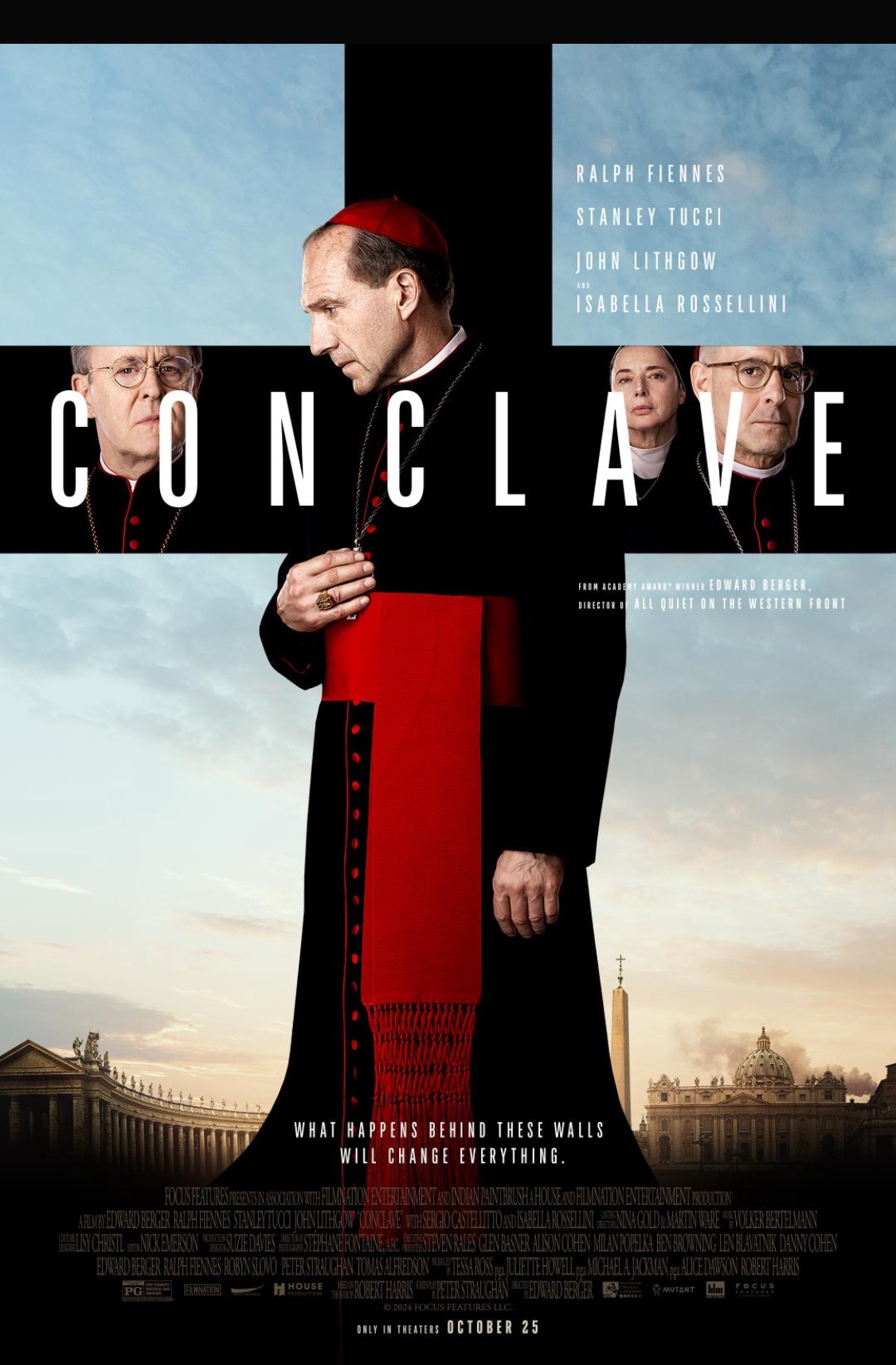
 Greetings again from the darkness. It feels like it’s been a while since we had a good old fashioned serious-minded, tension-packed, “big” drama film featuring big movie stars. Well, that’s exactly what director Edward Berger, fresh off his Oscar-winning ALL QUIET ON THE WESTERN FRONT (2022), serves up with his latest. Writer Peter Straughan (TINKER TAILOR SOLDIER SPY, 2011) has adapted the 2016 Robert Harris novel, and the result is a welcome crowd-pleaser that may garner some Oscar consideration.
Ralph Fiennes delivers what may be his best performance yet. And that’s saying something for the much-respected actor who has previously excelled in such films as SCHINDLER’S LIST (1993), THE CONSTANT GARDENER (2005), IN BRUGES (2008), A BIGGER SPLASH (2018), and THE MENU (2022). His impressive career is only enhanced by this most recent role of Cardinal Lawrence, saddled with the heavy burden of facilitating the titular Conclave charged with electing the new Pope. As the film opens, the beloved Pope has just passed … and as they say, “let the games begin”. Of course, these games are all about political maneuverings and power struggles and backroom promises. Director Berger opts to show us very little of the actual negotiations, and instead puts the various iterations of loyalty on display during each successive secret (of course) vote.
Within the confined walls of Vatican City and the Sistine Chapel, Cardinal Lawrence’s time is mostly spent investigating tips, scolding others for their behavior, and dealing with the immense egos of the few being considered (including himself). Stanley Tucci plays Cardinal Bellini, who pretends to not want the job while campaigning as the ‘progressive’ voice the church needs now. John Lithgow is Cardinal Tremblay, one of the most assertively ambitious who may or may not have purposefully undermined the work of another. Either way, Lucian Msamati’s Cardinal Adivemi is the victim of Tremblay’s actions. Cardinal Tedesco, portrayed by Sergio Castellitto, is the most outspoken in his desire to return the church to the old ways (Latin masses forever!), what he sees as proper. Bryan F O’Byrne plays O’Malley, assistant to Lawrence, and yet, despite all of these men, it’s Isabella Rossellini as Sister Agnes who manages to shoot (figurative) fire from her eyes, while maintaining her ‘place’ and significantly impacting the process. She is stunning and memorable in her limited role.
Early on, a big surprise arrives in the form of Cardinal Benitez (Carlos Diehz) of Kabul, who was the most recent appointee by the previous Pope, and unknown to the others. As a novel, this may be a real page-turner, and yet the movie never rushes from one moment to the next. Tension builds with each revelation and tarnished robe and secretive plot. Although the film barely skims the years-long sexual abuse scandal in the church, there is a stream of twists and turns that keep us on our toes as the Cardinals are sequestered. It’s fascinating to see how cinematographer Stephane Fontaine keeps things visually interesting in an enclosed environment filled with characters who aren’t allowed to go anywhere else. Another aspect I truly appreciated was the unusual musical score composed by Oscar winner Volker Bertelmann. This is the type of movie which often features overbearing music to ‘enhance’ tension, yet Bertelmann’s notes are effective jabs at just the right times.
Power plays, corruption, and political stunts are all present as these Men of God bungle the process of picking their next leader. Importance of the mission and tradition pale in comparison to ego and self-interest. The symmetry to U.S. politics is unmistakable and surely a purposeful approach by Berger. The final twist may be a bit out of proverbial left field, but in a room filled with secrets, perhaps that’s as it should be. To balance the tension and seriousness, anyone paying attention will appreciate the subtle humor, especially as it plays out as these relics muddle through modern day situations (technology, social progressiveness, terrorism). This is certainly not a film created for Catholics only, although for a brief moment, I worried we might have one that could be subtitled, “The Catholic Crying Game”. Fortunately, it’s one with a tension-filled story, terrific visual shots, a perfect score, and superb acting … a fun movie to watch.
Opening in theaters on October 25, 2024


 Posted by David Ferguson
 Movie Reviews from the Dark