BORIS KARLOFF: THE MAN BEHIND THE MONSTER (2021, doc)

September 16, 2021

Greetings again from the darkness. It’s a rare occurrence, but every once in a while subduing my internal fanboy is a bit of a challenge. A documentary on the career of the great Boris Karloff certainly is one of those times. Mesmerized by the Universal monster films as a kid, Karloff’s appearances continued to have a hypnotic effect on me throughout his career … a career that spanned fifty years and ended only with his death in 1969. Of course Christmas time each year returns Karloff back into our homes through his Grammy-winning voice acting in “Dr Seuss’ How the Grinch Stole Christmas!”

Somewhat oddly, director Thomas Hamilton chooses to open the film discussing Karloff’s work in Mario Bava’s 1963 film BLACK SABBATH. Contemporary horror master Guillermo del Toro (THE SHAPE OF WATER, PAN’S LABYRINTH) comments that the film heavily influenced his own CRONOS (1993). It may be an unusual opening segment to kick off a discussion of Karloff’s career, but understanding his stature and influence is really the legacy – it goes much deeper than his iconic Frankenstein monster. The opening credits are played over a stream of stunning chalk/graphite drawings of Karloff’s many characters.

Some of the key interviews are conducted with film historians; film directors del Toro, Roger Corman, Joe Dante, and John Landis; actors Caroline Munro, Christopher Plummer, and Dick Miller; and Karloff’s own daughter, Sara, who is now at an age her father never saw. For the most part, we go chronologically through Karloff’s career with commentary on each of the key roles and films. The vintage footage brings back many memories and is a blast to watch – likely aided significantly by movie memorabilia collector and Karloff expert Ron MacCloskey (the film’s co-writer). Karloff’s physical presence on screen is noted on multiple occasions, as is his ability to emote, even through heavy makeup.

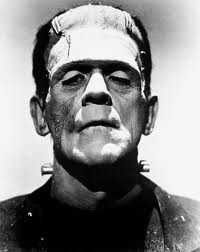
Obviously it’s FRANKENSTEIN (1931) that elevated Karloff from a character actor to a star. Although surprisingly, the man himself credits Howard Hawks’ THE CRIMINAL CODE (1930) as his big break. The following year, after the success of DRACULA with Bela Lugosi, Universal put Mary Shelley’s “Frankenstein” on the fast track and assigned James Whale to direct. Going against conventional wisdom, Whale decided not to cast Lugosi, and instead went with Karloff … in hindsight, a decision that looks brilliant. We hear about the makeup genius Jack Pierce, who worked with Karloff’s facial features in creating the now iconic look of the monster. Pierce had made an early name for himself with his work on THE HUNCHBACK OF NOTRE DAME (1923) and THE PHANTOM OF THE OPERA (1925), and then spent nearly two decades creating the now familiar Universal monsters: Dracula, Frankenstein, The Mummy, The Wolfman, and of course, Elsa Lanchester’s Bride in BRIDE OF FRANKENSTEIN (1935).

The film spends very little time on Karloff’s personal life, though it mentions his six marriages, his participation in the formation of the Screen Actors Guild (SAG), and his at-times debilitating back pain. He often wore a metal leg brace for stability and balance, and for those who only know him as the monster and the Grinch, the segments on his later career will likely be enlightening. Karloff loved live theater and received acclaim for his stage work in “Arsenic and Old Lace”. Daughter Sara confirms that he embraced television from the early days, and director Hamilton includes a clip of an elderly Karloff acting in a comedy skit with two other greats, Red Skelton and Vincent Price. As a fan, I truly appreciate some of Karloff’s work in his final 10-12 years, including “Shock” theater, the “Thriller” series, and Roger Corman’s THE RAVEN (1963). Beyond all of Karloff’s exceptional work through multiple mediums (including children’s book series), and that instantly recognizable face and voice, it’s his monster’s initial entrance onto the screen that remains one of the truly iconic moments in film history – even 90 years later.

The film is scheduled for a rolling release beginning September 17, 2021 and carrying through October 31. See the link for the schedule:                              

https://www.themanbehindthemonster.com/watch

WATCH THE TRAILER


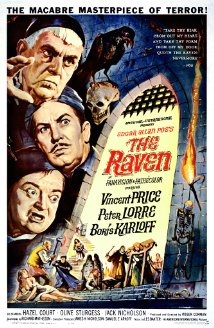
THE RAVEN (1963)

July 5, 2014

raven Greetings again from the darkness. It’s been more than 50 years since this one was released, so it seems a good time to offer up some thoughts and observations. Let’s start with the fact that you probably read Edgar Allen Poe’s poem “The Raven” in high school. Director Roger Corman and writer Richard Matheson take Poe’s work as a starting point in a most unique story of their own.

If you aren’t familiar with Roger Corman, he is one of the most prolific and entertaining “B” movie makers of all time. His writer here, Mr. Matheson, is best known for his work on numerous episodes of “The Twilight Zone“. Poe – Matheson – Corman would be enough, but we also get Vincent Price, Peter Lorre, Boris Karloff, Hazel Court and a young and not yet well known Jack Nicholson. Price is always a treat to watch (especially in horror films), Lorre appeared in 3 of the greatest movies of all-time (M, The Maltese Falcon, Casablanca), Karloff is the master of monster (and much more), Ms Court was one of the first stars of Hammer Films, and of course, Nicholson (fresh-faced here) went on to become one of the most successful actors in movie history.

Price, Karloff, Lorre and Nicholson offer up four of the most unique and recognizable voices ever heard in movies, and they each partake in the fun provided by Corman here. Yes, I said fun. This is almost slapstick comedy, and at a minimum, it’s a parody of the much darker series of Poe films. If you consider it as an influence of the 1960’s “Batman” TV series, you wouldn’t be wrong. Even the music (heavy on the tuba) has an air of comedy.

Watching Peter Lorre as a matador is pretty funny, as is Nicholson as the frenetic stagecoach driver.  Some of the back-and-forth with Lorre and Nicholson as father and son is clearly ad-libbed, but the classic comedic sequence occurs when Price and Karloff take their wizardry duel to the death and turn it into a special effects highlight reel.

This may be the only time you hear the phrase “precious viper” used to describe a woman, and if that, combined with all of the above reasons, isn’t enough to motivate you to seek this one out, then maybe you will never discover why so many adore the films of Roger Corman. Compared with films of today, this style is nevermore.

watch the trailer:


FRANKENSTEIN (1931) BRIDE OF FRANKENSTEIN (1935)

October 26, 2012

 Greetings again from the darkness. It’s pretty easy to underestimate the importance of a couple of monster movies from 80 years ago.  Since TCM and Cinemark teamed up for this double-feature, it seemed worth revisiting and discussing.  Most people are aware of Mary Shelley’s 1818 novel (published when she was 21) and have probably seen some of the many screen versions throughout the years. It is interesting to note that while the brilliant (and often misunderstood) novel was the source, it was really these two films that jolted the monster film genre to life … and careers for many actors, directors, make-up artists and set designers.

When Carl Laemmle, Jr assumed control (from his father, the legendary producer and studio founder) of struggling Universal Studios in 1928, he was very aware that something special and different was needed to save the business. A string of Universal horror movies soon followed: Dracula (1931), Frankenstein (1931), The Mummy (1932), The Old Dark House (1932), The Invisible Man (1932) and Bride of Frankenstein (1935).  Two driving forces of this period were director James Whale and actor Boris Karloff. While Dracula with Bela Lugosi hit theatres first, it was Karloff as “The Monster” who really captured the interest of the movie-going public.

Frankenstein was Karloff’s 81st film and he was only cast because Lugosi turned down the non-speaking role.  Wearing over 60 pounds of make-up, prosthesis and padding … including 26 pounds of shoes to make him over 7 feet tall …Karloff still managed to bring personality to the creature created by Dr. Henry Frankenstein (Colin Clive).  Yes, HENRY.  Though named Victor in the novel, the name was “softened” for the film.  In the film, Dr. Frankenstein is on a mission to create life from body parts and organs of the dead. His stated goal of a man-made race at his beck and call was a clear indication that his God complex was out of control.  His fiancé is played by Mae Clarke.  Ms. Clarke went on to Hollywood infamy when she took a grapefruit in the face from James Cagney in Public Enemy.

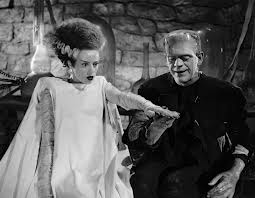
 The enormous success of Frankenstein begged for the first real sequel.  Bride of Frankenstein was released in 1935 with Karloff and Clive reprising their roles. Elsa Lanchester was cast as Mary Shelley (the writer of the Frankenstein novel), and we even get a scene with characters representing her husband (the poet Percy Shelley) and Lord Byron.  Of course, Ms. Lanchester became famous for her Bride’s iconic hairstyle, as well as her hissing and screaming.  Taking Mae Clarke’s place as Elizabeth was Valerie Hobson. Ms. Hobson later became famous as the stand-by-her-man wife of disgraced British Secretary of War John Profumo. Profumo lied to the House of Commons about his relationship with Christine Keeler, the mistress of a Soviet Spy. The “Profumo Affair” forced his resignation in 1963 and was the source of the 1989 British film Scandal.  Bride of Frankenstein is also renowned for the mad scientist Dr. Pretorius played by Ernest Thesiger. Much was made at the time of his “probable” homosexuality and, combined with the multiple crucifix imagery, the film was banned in some markets. It should also be noted that the film utilized a full score … just the second film after King Kong to do so. Previously, film music was thought to be distracting to viewers.

 When discussing these early monster movies, revolutionary make-up artist Jack Pierce must be noted. He created the bolts/electrodes and flat head look for the monster, and even came up with the now-famous green make-up that looked ash gray in Black & White films. Mr. Pierce is easily the most famous of the early movie make-up artists and made his mark during the Universal horror period of the 1930’s-40’s.  Director James Whale turned to monster movies after tiring of war films. His impact was felt as he turned the Frankenstein monster into a sympathetic character, and later added much humor to Bride of Frankenstein.  Unfortunately, once he tired of monster movies, his career and life took a dark turn, and he took his own life in 1967.

Numerous remakes, spin-offs and spoofs have been released over the years and, tip of the cap to Abbott and Costello, the most famous is probably Mel Brooks’ Young Frankenstein. It is a brilliant tribute and spoof, while also standing on its own as one of the best all-time comedies. With such creative works based on her writings, Ms. Shelley would surely be impressed to know that nearly 200 years after her novel; this can still be said about her monster …. “It’s Alive! It’s Alive!”

watch the trailer to Bride of Frankenstein:

http://www.youtube.com/watch?v=r9t6NHlPJHA&feature=related