INSIDE OUT 2 (2024, animated)

January 11, 2025

Greetings again from the darkness. In the age of sequels, here’s one we can actually give a warm welcome to. Pixar has followed up the brilliant INSIDE OUT (2015) with one that picks up Riley a couple years later as she hits those teenage years, which as all parents know, means puberty. The first film won the Oscar for Best Animated Feature, and director Kelsey Mann (in her first feature film) is hoping for a repeat. This follow-up is terrific, yet it faces some tough competition in a year that also delivered three other exceptional (and worthy) animated features.

I have described this film to a few people as a “must see” for any parent of an adolescent heading towards the teenage years. What we get is a pretty accurate depiction and clear description of some of the changes on the horizon. The emotions from the first film: Joy, Disgust, Fear, Anger, and Sadness evolve into and clash with emotions significantly more complex: Anxiety, Envy, Ennui, and Embarrassment.

Amy Poehler is back voicing the energetic Joy, Lewis Black returns as Anger, as does Phyllis Smith as Sadness. New voices here include Kensington Tallman as (older) Riley, Liza Lapira as Disgust, and Tony Hale as Fear. The new emotions are voiced by Maya Hawke (Anxiety), Ayo Edebiri (Envy), Adele Exarchopoulos (Ennui), and Paul Walter Hauser (Embarrassment). And don’t worry, Pixar good luck charm John Ratzenberger is back as Fritz … along with plenty of other Pixar Easter Eggs throughout.

Riley is a star hockey player hoping to make the big step to the next level as she enters high school. The coach has her eye on Riley and invites her to hockey camp … if only those new messy emotions don’t get in the way. The awkward stage of keeping old friendships (Grace and Bree) while trying to fit in with the older kids is front and center here – and it doesn’t always go smoothly. It’s kind of fun to watch as Joy struggles to make sense of this new world. Suppressed emotions and sarcasm catch her off guard, and she looks to be losing her spot at Riley’s control panel.

As we have come to expect, Pixar visuals are spectacular and play a key role in telling Riley’s story. Maturing is rarely smooth sailing, and the film, co-written by Meg LeFauve and Dave Holstein, pulls no punches. They even include “Pouchy”, a take-off on Toodles from “Mickey Mouse Clubhouse”, as one who can deliver special help when needed. The biggest tug-of-war for control of Riley occurs between Joy and Anxiety, and it’s as painful to watch as it is to live through … although much more entertaining in this context. Pixar has delivered more than just another superb animated film; it’s a starter kit (and cautionary tale) for parents and soon-to-be teens alike.

WATCH THE TRAILER


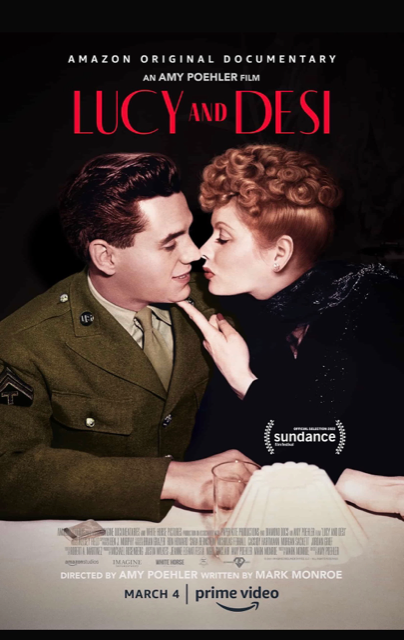
LUCY AND DESI (2022, doc)

March 3, 2022

Greetings again from the darkness. Since it is arriving on the heels of Aaron Sorkin’s dramatized BEING THE RICARDOS (2021), it’s tempting to view this documentary as if a professor is grading his work … or at least fact-checking. However, Sorkin’s film, which resulted in Oscar nominations for Nicole Kidman, Javier Bardem, and JK Simmons, was based on a snapshot in time (and even took some liberties with that), while this first documentary from Amy Poehler takes a much wider lens to the life and career of Lucille Ball and Desi Arnaz.

An elite comedian herself, Ms. Poehler’s obvious admiration and respect for Lucy is understandable, and her film plays much like a tribute to her hero. She includes brief interviews with such legends as Carol Burnett, Norman Lear, Bette Midler, and Charo … each who have had enormous success in the comedy field. These folks all tip their cap to Lucy and Desi and their remarkable groundbreaking achievements with “I Love Lucy” – the most important, the most beloved, and the most long-lived sitcom in TV history.

Ms. Poehler also interviews Lucie Arnaz, daughter of Lucy and Desi. We learn a long-forgotten box of audio tapes was discovered, and that allows us to hear much of their history directly from Lucy and Desi. Lucie adds to the loving and respectful nature of the presentation, although we can’t help but notice her brother, Desi Jr, only shows up in one brief clip of a previous interview. Poehler complements the audio tapes with some excellent archival footage, including home movies that add to the personal feel.

The necessary background is provided so that we may better appreciate just what these two accomplished. Lucy’s grandfather took her to vaudeville shows, and she worked as a model prior to becoming “Queen of the B’s”. Desi’s family was affiliated with the Bacardi rum empire and lost everything in the 1933 Cuban revolution when he was 14. He worked in Xavier Cugat’s band and refined the “Conga line” that is still a party favorite these days. Lucy and Desi met on the set of the RKO movie TOO MANY GIRLS (1940) and after a whirlwind romance, the two were married shortly thereafter.

The marriage difficulties are soft-pedaled, and while it’s clear they loved each other very much, we learn that due to Desi’s stint in the Army and near-constant touring with his band, that the newlyweds saw very little of each other those first few years. In fact, that’s what inspired Lucy to demand that Desi play her husband in the new TV show. We then learn about the extraordinary business decisions that were made – not just for the show, but also in founding their own studio, Desilu, which allowed them to own their show and produce others. It was the selling of all 179 episodes of “I Love Lucy” that kicked off the whole idea of reruns, a staple of today’s television programming.

We see some classic clips from the sitcom, as well as footage of Desi performing his signature “Babaloo”. Lucy and Desi met, fell in love, worked together in the most popular sitcom of all-time, had kids together, built a revolutionary studio business together, divorced, and loved each other forever. Lucie recalls her mother visiting Desi as he lay in bed, slowly dying from lung cancer. She could hear their laughter as they watched “I Love Lucy” reruns. Is the story truth or legend?  Does it matter? The two had a lasting and historic impact on the entertainment world, both from what was on screen and from the business side of running a studio. And even today, everyone still loves Lucy.

Exclusively on Amazon Prime beginning March 4, 2022

WATCH THE TRAILER


INSIDE OUT (2015)

June 18, 2015

inside out Greetings again from the darkness. Once upon a time … in 1995 to be exact … Pixar revitalized and revolutionized the world of animated movies with the release of the first Toy Story. In the process, they sent our expectations soaring for each of their subsequent movies. Despite the pressure of such high standards, the creative geniuses at the studio have regularly thrilled and delighted us over the years with classics such as Cars (2006), Ratatouille (2007), Wall-E (2008), and Brave (2012). And beyond these, there have been a few true cinematic masterpieces – transcendent  films: Finding Nemo (2003), The Incredibles (2004), Up (2009), and Toy Story 3 (2010).  This most recent release unquestionably belongs in the latter group … it’s one for the ages (and all ages).

Genius and brilliance could be used to describe all aspects of this movie. It’s a technical marvel, a visual kaleidoscope of bright colors across the full screen, and most amazingly, it packs an emotional wallop with real life moments for adolescents and parents alike.

My comments will be brief because this is one you should experience for yourself – and probably more than once. Riley (Kaitlyn Dias) is an 11 year old girl who lives in Minnesota and loves her parents, her friends, and hockey. She is happy and well-adjusted. When the family relocates to San Francisco, broccoli on the pizza is only one of the challenges Riley must face. This change affects everything for her – no more friends, no more hockey, and a strained relationship with her parents.  At this point, you are probably saying “So what?  That’s nothing we haven’t seen before.”  And you are correct, except we have never seen it explained the way Pixar does.

We literally go behind-the-scenes of Riley’s brain and see the control panel of her emotions. There is a constant battle between Sadness (Phyllis Smith), Fear (Bill Hader), Disgust (Mindy Kaling), Anger (Lewis Black), and the ring-leader Joy (Amy Poehler). This is an exploration of emotions and memories, and the explanation has some scientific merit. Memories are depicted as marbles, and Riley’s favorite things are shown as islands (Sports Island, Friendship Island, etc). How emotions affect memories is the key point here, and especially how sadness is necessary and vital to our joy. Have you wondered why we forget our imaginary childhood friends (Riley’s is Bing Bong, voiced by Richard Kind)? Have you wondered why our memories change over time, and are impacted by our emotional state in any given moment? This animated gem will help you understand.

Director Pete Docter (the genius behind Up) has a daughter of his own, and he clearly “gets” the emotional changes brought on during the pre-teen years. His research, and that of co-director Ronaldo Del Carmen, takes us on an adventure that should inspire much conversation between parents and kids. And even if it somehow doesn’t break the ice in every family, it will at a minimum help youngsters and parents better understand the link between emotions and memories … plus, they will probably share a good cry and a bunch of laughs along the way. Hats off (again) to the Pixar geniuses. I dare you to top this one!

***NOTE: you should also look forward to another Pixar tradition – the pre-movie short film. This one is a very unique short entitled Lava.

watch the trailer: