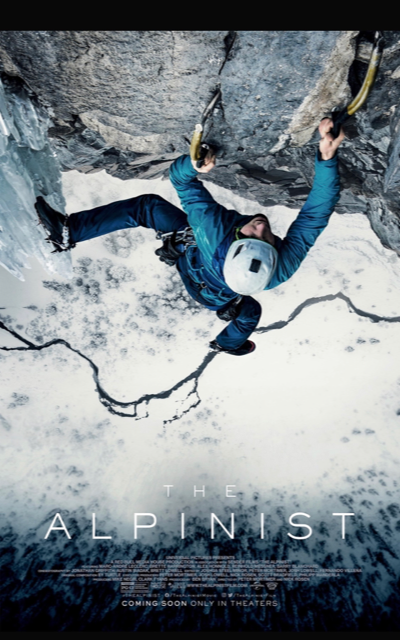
 Greetings again from the darkness. I nearly opted to pass on this since I assumed it would be similar to watching Alex Honnold climb in Best Documentary Oscar winner FREE SOLO (2018), and that was a visceral viewing experience that should not be messed with. To ease my concerns, the filmmakers Peter Mortimer and Nick Rosen interview Honnold early on, and Alex makes it abundantly clear how impressed he is with the solo climbing of Marc-Andre LeClerc, the focus of this film.
The opening sequence is truly breathtaking as we watch LeClerc climb. The filmmakers followed him, or at least attempted to, for the better part of two years. Honnold explains that LeClerc never sought adulation or recognition, and purposefully remained under the radar – a form of purity (and elusiveness). But even climbers have a grapevine, and over time the stories of LeClerc’s solo climbs became somewhat legendary.
Two things are well known about free climbing: these folks are a different breed – beating to their own drum, and the risk of death is extraordinary (we see a roster of some who have perished). Somehow LeClerc is even more extreme than this community of extremists. He owned neither a cell phone nor a vehicle. He had no home, and in fact, he and his girlfriend Brette Harrington recounted sleeping in a stairwell (for warmth, not comfort). As kindred spirits, LeClerc and Brette would sometimes climb together, while other times, he would take off on a new adventure.
As elusive and private as he remained, LeClerc’s own time on camera endears him to us – whether he’s climbing or just talking. For such a young man, his thoughts seem clear and deep. He understands what makes him tick, and his mother admits a 9-to-5 job was never a possibility. LeClerc recalls his hard partying phase, and how climbing helped him recover. The filmmakers panic about halfway through when their star goes AWOL and they struggle to track him down.
The photography is stunning at times, and there are drone shots that capture the spectacle of a lone climber dwarfed by nature. Just when our nerves are frazzled to bits, the ante gets upped with LeClerc displaying his ice climbing ability, and his trip to Patagonia to take on Torre Egger, the most challenging climb in the western Hemisphere. Other climbers provide some insight into the mindset, as well as LeClerc’s accomplishments. Brette and LeClerc’s mother also provide perspective, and while we may have some comprehension of alpinism and solo climbing, it’s Marc-Andre LeClerc’s natural habitat, and the only place he could quiet his mind.
In U.S. theaters on September 10, 2021, following a September 7 nationwide Fathom Events premiere, featuring exclusive bonus content (and an interview with directors Peter Mortimer and Nick Rosen)


 Posted by David Ferguson
  Greetings again from the darkness. In keeping with the times, writer-director Kay Cannon (the screenwriter for three
  Greetings again from the darkness. This is an unusual documentary from Andreas Keofoed. The first part examines the attempts to solve the origin mystery of a discovered painting, while the second half takes us inside the mysterious money side of the collectible art world. Both mysteries are fascinating on their own, and they blend together to track the 15 year history of a painting that may have come from the brushes of Leonardo da Vinci more than 600 years ago. Or it may not have.
 Greetings again from the darkness. As expected, we are beginning to see an influx of “pandemic” movies and TV shows. What wasn’t expected is the unique and creative approach in this one from Co-directors Stephen Daldry (
 Greetings again from the darkness. September 11, 2001 was “a blue sky day” in New York City. Until it wasn’t. Co-directors Pamela Yoder and Steven Rosenbaum previously collaborated on
  Greetings again from the darkness. Life is full of choices, however sometimes destiny takes charge and there’s little we can do about it. One’s parents are the most obvious and crucial example. We don’t choose our parents and yet their impact on our lives is unavoidable. Jennifer Vogel’s book, “Flim-Flam Man: The True Story of My Father’s Counterfeit Life”, has been adapted for the screen by the
  Greetings again from the darkness. It might have been quite enjoyable had we just continued to eavesdrop on Kate Mulgrew and Barbara Barrie as they strolled through the park talking about life – past, present, and future. Their segment is easily the highlight of the film, and unfortunately, it’s difficult to put a positive spin on any other piece of this project from writer-director Evan Oppenheimer. Okay, some of the drone shots of New York City are lovely, however, it’s important to know when enough is enough.
 Greetings again from the darkness. Ruby Rossi is a high school student. She is also a CODA – Child of Deaf Adults. Her older brother is deaf too, meaning Ruby’s life has been spent as an interpreter for her family, while also working on the family fishing boat in Gloucester, Massachusetts, where they are treated as outcasts and viewed as oddities by others. Ruby also loves to sing and listen to music, activities she can’t share with her family. This is no coming-of-age tale, as Ruby has long been wise beyond her years. It is, however, a story of a young person finding their true self and breaking from the ties that bind to the only life she’s known.
 Greetings again from the darkness. Nicholas Bruckman provides an intimate profile of a fascinating man, Ady Barkan, a brilliant and relentless advocate for health care rights. Barkan’s ALS diagnosis and commitment to cause is interesting enough to carry the film, but by following Barkan, the film serves a dual purpose of educating us on activism and political maneuverings.
 Greetings again from the darkness. The Holocaust and Nazi Germany. No subjects are likely even close in regards to the number of documentaries on topic. Yet somehow, there always seems to be more to mine. Co-directors Peppa Epperline and Michael Tucker have based their project on the 1978 book by Sebastian Haffner. The objective is to pull back the curtain on the self-conceit at the center of the cult of Hitler. How did this happen? How has it been repeated? How do we expose this without adding to the fascination of Hitler? It’s quite a conundrum, and one not easily navigated.
 Movie Reviews from the Dark