FED UP (doc, 2014)

May 28, 2014

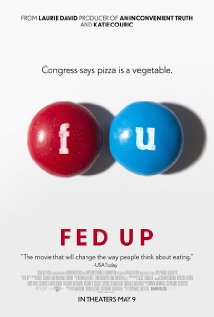
fed up Greetings again from the darkness. Changing traditional thinking is not easy, but filmmaker Stephanie Soechtig gives it her best shot. The main theme here is that the obesity crisis is getting worse because we are not looking at the problem correctly.

All calories are not created equal, so Energy Balance (calories in equal calories burned) is a flawed theory. This messes with our eat less and exercise more mantra. The real bad guy here is sugar – in all forms. We learn that the food industry is adding all types of sugar to all types of foods (as much as 80% of grocery store items). We know the dangers of corn syrup, and soda certainly gets some blame, but we get “tricked” with many other foods … especially those in school cafeterias.

Narrated by (Producer) Katie Couric, the film gets a boost from such well known types as Bill Clinton, Tom Harkin and Michael Pollan. The film doesn’t let Michelle Obama off the hook. It explains how her initial “Let’s Move” campaign was designed to help us eat better, but has been repositioned by the food industry lobbyists to promote exercise for kids, rather than proper diet. More detail on this would have been welcome.

There is no shortage of other experts or sobering statistics. One of the most fascinating was 40 out of 43 lab rats preferred sugar water to cocaine. The point is that a powerful sugar addiction can happen quickly and it causes our bodies to crave the foods that make us fat. Those same foods will not have daily requirements of sugar listed, because if they did, most servings would be over 100%.

So while the food industry is the clear target, the burden falls to each of us to better understand the negative impact of sugar. The Type 2 Diabetes statistics are stunning. Break your soda habit and learn what makes up the food you are eating. Don’t wait for the government to save you.

watch the trailer:


SOMM (doc, 2012)

May 26, 2014

somm Greetings again from the darkness. Alexander Payne’s 2004 hit Sideways made wine tasting and discussion a fun thing to do with friends, and U.S. wine tours exploded. In the movie, Miles (Paul Giamatti) is quite knowledgeable and opinionated on wine. However, comparing Miles to the real life characters in the Somm documentary is like comparing the boys of The Sandlot to major leaguers … it’s not even close!

Filmmaker Jason Wise follows four guys as they prepare for the nearly impossible-to-pass Master Sommelier exam. The certification has been around for 40 plus years, and less than 200 applicants have actually passed. We get to know the four who are studying so diligently by watching them interact and even talk to the camera. The competitive nature is on full display through the trash-talking and emotions that are evident through each disagreement. Mostly we witness the enormous stress that comes from working so hard for a single shot … the best comparison I can make is that of an Olympic athlete preparing for their single event.

We also meet Fred Dame, the Godfather of U.S. Master Sommelier. He trains through intimidation and seems to carry the burden of exclusivity in every interaction. Yeah, he’s kind of jerk, as are the four vying for the certification. It seems one must be self-absorbed and borderline ego-maniacal to build the knowledge and fine-tune the palate necessary to have a shot at passing.

The exam is broken into 3 parts: Blind wine tasting, Theory, and Service. The wine tasting segments are most fun to watch as we quickly learn there is a skill, a science and some luck involved. Through a sniff and a sip, they must be able to identify the type of wine, the subtle flavors, the age of the wine, the country of origin, the specific region, and even the level of winery. The theory section involves knowing wine history from all over the globe. This is accomplished through endless hours of reading and flash card drills. The Service portion gets the short straw here, but we do get a taste of the outlandish nature of a game whose sole point seems to be humiliating the participant.

To add another touch of legend, we do get some insight from Bo Barrett, the legendary California wine maker profiled in the movie Bottle Shock. Mostly though, we learn that this most prestigious designation can only be obtained through an elitist Obsessive-Compulsive approach that kills all sense of acceptable societal manner. For most of us, enjoying a glass of wine with friends is reward enough … for you others, best of luck learning the 3000 grape varietals in Italy.

watch the trailer:


DIRT! THE MOVIE (doc, 2009)

May 24, 2014

dirt Greetings again from the darkness. “Dirt might be more alive than we are.” It could be a tag line for the newest horror flick, but instead it’s one of the key elements to this well presented and informative documentary that’s been around, and discussed, for a few years.

Inspired by William Bryant Logan’s book “Dirt: The Ecstatic Skin of the Earth“, the three filmmakers roll out interviews from what must be a some kind of Guiness world record in professional diversity: farmers (of course), Mycologist (had to look it up), Professors, a Physicist, a Pastor, an Entomologist, an Anthropologist, Ecologists, a Horticulturalist, a Native American spokesperson, a prison worker, a photographer, a wine expert (who merrily eats dirt and then brags about it) and even a Nobel Laureate. This group would make up quite the dinner party!

Doing as much showing as telling, the film avoids the doom and gloom of so many “destroying the earth” documentaries and instead uses splashes of animation to lighten the mood, while still making serious and important points. It doesn’t, however, miss the chance to cast the negative light on monoculture farming (single crop over large land areas), strip-mining, logging, fertilizers and pesticides.

On the bright side, hope is provided through many isolated efforts of those trying to save our dirt (S.O.D. – see what I did there?)! These aren’t extremists picketing corporate farms, but rather groups of people doing what they can. Rooftop gardening and schoolyard gardens (by ripping out asphalt) are two of the most interesting. A fascinating point is made that if Ethiopia were properly farmed, it could feed all of Africa.

The story of Clyde’s pickup is pretty interesting as well – though I wondered why it never got towed. We get a history lesson on the use of dirt as a building material, and how man’s greed created the Dust Bowl.  After all this, somehow the one thing that is stuck in my head is Dino Pee … the point that all of Earth’s water is continually recycled, and every glass of water we drink goes back millions of years and could contain traces of … well you get the idea.

watch the trailer:


KIDS FOR CASH (doc, 2014)

May 20, 2014

kids for cash Greetings again from the darkness. Focusing on “the honorable” Judge Ciavarelli and Judge Conahan of Pennsylvania, director Robert May (Producer: The War Tapes, The Fog of War) provides some insight into a despicable miscarriage of justice that the media labeled Kids for Cash. It’s a catchy phrase that can best be defined as a convergence of some less-than-favorable traits: abuse of power, over-the-top greed, and a collapse of trust in the juvenile justice system.

The talking head approach is on full display, and proves quite effective here. We get interviews and statements from attorneys, journalists, citizens, a particularly vocal radio talk show, and surprisingly, even Judge Ciavarelli and Judge Conahan. The biggest wallop comes from the words and body language of those most directly impacted – the kids and their parents.

For those unfamiliar with the story, Ciavarelli and Conahan were charged in various felonies related to their conspiratorial actions that led to the closing of a County facility, the fundraising for a new private facility, and the subsequent sentencing of thousands of kids to ensure the facility remained at capacity. The financial rewards for these two men included “finder’s fees” ($2 million for Ciavarelli), or what most others would term bribes or kickbacks.

The actions of Judge Ciavarelli are defended by his staunch campaign strategy of “Zero Tolerance” in the wake of the Columbine tragedy. Once elected, his frequent speeches at local schools reinforced his commitment to zero tolerance, and his promise to severely penalize any kid that ran afoul of the law. In theory, most of this sounds like a formidable stance, however, the real problem occurs when the test of reasonableness is absent in the charging of teenagers (some only 13 or 14) with a crime. This is where the film falls a bit short. The kids going to court makes a dramatic story, but the missing link is HOW does this happen when most of these cases come across as schoolyard dust-ups, typical teenager antics (a MySpace page), and simply part of the maturing process for adolescents?

There is an acknowledgment that most young teenagers don’t have the necessary decision-making skills or sense of judgment to handle these situations. The point is well made that teenagers are not just “little adults” … there is much growth to come, both physically and intellectually. This leads to the real question: why aren’t we doing a better job of allowing kids to develop their judgment and dispute resolution skills. The pizza shop guy in the movie says “we all got in playground fights“. He’s right! But these days, that gets the kid (even first time offenders) arrested and possibly sent away … where they come back hardened and angry. This approach is not working – though, I’m certainly not suggesting mass playground fights. There has to be a better way.

This story really isn’t about the kids, rather the attention is on the (then) upcoming trials of the two judges. The film’s tone shifts to one of revenge and reckoning. It’s an emotional and powerful time, and neither of the judges come across as believable or likable. In fact, Conahan strikes a plea bargain, and Ciavarelli defiantly states he is not guilty of “kids for cash” … AFTER being found guilty of 12 felonies on related issues! His true character shines through.

The film expertly tells the story … often very personal stories … of some of those impacted by the Kids for Cash scandal. It raises many questions on numerous topics, though most are overshadowed by the focus on the judges’ trials. Near the end, many statistics are displayed – some of which could support their own documentary. The real impact of a documentary is judged by its call to action – the ability to get people involved in finding answers and solutions. Let’s hope the impact is profound, even if it’s too late for some.

To learn more about the film and watch the trailer, visit the website:  http://kidsforcashthemovie.com/


GODZILLA (2014)

May 18, 2014

godzilla Greetings again from the darkness. Sixty years after Godzilla made his initial screen appearance, we get a full blown Hollywood special effects blockbuster version that will eclipse the $100 million mark in its first weekend. This is director Gareth Edwards’ second feature film (Monsters, 2010) and he juggles the modern day re-imagining with the Japanese roots and a hand full of other tributes throughout.

The cast seems impressive: Bryan Cranston, Juliette Binoche, Elizabeth Olsen, Sally Hawkins, Ken Watanabe and David Strathairn. Unfortunately, most of these fine actors have little to do, and instead the dominant human presence (most every scene) is Aaron Taylor-Johnson (Kick-Ass) who somehow keeps getting gigs despite lacking even a dollop of screen presence or acting ability. Of course, this movie is supposed to belong to Godzilla, and even he is usurped on screen time by two nuclear-feasting praying mantis creatures that share some attributes with the classic “Alien”. These screen hogs are called MUTO’s (Massive Unidentified Terrestrial Organisms) and are quite substantial … crushing skyscrapers by landing.

The 1954 original film was an anti-nuclear statement, though the re-edited U.S. version replaced the political statement with Raymond Burr. Mr. Burr also appeared in the 1984 sequel which included a storyline of feeding off a nuclear plant (borrowed in this year’s version). This film’s prologue featuring Bryan Cranston working at a 1999 nuclear plant is an unmistakable nod to the recent Fukushima disaster, and sets the stage for the collision of science (Watanabe) and military (Strathairn). Director Edwards clearly enjoys his Jaws-like teasing of Godzilla, who finally shows up after almost an hour. And despite the Jurassic Park roar by our titular monster, this doesn’t hold a candle to Spielberg’s 1993 classic. We do get the quite familiar shots of bystanders running down the street, glancing back in fear – a must for any monster movie, and it should be noted that Godzilla films have a legacy of multiple creatures, as well as the man versus nature theme.

Having seen this one in 3D, I’ll mention again that the enhanced effects offered by this technology do not offset the darkened, dulled look. Add that to the almost total lack of color – it’s borderline Black and White – and there are simply too few breathtaking visual moments to consider this a monster classic.

SEE THIS MOVIE IF: you are a monster movie fan or a follower of the Godzilla legacy OR you need proof that a lead actor can be less engaging than Matthew Broderick was in the 1998 Godzilla film.

SKIP THIS MOVIE IF: you believe technological advances should produce a more visually stunning film than Jurassic Park from 21 years ago OR you happen to be a huge Juliette Binoche fan and expect to see her in a lead role.

watch the trailer:


AIN’T THEM BODIES SAINTS (2013)

May 18, 2014

ain't Greetings again from the darkness. Finally catching up with this one after it received such critical raves on the festival circuit last year. It’s one of those films that cause so many “normal” movie goers to question the tastes of critics. It certainly has the look and feel of a terrific independent art-house film, but as they say, looks can be deceiving.

The cast is outstanding and play off each other and the setting exceedingly well. Casey Affleck, Rooney Mara, Ben Foster and Keith Carradine are a pleasure to watch … they make it easy to KNOW these characters. Daniel Hart’s score is the perfect balance of haunting and complimentary – understated at its best. The most exceptional thing of all is the cinematography of Bradford Young. The look of the film is right there with the best of Terrence Malick … and that amplifies the film’s biggest problem. The story is highly recollective of Malick’s Badlands, and that’s where the shortcomings jump out. There is just not much substance to this story – it’s really just another in the line of disillusioned criminals dreaming of a clean slate.

Writer/director David Lowery is a definite talent, but his dependency on look and feel prevent this one from reaching greatness. We recognize immediately that this can’t end well. The only question is how badly will it get for each of the main characters. Crime may not pay, but some criminals just seem to keep paying … and drag down others with them. For those that enjoy the indies, this is one to catch up with … and filmmaker David Lowery’s best work is still ahead of him.

**NOTE: This may be one of the worst movie titles of all time

watch the trailer:


THE AMAZING SPIDER-MAN 2 (2014)

May 11, 2014

spider 2 Greetings again from the darkness. This follow-up to The Amazing Spider-Man (2012) seems to have the mission of throwing as much onto the screen as possible. There are not one, but three key villains, a teenage love story, a deathbed scene, numerous moments of soul-searching, a stream of wise cracks and puns, the most outrageous laboratory setting, a cartoonish evil doctor accent, the constantly furrowed brow of Aunt Mary (Sally Field), flashbacks and video of the mysterious father, teasers for future movies, and of course, enough action and special effects to ward off any thoughts of peace.

Personally, I find Andrew Garfield to be a nice fit as Spidey, but I just can’t buy him as ultimate science geek Peter Parker. He bumbles about and bats his eyes too much for my tastes, and can’t stand toe to toe with Gwen Stacy (real life squeeze Emma Stone) in scientific banter. Still, the original story is interesting enough that any minor issues are easily overlooked.

At its core, this entry is a story of revenge. The foundation for Peter Parket’s troubles all stem from Oscorp, so we are treated to some behind the facade sets that will keep viewers on their toes. After an initial face-off with bad guy Aleksei Sytsevich (a maniacal Paul Giamatti), we see the transformation of goofy Max Dillon (Jamie Foxx) into the shocking (get it?) Electro. If that’s not enough, childhood buddies Peter Parker and Harry Osborn (Dane DeHaan) are reunited to set the stage for more good vs evil.

The story would have benefited from more concentration on any of these three stories, while dropping one altogether. The viewer would have benefited from a slower jolt (one more!) in the transformation of Max to Electro. We needed to find the humanity, rather than just desperation. The same goes for Peter and Harry. The dots are a bit too far apart for connection, though DeHaan (so good in Lawless and Chronicle) is a striking contrast to the doe-eyed, beautifully coiffed Garfield.

It’s nice to see Stone’s Gwen portrayed as a smart, ambitious young woman who also understands how demanding a relationship is, and the responsibility that goes with dating a superhero. Speaking of responsibility, the lack of Uncle Ben’s influence here is disturbing, though probably necessary given the exploration of backstory on Peter’s parents (Campbell Scott, Embeth Davidtz).

When Paul Giamatti reappears near the end as Rhino, it’s a bit difficult to not think “enough is enough”. And oddly, this fight sequence ends abruptly, evidently setting the stage for future Spidey. And speaking of the future, the end credits scene plays as nothing more than a teaser trailer for the next X-Men movie, while robbing us of any details to the Sinister Six.

Admittedly, I feel somewhat overdosed on Superhero and Comic book adaptations, yet the action and effects are still quite fun to watch, even if director Marc Webb (Ok, that pun is just too easy) seems to jumble up too many story lines.

***NOTE: I find humor in the fact that both lead actors from Sideways (2004) have now played villains in Spider-Man movies. Paul Giamatti in this one and Thomas Haden Church in Spider-Man 3 (2007)

***NOTE: fans of The Matrix will experience deja vu as Peter Parker discovers his father’s laboratory

watch the trailer:


CYBER-SENIORS (doc, 2014)

May 9, 2014

cyber seniors Greetings again from the darkness. As the world has become more connected, the greatest generation is being left behind in a cloud of digital dust. As pointed out by one of the teenage mentors, the generation gap is wider than ever. The good old days of three generations living together under one roof are gone, and quite often there is a great geographic distance between family members. Two teenage girls set out to close the gap by teaching senior citizens how to connect via the World Wide Web. Their project, Cyber-Seniors, is captured on film by director Saffron Cassady.

Taking place in a couple of Toronto Assisted Living Centers, the Cyber-Senior project has millennials making the rounds to tutor the residents on how to use a computer, and specifically, how to connect with distant family members. The film focuses on five individuals ranging in age from 77 to 93. While the seniors are absorbing the power of technology, the teenage mentors slowly come to realize the spirit of life and the interesting backstories of their much older pupils. Patience and a sense of humor are necessary for all parties involved, creating a very interesting, entertaining and meaningful story for the viewer.

Playing significant roles in the process are such items as Facebook, email, digital photos, chatting, online banking and Skype. There is a brief, but humorous segment on a dating site, but the real fun begins when 88 year old Shura creates a “cooking” video for YouTube. My guess is you will never again think of corn on the cob or grilled cheese the same. This leads to a YouTube contest, and this portion could have made a film unto itself, as each senior creates a video in line with their own personality – exercise, friendship, dating, and yes, even dental work. It’s fascinating to watch these folks flash some of their knowledge and personality.

The project itself is ambitious and worthwhile, but the real payoff comes as these fine people re-connect with their kids and grandkids and friends. While the humor and touching moments make for wonderful viewing, the film is a not so subtle reminder that everyone has something to offer, and we can all benefit from more personal interactions with those who mean so much to us. For other wonderful documentaries centered on senior citizens, see Young at Heart (2007) and Ping Pong (2012).

To see the trailer and learn more about the film, go to:

Home Page


LAURA (1944) revisited

April 27, 2014

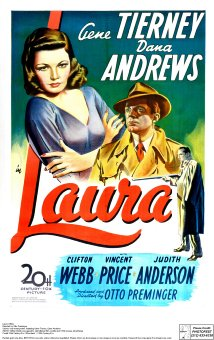
laura Greetings again from the darkness. Some movies from the 1940’s remain fun to watch for mostly nostalgia reasons. Others still hold up well today and can be enjoyed for the story, script, acting and production value. Director Otto Preminger’s Laura falls easily into the latter category. This quasi-film noir, murder mystery, creepy love story is based on the novel from Vera Caspary is probably more respected today than when it was released … 5 Oscar nominations, but not one for Best Picture.

To fully appreciate the film, it helps to know the tortured back story. This was always Otto Preminger’s baby, but Daryl Zanuck initially chose a different cast, a different director and a different ending. In the end, Preminger (Anatomy of a Murder) won all of his battles – directing Gene Tierney with the ending he wanted (thanks to Walter Winchell). TCM’s Robert Osborne correctly states that the film has one of the best opening lines: “I shall never forget the weekend Laura died“. The line is spoken by narrator Waldo Lydecker (great screen name) played by the elegant Clifton Webb.

Playing out as mostly a murder investigation led by the detective (Dana Andrews), we are treated to a stream of unusual story choices and only one scene at the police station … a terrific interrogation scene. Instead, we spend the entire movie on the turf of rich, high society types. There are at least four credible murder suspects and they are strung along by a mostly monotone detective, who only flashes personality on his date night with the dead girl’s portrait (well, that’s how it plays!) and when he is messing with a pocket baseball toy.

gene tierney Gene Tierney plays the titular Laura, and every time she appears on screen her startling beauty distracts us … just as it does the other characters in the film. Tierney was only 23 years old when this was filmed, and a couple years later she had a romance with young John F Kennedy (though she became a long time supporter of Richard Nixon). Her tragic personal story was the basis for Agatha Christie’s novel and movie The Mirror Crack’d. In the 1950’s a suicidal Tierney was treated with shock therapy in a sanatorium, and though she recovered, she struggled for the rest of her life. Her second husband was Houston oil man W Howard Lee, who had previously divorced actress Hedy Lamarr … another of the all-time screen beauties, who also turned down the lead role in Laura. Lucky guy.

The spirit of the movie comes courtesy of the magnificent performance of Clifton Webb as Waldo Lydecker. He is mesmerizing in his ability to take over every scene. This was Webb’s first “talkie” feature film – he left for the stage 15 years prior. The 30 year age difference between Waldo and Laura only works because Webb plays it as her society mentor, though it’s obvious he is obsessed.

Some of the best scenes and banter occurs with Webb and Vincent Price, who plays Laura’s fiancé. If you are only accustomed to Vincent Price in horror films, you will certainly get a kick out his odd role here as the virile, insecure fiancé. He also has some very good and uncomfortable scenes with the great Judith Anderson, who clearly lusts after the Price character.

The aforementioned portrait of Ms. Tierney was also used in 3 other films, and it’s interesting that Tierney and Andrews made 5 total films together. David Raskin’s haunting “Laura’s Theme” plays throughout the film in various fashions, and Joseph LaShelle won the film’s only Oscar – best black & white cinematography. This is certainly one of the best from the 1940’s and holds up very well today … enjoy the many facets of quality filmmaking.


**NOTE: None of the available online trailers are of acceptable quality, so I have decided not to post one


THE LUNCHBOX (Dabba, India, 2013)

April 26, 2014

lunchbox Greetings again from the darkness. What a terrific first feature film from writer/director Ritesh Batra. Don’t mistake this for the typical Bollywood release in the U.S. There are no song and dance numbers here. Instead it’s a very intimate portrait of how two people awaken to their own situations by connecting with each other through notes in a lunchbox.

“Lunchbox” takes on a life of it’s own when referring to the dabbawallahs – the infamous lunch delivery men in Mumbai. The opening credits provide us a ride-along with the key lunchbox as it takes multiple forms of transportation prior to arriving at its destination. Only this time, a rare mistake occurs. The lunchbox from Ila lands on the busy desk of Saajan, rather than her husband. See, Ila is trying to re-capture the attention of her distracted husband. Instead, she finds a soul mate in Saajan via note exchange and tasty dishes.

While Ila is a desperate and frustrated housewife, Saajan is a melancholy widower who is headed to retirement in hopes that it helps him forget all that he now tries to cover up through his cigarette habit and retreat from society. The real magic here stems from the slow process of self-realization that occurs for the two characters. There is humor and emotion aplenty, yet both performances of Irrfan Khan (Saajan) and Nimrat Kaur (Ila, and her extremely expressive eyes) are remarkably understated and believable and touching. We immediately care for both.

Nawazuddin Siddiqui offers support as the very interesting and entertaining Shaikh … a character that could easily support his own film. We also see Lillete Dubey as Ila’s mother. Ms. Dubey also appeared in the terrific Monsoon Wedding (2001). Equally impressive is the city view of Mumbai. The overcrowded streets, trains and buses leave us understanding how difficult daily life is for these folks.

Not since Lost in Translation has a platonic relationship been so effectively told on screen. This story and these characters remind us just how important human connection is … letting someone share your dreams is a rewarding step.

watch the trailer: