BEASTS OF NO NATION (2015)

October 16, 2015

beasts of no nation Greetings again from the darkness. Cary Joji Fukunaga has quickly established himself as an expert storyteller with his previous writing and directing of Sin Nombre (2009), Jane Eyre (2011) and the fascinating and conversation-sparking first season of “True Detective” (he did not direct the much-maligned Season Two).  He goes even deeper and darker this time by adapting Uzodinma Iweala’s novel about a child soldier.

When first we meet Agu, he is but an enterprising and fun-loving kid who thrives on mischief such as trying to sell “Imagination TV” – the empty shell of a console TV, complete with Agu and his buddies acting out scenes for those who peer through the picture tube opening. Agu describes himself as “a good boy from a good family”, and we believe him.

Somewhere in Africa is all we know about the location, and soon enough Agu’s village is under siege and he is separated from his mother, and forced to stay behind with the men – including his father and big brother. More terror forces Agu alone into the forest until he is brought into a mostly young group of rebel forces led by the Commandant (Idris Elba). It’s around this time that Agu begins “talking” to God through voice over narration that allows viewers to understand what’s going on inside Agu’s head – often quite contrary to what is happening on the outside as he transforms from mischievous kid to dead-eyed child soldier.  When Agu stops speaking to God, we understand that he believes he no longer deserves to be heard, but his words to the universe (directed to his mother) let us know, this boy has not yet lost his soul.

Though we never understand the war, or even who is fighting whom, this uncertainty is designed to help us better relate to Agu. He may be a tough-minded soldier, but we also never forget that he is mostly a little boy hoping to re-connect with his mother. Idris Elba plays the Commandant as part father-figure, part war lord, and part cult leader. He is a menacing presence one moment and a soothing voice of reason the next. When we (and Agu) learn the full story of his multiple sides, we are both sickened and disheartened. It’s the performances of both Elba and newcomer Abraham Attah (as Agu) that make this such a devastating and fascinating movie to watch, and it’s the filmmaking of Fukunaga that keeps our eyes glued to the screen when we would just as soon turn away.

This is a Netflix original film and they are experimenting with a simultaneous release in theatres and streaming. This approach has not previously been met with open arms by theatre chains when attempted by other distributors. It will be interesting to see if Netflix can make it work.

watch the trailer:


A BALLERINA’S TALE (2015, doc)

October 15, 2015

a ballerina tale Greetings again from the darkness. You may have seen her “60 Minutes” segment earlier this year, or you may have heard the announcement over the summer when she became the first African-American Principal dancer (prima ballerina) at American Ballet Theatre. Or perhaps you recognize her being featured in advertisements for Under Armour or T-Mobile. If none of this sounds familiar, then you may be totally unaware of Misty Copeland, and director Nelson George has just the documentary for you.

One need not be an expert on ballet to recognize the ability, tenacity and stage presence of the lovely and incredibly athletic Misty Copeland. The grainy footage of her dancing at age 15 can’t prevent this star from shining. Soon enough she is the only black dancer in the American Ballet Theatre troupe of 80, and from there she just continues to advance.

The film touches on her unusual and challenging childhood, and also provides a brief primer on the history of ballet (15th century Italy, 17th century France), before naming the few names of the African-American ballet dancers over the years. See, skin with color and a muscular body were considered taboo in the lofty world of ballet … and it became even worse during the era of famed choreographer George Balanchine. His vision of the perfect dancer led to a culture of eating disorders, depression and impossible standards for body image. The point is that Misty Copeland not just broke down color barriers, but also body image expectations … even though she went through her own struggles (Krispy Kreme, anyone?).

We are also provided a peek at the physical grind and incredible strain that these dancers go through to appear so graceful and effortless on stage. A stress fracture in her shin threatened Misty’s career, and the film follows her recovery and remarkable ability to become an even better dancer after the injury and surgery.

Most interesting is the relationship that Susan Fales-Hill cultivated with Misty. This mentorship helped Misty fight through the personal and social challenges, while also connecting with the movers and shakers throughout the African-American community. The film’s best sequence has Misty connecting with Raven Wilkinson, who was a ground-breaking dancer from the 1950’s. Watching these two ladies (separated by multiple generations) bond through dancing is heart-warming and extraordinary.

Of course, we also are treated to a few extended dance performances from Misty – both live performances and the under-appreciated practice sessions. This culminates with her being cast as Odette/Odile in “Swan Lake” … yes, a black ‘white swan’. Her talent leaves us in awe, and is surely inspiring an entire generation of young dancers. The film certainly would have been better served by allowing us to connect with or understand Misty the person … but we must be satisfied watching Misty the dancer.

To see Misty’s Under Armour commercial entitled “I Will What I Want”:

https://www.youtube.com/watch?v=ZY0cdXr_1MA


99 HOMES (2015)

October 8, 2015

99 homes Greetings again from the darkness. Thumping music, the aftermath of a suicide, and an arrogant and immediately dislikable real estate agent fill the screen in a tension-packed opening sequence. This is how writer/director Ramin Bahrani begins our descent back to 2010 during the severe housing and economic crash. While the foundation of the story is the “system” that screwed over so many homeowners, it’s really more a tale of morality and how we react during desperate times.

Andrew Garfield plays Dennis Nash, a skilled construction worker scrounging for jobs as he tries hard to make ends meet in the house-building industry so devastated by the economy. He lives in his childhood home with his mom (Laura Dern) and his young son. In an attempt to stave off foreclosure, Dennis goes to court pleading his case. See, he received contradictory instructions from his bank, and he ends up on the wrong end of the bailout. Watching a family getting booted from their home is excruciatingly emotional, and we empathize with the anger, frustration and helplessness of Dennis as realtor Rick Carver (Michael Shannon) and the Sheriff’s department execute the eviction.

In an odd turn of events, Dennis ends up working for Carver and quickly becomes addicted to the money. As Carver pulls him deeper into his scheme of bilking the banks and government agencies, Dennis rationalizes with the knowledge that he is providing for his family and on track to get his family house back. Watching Garfield’s emotionally vulnerable character interact with Shannon’s brutal businessman is pretty fascinating. It’s a bit Faustian as Dennis basically sells his soul to the devil (Carver), though he continually struggles with the moral issues until the final act … where the true line in the Florida sand is drawn.

Garfield makes the acting transition to adult in a fine turn, but it’s Shannon’s creepy Realtor who dominates the picture. From the beginning, we don’t like him – but we find ourselves better understanding his motivations after we finally get his personal explanation. The film does a nice job pointing out all parties who are somewhat responsible for the horrific housing downturn, and does so without sermonizing on the evils of big banks. In fact, it could be taken as a reminder that the “system” so many love to bash is actually made up of individuals who, in the words of Rick Carver, have learned to go “numb” rather than show emotion or respect. It’s a tough movie to watch, but a needed reminder of the importance of humanity during desperate times.

watch the trailer:


PAN (2015)

October 8, 2015

pan Greetings again from the darkness. Writer J.M. Barre first introduced the world to Peter Pan just after the turn of the twentieth century. Children and adults alike were enamored with “the boy who wouldn’t grow up”. The stories were filled with the mischief created by Peter and his Lost Boys buddies from their Neverland home, and although there existed elements of danger (Captain Hook), Barre’s story was mostly about holding on to the joy and carefree world of childhood.

Sadly, these days we don’t encourage kids to be kids. Instead, we push them to take on responsibility and act ‘grown up’ … heck, most kids today never really experience free play time with their friends. Everything is organized and scheduled (just check the calendar on the fridge). Writer Jason Fuchs and director Joe Wright (Atonement, Hanna) have created a Peter Pan “origin” story that lacks any touch of whimsy or enchantment from the original books or the numerous film adaptations: the 1953 Disney animated classic, the 1991 Steven Spielberg/Robin Williams/Dustin Hoffman vehicle, the underrated 2003 live action version from director P.J. Hogan, or even last year’s Live TV broadcast featuring Allison Williams as Peter.

This one begins with a talented Parkour-enabled Mother (Amanda Seyfried) dropping off her infant son on the steps of an orphanage. She leaves only a note and a pan flute medallion. Flash forward twelve years and Peter (Levi Miller) is questioning the mysterious disappearance of kids from an environment straight out of a Dickens novel, as well as the hoarding talents of the evil Mother Superior (Kathy Burke). Soon enough Peter finds himself, along with scores of other youngsters, slaving in the fairy dust mines belonging to Blackbeard (Hugh Jackman).  Are you depressed yet?

Things only get bleaker as Peter escapes with his new friend James Hook (the name is no coincidence). They soon encounter the tribe that protects the Fairy Kingdom and the fairy dust that Blackbeard so values. Part of the tribe is Tiger Lilly (Rooney Mara) who believes that Peter is “the chosen one” who has come to lead and protect them. Lots of fighting ensues, plus some soaring giant crocodiles, flying pirate ships, and a trio of mermaids (all played by supermodel Cara Delevingne).

Re-imagining the classics is about the closest thing we get to creativity in Hollywood these days, so it’s not the idea of the project that so bothers, but rather the approach. Where is the fun?  Where is the sense of wonderment?  In fact, young Peter’s destiny seems to be an urgency to assume more responsibility as a leader … not live the carefree days of fun and games that Mr. Barre had set out.

Newcomer Levi, who plays Peter, ranks right there with director Joe Wright’s previous discovery of Saoirse Ronan, as child actors with big time screen presence. Young Mr. Miller has a grasp of the script and character and is the best part of the film. Hugh Jackman plays Blackbeard, but can never really reach the necessary level of intimidation or theatricality. For some reason Garrett Hedlund plays Hook as if he is imitating Christian Slater who is imitating Jack Nicholson playing Indiana Jones. It’s so over-the-top that we must assume Hedlund was directed to bring some comic relief to the bleak environment. Much has already been written about the casting of ultra-Caucasian Rooney Mara in the role of Tiger Lilly, though she performs the role quite well (avoiding the screeching of her lines in the manner of Jackman and Hedlund).  Rounding out the cast is Adeel Axhtar as Smiegel/Smee.

Some of Wright’s action sequences and CGI are quite impressive, though it’s difficult to overlook the obvious influences of Terry Gilliam, Baz Luhrman, and even George Lucas and James Cameron. Particularly painful and out of place are the Luhrman-influenced musical interludes of Nirvana’s “Smells Like Teen Spirit” and The Ramone’s “Blitkrieg Bop”.  Even the pixie dust effect reminds of Dorian Gray, though Jackman only gets one brief scene in which to capitalize.

Devotees of the J.M. Barre source material will be no doubt disappointed and confused, but the theatre was filled with youngsters who couldn’t seem to care less that Joe Wright had taken a classic story in the opposite direction. They enjoyed the visual effects as evidenced by the numerous “oohs” and “ahhs”. So let’s allow that reaction to speak for itself, rather than saying this version just didn’t pan out.

watch the trailer:


SURVIVING ME: THE 9 CIRCLES OF SOPHIE (2015)

October 8, 2015

surviving me Greetings again from the darkness. A director’s first feature film is often the most personal of their career, which always adds an element of interest. Leah Yananton writes, directs, produces and acts in this story that focuses on the self-discovery of a young woman who passes (loosely) through Dante’s nine circles of Hell on her way to becoming a better person … or at least one quite apologetic for her previous self.

Most movies have a protagonist that we can root for, or at least relate to. Sophie (newcomer Christine Ryndak) is a poet-wannabe in her junior year of college. She is also whiny, needy, self-centered, and altogether unlikeable (to this viewer). Her feel for literature and poetry catches the attention of a married professor (Frederic Lehne), and we know immediately that this will get messy. Sophie inserts herself into the home life of Professor Slateman and Jacqueline (Mira Furlan), and her immaturity causes her to miss out on a real opportunity.

Instead of true relationships, Sophie pursues the professor while leading on Jimmy (Vincent Piazza, “Boardwalk Empire”), a fellow student who really likes her. She also uses and abuses her best friend Kiera (played by director Yananton), who is equally misguided, but much more self-aware. Equally frustrating is Sophie’s treatment of Jacqueline, who initially takes a legitimate interest in Sophie’s talent. Jacqueline is far and away the most intriguing character here, and a movie centered on her would have been significantly more interesting.

Dante’s “Inferno” detailed the path to rejection of sin, and we follow Sophie through each circle … some are a bit of a stretch, but the effort is commendable. Her choices along the way can sometimes be chalked up to being a 20 year old, while others are simply inexcusable for anyone with a conscience. By the time Ms. Yananton’s own version of “Ring of Fire” plays over the closing credits, we are relieved that our time with Sophie is over. Still, given that it’s her first feature, we see enough good that we look forward to this filmmaker’s next outing.

watch the trailer:


THE KEY (2015)

October 8, 2015

key Greetings again from the darkness. Novelist Jurichiro Tanizaki was nominated for Nobel in Literature, and is one of the more revered modern era writers from Japan. His 1955 novel “Kagi” is the source for this direct-to-video effort from director Jefery Levy, as well as a 1983 film version from Italian director Tinto Brass. Mr. Levy’s production is some sort of experimental film approach that employs the LSD effect utilized by so many movies … only this one isn’t based in the 1960’s and the trippy drug plays absolutely no role here.

Jack (David Arquette) and Ida (Bai Ling) have been married 16 years, and have for the most part, ceased to communicate. This void especially bothers Jack as it pertains to their sex life. He is so focused on this aspect that he commits to writing down all his feelings on this topic in his diary. We learn this because he tells us. Narration is key to the film … well that and the headache-inducing strobe edits and combination lighting-color-texture used to bring the diary entries to life.

One day Jack leaves the key to his desk drawer out so that Ida has full access to his diary, and his deepest thoughts. She refuses to read it, and instead decides to start her own diary. These two are not so creative when it comes to tormenting each other … though they go to great lengths to avoid a conversation.

Somehow, despite the lack of a plot, the obnoxious strobe-lighting, the never-ending nudity, and the droning narration, Bai Ling manages to stand out in her role. For one thing, she is an infinitely better narrator than Mr. Arquette, but more importantly, she seizes the few opportunities to bring some depth and humanity to her character.

It’s a story of frustration, obsession, questionable sexual habits, and the price paid for an absence of communication. The dreamlike visuals and the incessant narration never allow us to really connect with either character … even with the Charlie Chaplin bits performed by Ms. Ling. The film might be worth exploring from a technical aspect, but the less-than-graceful translation of the novel makes this a tough one to watch, or even to understand who its audience might be.

watch the trailer:


HE NAMED ME MALALA (doc, 2015)

October 7, 2015

malala Greetings again from the darkness. One would be hard-pressed to name anyone currently on the planet who is more deserving of having her story told than Malala Yousafzai. In case you don’t recognize the name, Malala is the teenage girl who was shot in the head by the Taliban for speaking out in favor of education for Pakistani girls.

Unlike her namesake in the legendary story told to open the film, this Malala somehow survived the gunshot and has continued her mission of spreading the importance of education throughout the globe. Her efforts resulted in her being named the Nobel Peace Prize winner in 2014. This girl is extraordinary and inspiring.

Davis Guggenheim has proven his expertise in the documentary world with excellent work in Waiting for Superman (2010) and his Oscar winner An Inconvenient Truth (2006). Though Malala may be his most fascinating subject to date, this is probably not his best filmmaking. The extensive use of animation distracts from Malala’s story, and also Guggenheim’s attempts to show the teenage girl that exists alongside the global activist are often disjointed. We enjoy seeing her warm and sincere interactions with her brothers and her embarrassment at low grades on school work, but each time one of these sequences begins, the film abruptly shifts to another incident – possibly as a reminder to us that her life is anything but normal.

Some of the film’s highlights include Malala’s speech to the United Nations assembly, the crime scene photographs of the bus on which she and her friends were shot, and those moments when she lets her emotions roam free … she mutters “It’s so hard to get things done in this world”. We feel her pain and find ourselves wanting to stand with Malala.

Much of what we see is from her promotional tour to support her book “I am Malala”, and it’s her words and commitment to the cause that leave such an impression. Guggenheim hints that her father may have pushed her into this life, but this wise-beyond-her-years young woman has more than earned our respect and admiration. She convinces us that the best way to “arm” young people around the world is with books and a pen … the most powerful weapons.  Her courage and commitment cause us to question our actions as 17 year olds. What a truly extraordinary person she is.

To learn more about her mission: https://www.malala.org/malalas-story

watch the trailer:


THE MARTIAN (2015)

October 4, 2015

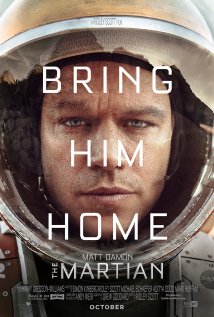
martian Greetings again from the darkness. With this week’s NASA announcement of the discovery of water on Mars, it seems necessary to point out that director Ridley Scott’s latest was not actually filmed on the red planet, but rather in the Jordan desert. OK, maybe not necessary, but it does serve as a reminder that the film (based on the popular book from Andy Weir) may be filled with science … but it’s also fiction – hence the label Science-Fiction.  If you were one of THOSE who actually paid attention in science classes and read the optional material, then you will probably find much fault in the details. For the rest of us, it’s a pretty fun ride.

Space has long been a popular movie topic, and a key to such favorites as 2001: A Space Odyssey, Alien, Aliens, The Right Stuff, Contact, Space Cowboys, Armageddon, Moon, and most recently Gravity and Interstellar. And of course there are the immensely popular franchises of “Star Wars” and “Star Trek”, which both chose a different path than the “grounded” nature of the others. This latest film may actually have as much in common with Cast Away as it does with any of the space-based films, and while many movies these days seem to be advertisements for Apple, this one is owed a debt by the duct tape company.

Commander Lewis (Jessica Chastain) and her crew (Matt Damon, Michael Pena, Kate Mara, Sebastian Stan, Askal Hennie) are hard at work on their Mars mission when a severe storm causes them to evacuate in panic mode. When the storm hits, Damon’s astronaut Mark Watney is lost and presumed dead. Once it’s realized that Watney survived and has every intention of being rescued, the film kicks into gear.

There are three separate stories we follow: the ingenious and spirited survival mode of Watney, the politics and brilliance of the NASA organization, and the crew who now believes Watney’s rescue is their responsibility. The NASA group is led by director Teddy Sanders (Jeff Daniels) and includes support work from Chiwetel Ejiofar, Kristen Wiig, Sean Bean, MacKenzie Davis, Donald Glover and Benedict Wong.

Taking the approach of an adventure film with the MacGuyver of all Botanists, Damon’s charm and humor stand in stark contrast to the annoyances of the two leads from Gravity, and provide a mass appeal that should make this entertaining for most any viewer. This approach allows us to imagine ourselves stranded on Mars, and whether we would panic or consider ourselves Space Pirates. There is also a lesson here for all students out there … pay attention in Science class! For the rest of us … “get your a** to Mars”!

martian2


ELEVATOR TO THE GALLOWS (1958) revisited

October 4, 2015

Ascenseur pour l’echefaud (France)

elevator to gallows For an introduction to the French New Wave, the first feature film from director Louis Malle is a good place to start. The neo-realism in this crime drama (based on the novel from Noel Calef) was new to film goers at the time, and even more startling was the natural lighting and minimal make-up used to photograph lead actress Jeanne Moreau. Beyond that, the haunting score from the legendary Miles Davis has been best described as “the loneliest trumpet”.

The film jump starts with an emotional and desperate phone call between lovers shown in extreme close-up: Florence (Ms. Moreau) and Julien (Maurice Ronet). The two have plotted to kill her husband (his boss) – war profiteer Simon Carala (played by Jean Wall) – so that they can be together. The details of the perfect murder plan are carried out with the intention of making it appear like a suicide. Unfortunately for Julien, a frantic attempt to hide some evidence leaves him trapped in an elevator. The fallout from this bad break finds Florence believing he has deserted her, and creates a secondary story line involving the theft of his car by a couple of youngsters out for a good time.

It’s here that the film bounces between the three sequences and really capitalizes on Malle’s expertise with a camera. Julien’s frustration in trying to escape the elevator generates the necessary tension, while the exploits of the young couple Louis and Veronique (Georges Poujouly, Yori Bertin) find them in a bad-situation-gone-worse when their impromptu party with a German couple (Ivan Petrovich, Elga Andersen) turns tragic. It’s easy to see how Jean Luc Godard was influenced by this young couple for his classic Breathless (1960). But best of all is the wandering woman of despair … we follow Florence as she tries to track down Julien on the rainy late night city streets.  These shots of Ms. Moreau are truly spectacular thanks not just to the lighting, but also the realistic emotions of her facial expressions … we never doubt her feeling of resignation.

Mr. Malle was only 26 when he directed this film, and the follow-up (also with Ms. Moreau) entitled The Lovers, also released in 1958. He had worked as an underwater photographer for Jacques Costeau and referenced this in the film. Malle had a long time marriage to Candice Bergen, and an incredible career that featured three Academy Award nominations (including Atlantic City, 1980). This was Ms. Moreau’s breakthrough film and led to her best known role in Francois Truffaut’s 1962 film Jules and Jim. She is still working today at age 87.  She also had a successful singing career, as well as numerous love affairs (Malle, Truffaut, Pierre Cardin, and Miles Davis).

Although there are some details and plot points that might annoy those who pay close attention, it doesn’t take away from the groundbreaking work of a young director who helped change the tone of movies. It’s interesting to note that Florence and Julien don’t share a scene in this film, outside of the opening phone call split scene. Additionally, the contemporary influence lives on through the line “Never leave photos lying around” (or on social media).  A special thanks goes out to The Texas Theatre in Dallas for bringing this classic back to the big screen.

Rather than post a clip or trailer, below is a video showing a young Miles Davis playing along to the film:


FREEHELD (2015)

October 2, 2015

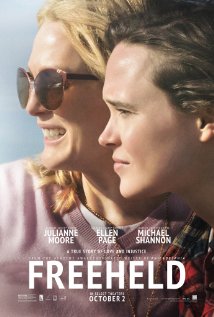
freeheld Greetings again from the darkness. A touching story based on the struggles of two people in love … that description fits, but leaves out the crucial details that make the saga of Laurel and Stacie so poignant and important. Laurel Hester was an Ocean County, New Jersey police officer who, like most non-heterosexual people of the era, went to extremes to conceal that part of her life for fear of personal and professional reprisals.

We catch up with Laurel (Julianne Moore) and her police partner Dane Wells (Michael Shannon) while on a drug bust in 2002. This scene is meant to quickly establish that Laurel is an excellent cop who is fully trusted by other cops. Soon after, we find Laurel and her god-awful volleyball skills flirting with Stacie (Ellen Page), a much younger auto mechanic. The two strike up a romance that leads to buying a house and jumping through the legal hoops required under the Domestic Partnership Act.

When Laurel is diagnosed with late stage lung cancer, the battle for her pension benefits begins as she goes up against the Freeholders who control Ocean County. While Stacie holds out hope for a cure and full recovery, Gay activist Steven Goldstein (Steve Carell) swoops in to generate media attention through protests and chants against the County. His cause is Gay marriage, while Laurel simply wants equality. It’s an odd differentiation that the movie dwells on, but never quite explains.

A significant social issue, a stroll on the beach, a pet dog, and a terminal illness … this sounds like the TV Guide synopsis of the latest Lifetime Channel movie. Perhaps that was the goal of screenwriter Ron Nyswaner (Philadelphia, 1993), whose next movie is a sex-change love story. Fortunately, the extremely talented cast elevates the material to an emotional level that allows viewers to connect. Those opposed to the issue include the macho cops from Laurel’s own squad room, and the ultra-conservative faction on the County board – who predictably runs and hides when the conflict reaches its peak.

Julianne Moore and Ellen Page do outstanding work in allowing us to accept a romance that at times looks more like a mother/daughter relationship due to the age difference. Humor is injected with a rare drywall joke and possibly the first ever on screen tire-rotation contest.  However, this isn’t a story for laughs.  Rather, director Peter Sollett (Nick and Norah’s Infinite Playlist, 2008) shows one of the many personal stories that have led to the legal authorization of gay marriage and rights. We view this acceptance through the eyes of Laurel’s partner Dane, and Michael Shannon’s low key performance prevents the role from being too clichéd. The film suffers a bit with Steve Carell’s over-the-top portrayal of the over-the-top Goldstein, but it does ring true in that desperate times call for desperate measures.

Certainly the film suffers from technical and script issues, yet the true story and the emotional subject matter, along with the fine performances, provide a clear look and reminder of some of the obstacles faced by good people over the years. Be sure to watch the closing credits for photographs of the real Laurel, Stacie, Dane and Goldstein – each (except Laurel, of course) have cameos in the film.

watch the trailer: