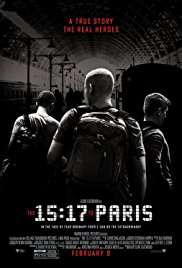
THE 15:17 TO PARIS (2018)

February 8, 2018

 Greetings again from the darkness. Allowing three regular guys to play themselves in the cinematic re-telling of their courageous and heroic actions is a fitting tribute to the men, and it’s an approach that we must be willing to cut some slack. On August 21, 2015, a terrorist aboard the Thalys train bound for Paris was thwarted in his attempt to carry out his mission of evil. Spencer Stone, Alek Skarlatos, and Anthony Sadler ultimately subdued the terrorist (who won’t be named here), likely saving many lives.

The real world heroics fall right in line with director Clint Eastwood’s two most recent films, SULLY and AMERICAN SNIPER. Unfortunately, while we admire his decision to allow these heroes to re-enact their life-saving bravery, we can’t let slide the downright boring first two-thirds of the film taking us through the origin story of their childhood (Sacramento 2005) to the backpacking trip that put them on that train. Some of the scenes are inexplicable. For instance, Judy Greer and Jenna Fischer play the mothers of Spencer and Alek respectively, and their confrontation with the boys’ elementary school teacher is a candidate for the worst and most embarrassing scene of the year.

Based on the book “The 15:17 to Paris: The True Story of a Terrorist, a Train, and Three American Heroes” (written by the three men and journalist Jeffrey E Stern), the script is adapted by Dorothy Blyskal, and when combined with some of the director’s choices, generates some unintended audience laughter … rarely a good thing. Watching three regular guys – three lifelong buddies – retrace their steps through Germany, Rome, Venice, and Amsterdam is almost tolerable because these are really nice guys. However, we can’t get over the feeling that we are watching home movies of our friends’ trip – a trip we weren’t even on. Jokes about selfie sticks and hangovers don’t make it any easier.

When the film finally gets to the moment of truth on the train, we end up where we should have started … admiring the heroics of three regular guys: Spencer Stone, Alek Skarlatos, and Anthony Sadler. We witness then French President Francois Hollande awarding them with the Legion of Honour. Themes of God, military and friendship are commonplace in Eastwood films, and eagle-eyed viewers will catch a glimpse of Alek wearing a “man with no name” t-shirt (in honor of the director). Bottom line, it plays like a film about nothing – until the end when it’s really about something special.

watch the trailer:


BOMB CITY (2017)

February 8, 2018

 Greetings again from the darkness. This feature film debut from Texas filmmaker Jameson Brooks (co-written with Sheldon Chick) was an Audience Award winner at last year’s Dallas International Film Festival. It’s based on the incredulous true story of a tragic crime and the subsequent trial that occurred in Amarillo in the late 1990’s. It’s also an introduction to a talented and exciting filmmaker with a message that is as every bit as important now for every community as it was 20 years ago in the Texas panhandle.

The courtroom scenes serve as the story structure while flashbacks are blended with the defense attorney (Glenn Morshower) commenting/mocking the evidence as it’s shown to the jury. This style keeps those unfamiliar with the story uncertain as to the actual victim and the circumstances of the crime – at least until the final act when we see a re-enactment of the crime and the final day of trial. However, even if one is familiar with the specifics of the case, it is presented in such an exceptional manner that it will surely be just as impactful.

Keeping in mind that this is west Texas (remember “Friday Night Lights”) and football reigns supreme, so the ongoing battle between the Punks and the Preps sets the stage for ultimate cultural battle … especially in an area that is home to a nuclear bomb assembly plant. Volatility abounds. There is a terrific sequence with parallel cuts between the mosh pit of a local punk rock concert and the on-field violence of a local high school football game. There are more similarities than differences, well, until the kids from the two sides cross paths in the real world. Class differences are obvious, and so is the usual teen angst and rebellious nature.

Distinct differences in how the authorities handle each group’s form of release are on full display. The punks are caught tagging, while the pasture party of the jocks gains frenzy. One of these ends with handcuffs, and the other with polite dismissal. The core of the story is the ongoing comparison between Brian (in a wonderful performance from Dave Davies), sporting a colorful Mohawk as he skateboards through town, and Cody (an effective Luke Shelton), a buttoned-up football player always striving to prove his mettle as he cruises around town in Daddy’s Cadillac. A sense of doom-filled destiny accompanies their scenes, and of course, we know it won’t end well.

Many will find the film reminiscent of Frances Ford Coppola’s 1983 film THE OUTSIDERS, which featured the Greasers versus the Socs. The biting realism and grit of Mr. Brooks’ film helps us better understand the similarities between the two groups who look so different. And that’s the real message here: judging others by looks will never lead to understanding and peaceful coexistence. The cinematography of Jake Wilgonwski is a huge part of the emotional reaction we have to this story, and the notes provided at the end of the film leave us wondering if, 20 plus years later, we are any more advanced as a society than what occurred in that Amarillo parking lot.

watch the trailer:


THE INSULT (2017, Lebanon)

February 1, 2018

 Greetings again from the darkness. When a film opens with a statement that ‘the views expressed are those of the authors and director, and not of the government of Lebanon’, one quickly understands the difference in artistic freedom in that country versus what occurs in the United States, where cartoons and memes regularly poke fun at this country’s President. Director Ziad Doueri and his co-writer Joelle Touma present an intense story of human nature that might happen anywhere, but since the leads are a Lebanese Christian and a Palestine refugee, that opening statement is warranted.

One morning, a seemingly innocuous exchange between Tony (Adel Karam) and Yasser (Kamel El-Basha) takes place. While watering flowers on his balcony, the overflow sprays Yasser on the street below. Yasser, a city contractor, orders his team to fix the drainage issue, and Tony reacts violently – leading to Yasser delivering the titular insult. From there, all heck breaks loose. Apologies are requested and never delivered. Appeals to rational reconsideration are made. Tony’s pregnant wife (an excellent Rita Hayek) pleads with him to let it go. Yasser’s boss threatens him with termination. Still, two stubborn and prideful men refuse to give in.

The subsequent courtroom drama feature other side stories, not the least of which is the relationship between the two opposing attorneys (Diamond Bou Abboud and Camile Salaheh), one a rising legal star and the other a veteran attempting to make up for a past failure. Emotions run high as two too-proud men turn what was little more than a playground standoff into a national incident being fought in the legal system and the media. Tony is a hot-head who somehow thinks an apology from Yasser is actually an apology for how Palestinians “messed up this country”. Yasser’s stoic nature barely shrouds his bitterness at the world since the Lebanon Civil War. History and childhood roots play a role, but mostly it’s human nature that is at the core of this escalation.

Though the title is not plural, there are multiple insults slung throughout the film, each reminding us of the power of words and the futility of the “sticks and stones” phrase. Our own prejudices and preconceptions alter our views and reactions, often preventing us from standing in the other fellow’s shoes. Again, this situation could have played out in most any neighborhood on the globe, but this particular locale shows various ethnic and religious groups are still grappling with what it means to live together – despite the years of wars and unrest. We don’t see a great deal of Middle Eastern cinema, but three days after I watched this film, it became the first ever movie from Lebanon to receive an Oscar nomination (Best Foreign Language Film) … proving yet again that the language of cinema is universal.

watch the trailer:


HAVE A NICE DAY (2018, animated)

February 1, 2018

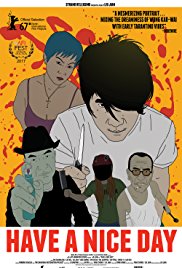
 Greetings again from the darkness. One need only read the credits to understand that this is a personal project of Liu Jian. It’s kind of comical to see his name come up as writer, director, illustrator, producer, and editor. He even wrote at least one of the songs featured in the film! An animated film from China that is clearly influenced by the likes of Quentin Tarantino and some modern day madcap caper films offers a nice respite from the typical January releases that hit the theatre.

Jian’s film is a crime thriller with socioeconomic subtext that hovers over each scene. An extended opening credits sequence provides the lay of the land (in this case, city) for the upcoming story. There is very little build up to the crime that ignites the cluster that follows. Xiao Zhang steals a bag filled with one million yuan. The bag belongs to “Uncle Liu”, a feared crime lord and gangster who sends his trusted and ruthless hitman “Skinny” to retrieve his money.

The old adage, “follow the money”, comes into play here. Following the money is not as simple as it sounds, as these aren’t brilliant criminal minds at work here. In addition to Tarantino, thoughts of the Coen Brothers came to mind, as did the Scorsese gem AFTER HOURS. Xiao Zhang has no heroic or altruistic motives. He simply wants to pay for a re-do of his fiancé’s botched plastic surgery. The zaniness around the money involves many colorful participants, each who have their own designs for the bag.

A couple of odd musical interludes involve Shangri-La and some ocean waves, and there is a God vs. Buddha debate that reminds of the infamous Mighty Mouse vs Superman argument in STAND BY ME. The film played well at festivals and at 77 minutes, it’s a briskly-paced chase movie that might have benefited from a bit more humor.

watch the trailer:


FILM STARS DON’T DIE IN LIVERPOOL (2018)

January 26, 2018

 Greetings again from the darkness. Old Hollywood glamour is merely something we read about or reminisce about these days. Part of the reason is that we are almost as likely to see a favorite star on TV as in a new movie, and a bigger cause is that we simply know too much about them as people … the mystique has been replaced by (too many) personal details and divisive political influence.

Classic movie lovers always have favorite performers, and there were certainly some great ones in the Golden Era: Bogart, Gable, Hepburn, Davis, etc; however, I’ve always felt there was one actress who time seems to have forgotten. Gloria Grahame never seemed to choose the easy route (either on screen or real life), and she turned in some terrific performances in the 1940’s and 50’s. You might only know her as Violet in IT’S A WONDERFUL LIFE, but she was also an Oscar winner for THE BAD AND THE BEAUTIFUL (1952), and had standout roles in OKLAHOMA! (1955), THE BIG HEAT (1953), and IN A LONELY PLACE (1950). Her talent allowed her to fit as well for a musical or family film, as in the Noir Thrillers for which she seemed to thrive.

So why all the background on a mostly forgotten actress from a bygone era? Because Annette Bening magically channels the late actress in her role as Ms. Grahame in the final stages of her life. Director Paul McGuigan’s film is based on the memoir of Peter Turner, a young man who had a relationship with the actress in her later years. Turner is played here by Jamie Bell (BILLY ELLIOT) and he and Ms. Bening are so believable, that we are fully drawn in by their characters and their touching story.

Opening with the actress in her dressing room prepping for a dinner theatre version of “The Glass Menagerie”, the film conveys much in these few minutes. Clearly, this is an actress far removed from the Hollywood spotlight. We also sense her immense pride is still present, and the glass of milk is for relief from her discomfort … later self-diagnosed as “gas”.

We start in 1981 and flashback to 1979. Creative transitions between scenes and times add a stylish element to a story that is ultimately about human relationships, aging and loneliness. The need to be cared for when sick is as crucial as the importance of being a dependable caregiver for loved ones. The film’s script from Matt Greenhalgh allows for an empathetic look at these topics through the eyes of people we quickly care about.

Julie Walters (Bell’s dance teacher in BILLY ELLIOT) is exceptional as Turner’s mother and Ms. Grahame’s caregiver. Other supporting roles include Kenneth Cranham as Turner’s dad, Stephen Graham as his fiery brother, and Vanessa Redgrave as Ms. Grahame’s mother. We never get the back story on why Ms. Grahame feels so connected to the Turner family – only that the 28 year age difference between herself and Peter didn’t much matter to either of them.

There is a sexually-charged disco dance with Ms. Grahame and Peter in her hotel room that makes clear why any young man might fall for her, but it’s really in the quieter moments where the film and Ms. Bening and Mr. Bell shine. The emotions and pain are palpable, and yet neither her spirit nor his devotion will quit. The music from Jose Feliciano and Elvis Costello is terrific and comfortably fits a story of love and aging and illness, while also reminding us … once a starlet, always a starlet, even when the star has faded.

watch the trailer:


Confession of a Movie Reviewer (January 2018)

January 25, 2018

 Over the years, I’ve been diligent in my efforts to keep my writing focused on the movies I watch, rather than the personalities and politics of the film industry. In a world that bombards us with daily (seemingly non-stop) irrational, illogical and downright inexplicable occurrences, I’ve attempted to maintain a sense of separation. I strive to consider each film as a self-contained work of art, irrespective of the collective noise and attention that might surround it.

It’s for this reason that I consistently turn down industry interview opportunities and press junkets.  It’s important to me that my viewing experience and analysis of a movie not be influenced by where the lead actor (or actress, or director, or writer) ranks on my personal scale of virtue … or even how tasty the pre-screening buffet and free drinks might be.

A movie should stand – or fall – on its own merits. Perhaps in these times, striving to assess a film as an unencumbered work of art is a near-impossible task. I could simply admit defeat and fall in formation with many who (often unwittingly) allow themselves to be influenced by outside (off-screen) factors. However, this would only rob myself of the one escape from reality I enjoy, and more significantly, would undermine the art form of cinema and what it contributes as societal commentary and pure entertainment.

This is my public confession of acceptance that no ‘bubble’ exists. Movies are made by good folks and bad – just like everything else in life. That’s not something that should be ignored in today’s environment of full disclosure and admirable and necessary movements toward a more civil industry.  However, a line of demarcation can be drawn. My movie reviews and comments will continue to focus on what we see on screen, even though the external noise sometimes deserves to be heard.  While I support the causes and movements towards industry improvements, I also believe that by periodically fighting through that noise, we can still find beauty and grace in the cinematic art form. And that’s a cause I also believe is important.


12 STRONG (2018)

January 18, 2018

 Greetings again from the darkness. During the movie, Afghanistan is referred to as “the graveyard of many empires”. Traditionally, January is the graveyard of most new movie releases, so it’s a pleasant surprise when we see an entertaining, well-made and historically interesting film, and it’s still mid-January!  Doug Stanton’s book “Horse Soldiers” is the source material for director Nicolai Fuglsig’s first feature film, and it’s anything but a disappointment.

The film opens on September 11, 2001 and subjects us, yet again, to those horrific images seared into the minds of anyone alive on that day. What most of us didn’t know, was that about a month later, a team of U.S. Army Special Forces (the Green Berets) were being dropped into the rough and mostly unfriendly terrain of Afghanistan. This ridiculously courageous team of 12 men had one mission: secure Mazar-i-Sharif to prevent a takeover by the Taliban.

An early scene tells us this won’t be the usual blind patriotism we often see on screen. One of the soldiers, Hal Spencer (Michael Shannon), is told (with a bit of anger) by his wife, “I’ll love you when you get back.” This contrasts to the usual loyal and stiff-upper-lip military wife we see in most war movies. Another wife scrubs the oven rather than snuggle with her man, while yet another coerces a taboo pledge to come home to her.

Chris Hemsworth (THOR) plays Captain Mitch Nelson, the intelligent but not-yet-battle-tested leader of a special ops team. The plan is for Nelson and his team to connect with General Dostum, an Afghan War Lord in charge of the Northern Alliance, and fight together to gain control of Mazar. After arriving at a local outpost nicknamed “The Alamo” (34 miles from town), the team gets their first surprise … they must split up and cover the ground on horseback. Filmed in New Mexico, the journey is miserable and filled with danger – an ambush could occur at any moment, or perhaps they are being set-up by those they have been ordered to trust.

Horseback riding, caves, the weather, and the elements of the terrain are all challenges, but none of it compares to facing the Taliban forces which number in the thousands, and feature tanks, rocket launchers and an endless supply of weaponry. Director Fuglsig utilizes a “Days in Country” counter so that we can get some semblance of time and ongoing misery being fought through by the Americans. But no day is normal when the soldiers are on horseback while being attacked by tanks. The odds seem unsurmountable.

One of the more fascinating aspects of the story and welcome approaches of the film is back-and-forth between Captain Nelson and General Dostum. Initially, Dostum shows little respect by telling the young officer that he lacks “the eyes of a killer” and isn’t yet a warrior, and he spends a great deal of time lecturing and philosophizing on Nelson’s behalf. Of course, the lessons may be frustrating in the moment, but aren’t lost on Nelson as there is a huge payoff at the peak of the key battle.

The battle scenes come in all sizes – small skirmishes and massive, large scale assaults. Each is intense and dramatic and well-staged, though there are some moments where we shake our head in disbelief. At least we do until we remember that this is a true story, and despite that, it is truly unbelievable.

The supporting cast includes Michael Pena and his snappy punchlines, Trevante Rhodes (MOONLIGHT), William Fichtner with a shaved head, Elsa Pataky – Hemsworth’s real life wife as his screen wife, Taylor Sheridan, Geoff Stults and Jack Kesy. Rob Riggle plays Colonel Max Bowers, who was Riggle’s commanding officer when he served in the Marines. The previously mentioned Michael Shannon is a bit underutilized, but the film’s best moments are those with Hemsworth and Navid Negahban (as General Dostum). You likely recognize Negahban as Abu Nazir from “Homeland”. It’s their exchanges that show how the line between allies and enemies is not always crystal clear – even if they are fighting for the same thing.

Writers Peter Craig (THE TOWN) and Ted Tally (Oscar winner for THE SILENCE OF THE LAMBS) do a nice job of character development, and the camaraderie of the 12 men of ODA 595 seems authentic – despite some schmaltzy moments over their 23 days of Task Force Dagger. Early on, we are informed that the most important thing to take to war is “a reason why”, and then towards the end, Dostum explains that the United States is in a no-win situation: we are cowards if we go, and enemies if we stay. It’s chilling commentary on a war that has dragged on much too long … despite the heroic efforts of the 12 horse soldiers.

watch the trailer:


FOREVER MY GIRL (2018)

January 18, 2018

 Greetings again from the darkness. To determine if this is your type of movie, you need only answer one question: Are you a Nicholas Sparks fan? Even though this is based on a novel by Heidi McLaughlin and not Nicholas Sparks, no normal person would be able to tell the difference, as the formula and story structure is very familiar (even the marketing campaign capitalizes on this). Perhaps that is the key to the success of movies like this – the stories are like a warm, comfy blanket to some folks.

Picturesque (and fictional) St Augustine, Louisiana is the setting for the love story of Liam and Josie. Things get off to a rocky start as the jilted bride is stranded on her wedding day. The film jumps ahead 8 years and we find that Liam (Alex Roe, THE 5TH WAVE) is now a country music superstar with a drinking problem and a duct-taped flip phone, while Josie (Jessica Rothe, HAPPY DEATH DAY) is a successful business owner and single mom. It’s at this point where you could most assuredly guess what happens next, as predictability and commitment to the formula are the mission.

Bethany Ashton Wolf is the writer/director and her film benefits from the presence of star-in-the-making Alex Roe and the precocious Abby Ryder Fortson as Josie’s daughter. Mr. Roe spends much of the movie in various stages of sweat (I guess that’s supposed to be sexy?), but the camera loves him and he has a unique approach that sets him apart from the endless line of pretty boy actors. Young Miss Fortson has already played the daughter of ANT-MAN and she has the ability to come off as normal kid, rather than an actress playing a kid.

John Benjamin Hickey (Liam’s dad), Gillian Vigman (publicist), Tyler Riggs (Josie’s brother), and Peter Cambor (Liam’s agent) fill the supporting roles, and it’s Travis Tritt who adds an all-too-brief touch of authenticity to the music and local saloon. The movie is exactly what it portends to be … nothing more, nothing less. If it’s to your taste, it’ll be that soft comforter that brings you serenity. If it’s not your style, it will likely be as itchy and scratchy as a new wool horse blanket.

watch the trailer:


HAPPY END (2017)

January 18, 2018

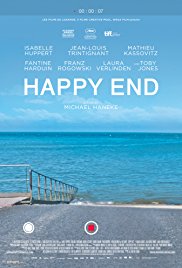
 Greetings again from the darkness. Austrian filmmaker Michael Haneke has blessed us with, what I consider, at least five excellent movies (AMOUR, THE WHITE RIBBON, CACHE, FUNNY GAMES, THE PIANO TEACHER), and though it’s been 5 years since his last, there is always a welcome anticipation for his next project. Unfortunately, this latest is esoteric and disjointed even beyond his usual style. In fact, at face value, it just seems only to be an accusation lobbed at the wealthy, stating that their privilege and cluelessness brings nothing but misery and difficulty to themselves and the rest of society.

We open on an unknown kid’s secretive cell phone video filming of her mother getting ready for bed, followed by the mistreatment of a pet hamster as a lab rat, and finally video of her mother passed out on the sofa – just prior to an ambulance being called. Our attention is then turned to a family estate in Calais, which is inhabited by the octogenarian patriarch Georges (Jean-Louis Trintigant), his doctor son Thomas (Mathieu Kassovitz) and daughter Anne (Isabelle Huppert), Anne’s malcontent son Pierre (Franz Rogowski), Thomas’ wife and infant son, and the Moroccan couple who are household servants. While her mother is being treated for an overdose, 13 year old Eve (Fantine Harduin), moves in to the estate (Thomas is her re-married father). It’s here that we learn the opening scenes were Eve’s video work … clearly establishing her as a damaged soul.

Initially, it seems as though we will see the family through Eve’s eye, but what follows instead is the peeling back of family layers exposing the darkness and menace that haunts each of these characters. Georges appears to be intent on finding a way out of the life that has imprisoned his body and is now slowly taking his mind through dementia. Thomas is carrying on an illicit affair through raunchy email exchanges. Anne is trying to protect the family construction business from the incompetence of her son Pierre, while also looking for love with solicitor Toby Jones. At times, we are empathetic towards Eve’s situation, but as soon as we let down our guard, her true colors emerge. The film is certainly at its best when Ms. Harduin’s Eve is front and center. Her scene with her grandfather Georges uncovers their respective motivators, and is chilling and easily the film’s finest moment.

The film was a Cannes Palme d’Or nominee, but we sense that was in respect to Mr. Haneke’s legacy, and not for this particular film. The disjointed pieces lack the necessary mortar, or even a linking thread necessary for a cohesive tale. What constitutes a happy end … or is one even possible? Perhaps that’s the theme, but the film leaves us with a feeling of incompleteness – or perhaps Haneke just gave up trying to find such an ending, and decided commentary on the “bourgeois bubble” was sufficient.

watch the trailer:


THE MEMORY OF FISH (2018, doc)

January 18, 2018

 Greetings again from the darkness. Nutritionists consistently advocate for the consumption of more salmon for a healthy diet … wild salmon, specifically. It’s one of the few dietary recommendations that hardly anyone bemoans. Most of us really enjoy a tasty grilled salmon, and the fact that it’s “good” for us puts it in the rare food category of ‘yummy and healthy’ (not an officially recognized category).  It’s what would be a perfect plan, were it not for the challenges in tracking down true wild salmon at the local supermarket. Salmon habitat and breeding grounds have been compromised and even destroyed through encroachment, and for the needs of the human race.

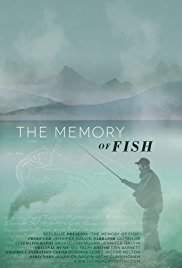
It’s exactly this situation, and the decades-long efforts of one man, that are the focus of this documentary from co-directors Jennifer Galvin and Sachi Cunningham. Dick Goin lives on the Olympic Peninsula in the Pacific Northwest, and he is especially connected to the Elhwa River. The film opens with his recorded voice from 1983 as he discusses his memories of the river packed with 50-60 pound salmon taking advantage of the gravel river bottom, and then how they basically disappeared when the two giant dams were built to supply power to the area.

Mr. Goin describes the river as being broken from 1911 through 2014 when the dams were in place. He emotionally describes his personal conflict at working for one of the mills being powered by the dams … even as he was fighting for their destruction in order to free the river. Working at the mill was a choice necessary for life – a difficult decision that required compromise. The dams, though engineering marvels, were the enemy of nature.

Clearly passionate, the elderly Mr. Goin speaks with humble respect and awe of the “madhouse” river. The underwater photography is effective, especially when blended with the archival footage from previous interviews Mr. Goin conducted. The video clips of the dams being destroyed are fascinating, but not nearly as gut-wrenching as the once vital Mr. Goin slowly and unsteadily makes his way back to the river, after the dam destruction, so he can personally witness the return of the salmon. As he describes the efforts of a struggling salmon as having done what she was here for … we can’t help but acknowledge the parallels with Mr. Goin’s own life.