ASBURY PARK: RIOT, REDEMPTION, ROCK N ROLL (2019, doc)

May 23, 2019

 Greetings again from the darkness. Ask most people what they think of when you mention Asbury Park, New Jersey, and the vast majority would answer Bruce Springsteen. In today’s global music climate, it’s rare for a musician to be so closely associated with a city or geographic area. Perhaps only Elvis and Memphis eclipses The Boss and Jersey. However it’s important to note that this documentary from director Tom Jones (no, not that one) is not the story of Bruce, but rather a historic tale of a divided city whose music defined a generation.

New Jersey radio personality Big Joe Henry narrates the film, and we learn Asbury Park was founded in 1871, and became a town literally divided by railroad tracks (not the proverbial kind). The East side was populated with well-off citizens and tourists, while the West side was comprised of working class and minorities. Though only 1 square mile in size, the city’s division and segregation was clear and beyond question. Of course, the one aspect those tracks couldn’t stop was the music.

What happened in the 1960’s was a blend of jazz, soul, R&B, rock and blues. Music acted as a uniter in the evenings after the daytime maintained the line of demarcation. We hear the stories from the local musicians who thrived during the era: Steven Van Zandt, Southside Johnny Lyon, David Sancious, Max Weinberg, Garry Talent, Vini “Mad Dog” Lopez, and Edward Carter among others. To top it off, we get New Jersey’s own Bruce Springsteen casually lounging on a chair (well-lighted, mind you) within the walls of the infamous Upstage Club, deserted for more than 40 years, but looking pretty much the same as it did when a young Bruce and all of the previously named musicians played there.

July 4, 1970, changed everything for Asbury Park. Race riots, police, destruction, and fire. The city went through some dark times. Urban blight prevailed on the west side, and to this day it has not recovered. On the other side of the tracks, the east side has bounced back with music, the boardwalk and resorts leading the way. The Empress Hotel features The Paradise Club, a favorite establishment for the gay community … a community that has been behind much of the town’s resurgence.

It’s quite fascinating to have these local musicians recalling their own memories, and how the artistic freedom provided by The Upstage allowed their music to blossom. Asbury Park is described as “the Liverpool of America”, and through these passionate interviews, we get a taste of how. Not much actual music is included in the film, though near the end, we see clips of Springsteen joining Steve Van Zandt on stage with some young students from the local Lake House Music Academy. The film is co-sponsored by Jersey Mike’s and Halo X media, with much of the proceeds going to youth music programs. The only way this could have ended better would have been Bruce playing Ten Years After’s “I’m Going Home” … for 30 minutes.

watch the trailer:


ALADDIN (2019)

May 22, 2019

 Greetings again from the darkness. Aladdin … come on down!  You are the next participant in Disney’s ongoing mission for live-action remakes of their classic films. And rest easy fans, this time the mega-studio has done right by the original. Now that doesn’t mean there aren’t surprises. How about Guy Ritchie as director?  How about a cast of mostly unknowns? How about modernized songs and even a new one sung by Jasmine? And it probably goes without asking, but how about a lot of CGI?

Mena Massoud (“Tom Clancy’s Jack Ryan”) stars as Aladdin, and he gets to showboat early in the film and flash some parkour skills in the familiar and high-octane chase through the village. Aladdin, of course, is labeled a ‘street rat’ and ‘riff-raff’, but he’s also charming, handsome, talented as a thief, and quite warm-hearted. He and his pet monkey Abu – or more accurately, partner in crime – are streetwise and work quite well together, both for theft and love.

Naomi Scott (slated to star in the CHARLIE’S ANGELS movie coming out later this year) is a beautiful and ambitious Princess Jasmine, who wants to succeed her father as Sultan of Agrabah, but is instead forced to choose between a steady stream of suitors – each a Prince, as required by law. Ms. Scott has a terrific singing voice and really gets to cut loose on the new woman power song “Speechless”.

The blue Genie is played by Will Smith, and this is what has fans of the beloved 1992 animated film so flustered. No, Will Smith is not Robin Williams, and few if any, could match the late great comedian for his energy and comedic flair. But Mr. Smith does a marvelous job of staying true to the original, while also adding his own style … a style that works very well for comedy, music, and dramatic moments. He is not likely to disappoint anyone who has an open mind.

So let’s talk about the villain. Marwan Kenzari is Jafar, the man so dissatisfied with being number 2. Personally, I would have preferred a more intimidating bad guy, but given the tone of the film (more on that below), he’s a solid fit. His sidekick and smart-aleck parrot Iago is voiced by Alan Tudyk (it was the distinctive Gilbert Gottfried in the 1992 version). Two other key supporting roles include Nasim Padrad (“Saturday Night Live”) as Dalla, Jasmine’s handmaiden; and Navid Negahban (Abu Nazir in “Homeland”) as the Sultan and Jasmine’s father.

It’s been 27 years since Robin Williams’ Genie entertained so many, and the comparisons to that version are inevitable. It’s a relief that Disney opted to keep the film family friendly (Rated PG) and avoid the dark tone that had their recent projects aimed more at adults than kids, rather than the balance they’ve been known for more than 6 decades. Yes, this is the same director that made SNATCH (2000) and SHERLOCK HOLMES (2009), neither of which any decent parent would allow their young kids to watch. But, Mr. Ritchie has delivered a film which entertained (and didn’t overly frighten) kids as young as 5 in the screening I attended.

Director Ritchie co-wrote the script with John August, who is best known for his work with Tim Burton (BIG FISH, CHARLIE AND THE CHOCOLATE FACTORY, CORPSE BRIDE, DARK SHADOWS, FRANKENWEENIE). The film runs 2 hours and 8 minutes, 38 longer than the 1992 film … though it doesn’t feel too long. Gemma Jackson’s set design of Agrabah, the Palace, and the Cave of Wonders are all stunning, and then of course, there is the music. Alan Menken won an Oscar for ALADDIN (1992) and his music is back and modernized, and sounds wonderful … especially “A Whole New World” and Jasmine’s new song.

With a talented cast of Arab/Middle Eastern/Central Asian/Southern Asian actors, there should be no cries of “foul”, and there really is something special about a movie that can be thoroughly enjoyed by all ages. The Bollywood-type closing number provides a kaleidoscope of color, texture and dancing … and is a nice twist to “You’ve Never Had a Friend Like Me”. And I’ll leave you with this final offer: you can have the monkey, if I can have the magic carpet.

watch the trailer:


JOHN WICK 3: PARABELLUM (2019)

May 16, 2019

 Greetings again from the darkness. Worlds are colliding! No, no … not in the way of “The Avengers” movies, but it’s kind of hard not to smile when Keanu Reeves and Laurence Fishburne share a scene (or two) in a mini-reunion of THE MATRIX. Mr. Reeves and director Chad Stahelski are back for a third time, and somehow they manage to raise the bar yet again on the fight sequences. And let’s face it, the fighting and action are why so many are drawn to this franchise. This latest entry runs 2 hours and 10 minutes, and almost every bit is a frantic chase scene or violent fight … or both.

The film picks up mere moments after JOHN WICK: CHAPTER 2 ended. If you recall, John had killed a member of the High Table inside the Continental Hotel, an unforgivable break in the treasured rules. Winston (Ian McShane), the manager of the hotel, has given his friend a one hour head start prior to issuing the “excommunicado”. It’s that order (and the $14 million bounty) that sends every assassin on the planet on Wick’s trail.

No need to wait for the good stuff … the film’s first two fight sequences are extraordinary feats of stunt coordination, and consume the first 15-20 minutes. Here is what John Wick (and we viewers) are in for: Guns (many kinds), lots of knives, a hatchet, swords, a book, enough broken glass to fill a recycle center, horses, motorcycles, cars, every martial art known to man, highly trained dogs, a public library, a museum/collectibles display, a stable, and a ballet theatre complete with dancers. There is even a current NBA player, 7’3” Boban Marjonovic, who battles John Wick and ultimately learns books can be used for something other than reading.

John Wick’s background is revealed, and his general level of tiredness reaches exhaustion, which actually adds an element to a character who is quite efficient with his conversation. There are a few people who are called on to help Wick, in particular we have Laurence Fishburne as the Bowery King, Anjelica Huston as the Ballet Director, and Halle Berry as Sophia, a former assassin who now runs the Continental Hotel in Morocco. See, even an underworld crime syndicate promotes from within. The segment with Sophia is one of the most fun, and it’s not because of Ms. Berry. Rather her beautiful and highly-trained dogs are scene stealers who are devastating in their commitment to carry out orders.

Other characters of interest include Asia Kate Dillon (“Billions”) as the Adjudicator, one who enjoys doling out punishment; Mark Dacascos (Wo Fat in “Hawaii 5-0) as Zero, the ultimate Wick fanboy who wants nothing more than to be the one who kills him; Jerome Flynn (“Game of Thrones”) as Berrada, the senior official who doesn’t negotiate fairly; Said Taghmaoui as The Elder from the High Table, who listens to Wick’s proposal. Other supporting roles are filled admirably by Robin Lord Taylor, Jason Mantzoukas and Susan Blommaert.  Of course, some of the most fun occurs again at The Continental Hotel as Reeves’ Wick interacts with Lance Reddick and Ian McShane.

From the department of “Give ‘em what they want”, the film has a very similar look, feel and tone to the first two, but director Stahelski (a standout stunt coordinator) and writers Derek Kolstad, Shay Hatten, Chris Collins, and Mark Abrams keep it fresh with new characters, new props and some terrific set design. The early model computers are contrasted with the high tech gadgetry of the Continental, and with a body count likely higher than the first two films combined, this entry can best be described as brutally entertaining … is that even a thing?  The violence is vivid and excessive and non-stop, and if that’s not your style, you should at least know that the title is taken from the Latin “Si vis pacem, para bellum” – If you want peace, prepare for war.

watch the trailer:


THE SUN IS ALSO A STAR (2019)

May 16, 2019

 Greetings again from the darkness. Taking star-crossed lovers to a new dimension, director Ry Russo-Young (BEFORE I FALL, 2017) presents Nicola Yoon’s best-selling YA novel as a traditional love-at-first-sight romance augmented with contemporary twists and issues. Tracy Oliver (GIRLS TRIP, 2017) adapted the story for the screen and enhances the familiar trope with racial, cultural, economic and political aspects – resulting in a romance meant to both charm and influence. If only those enhancements had played a larger role, this little film might really have had something to say.

The film certainly succeeds with its charm. Yara Shahidi (“Black-ish”) and Charles Melton (“Riverdale”) star as Natasha and Daniel, respectively. These are two beautiful young people blessed with electric smiles to complement their great hair and world class cheek bones. She is a Jamaican immigrant and a scientific prodigy as a high school junior, whereas he is a first generation U.S. born Korean who writes poetry while prepping for his Dartmouth admission interview. His family long ago christened him as the one who would be doctor.

Loosely based on the courtship of author Nicola Yoon and her husband, even the meet-cute for Natasha and Daniel has a theme: Deus Ex Machina – God from the Machine, where magical powers or destiny bring the two together. Not only does Natasha wear a jacket with the Latin phrase, but the conductor on Daniel’s subway even counsels the delayed passengers to “Open up your heart to destiny.” OK, by now you know if this is your type of movie or not. I would offer a mild caution to naysayers with this – Natasha and Daniel are fun to watch as they get to know each other, and there are some breath-taking shots of New York City interspersed throughout the film courtesy of cinematographer Autumn Durald. These two things make the film watchable no matter how deep your allergy to cuteness runs, although the tour of NYC sometimes has the feel of (a well photographed) tourist brochure.

The political side of the story comes courtesy of Natasha’s ‘last hope’ meeting at the immigration office to postpone her family’s deportation scheduled for the next day. We only get to see quick glimpses of the process, but it’s enough to understand the red tape she has tried to maneuver in order to keep her family in NYC after 9 years. More of immigration attorney John Leguizamo would have contributed a bit of substance to the film. The immigration topic is also broached in Daniel’s family as his parents came to the country and started their own business. The American Dream giveth and taketh away. The immigration bits work as plot devices, but the film is most comfortable as a story of star-crossed lovers accompanied by “Crimson and Clover” in a karaoke bar. However the film’s biggest mystery might be how the couple survived sleeping all night in a New York park without getting mugged or even needing to brush their teeth before their crucial meetings. The magic of love.

watch the trailer:


THE PROFESSOR (2019)

May 16, 2019

(aka RICHARD SAYS GOODBYE)

 Greetings again from the darkness. Cancer comedies are few and far between, and that’s understandable since the often deadly disease brings with it so much suffering and sadness. Writer-Director Wayne Roberts pulls no punches. The opening scene finds a doctor breaking the dreaded diagnosis to a patient … lung cancer. The patient, a college professor named Richard, is told he has 6 months to live.

The cold opening has us questioning if this is truly a comedy – even though the opening scene professor-patient is played by Johnny Depp. The news hits him hard of course, and we can see his mind spinning as he works out his approach and acceptance. What follows are some quite awkward and uncomfortable scenes with both his class and his family – a wife Veronica (Rosemary DeWitt) and teenage daughter Olivia (Odessa Young). Both of the women in his life usurp is announcement with those of their own: Veronica is having an affair with the Chancellor of the college where Richard works, and Olivia discloses that she is a lesbian. The two dinner time announcements and Richard’s still held secret are integral to every scene that follows.

Six title chapters clue us in on each subsequent phase in Richard’s life, and the key is that he tosses conventions aside and tries to find meaning in life … all while facing his own mortality. On one hand, Richard does what a professor does – he teaches. His small group of students are privy to such insight into life as “it ends in death for everyone”. On the other hand, he experiments with drugs, alcohol, and sexual experiences, including a couple of episodes with students – something that should never happen.

Ron Livingston is perfectly cast as the somewhat slimy Chancellor who is sleeping with Richard’s wife, but it’s Zoey Deutch and Danny Huston whose characters generate a bit more substance in Richard’s life. Ms. Deutch (daughter of Lea Thompson and a star in the making) plays Claire, a student who seems to quickly “get” what her professor is going through. And Mr. Huston gives one of his best performances in years as Richard’s long-time friend Peter who doesn’t want to accept the inevitable.

With all of the fantastical characters he has played (often masked in make-up and costumes), we sometimes forget what terrific dramatic acting ability Johnny Depp possesses when he’s engaged. For those who only know him as Captain Jack Sparrow (the “Pirates of the Caribbean” movies), or as Grindewald (the “Fantastic Beasts” films), or as the Mad Hatter, Tonto, or Willy Wonka, you’ll be pleasantly surprised with his turn here (or in BLACK MASS, FINDING NEVERLAND, or BLOW).  Filmmaker Wayne Roberts offered up an excellent debut in 2017 with KATIE SAYS GOODBYE, and he follows that with this unusual look at mortality – including a “celebrate life” soliloquy.

watch the trailer:


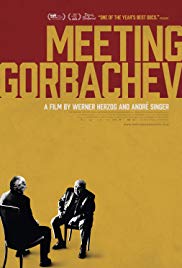
MEETING GORBACHEV (2019, doc)

May 16, 2019

 Greetings again from the darkness. Werner Herzog has been one of the most prolific filmmakers over the past six decades, and with so many projects, it’s not surprising that his films range from very good (AGUIRRE: THE WRATH OF GOD) to fascinating (GRIZZLY MAN) to disappointing (QUEEN OF THE DESERT). With this latest documentary, co-directed with Andre Singer, Herzog sits down for interviews with Mikhail Gorbachev three times over a six month period, and yet somehow squanders this rare opportunity by ensuring his own mug gets equal screen time, and his own voice even more.

Mikhail Gorbachev was the 8th and final President of the Soviet Union and is considered to be one of the most influential political figures of the second half of the twentieth century. He is now 87 years old, and his diabetes likely contributes to his puffy, bloated look and his recent hospital stay prior to his third interview with Herzog. The film walks us through a chronological look back at Gorbachev’s life and his beginnings as the son of peasants. His father became a decorated war hero, and upon returning to his war-torn country, offered this to young Mikhail: “We fought until we ran out of fight. That’s how you must live.”

Having joined the Communist Party at an early age, Mikhail went on to study at the prestigious Moscow State University, which soon led him into politics. He was a fast riser and a true man of the people … unusual for the Soviet Union. We see many interesting photos and clips, including video of a senile Leonid Brezhnev presenting Gorbachev with an award. The film breezes through the 3 year period which saw funerals for Brezhnev (1982) and his successors, Yuri Andropov and Konstantin Chernenko. These deaths led to Gorbachev becoming the youngest leader in Soviet history as General Secretary of the Communist Party and Chairman of the Supreme Soviet Union.

Herzog as an interviewer spends entirely too much time on screen and narrating. We have come to hear what Gorbachev has to say, not take Herzog’s word that he’s authentic, or to waste time with the presentation of a box of sugar-free chocolate. It’s a bit of a fluff piece, and Herzog is certainly no Mike Wallace; however, it is quite informative to go through the timeline of Gorbachev’s life.

We are reminded of Gorbachev’s reform platform that included Perestroika (re-structuring) and Glasnost (transparent government), and there are clips of Margaret Thatcher, Lech Walesa, George Shultz and James Baker offering their insight into dealings with this most unusual Soviet leader. Gorbachev does offer his thoughts on the 1986 Chernobyl disaster, the fall of the Iron Curtain, the tearing down of the wall and reunification. His historic “breakthrough” meeting and subsequent handshake with Ronald Reagan took place at Reykjavik, Iceland, in a building that is now a tourist attraction.

Ever the optimist, Gorbachev still firmly believes the world should be rid of nuclear weapons, and this segment provides some contemporary context as this topic has reared its head again in modern politics. He bluntly offers his take: “People who don’t understand cooperation and disarmament should quit politics.” He serves up a hot take on America after the Cold War ended, but is given little time to discuss Helmut Kohl and the 10 Points of Light.

The 1991 coup where Boris Yeltsin seized the moment is clearly still painful for Gorbachev, and Herzog offers up a soft landing by ending the film with personal and legacy topics … what he terms the tragedy of Gorbachev. The love of his life, his wife Raisa, is ever-present even after her death, and he understands that many consider him a traitor and responsible for the disintegration of the Soviet Union. His idealism for a social democracy remains impressive and is likely the reason his story is more humanistic than political. Looking back, he simply states, “We tried.”

watch the trailer:


ASK FOR JANE (2019)

May 16, 2019

 Greetings again from the darkness. Sometimes the message of a movie is so much more important than the production quality that we can look past the ‘how’ that would normally make watching a chore, and instead focus on the ‘what’ and the ‘why’ to find enlightenment. Writer-director Rachel Carey’s first feature film, co-written with Cait Cortelyou, tells the fascinating story of The Jane Collective … also known as ‘The Janes’ and ‘The Abortion 7’. It’s yet another true life story that finds us asking ourselves, “How have I never heard of this before?”

The film opens in 1972 when abortion was still illegal. The camera focuses on women in a jail cell … women that seem quite out of place behind bars. We then flashback 4 years to a dorm room in Chicago, and female students are discussing the predicament of one of their friends. This leads to the development and early stages of the Jane Collective, a secret organization to assist women in obtaining counseling and abortion. This was a time when not only was abortion illegal, but doctors would often speak directly to a husband about medical options for their wife, leaving the women with little information and no power to make their own decisions. The film touches on just how desperate women were. Rat poison, self-punches to the gut, razor blades, knitting needles, and even jumping off roofs were all used as ‘solutions’ to a situation for which they were only half responsible.

Now depending on your views, you may find abortion unacceptable. This underground abortion network assisted 11,000 women between 1968 and 1973, when Roe vs. Wade legalized the procedure. This landmark legal decision put an end to the Janes, as well as the back alley con artists and dangerous methods women previously used. Co-writer Cait Cortelyou stars as Rose, a character based on the real life Heather Booth, a hero to many. Supporting roles are covered by Cody Horn, Chloe Levine, Sarah Steele, Ben Rappaport, Sophie von Hasleberg, Alison Wright, Danny Flaherty, and Michael Rabe (son of the late Oscar winning actress Jill Clayburgh). Judith Arcana, a real life Jane, has a cameo and was a consulting producer on the film.

With a budget of only $250,000 raised (fittingly) through grass roots donations, the film is not a slick Hollywood production; however, these are women from recent history who deserve to be recognized and remembered for their courage and commitment. Women were forced to look out for each other, and these women certainly stepped up. With the recent legal attention being brought back to the topic of abortion, this story is quite timely, despite having taken place 50 years ago. How sad.

watch the trailer:


TOLKIEN (2019)

May 9, 2019

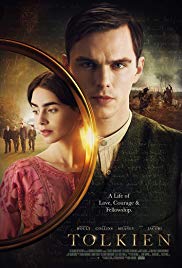
 Greetings again from the darkness. As fascinated as we are with great writers, the cinematic appeal of watching someone put pen to paper, clack away on a manual typewriter, or peck at their laptop keyboard is at best negligible, and more likely, non-existent. Still, award-winning Finnish director Dome Karukoski chose renowned writer J.R.R. Tolkien as the subject of his first English language film. Tolkien’s actual writing time on screen is mostly limited to a single shot at the film’s conclusion; however, the script from David Gleeson and Stephen Beresford attempts to connect the dots between his real world life to his Middle-earth characters and adventures from “The Hobbit” and “The Lord of the Rings”.

Harry Gilby portrays the young John Ronald Reuel Tolkien, and then Nicholas Hoult stars from college age forward. The film bounces between Tolkien’s childhood as an orphan, his elite private school education at King Edward’s School in Birmingham, matriculating at Oxford University, and soldiering in WWI. It’s during his stay at Ms. Faulkner’s (Pam Ferris) boarding house when he meets Edith Blatt, the love of his life. While attending prep school, he and three friends: Robert Gilson, Christopher Wiseman and (poet) Geoffrey Smith, form the TCBS (Tea Club and Borrovian Society), a club dedicated to changing the world through art. It’s at Oxford where Tolkien’s love of language kicks into a yet higher gear, though it’s during his time in The Somme – one of the deadliest battlefields of WWI, that we see his ‘trench fever’ contribute to many of the visuals later associated with his books.

Lily Collins portrays Edith at the age where Tolkien must choose between her and his Oxford education, but as often happens with true love, the two later reconnect and remain married for more than 50 years (until her death). This film doesn’t cover their later years, and instead focuses on the formative ones – both for his imagination and their relationship. We see his early childhood games (The Shire inspired from his time in Sarehole outside Birmingham) and the film often slaps us with an ‘obvious stick’ on how certain segments of life translate directly to his familiar stories in future years. In fact, there is no mention of C.S. Lewis and The Inklings – his friends who later supported his writing efforts. We do, however, get a sequence with Tolkien and Edith backstage at Wagner’s “The Ring Cycle” Opera … a dot that requires the simplest of connectors.

The film looks terrific – especially in the battle scenes which are staged dramatically and horrifically (much as we imagine the war was) by cinematographer Lasse Frank Johannesson. Unfortunately, that’s the highlight. This is mostly a generic biography of an extraordinary writer. Adding to the frustration is the fact that Nicholas Hoult recently portrayed reclusive writer J.D. Salinger in REBEL IN THE RYE … roles too similar for the same actor.

“The Hobbit” was published in 1937 and “The Lord of the Rings” trilogy in 1954-55, the latter being the best-selling fiction of all-time before being overtaken by JK Rowling’s ‘Harry Potter’ series. Tolkien’s key seems to have been his lifelong fascination with language. He even created his own – not just words, but complete languages. That would likely have made a better focus here. Seeing the foundation of “the fellowship” was somewhat interesting, although much of that segment came across like a poor man’s DEAD POET SOCIETY. Supposedly the Tolkien family has refused to endorse the film, likely placing the script “In a hole in the ground …”

watch the trailer:


THE WHITE CROW (2019)

May 9, 2019

 Greetings again from the darkness. Nijinsky. Nureyev. Bruhn. Baryshnikov. The legends of male ballet dancers starts with that list, and possibly include a handful of others. Ralph Fiennes directs a screenplay from David Hare that brings us the story of how one of these, Rudolph Nureyev, defected from Russia to the west in 1961.

Opening with Nureyev’s teacher Alexander Pushkin being interrogated (“Why did he defect?”) by a Russian official immediately after the defection, the film ping pongs between 3 time frames in an attempt to better explain Nureyev’s reasons … or at least the background that created such a headstrong and talented young man. We flashback to 1938 where his mother famously gave birth to him in the confines of a moving train (traveling and trains remained important to him). We then flash forward to 1961 when Nureyev arrives in Paris with the Kirov Ballet, and then back to 1955 as he’s first admitted at the Vaganova Academy of Russian Ballet (established 1738) – a prestigious dance school.

It’s actually this hopping from one time frame to another that is the film’s weakness. The script is ambitious but ultimately flawed, as it attempts to tackle too much rather than concentrating on what’s most important and interesting. We didn’t need so many childhood flashbacks to grasp that Nureyev was a different kind of kid who grew up in poverty in Siberia, raised with his sisters by a mother whose husband was away at war. Julie Kavanagh’s book “Rudolph Nureyev: The Life” inspired Mr. Hare’s screenplay, but the multiple timelines can be more fully explored in book form.

Ralph Fiennes plays the aforementioned Pushkin, a soft-spoken man who was a father figure to Nureyev, as well as a technical instructor. He also shared his philosophy of dance (and his wife – maybe he knew, maybe he didn’t) with his star pupil, and it’s easy to see how this elevated Nureyev’s ability. Combining that with his interest in classic art, a theme of turning ugliness into beauty was something Nureyev latched on to.

Oleg Ivenko stars as Rudolph Nureyev. Ivenko is a marvelous dancer and bears enough resemblance to the legend that we are quickly taken in. Ivenko is not a trained film actor, but as a dancer, he is accustomed to the spotlight and never wavers in his portrayal of a dancer he likely admired. He captures the emotional turmoil of a man enticed by the artistic and social freedoms of the west, while also remaining loyal to his homeland – loyal at least until he felt threatened (both physically and artistically). A tortured genius typically struggles with those in positions of authority and that’s on full display here.

This is the third directorial outing for 2-time Oscar nominee (for acting) Ralph Fiennes. His previous projects were THE INVISIBLE WOMAN in 2013 which no one saw, and CORIOLANUS in 2011 which almost no one saw. It’s likely his latest won’t draw a huge audience either, but Ivenko’s dancing is quite something to behold, and the climax at Le Bourget Airport in France is a suspenseful highlight. Nureyev was 23 at the time, and the defection decision is made almost spontaneously with a little help from his socialite friend Clara Saint (Adele Exarchapoulos, BLUE IS THE WARMEST COLOR) and French dancer Pierre Lacotte (Raphael Personnaz). Rudolph Nureyev died of complications from AIDS in 1993, but he truly was a “white crow” – something extraordinary, and one who stands out.

watch the trailer:


CHARLIE SAYS (2019)

May 9, 2019

 Greetings again from the darkness. Author Joan Didion wrote “the 1960’s ended abruptly on August 9, 1969”, and as we approach the 50th anniversary of that tragic night … actually two tragic nights (August 8 and 9) … there is no shortage of recollections and reenactments through both print and visual media. For anyone who was alive at the time or has read the story since, the grisly murders and cult commune lorded over by Charles Manson remains nearly beyond belief. Unfortunately, it’s all too real.

Director Mary Harron and screenwriter Guinevere Turner previously collaborated on AMERICAN PSYCHO (2000) and THE NOTORIOUS BETTIE PAGE (2015), and here, “inspired by” books from Karlene Faith (“The Long Prison Journey of Leslie Van Houten: Life Beyond the Cult”, 2001) and Ed Sanders (“The Family”, 1972, also one of the film’s producers), we get a glimpse of the Manson cult through the eyes of the women, especially Leslie Van Houten. And let’s be honest, that’s where the real mystery is. A domineering, arrogant, white supremacist is not nearly as interesting as the story of how these women became so enchanted by him that they were willing (even anxious) to murder innocent people on his behalf.

Hannah Murray (“Game of Thrones”) stars as Leslie Van Houten, nicknamed “LuLu” by Manson not long after they meet for the first time. We see Van Houten, Susan “Sadie” Atkins (Marianne Rendon) and Patricia “Katie” Krenwinkel (Sosie Bacon, daughter of Kevin Bacon and Kyra Sedgwick) in an isolated cell block of a California Women’s Prison five years after the murders. They are going through therapy sessions with Karlene Faith (Merritt Weaver, “Godless”) whose goal is to remind them of who they were before meeting Manson.

During the prison therapy sessions, we get flashbacks to the Spahn Ranch where Manson ruled over his followers which also included Mary Brunner (Suki Waterhouse), Squeaky Fromme (Kayli Carter), Linda Kasabian (India Ennenga), and of course, Tex Watson (Chace Crawford), who initially comes off as quite aloof, but eventually buys in totally – in a most violent manner. It’s these flashbacks that are meant to help us understand the brainwashing which stuck with these women through the crimes, through their trial, and through years of incarceration. We hear the “garbage dump” song. We hear about money and ego. We learn that ‘the new rules are no rules’. We see Manson’s dream of becoming a rock star shattered by music producer Terry Melcher (the son of Doris Day) after his introduction from Dennis Wilson (The Beach Boys drummer), who hung around the ranch sometimes. And we hear Manson’s rantings about the correlations between The Beatles’ White Album and the Bible, and about how a race war is coming (and it’s named Helter Skelter).

Matt Smith plays Charles Manson, and oddly enough, this comes on the heels of his playing artist Robert Mapplethorpe in MAPPLETHORPE (2018). Smith seems to have fun with the role, but it’s these segments that feel underwritten. We want more of an explanation of how this could happen. On the other hand, the therapy sessions in the prison actually provide more insight to the lasting effects of the man and the cult that brainwashed them right into committing cold-blooded murder and a life behind bars. The thankless job of a prison therapist becomes clear as Ms. Faith realizes that if she breaks the Manson spell, these women will be forced to live with the unimaginable atrocities they committed. For a different perspective, track down the 1976 TV movie HELTER SKELTER that was based on prosecutor Vincent Bugliosi’s book. It starred Steve Railsback as a terrifying Charles Manson.

watch the trailer: