JUNGLELAND (2020)

November 9, 2020

 Greetings again from the darkness. We’ve rarely seen more improvement from an actor than what we’ve witnessed on screen from Charlie Hunnam in his nearly 25 year career. His work was particularly strong in James Gray’s LOST CITY OF Z (2017), and he builds on that here as the older brother filled with dreams of a better life. Writer-director Max Winkler (FLOWER, 2017, and son of Henry) co-wrote the script with Theodore Bressman and David Branson Smith (INGRID GOES WEST, 2017), and while it has a ‘seen this before’ vibe, we remain engaged throughout.

Hunnam stars as Stanley, the visionary who manages the underground boxing career of his brother Lion (Jack O’Connell, UNBROKEN, 2014). Lion is quiet and reserved, while Stanley thinks talking is the key to life. We don’t get the full back story on the brothers, but enough to know that Stanley has made an endless stream of bad decisions that have left the brothers squatting in a deserted foreclosed house in Massachusetts that requires them to sneak in and out of windows for access. Preaching a belief in “fate”, Stanley gushes about their future, which he envisions as a beautiful house in California and tailored Italian clothes.

In a scene that we assume has occurred numerous times, Stanley finds himself unable to pay the $2000 he owes his crime boss Pepper, played by Jonathan Majors. Rather than kill Stanley, Pepper offers him the kind of deal that seems too good to be true. All the Kaminsky brothers have to do is drive Sky (Jessica Barden) across the country to Reno, where they are to deliver her to Yates (John Cullum). At this point, we only know enough about Yates to understand that he’s not an upstanding citizen. If the brothers manage to execute this “simple” task, Pepper will ensure that Lion is added to the list of fighters of “Jungleland”, a bare-knuckles, no-holds-barred fight in San Francisco where the Grand Prize is $100,000. Stanley sees this as a much better alternative than being killed, and Lion agrees to go along with the plan.

What follows is a road trip with the Kaminsky brothers, their Whippet dog Ash, and Sky, the mysterious young lady whose minimal dialogue masks intentions that don’t necessarily mesh with the mission of trip. On the road, Stanley makes a few more less-than-brilliant decisions, while Lion and Sky bond … or do they? Regardless, things get challenging and obstacles appear everywhere. Once Yates appears, it’s a joy to behold 90 year old Jack Cullum (“Northern Exposure”) as he tears into the role of tough guy.

Mr. Winkler’s film actually has very little fighting in it, especially when compared to Gavin O’Connor’s outstanding 2011 film, WARRIOR. Instead, this is about brotherly love and the ties that bind (although so was O’Connor’s film). Surprisingly, the soundtrack features Bruce Springsteen singing “Dream Baby Dream”, and we do learn how to dress a knife wound with duct tape.

watch the trailer


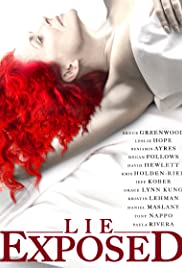
LIE EXPOSED (2020)

November 9, 2020

 Greetings again from the darkness. The fine line of demarcation between “art” and pornography is one of society’s longest-running debates. “I know it when I see it” was made official in 1964 by Supreme Court Justice Potter Stewart in a case where the subjective categorization of obscenity was on trial. Of course the obvious problem with that definition is that everyone “sees it” differently. Director Jerry Ciccoritti (“Schitt’s Creek”) presents a film version of Jeff Kober’s stage play “Pornography”. Mr. Kober, a veteran actor, also appears here as a key character.

Leslie Hope stars as Melanie, our lead character and narrator. Melanie is diagnosed with a terminal illness, and her reaction to that affects her marriage, her sobriety, her friends, and results in a controversial art exhibit. That art exhibit acts as a framing device and structure for a film that is mostly various vignettes assembled together in a somewhat related, yet haphazard manner. We initially witness Melanie’s anxiety over opening night, and the reason for her trepidation is slowly revealed … the exhibit is set up as a peep show of the tintype photographs taken of her vagina. Yep, the worst possible news from the doctor led her to expose her lady parts, while also falling into the stereotypical lustful affair with the photographer (played by writer Kober).

We watch as each of her invited friends take a glimpse at the photographs. It’s not until the closing credits that we see Melanie the way they see Melanie, but the ensuing conversations tell us what we need to know. Each of the attending couples and friends gets their own dedicated segment preceded by their own tintype photograph. These cool retro photographs were the highlight to this viewer. However the focus of the film is how each person reacts to the exhibit and how it impacts their own relationship, most of which seem teetering on the brink of collapse. After each vignette, we are returned to the exhibit’s opening night, and also get additional color on Melanie’s search for meaning in life.

The characters we briefly get to know include Melanie’s husband Frank (Bruce Greenwood), who seems impossibly patient and understanding, given the situation. A substantial portion of their conversations occur over the phone while Frank sits alone in their bedroom (or even asleep). Others we meet: Mickey (Kristin Lehman), an alcoholic middle-aged party girl, Jerry (Daniel Maslany, brother of Tatiana), the acting DJ and AA member under sponsor Frank, Diane (Megan Follows), Tom (Kris Holden-Reid), Brian (David Hewlett), and married couple Betsy (Grace Lynn Kung) and Gregg (Benjamin Ayres), who air entirely too many grievances for our comfort.

Alcoholism and AA are referenced throughout the film, and Mickey even spouts, “Alcoholism is a good idea taken too far.” A misplaced debate on the best rock and roll drummer falls flat, but at least offers a momentary reprieve from the non-stop chatter on sex and vaginas. Obviously the title has dual meanings, and what the film does best is reinforce the need for art to spark conversation, debate and reflection.

watch the trailer


LET HIM GO (2020)

November 5, 2020

 Greetings again from the darkness. Diane Lane and Kevin Costner reunite on screen, only this time it’s not as the earthy and earthly parents to Superman (MAN OF STEEL, 2013). Instead, this film from writer-director Thomas Bezucha (THE FAMILY STONE, 2005), based on Larry Watson’s 2013 novel, features the two stars as long-time married couple, Margaret and George Blackledge, living a peaceful existence on their Montana ranch. Well, it’s peaceful now, as George is retired from his career as a lawman.

Their son James (Ryan Bruce), his wife Lorna (Kayli Carter, “Godless”), and young son Jimmy live on the ranch with Margaret and George. Grandma Margaret’s devotion to her grandson and judgmental nature sometimes crosses the line, creating quiet tension with his mother Lorna. George’s trained eye sees it all, but he mostly keeps his thoughts private, although the communication he shares with Margaret is often through a simple gesture or nod. Their chemistry is one that’s only built through time (and fine acting).

When a freak accident leaves James dead, we flash forward three years as Margaret and George attend Lorna’s wedding to Donnie Weboy (Will Brittain, who was excellent in this year’s BLOW THE MAN DOWN). George senses that Donnie does not possess the highest moral character, but Margaret is hit hardest by the newlyweds moving off the ranch and taking her beloved grandson with them. Concern escalates quickly when Margaret witnesses Donnie being physically abusive to Lorna and Jimmy, and then he relocates them to North Dakota to be near his family … without so much as a warning or goodbye to Margaret and George.

Crossing Grandma Margaret is like kicking the hornet’s nest. Poor George arrives home one day to find the car packed and Margaret on a mission to bring Jimmy home. George’s feeble attempt to reason with her fails (as he knew it would) and the two are soon on the road through some gorgeous countryside captured by cinematographer Guy Godfree. Along the way, they cross paths and befriend Peter (Booboo Stewart), a Native American who deserted “Indian School” for a life of solitude on the plains. It’s also on this road trip where Margaret and George are inundated with every possible warning about the notorious Weboy clan of North Dakota. No specifics are provided, but the message is clear … no one messes with the Weboys.

A tip leads the grandparents to Bill Weboy (Jeffrey Donovan, “Burn Notice”), and he provides living proof that the Weboy clan is rotten to the core. Behind an evil grin, Bill invites Margaret and George to the family ranch for dinner and a visit with their grandson. At the ranch, we are introduced to the twisted matriarch, Blanche Weboy (Lesley Manville, PHANTOM THREAD, 2017). This meeting of the families is about as tense as any we’ve seen on screen. A clash of good versus evil is always welcome, which makes it so disappointing that a film so stellar to this point, abruptly shifts from an intriguing psychological thriller into a ludicrous circus of violence, poor decisions, and absurdity.

There is a lot to like here, before it spins off the axis. Diane Lane is ferocious in the role, and Costner is very effective as her ‘still waters’ husband. It’s a hoot to see Ms. Manville lose her British accent and go over-the-top as nasty Blanche, and the early 1960’s setting looks great, including the vehicles. As mentioned before, the scenery is breath-taking, with Alberta (Canada) standing in beautifully for Montana and North Dakota. Composer Michael Giacchino is more accustomed to working on superhero and animated movies, and the score is often distracting in the first half, but fits better in the final act. Brace yourself for a couple of tough to watch scenes and a jarring tonal shift.

watch the trailer


KINDRED (2020)

November 5, 2020

 Greetings again from the darkness. It’s the first feature film for writer-director Joe Marcantonio and his co-writer Jason McColgan, which might explain why the film starts strong before faltering, mostly salvaged by three strong performances. Eighteen months into their relationship, veterinarian Ben (Edward Holcroft, KINGSMAN: THE SECRET SERVICE, 2014) and Charlotte (Tamara Lawrance) break the news to his mother that they are moving from England to Australia. Mum is none too pleased, as she expects her son to carry on the legacy of nine generations that have lived in the now dilapidated (and isolated) family estate.

Ben’s overbearing mother is Margaret (Fiona Shaw, Petunia in the Harry Potter movies) and she lives in the drafty mansion with Ben’s step-brother Thomas (Jack Lowden, TOMMY’S HONOUR, 2016), who seems more man-servant than son to Margaret. Charlotte soon discovers she’s pregnant, and while Ben is thrilled, she is unsure whether she even wants to keep the baby. Her own mother’s history plays a significant role in her uncertainty. A freak on-the-job accident kills Ben, and Charlotte soon finds herself … um … a guest of Margaret and Thomas. She’s the type of guest that’s not allowed to leave or make phone calls. Yep, she’s being held captive under the guise of this being in the best interest of her baby.

While Margaret is straight-forward vile and ignoble towards Charlotte, Thomas is more difficult to read … albeit no less off-center. Clearly both have a vision for where this is all headed. Margaret spills hers in a terrific scene where she lets her guard down with Charlotte, while Thomas is perfectly creepy and overuses the “making a quiche” punchline. For her part, Charlotte frequently passes out and has recurring dreams featuring birds/ravens/crows … and as fans of horror can tell you, that’s never a good sign. Has Charlotte been drugged or is she being gaslighted by Margaret and Thomas?

Director Marcantonio has delivered a psychological thriller that’s more frustrating than haunting. It has vibes of the classic ROSEMARY’S BABY (1968) sans Satan, but of course, is not at that level – although we do get the chilling doctor played here by Anton Lesser. Charlotte is the proverbial trapped damsel, but the film falls into a pattern of ‘escape-capture-repeat’. It also attempts to use music, but the combination of Debussy’s “Claire de Lune”, Bach’s Cello Suite No. 1, and the long-time standard “Dream a Little Dream of Me”, reaches overload. The Production Design from Derek Wallace and Set Decoration by John Neligan are top notch, but in the end, the frustration we feel overrides any creep factor or strong performance. It’s a near miss.

watch the trailer


THAT GOOD NIGHT (2020)

November 4, 2020

 Greetings again from the darkness. Art imitating life is something we’ve not only grown accustomed to, but also something we expect. In this case it’s the bittersweet final performance of the great John Hurt. A terminally ill man taking on the role of a terminally ill man. Director Eric Styles is working from a script by Charles Savage that was adapted from N.J. Crisp’s stage production. It’s easy to see how this could be a powerful live show, but the stunning home in Portugal where most of the film is set, makes for a pleasant transition to the screen.

John Hurt stars as Ralph Maitland, a self-centered, highly successful screenwriter, who may be an even more proficient curmudgeon. He lives in a beautiful home with his younger wife Anna (Sofia Helin, “The Bridge”), who was once his nurse. Ralph receives the dreaded prognosis at his doctor appointment. Rather than tell his wife, he proceeds with ‘getting his affairs in order’ and summoning home his estranged son Michael (Max Brown, “The Royals”). Michael was born to Ralph’s first wife, and he is also a writer.

Ralph’s true colors shine when Michael shows up with his girlfriend Cassie (Erin Richards, “Gotham”). Although Cassie is pretty tough, Ralph devolves from curmudgeon to downright churlish. His rudeness exceeds the bounds of palatable during dinner at a local restaurant, sending Michael and Cassie scampering off before appetizers. Anna is embarrassed by her husband’s actions, but he just continues on with his process – a process that includes contacting “The Society”, which facilitates Euthanasia.

A man in an impeccable white linen suit appears in the doorway of Ralph’s office. He’s only referred to as “The Visitor”, and his played by Charles Dance, Mr. Hurt’s co-star in the underrated 1987 film WHITE MISCHIEF. The conversations between Ralph and The Visitor deliver the best dialogue in the film, and likely the deepest since it forces Ralph to face his mortality and the impact and finality of his decision. It’s here where Ralph’s “low boredom threshold” is mentioned, and quickly minimized by The Visitor.

The film is a relatively simple look at a complex topic, and it also highlights the importance of reconciling with family members, and discovering a reason to keep living. The weakness here is that we only scratch the surface of Anna and Michael, and even what turned Ralph into the man he is. We get a quick glimpse of Ralph interacting with Ronaldo (Noah Jupe, HONEY BOY, A QUIET PLACE), the housekeeper’s son, in a manner that makes us believe he has regrets on his poor parenting during Michael’s childhood. Cinematographer Richard Stoddard takes full advantage of the beautiful scenery, as well as the uncomfortable interactions amongst the family.

John Hurt died in 2017, just 3 weeks after filming was complete. He had a remarkable 55 year acting career, including Oscar nominations for his work in MIDNIGHT EXPRESS (1978) and THE ELEPHANT MAN (1980). Of course he will always be remembered for his iconic chestburster moment in ALIEN (1979). He compiled more than 200 acting credits, and some of my other favorite John Hurt characters are found in: 1984 (1984), OWNING MAHONEY (2003), TINKER TAILOR SOLDIER SPY (2011), and the voice of rabbit Hazel in WATERSHIP DOWN (1978). Dylan Thomas’ 1947 poem plays a key role in this film (and title), and the sentiment also captures the spirit of John Hurt: “Do not go gentle into that good night. Old age should burn and rave at close of day. Rage, rage against the dying of the light.”

watch the trailer


COME PLAY (2020)

October 28, 2020

 Greetings again from the darkness. Hopes are always high this time of year for a creative new horror film. As each Halloween approaches, we search for new movies that will frighten us in an entertaining way, or at least be creepy enough to make us sleep with the lights on! Looking to be this year’s horror breakout, writer-director Jacob Chase has expanded his own 2017 5-minute short film LARRY into a full-length feature film.

Azhy Robertson (the young son in Noah Baumbach’s Oscar nominated MARRIAGE STORY, 2019) stars as Oliver, a dead-ringer for Danny Torrance in THE SHINING (1980). Oliver is an autistic, non-verbal boy who has no friends and depends on his electronic devices to communicate and entertain (he loves “SpongeBob SquarePants”). His parents, Sarah (Gillian Jacobs, “Community”) and Marty (John Gallagher Jr, SHORT TERM 12, 2013) constantly argue, which exacerbates Oliver’s hyper-sensitivity. When Dad moves out, an overwhelmed mother does her best to follow the advice of Oliver’s therapist. What she doesn’t know initially is that some being or creature named Larry is tracking her son through an online story called “Misunderstood Monsters” that pops up on his mobile devices.

Larry just wants a friend.” As the story slowly unfolds on the tablet Oliver’s dad found in the lost & found in the parking lot booth where he works, we come to understand exactly what is happening, and who and what Larry really is. The theme has some similarities to Jennifer Kent’s excellent film, THE BABADOOK (2014), with a dose of THE RING (2002), but the suspense never builds to that level despite a nice performance from young Mr. Robertson.

A clever twist actually ends up lessening the fright factor here. The monster can (mostly) only be seen via the mobile devices, which means the visuals are often limited by the size of the screen, although I’m a fan of the practical effects. Because of this, sound effects are critical, as are the reactions of Oliver and his parents … as well as the classmates unfortunate enough to get volunteered for a sleepover.

It seems only fitting that in 2020, loneliness is the real monster, and technology is the conduit for its impact. Additionally, all parents will relate to the extremes Sarah and Marty go to protect Oliver, and the final scene does offer an all-knowing moment that reverts to a simpler time … one that Larry wouldn’t appreciate.

watch the trailer


FISHBOWL (2020)

October 28, 2020

 Greetings again from the darkness. In the not so distant past, folks who lived in small towns felt like there were no secrets – everyone in town knew each other and what they were up to. Thus, the proverbial “fishbowl” of the title. Of course, these days, people in towns and cities of all sizes voluntarily advertise their every waking moment on social media, making privacy and gossip relics of a bygone era. Brother-sister co-directors Alexa Kinigopoulos and Stephen Kinigopoulos (first feature for both), working with a script by writers Piero S Iberti, Maria Stratakis, and (co-director) Stephen Kinigopoulos serve up a taste of small town life in the good ‘ol days.

“In Bishop, you either talk or you’re talked about.” So says our narrator Belle over the slow-motion opening montage. She’s the oldest of three sisters who live with their father and attend a local Catholic school. All members of this family are broken in their own way, and it’s made clear this is due to the beloved mother/wife no longer being around (though initially we aren’t sure what happened). Belle (newcomer Belle Shickle) is the rebellious one, though not quite as self-assured as she likes to think. The middle girl, Rachel (Emily Peachey), is sensitive and stunned when her friend tells her they can’t hang out anymore – even for her birthday. The youngest, Jessa (newcomer Caroline Coleman) hasn’t spoken a word in the 4 months (actually 118 days) since mom has been gone. Their dad (longtime stuntman-actor Rick Kain) is a mess, bouncing from over-zealous religious fanatic to forsaking it altogether, and then back again.

We see the family faced with hostile reactions in the community, at school, and even at church, where the priest suggests it would be better for everyone if they stayed away. Dad is drawn in by Tele-Evangelist Ron Peltz (Bobby J Brown) who is hocking his $1000 “Save Me Now” program as protection from The Rapture, which he proclaims will arrive on September 29. Close to foreclosure on their house, the dad plops down the grand, and forces his daughters to go door-to-door trying to “save” the neighbors from the end of the world.

A countdown to the final days also includes the teenage sisters trying to find their way in this new world. We get flashbacks to when they were younger and family life with mom (Judith Hoag, TEENAGE MUTANT NINJA TURTLES) was pleasant, despite dad’s alcoholism at the time. The three sisters cling to each other, but grow more concerned for their father and themselves. A particularly telling sequence has them defying their father and attending a costume party dressed as a devil, a nun, and a princess. It doesn’t end well, and sets up the finale.

The Kinigopoulos filmmakers give the movie a dreamy/surreal look and feel, and perhaps Jeff Nichols’ far superior 2011 TAKE SHELTER is the closest comparison. The four lead actors are fine (especially Ms. Shickle), but the background actors are exaggerated and distracting – perhaps this is done on purpose to help us understand what the family is going through. Pretty significant observations are offered up on small towns, parenting, church-goers, faith as a crutch, and alcoholism. It’s not an easy watch, and one that will probably not have mass appeal. It’s the type of movie that fits easily into the line-up of many film festivals, as that’s the environment where it is most likely to find appreciation.

Available VOD October 27, 2020

watch the trailer


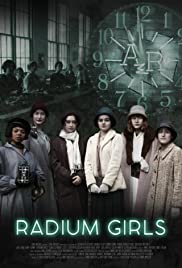
RADIUM GIRLS (2020)

October 23, 2020

 Greetings again from the darkness. A huckster or carnival barker is spouting off the many uses and health benefits of radium. He even hails it as “liquid sunshine”. That’s how this film from co-directors Lydia Dean Pilcher (A CALL TO SPY, 2020) and Ginny Mohler kicks off. Ms. Mohler co-wrote the screenplay with Brittany Shaw, and it’s presented as a historical dramatization – some of the names have been changed to protect both the innocent and guilty.

Joey King (“Fargo”) stars as Bessie, younger sister to Josephine (Abby Quinn, I’M THINKING OF ENDING THINGS). Josephine is the more studious of the two, as Bessie dreams of becoming a Hollywood star. Both girls work as dial painters at American Radium (re-named from the actual United States Radium Corporation). Josephine wins awards for being the most productive, while Bessie gets scolded and has her pay docked due to shoddy work. See, Bessie refuses to lick the brush to create the fine tip needed for precise work. So what’s a dial painter? Well, it’s 1925, and these women are applying a radioactive liquid to the faces of watches to create the popular glow-in-the-dark effect. Marie Curie’s discovery from twenty years prior has been found to have many uses, including shrinking cancerous tumors. However, the story finds the dial painters who lick-dip-paint, are getting sick and dying at an ever-increasing rate.

Mary, older sister to Bessie and Josephine and also a dial painter, had previously died after being diagnosed with syphilis. Bessie’s outrage and curiosity starts to build when the company doctor passes along the same diagnosis to (virgin) sister Josephine when her teeth start falling out, her joints ache, and her skin breaks out in a rash. We witness the transformation of Bessie from teenybopper to activist. She’s helped along by love interest Walt (Collin Kelly-Sordelet) who introduces her to the socialist movement, as well as Wiley Stephens (Cara Seymour, “The Knick”), the real life founder of the Consumers League.

Many dial painters refused to believe the connection and were frightened to lose their job. A few came forward, though they struggled to find a legal counsel willing to go against the giant corporation led by the arrogant Mr. Roeder (John Bedford Lloyd). It’s interesting to see the pieces come together for the 1928 court case. Another real life player in this chain of events was Dr Katherine Drinker (played her by Veanne Cox), the scientist who conducted the confidential study that concluded radium produced harsh effects, including physical deterioration – just as Josephine has experienced.

The courtroom scenes may not have the dramatic impact that we are accustomed to seeing in cinema, but this is a remarkable story of some incredibly strong women who stood up, not just for themselves, but for those who wouldn’t or couldn’t come forward. Their court case led to changes in workplace safety laws, while also reminding us of an era when women were given so little power, and giant corporations and the government ruled the roost and couldn’t be trusted. The filmmakers blend some vintage clips throughout, and use the discovery of King Tut’s tomb only three years prior to give the feel of this era nearly 100 years past. Rosamund Pike starred as Marie Curie in RADIOACTIVE earlier this year, and there have been a couple of books written on this topic: “The Radium Girls: The Dark Story of America’s Shining Women” by Kate Moore (2016), and “Radium Girls: A Play in Two Acts” by DW Gregory (2000). It’s a story of courageous women that deserves a wider audience.

watch the trailer


SYNCHRONIC (2020)

October 23, 2020

 Greetings again from the darkness. Innovative filmmakers Justin Benson and Aaron Moorhead are frequent collaborators, as evidenced by such films as SPRING (2014) and THE ENDLESS (2017). Their films teeter between science-fiction, horror, fantasy, and personal drama, and this latest easily slides into the mind-bending and time-warping space they excel in … and all without the mega-budget we’ve come to expect from such films (I’m looking at you INCEPTION).

The film opens on a couple sharing a motel room and what appears to be an acid trip. Strange hallucinations hit them both. We soon flip to an emergency call performed by best buddy New Orleans paramedics Steve (Anthony Mackie) and Dennis (Jamie Dornan). Their overdose victim is located in a setting where something is just a bit off, and “Time is a lie” is written on the wall. When Steve and Dennis are called to the motel of the first scene, we all start to understand something bizarre is happening.

Dennis is married to his wife Tara (Katie Aselton), who has recently given birth, and their headstrong 18 year-old daughter Brianna (Ally Ioannides) lives with them. Steve’s days consist of one-night stands, more booze than any person should ingest, and time with his loyal dog Hawking (an obvious reference to the elements of time at play here). Dennis is bored and Steve is a mess, and things get worse when Steve is diagnosed with a brain tumor by his pineal gland, and Dennis’s daughter Brianna disappears.

A clue to the increasingly bizarre overdose and death scenes that Steve and Dennis run into is the “Synchronic” packaging. It’s a synthetic/designer drug that has dramatic and lethal effects, and a packet was found where Brianna was last seen. Steve decides to test the drug in an effort to “bring back” his friend’s daughter. As Steve videos his 7 minute trips to the past, and then kindly spells out everything he discovers, we viewers are spoon fed the details that would typically require some effort. Beyond the reference to Stephen Hawking, we also get plugs for French composer Claude Debussy and a rare James Bond- Charlie Sheen joke.

Time travel has long been a fun topic for movies, and the ideas behind this one are quite promising. The only downsides are that it too obviously guides us through what’s happening, and the trips back in time aren’t as structured or interesting as we would hope … although the idea of having the past be in the identical spot as the future is terrific. Benson and Moorhead are ambitious and creative filmmakers, and their shot at appealing to mainstream audiences is appreciated, as is the atmosphere and camera work. However, many of us would rather a bit more be left to our imagination.

watch the trailer


THE CAMPAIGN OF MINER BO (2020, doc)

October 19, 2020

 Greetings again from the darkness. During her campaign for the presidency, Hillary Clinton appeared at an Ohio Town Hall meeting, and while pushing green energy alternatives said, “We are going to put a lot of coal miners and coal companies out of business.” It’s the kind of statement that makes headlines, and it did. Of course, Hillary went on to say that it was important we don’t forget about the people that work and depend on the coal industry, but that never became part of the story. Director Todd Drezner does include it here, while mostly focusing on how West Virginian native Bo Copley, a former mining company employee, became a candidate for U.S. Senate.

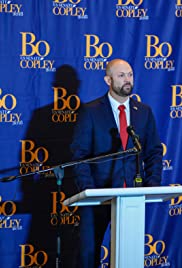
As a refresher, we see Hillary’s Town Hall statements, and we also see the clip of the roundtable where Bo Copley handed a family photograph to Hillary, confronting her with the real life impact of shutting down coal production.  That simple gesture turned Bo Copley into a “coal miner celebrity”, ultimately pushing him towards the campaign that inspired this documentary. The film opens in June 2017 in Williamson, West Virginia, as Bo rehearses his announcement speech. He’s neither polished, nor confident, and admits, this is “not my natural habitat”.

One thing that quickly becomes clear – Bo is a good dude. He’s a family man and a man of faith. Another thing that’s just as clear – Bo is in over his head for this process. He’s a well-intentioned nice buy, but his platform seems to be, “I think an everyday person should represent everyday people.” This happens to be a highly contested Republican primary featuring five other candidates, two of which are skilled politicians, and a third is a mining company owner who served prison time for a tragedy that killed 29 miners.

The film is structured as a countdown to the primary, and it follows Bo on some of his campaign stops – most of which reinforce that he’s not equipped for this race. He is the prime example of a guy who wants a change in politics and is willing to step up, but simply doesn’t have the understanding … or the funds … to actually compete. He believes if people like him, they’ll vote for him; so there’s no need to ask for votes, even as he’s coaching a kids’ soccer team.

Bo’s wife Lauren is also included here, and she’s supportive of his run, though not initially. Their Christian beliefs are on full display. Director Drezner’s and Bo’s best moment occurs during a talk show interview when the candidate answers the obvious question, “Why start your political career running for the U.S. Senate.” Bo’s answer is spot on and thought-provoking, and goes to the heart of the flaw in our system. The film should be watched by anyone looking to dive into a political run, as it excels as a how-not-to guide.

watch the trailer